





Breaking Google news: GBP messaging is back, now with an AI chatbot for your business
Google removed Business Profile messaging in 2024. In 2026, it returns as an AI chatbot that answers customers and hands off...





Most institutions running pay-per-lead programs are measuring the wrong things, contacting leads too slowly, and paying more per enrolled student than their reports show. The lead counts look fine on paper. The actual cost per start often tells a different story.
This guide covers the full picture: how PPL vendors operate, what leads cost by program type, how to audit a vendor relationship, what TCPA rules require when contacting purchased leads, and how to build the operational and data systems that improve conversion rates across every lead source you use.
Pay-per-lead is a buying model where an institution pays a fixed fee to a third-party vendor for each prospective student contact delivered. The institution does not run or own the advertising. A vendor, typically a lead aggregator or comparison platform, collects student contacts through its own marketing and sells those records to one or more schools. This differs from pay-per-click, where the institution runs its own ads and owns the resulting leads outright.
Ready to grow your organic traffic?
Get a free SEO audit from the Launchcodex team.
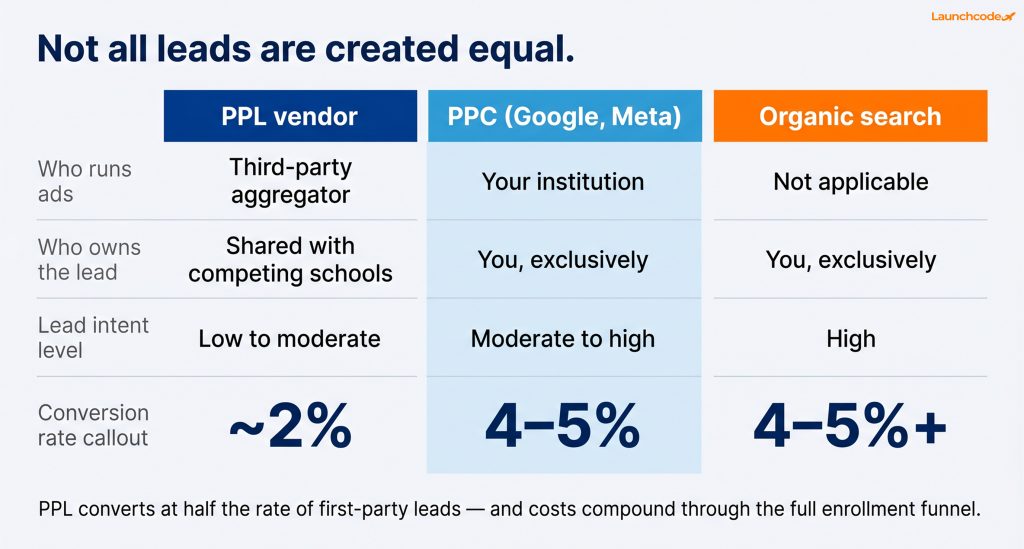
That distinction matters because PPL and first-party leads are not interchangeable. A student who clicked your Google ad, visited your program page, and filled out your form chose your institution. A student delivered through a PPL vendor may have submitted a general "learn more about MBA programs" form on a comparison site and had no idea which schools would receive their information.
| Channel | Who runs the ads | Who owns the lead | Lead intent level | Average conversion rate |
|---|---|---|---|---|
| PPL vendor | Third-party aggregator | Shared with competing schools | Low to moderate | ~2% |
| PPC (Google, Meta) | Your institution | You, exclusively | Moderate to high | 4-5% |
| Organic search | Not applicable | You, exclusively | High | 4-5%+ |
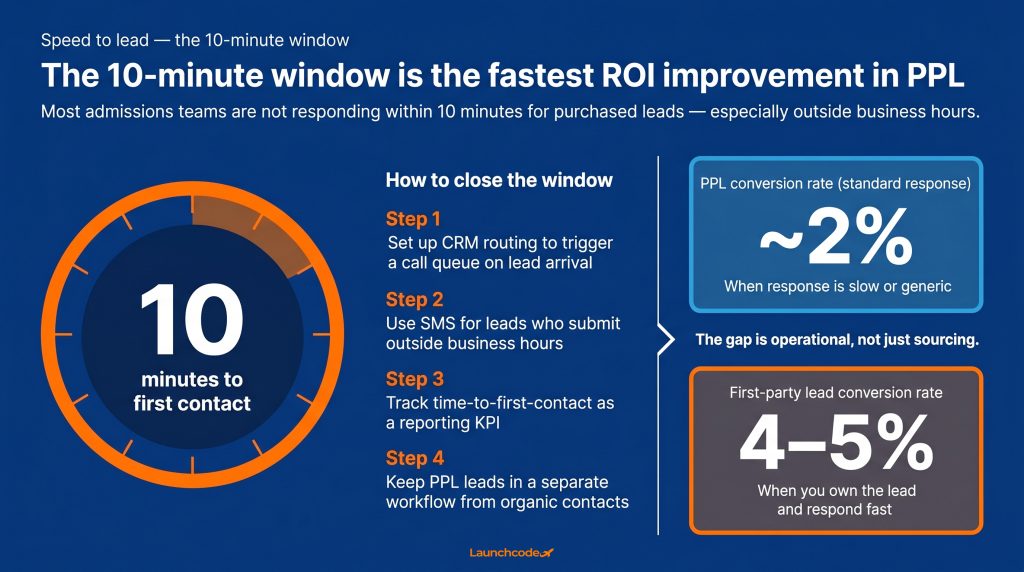
The conversion gap is significant. PPL leads convert at roughly 2% compared to 4-5% for first-party leads. That difference compounds across a full enrollment cycle and directly affects cost per start.
The major PPL aggregators include Niche, College Board student search, and EducationDynamics. Each operates differently in how leads are sourced, how many schools receive the same contact, and what consent language the student saw before submitting. Understanding the sourcing model is one of the first questions to ask any vendor before signing a contract.
PPL is under real pressure. CPLs have risen sharply, conversion rates have dropped, and PPL now drives just 4% of total enrollments, down from over 8% in prior years. At the same time, generative AI tools have reduced organic traffic to many institutional websites by 16-20%, pushing enrollment teams back toward paid acquisition channels including PPL. The result is a tighter market where lead costs are up and returns are down.
PPL no longer performs as effectively as it once did for higher education lead generation. CPLs are consistently rising, especially for specialized schools.
Several factors are driving weaker results across the board:
AI-generated search overviews are reducing click-through rates from organic search. Institutions like National University responded by increasing paid search budgets by 10-25% to compensate. That pressure makes abandoning PPL entirely impractical for most schools. The goal is not to exit PPL but to run it more precisely and measure it more honestly.
PPL vendors collect student contacts through comparison sites, scholarship tools, career assessments, and content pages built around broad educational search queries. They then sell those contacts to institutions, often to multiple schools at once, unless the institution pays a premium for exclusivity. Understanding this sourcing model explains why roughly 50% of purchased leads never engage after delivery.
The student's experience on the aggregator site shapes their expectations entirely. If they submitted a general form for "online business programs" on a comparison platform, they did not choose your institution. Some may not remember submitting the form by the time your admissions team calls.
The distinction between shared and exclusive leads affects both cost and conversion outcome.
| Lead type | Cost | Competing contacts | Typical engagement rate | Best for |
|---|---|---|---|---|
| Shared | Lower CPL | Sold to 3 to 5 or more schools | Lower | High-volume, fast-response teams |
| Exclusive | Higher CPL | Sold only to you | Higher | Programs with strong nurture systems |
Institutions with fast response infrastructure and lead scoring in place can extract value from shared leads. Those without those systems tend to see worse results than the CPL difference suggests, because competing schools with better operations reach the student first.
Ask every vendor these questions before signing:
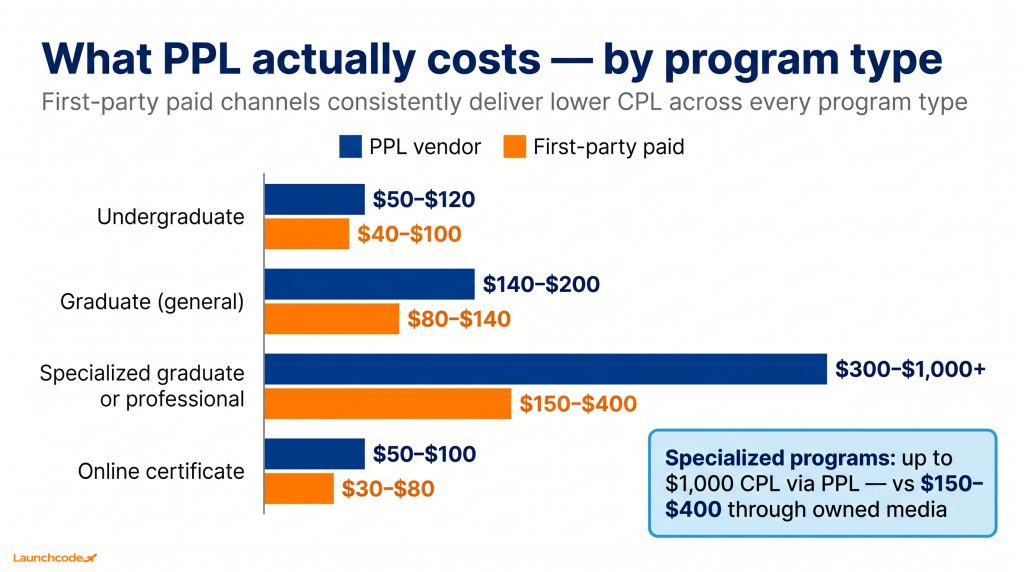
Average CPLs in higher education range from $60 to over $1,000 depending on program type, degree level, and vendor. Graduate programs cluster around $140 to $200. Specialized programs in healthcare, law, or executive education can exceed $1,000 per lead. Institutions running direct paid media through their own Google campaigns typically see CPLs closer to $96 across all paid sources.
These numbers matter because CPL alone does not tell you whether PPL is working. A $200 CPL that produces a 3% application rate and a 60% yield rate is a better investment than a $60 CPL that produces a 1% application rate and a 30% yield.
| Program type | Typical PPL CPL range | First-party paid CPL range |
|---|---|---|
| Undergraduate | $50 to $120 | $40 to $100 |
| Graduate (general) | $140 to $200 | $80 to $140 |
| Specialized graduate or professional | $300 to $1,000+ | $150 to $400 |
| Online certificate | $50 to $100 | $30 to $80 |
Facebook Ads CPL for education averaged $19.27 across 2025, with notable seasonal variation by quarter. Social lead ads produce higher volume at lower CPL but lower engagement rates than search-based leads, because the student was not actively searching at the moment of form submission.
Brandon Rowe, AVP of Performance Marketing at National University, puts it plainly: "Brands need to integrate PPL within a broader media strategy rather than viewing it in isolation. This means shifting focus from cost per lead to metrics like cost per application and cost per start."
Specialized programs in healthcare, law, or executive education also see the widest variance between CPL and cost per start. A $200 PPL lead that results in a $4,000 cost per enrolled student is a worse investment than a $140 CPL program that produces a $2,800 cost per start, even though the surface-level CPL looks similar. Track all the way to the start before evaluating any PPL vendor relationship.
Speed to lead and AI-driven lead scoring are the highest-leverage improvements available to institutions running PPL programs. Most institutions underestimate the impact of response time and apply no prioritization logic to their lead queues. Both problems are fixable with the right systems in place, and together they change the math on PPL ROI without requiring a vendor change.
Responding to a lead within 5 to 10 minutes significantly improves conversion rates. Most admissions teams are not operating on that timeline for purchased leads, particularly outside of business hours.
For PPL leads, which often arrive already shared with competing schools, the first institution to make contact has a structural advantage. A general admissions queue will not prioritize PPL contacts correctly.
Brandon Rowe describes a direct fix from his time at a previous institution: "Creating a dedicated call center specifically for PPL contacts significantly improved outcomes." Dedicated routing and response capacity changes results without requiring a larger budget.
Steps to improve speed to lead:
Lead scoring assigns a numeric value to each contact based on behavioral and profile signals, then routes high-propensity leads to priority follow-up. For PPL programs, where a significant share of contacts will never engage, scoring lets admissions teams focus effort on the records most likely to convert.
Tools like LeadSquared and Salesforce Education Cloud include built-in scoring frameworks. Slate (Technolutions) allows custom scoring logic inside the enrollment CRM. Platforms like EAB, Othot, and RNL build custom predictive models calibrated to specific institution data.
Key scoring inputs for higher education PPL leads include:
"A lead score is only as useful as the CRM workflow behind it. If scores are not triggering different routing or outreach sequences, you are just adding a number to a spreadsheet." Derick Do, Co-Founder and Chief Product Officer, Launchcodex
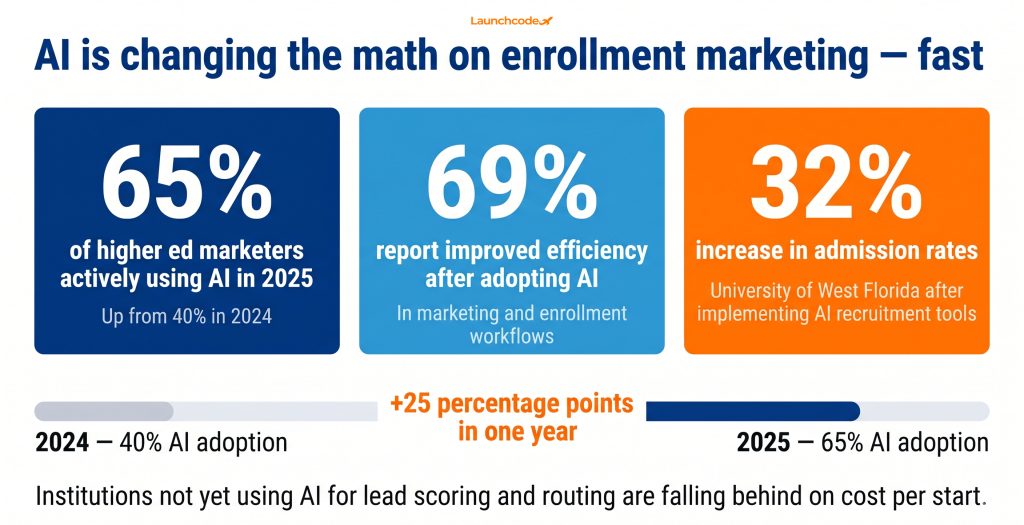
The University of West Florida reported a 32% increase in admission rates after implementing AI-powered tools for lead enrichment and qualification. The same principle applies directly to PPL: the same lead pool delivers better results when admissions teams focus on the right contacts first.
Before contacting any purchased lead via automated call, robocall, or automated text, institutions must have prior express written consent (PEWC) from that individual. TCPA violations carry statutory penalties of $500 to $1,500 per non-compliant call or message. Confirming that your PPL vendor's consent language covers your institution is not optional and should happen before a single automated message is sent.
The consent rules have shifted in recent years. The FCC adopted a one-to-one consent rule that would have required separate consent for each institution receiving a shared lead. That rule was vacated by the 11th Circuit Court of Appeals in early 2025. The FCC then reinstated its prior consent standard on August 29, 2025. Standard TCPA PEWC requirements remain in force. The stricter one-to-one requirement is gone, but the regulatory environment is still active.
Before sending automated outreach to any purchased contact, confirm all of the following:
Maintain a current internal Do Not Contact list and honor both the National Do-Not-Call Registry and state-specific requirements. New Jersey, Tennessee, and several other states have enacted additional telemarketing regulations beyond federal TCPA minimums.
TCPA rules and FCC guidance change. Before building automated outreach workflows around purchased lead data, consult qualified legal counsel to confirm your consent documentation and contact practices are compliant.
When PPL lead data enters your CRM and begins intersecting with student records, FERPA applies. Confirm that CRM workflows, data storage practices, and third-party tool integrations meet FERPA requirements. This matters most when using AI scoring tools that ingest enriched student profiles from multiple sources.
The institutions with the lowest cost per enrolled student are not the ones spending the most on PPL. They are the ones building first-party lead engines through content, search, and email, then using AI to score, route, and nurture those contacts more efficiently than competitors. First-party leads convert at 4-5% compared to PPL's 2%. Over an enrollment cycle, that gap directly reduces cost per start.
In 2025, 65% of higher education marketing and enrollment professionals reported actively using AI in their work, up from 40% in 2024. Of those using AI, 69% reported improved efficiency in marketing and enrollment workflows. The adoption curve is real, and the performance gap between early movers and late adopters is widening with each cycle.
A first-party strategy does not replace PPL overnight. It runs in parallel and gradually shifts the budget mix as owned channels become more productive.
Key first-party channels that compound over time:
Value-based bidding on Google and Meta shifts campaign optimization from a flat CPL target toward actual enrollment value. Instead of telling an algorithm to deliver leads at $100 each, you tell it to find students most likely to enroll. The algorithm then allocates budget toward the behavioral profiles associated with applications and starts.
When combined with predictive scoring tools from EAB, Othot, or RNL, institutions can score both first-party and PPL leads against the same enrollment likelihood framework. That unified model allows direct channel comparison, making budget decisions more defensible and more accurate than CPL alone can support.
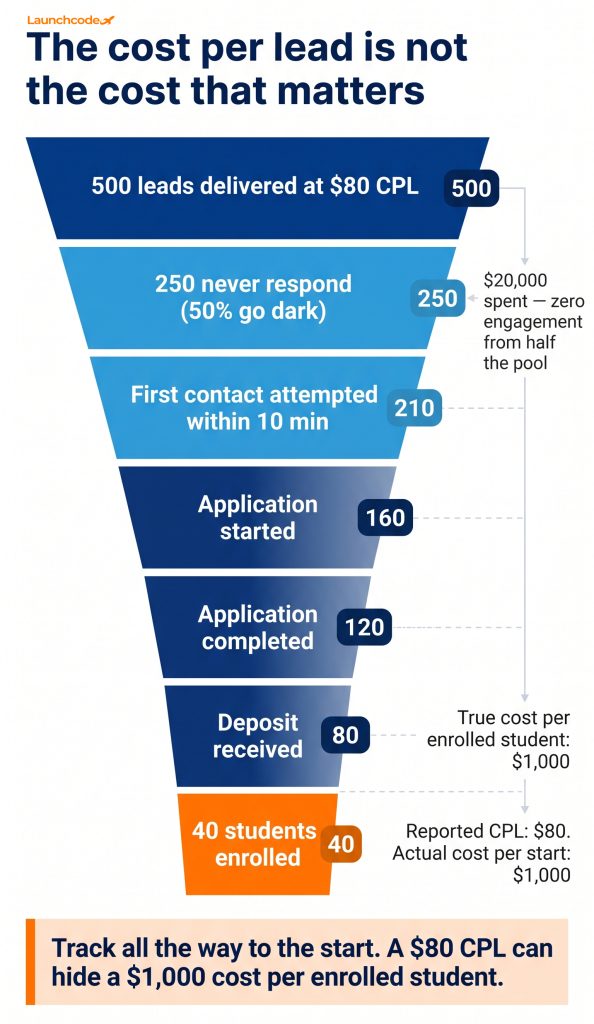
Cost per lead is the least useful metric for evaluating a PPL program. The metrics that matter are cost per application, cost per admitted student, and cost per start. Tracking only at the lead stage allows the most expensive and least productive sources to appear to perform well while consuming budget that would produce better results elsewhere.
Most enrollment teams are measuring accurately at the wrong stage. A PPL vendor that delivers 500 leads at $80 each, where 250 never respond, 100 drop before applying, and 40 enroll, produces a true cost per enrolled student of $1,000. That number looks very different from the $80 CPL in the vendor contract.
"Most schools we audit can tell you their cost per lead instantly. Very few can tell you their cost per enrolled student by channel. That gap is where the budget problems live." Tanner Medina, Co-Founder and Chief Growth Officer, Launchcodex
To measure PPL accurately, your CRM must tag leads by source and track them through each funnel stage:
Tools like Slate and Salesforce Education Cloud can track this full sequence when configured correctly. The challenge is consistency: enrollment teams must log contacts and outcomes against the correct source record, not just the most recent interaction.
Brandon Rowe raises a specific attribution risk that institutions often overlook: enrollment teams may unconsciously prioritize PPL leads that seem more familiar or easier to convert, and deprioritize harder-to-reach contacts. The result is that apparent PPL performance looks better than the true program average.
Rowe advises separating branded from non-branded search analysis and watching for enrollment team behavior that inflates perceived performance. Automated lead routing and scoring reduce this risk by removing manual discretion from the initial prioritization step.
PPL sometimes contributes to enrollment outcomes that do not show up in last-touch attribution. A student may encounter your institution through a Niche listing, research the school directly, and then apply through a branded Google search. The PPL touchpoint influenced the outcome but receives no credit in standard models. Media mix modeling can surface this contribution and give a more complete picture of PPL's actual role in the enrollment mix.
The institutions seeing the best results from PPL in 2025 treat it as one channel in a broader student acquisition system, not a standalone solution. They measure downstream. They invest in operational infrastructure, including dedicated routing, CRM configuration, and lead scoring, that makes purchased leads more productive. And they build first-party lead capacity so that PPL dependency decreases over time.
The path forward has four clear steps:
Brent Ramdin, CEO of EducationDynamics, describes the student mindset shaping this challenge: "The Modern Learner is outcome-focused. They expect transparency about costs, programs, and career prospects. Institutions that can meet these demands by aligning offerings with workforce needs will drive enrollments and improve student success."
That expectation applies to every channel, including PPL. Students who receive generic, slow, or misaligned outreach after submitting a form go elsewhere. The institutions that respond fast, communicate specifically, and align messaging to what the student actually asked about will convert a higher share of every lead source, purchased or owned.
If you want to understand how AI systems and full-funnel data infrastructure can reduce your cost per enrolled student, Launchcodex's enrollment marketing and data infrastructure services cover the full stack from lead acquisition through CRM automation and attribution.
Pay-per-lead means you pay a vendor a fixed fee for each student contact delivered to you. The vendor runs their own marketing. Pay-per-click means you run your own ads on Google or Meta and pay each time someone clicks. First-party PPC leads typically convert at 4-5%, compared to 2% for PPL, because the student chose to engage with your institution directly.
Average CPLs for graduate programs range from $140 to $200 through PPL vendors. Specialized programs in healthcare, law, or executive education can exceed $1,000 per lead. Institutions running their own Google campaigns typically see CPLs closer to $96 across all paid sources.
Respond within 5 to 10 minutes of lead delivery. The first institution to make contact with a shared lead has a clear advantage. Set up CRM routing to trigger an immediate call queue on lead arrival. For leads that come in outside business hours, an automated SMS or email with a clear next step can hold the contact until your team is available.
Not automatically. Prior express written consent (PEWC) is still required under TCPA before contacting a purchased lead via automated call or text. Ask your vendor for the consent language the student saw and confirm your institution is named or clearly covered. TCPA penalties run $500 to $1,500 per non-compliant message. Consult legal counsel before building automated outreach workflows around purchased lead data.
Build first-party lead capacity through organic search content, Google Performance Max campaigns, and email nurture systems. First-party leads convert at two to three times the rate of PPL leads and cost less per enrolled student over time. Use AI-driven lead scoring and value-based bidding to improve the efficiency of owned channels progressively each enrollment cycle.
Ask where leads are sourced, what consent language the student saw, how many schools receive the same contact, what the return policy is for invalid leads, and what data the vendor provides for downstream performance tracking. Exclusive leads cost more but remove the competing outreach problem entirely.




Google removed Business Profile messaging in 2024. In 2026, it returns as an AI chatbot that answers customers and hands off...
Most healthcare marketers track activity, not outcomes. Learn the five most common ROI measurement failures in healthcare ma...
Learn how tattoo artists rank in Google's local map pack and get recommended by AI tools like ChatGPT and Perplexity in 2026...