




Local SEO for multi-location healthcare networks: A step-by-step guide
Local SEO for healthcare networks with multiple locations. Step-by-step framework covering GBP, location pages, NAP, HIPAA r...




Most higher education marketing teams are not failing because of poor execution. They are failing because the funnel they are running was built for a world that no longer exists. Students once followed a predictable path from Google search to institutional website to application. That path is now one of dozens. Prospective students ask ChatGPT which programs are worth considering, watch TikTok videos from current students, read Reddit threads about campus culture, and arrive at your website already deep into a decision, or never arrive at all.
At the same time, the pool of traditional 18-year-old prospects is shrinking. Paid search costs are climbing without proportional enrollment gains. More than 88 percent of prospective students use at least two platforms before making a decision. This article breaks down where the funnel breaks and gives a practical, stage-by-stage guide to rebuilding it for 2026.
The current funnel was built for a different student, a different search environment, and a different level of competition. In 2025, total digital media spend in higher education surpassed 2.77 billion dollars. Non-brand paid search CPCs climbed 30.9 percent year over year. Efficiency across traditional acquisition channels eroded. Institutions spent more and got less, not because the work was poor, but because the model is outdated.
Ready to grow your organic traffic?
Get a free SEO audit from the Launchcodex team.
According to the EAB 2026 Higher Ed Marketing Outlook, 61 percent of enrollment marketing budgets now support digital efforts, yet spending growth has stalled. The EducationDynamics 2026 benchmarks are direct: institutions are funding tactics that defend a declining model.
Three forces are compounding at once:
Top of funnel. Institutions built awareness programs around Google organic rankings and branded search ads. Both still matter, but they are no longer sufficient on their own. Students get answers from AI tools before they reach any website. Organic traffic has dropped more than 30 percent at some institutions, according to Collegis Education, even when rankings hold.
Middle of funnel. Lead management was designed for volume. Mass email sequences, generic drip campaigns, and slow manual follow-up do not match the expectations of a student who already knows your program outcomes, tuition range, and graduate placement rates before they ever contacted you.
Bottom of funnel. Conversion logic is anchored to last-click attribution. Teams cannot see where trust actually formed. They optimize for the wrong signals and allocate budget based on incomplete data.
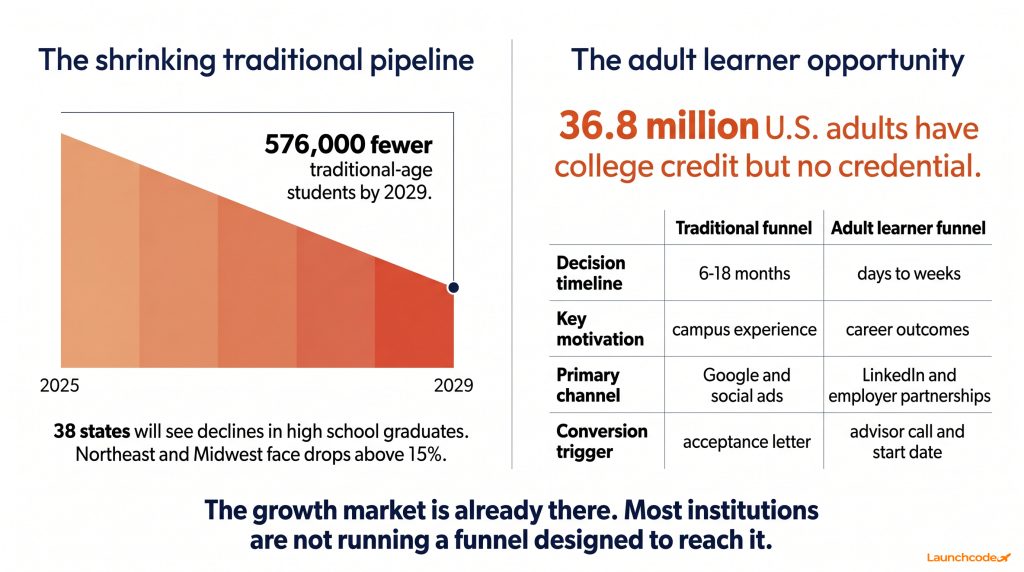
The traditional-age student pool is not going to recover. According to economist Nathan D. Grawe, whose research is cited by the Association of Governing Boards, the number of traditional college-age students will decline approximately 15 percent between 2025 and 2029. WICHE projects that 38 states will see declines in high school graduates. Institutions that keep targeting the same 18-year-old prospects are competing harder for a smaller pool.
The demographic cliff will eliminate approximately 576,000 college students between 2025 and 2029, with Northeast and Midwest states facing declines above 15 percent. This is not a temporary dip. A second contraction extends through 2039.
The growth market is already visible. There are 36.8 million U.S. adults who hold some college credit but no credential. These stopped-out students are the largest underpursued segment in higher education. They do not respond to the same funnel built for 18-year-olds. They need a different message, a different channel mix, and a much faster enrollment path.
The key data point from RCStrat research: nearly 75 percent of online learners enroll at the first school that admits them. Speed and a frictionless process matter more than brand prestige for this segment.
Institutions need to run two parallel funnels. One aimed at traditional-age students through the channels they actually use. One aimed at adult learners, built around outcomes, affordability, and rapid enrollment. A single-funnel approach loses enrollment to faster, more focused competitors.
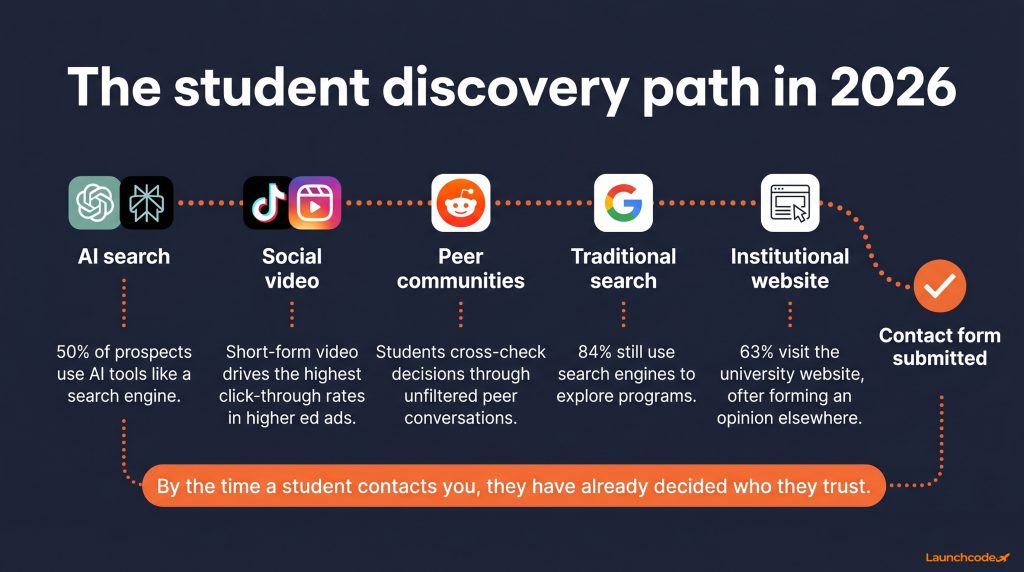
Students are no longer starting their college search on your website or even on Google. They start on ChatGPT, Perplexity, TikTok, and Reddit. According to research from Manaferra and the State of College Search 2025, 36 percent of students across all segments, undergraduate, graduate, and adult learner, are using AI search engines to guide their college search. Another 50 percent use AI tools the same way they use a traditional search engine. More than 88 percent use at least two platforms during the process.
Zero-click behavior is the mechanism that severs the connection between ranking and traffic. According to Similarweb data reported by Search Engine Journal, zero-click searches grew from 56 percent to 69 percent of all Google queries between May 2024 and May 2025. When Google displays an AI Overview above organic results, students read the answer and move on. No click happens.
A prospective student searching for an MBA program in supply chain today may encounter:
By the time that student submits a contact form, they have already formed a strong opinion. If your institution did not appear in those earlier touchpoints, you were not in their consideration set at all.
EducationDynamics uses the term "stealth researcher" to describe this pattern. These are prospective students who learn about your institution through AI tools, social content, and peer communities without ever triggering a tracking pixel or filling out a form. Your CRM shows zero activity. Your analytics show no visits. But the student has been evaluating you for weeks.
Institutions that do not optimize for this stage lose students they never knew they had.
The top of funnel in 2026 requires two parallel investments: traditional SEO for students who still click through to websites, and Generative Engine Optimization (GEO) for students who find answers inside AI systems before any click occurs. GEO is the practice of structuring content so it gets cited, summarized, or referenced in AI-generated answers from ChatGPT, Perplexity, and Google AI Overviews. Without it, your institution is invisible to a growing share of early-stage researchers.
As the EducationDynamics 2026 benchmarks put it: "Reputation is the new SEO. If students don't trust you, they never search for you." By 2025, nearly 60 percent of online learners started their search by looking up a specific institution, reflecting a 354 percent increase in brand-first searches since 2015. Brand recognition now drives discovery more than keyword rankings.
"Most program pages are built to rank, not to be cited. GEO requires a different content structure entirely. You need to lead with outcomes, structure clear answers, and give AI systems something clean to extract." Derick Do, Co-Founder and Chief Product Officer, Launchcodex
GEO is a content and authority strategy, not a single tactic. Start with these five steps:
| Channel | Primary role | Key action |
|---|---|---|
| SEO | Capture students who click | Optimize program pages for intent-based queries |
| GEO | Get cited in AI answers | Structure content for extraction and summarization |
| Paid search | Capture high-intent clicks | Focus budget on branded and bottom-funnel terms |
| Social video | Build familiarity before search | Student-led content on TikTok, YouTube, Instagram Reels |
| Reddit and forums | Influence peer discovery | Monitor and respond to program mentions |
The middle of the funnel is where most enrollment is lost. Students who have moved past discovery but have not yet applied need consistent, relevant, and fast communication. Generic drip campaigns and weekly email blasts do not move them. Personalized, behavior-triggered outreach tied to where the student is in their decision does. According to a 2025 higher education marketing report cited by Goedmo, 69 percent of institutions using AI and automation reported improved efficiency across marketing and enrollment processes.
As Encoura's 2026 research team notes: "College search no longer has a single starting point. Students follow countless paths from social platforms and mobile queries to AI assistants and peer-generated content, often before ever reaching your website." Your nurture strategy must follow the student across channels, not wait for them to return to your site.
Modern enrollment CRMs like Element451, Slate, and Salesforce Education Cloud can trigger personalized outreach based on specific student behaviors. Examples:
These are contextual responses to real behavioral signals, not mass campaigns.
Teams rebuilding their middle funnel consistently make the same errors:
Speed is a direct enrollment driver. Research shows that nearly 75 percent of online learners enroll at the first institution that admits them. The institution with the fastest, most frictionless admissions process wins, not necessarily the most prestigious one. The bottom of the funnel must be engineered for velocity, from first contact to personalized response, from response to application, from application to enrollment decision.
According to industry research cited by Goedmo, 81 percent of higher education professionals believe chatbots and virtual assistants will have the greatest impact on enrollment management. AI-powered admissions tools can respond to student contacts 24 hours a day, answer program-specific questions, and guide students to the next step without waiting for a human advisor.
Before rebuilding, measure these five points in your current bottom-funnel experience:
Each of these is a conversion lever. Improving any one of them improves enrollment without generating a single additional lead.
A streamlined application process is a brand signal. If a student encounters a confusing form, a broken upload process, or a week of silence after submission, that experience contradicts everything your marketing promised. Practical fixes include:
Adult learners and stopped-out students require a completely different funnel from the one built for 18-year-olds. They are not browsing options. They have specific outcomes in mind, a credential for a promotion, a career change, or a skill gap to close. The message that works for a high school senior exploring campus life will not work for a 34-year-old with a family, a job, and two years of prior credits at a different institution.
There are 36.8 million U.S. adults who hold some college credit but no credential. This is the largest untapped enrollment market in higher education, and most institutions are not running a funnel designed to reach them.
| Stage | Traditional funnel | Adult learner funnel |
|---|---|---|
| Discovery | Google, social ads, high school counselors | LinkedIn, employer partnerships, AI search, workforce development referrals |
| Motivation | Campus experience, social life, career readiness | ROI, career advancement, schedule flexibility, credit transfer |
| Decision timeline | 6 to 18 months | Days to weeks |
| Key objection | Cost, campus fit | Time, cost, whether prior credits transfer |
| Conversion trigger | Acceptance letter, campus visit | Advisor call, enrollment estimate, start date |
Organic search still plays a role for this segment, but the query language is different. Adult learners search for specific outcomes, not general program exploration. Terms like "online MBA for working professionals with transfer credit" signal intent and specificity. LinkedIn advertising works well for professional credential programs. Employer partnership channels, where companies refer employees to partner institutions, produce some of the highest-converting leads in continuing education.
The rebuilt funnel requires a rebuilt measurement model. Last-click attribution assigns all credit to the final touchpoint before conversion, and that misrepresents how students actually decide. A student who discovered your program through a ChatGPT response, watched a TikTok video, visited your program page twice, and then clicked a paid search ad to submit a contact form did not convert because of that ad. The ad was the final step in a multi-week trust-building process.
As one analysis from Higher-Education-Marketing.com frames it: "In 2026, the better question is not 'Where did the lead come from?' but 'Where did trust form?'" That shift requires more sophisticated tracking than most institutions currently run.
"Stop optimizing for cost per lead. In higher ed, it is a vanity metric. The number that matters is cost per enrolled student, traced back to the first touchpoint that created awareness." Tanner Medina, Co-Founder and Chief Growth Officer, Launchcodex
Replace or supplement last-click reporting with:
The measurement gap at most institutions is the disconnect between the marketing automation platform and the admissions CRM. Leads enter the marketing system and move into an admissions process, but few institutions track the full path from first touchpoint to enrolled student.
Closing that gap requires:
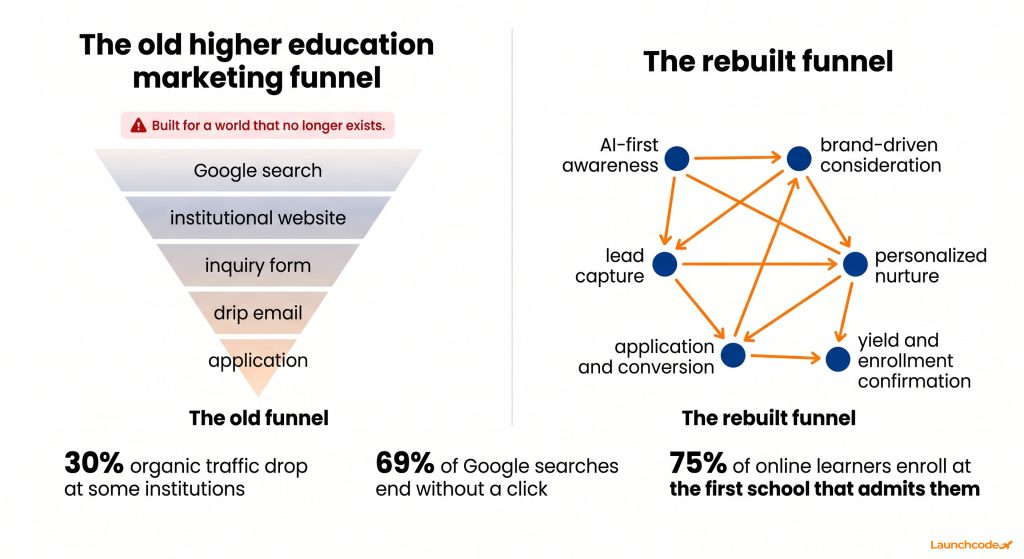
A modern higher education funnel does not look like a funnel. It looks like a network of touchpoints converging toward enrollment. The institution's job is to show up clearly at each node, deliver information students trust, and make the path from awareness to enrollment as fast and frictionless as possible. This is a strategy problem that technology helps solve.
Here is what the rebuilt funnel looks like across each stage:
Institutions that connect these six stages into a coordinated system, where GEO feeds awareness, CRM captures intent, and data connects marketing to enrollment outcomes, are the ones growing enrollment while others watch their funnel shrink.
The demographic cliff refers to the projected 15 percent decline in traditional college-age students between 2025 and 2029, driven by falling U.S. birth rates after the 2007-2008 recession. Economist Nathan D. Grawe estimates that approximately 576,000 college students will be lost during this period, with a second contraction continuing through 2039.
Generative Engine Optimization (GEO) is the practice of structuring content so it gets cited or summarized by AI-powered search tools like ChatGPT, Perplexity, and Google AI Overviews. It matters because 36 to 50 percent of prospective students now use AI search during the college discovery process. If your institution does not appear in AI-generated answers, you are invisible to a growing portion of your audience before they ever visit your website.
Shift from last-click attribution to assisted conversion tracking. The most important metrics are cost per enrolled student, application start rate by lead source, brand search volume growth, and direct traffic trends. These give a more accurate picture of where trust forms, not just where the final click happened.
Speed-to-lead is the time between when a prospect submits a contact request and when they receive a personalized response. For adult learners, it is a direct enrollment driver. Research shows that nearly 75 percent of online learners enroll at the first institution that admits them. Institutions that respond within minutes convert significantly more contacts than those that wait 24 to 72 hours.
Slate by Technolutions is the most widely adopted admissions CRM in higher education, known for flexibility and application management. Salesforce Education Cloud is common at large institutions with complex pipelines. Element451 is an AI-first option built specifically for enrollment automation and personalization. HubSpot works well at smaller institutions and online programs where general marketing automation is sufficient.




Local SEO for healthcare networks with multiple locations. Step-by-step framework covering GBP, location pages, NAP, HIPAA r...
Open rate is broken. Apple Mail Privacy Protection distorts more than 55% of all recorded opens. Learn the three-tier email ...
A practical guide to email marketing best practices in 2025. Learn how to improve deliverability, segment your list, build a...