
Share:

AI marketing & automation


You ran your site through Moz, Ahrefs, or SEMrush, got a number, and now you want to know what it means. That is a reasonable place to start. The problem is that most resources either give you a vague “higher is better” answer or bury the useful benchmarks inside 2,000 words of background.
This article gives you the benchmarks by industry, explains why your score looks different across tools, and walks through the tactics that actually move domain authority in 2026. It treats the metric as the practitioner tool it is, not the performance guarantee many teams mistake it for.
Domain authority is a Moz-created score that predicts how likely a domain is to rank in search results compared to competing sites. Ahrefs measures the same concept under the name Domain Rating (DR) and SEMrush uses Authority Score (AS). All three run on a 1 to 100 scale. None of them are metrics Google uses. Google’s John Mueller has said it plainly: “We don’t use domain authority; that’s a metric from an SEO company.”
Understanding that distinction prevents bad decisions. Teams that treat DA, DR, or AS as Google signals tend to buy links, chase inflated scores, and optimize for a metric that has no direct effect on their rankings. The useful frame is to treat these scores as competitive proxies. They tell you how your backlink profile stacks up against others. A stronger backlink profile tends to produce better rankings because both outcomes flow from the same underlying inputs.
Mueller also said: “There are some things where we do look at a website overall though.” Google does evaluate sitewide trust and quality signals. It uses its own link-based signals, not Moz’s DA or SEMrush’s AS, but those signals overlap heavily with what these tools measure. That is why a strong correlation exists between authority scores and rankings even though the metrics themselves are not ranking factors.
Ahrefs studied 218,713 domains and found that Domain Rating correlates well with keyword rankings. The conclusion was not that DR causes rankings. The conclusion was that the underlying backlink strength reflected in all three metrics tends to produce better organic visibility.
Moz calculates DA using more than 40 signals. SEMrush Authority Score adds organic traffic data on top of backlink signals. Ahrefs DR focuses almost entirely on backlink profile strength. Despite their differences, the distribution of influence across all three tools breaks down in a broadly similar way:
The logarithmic scale compounds the difficulty as you climb. Moving from DA 20 to 30 takes far less effort than moving from DA 70 to 80. Each 10-point increase requires roughly two to three times more referring domains than the previous tier. This is why many growing sites plateau around DA 40 to 50 and struggle to push past that range without a structural shift in their link acquisition strategy.
There is no single number that counts as universally good. Domain authority is a relative metric. A DA of 45 is strong if your competitors average 35 and weak if they average 60. The correct benchmark is always the average score of the top three to five sites ranking for your target keywords, whether you check that in Moz, Ahrefs, or SEMrush.
General ranges give some context:
Benchmark research compiled from Moz, Ahrefs, and SEMrush analysis shows that sites ranking in the first position on Google average a DA of 68. The top 10 results average between DA 51 and 71. Sites with DA 60 or higher are 2.1 times more likely to appear in the top 10.
Most businesses do not need to hit those levels to win in their specific market. The ranges above reflect competitive national and global search conditions, not the niche and local results where most SMB and mid-market brands actually compete.
The practical problem with targeting a fixed score goal is that it ignores competitive context. A local HVAC company does not need the same domain authority as a national insurance platform. If the top five sites ranking for your primary keywords have DA scores between 28 and 42, closing that gap is your working target, regardless of which tool you use to measure it.
Every resource spent pushing from DA 42 to 55 in a market where competitors average DA 38 could instead go toward content that captures more of that competitive range. Benchmark against your actual competitors, not the scale.
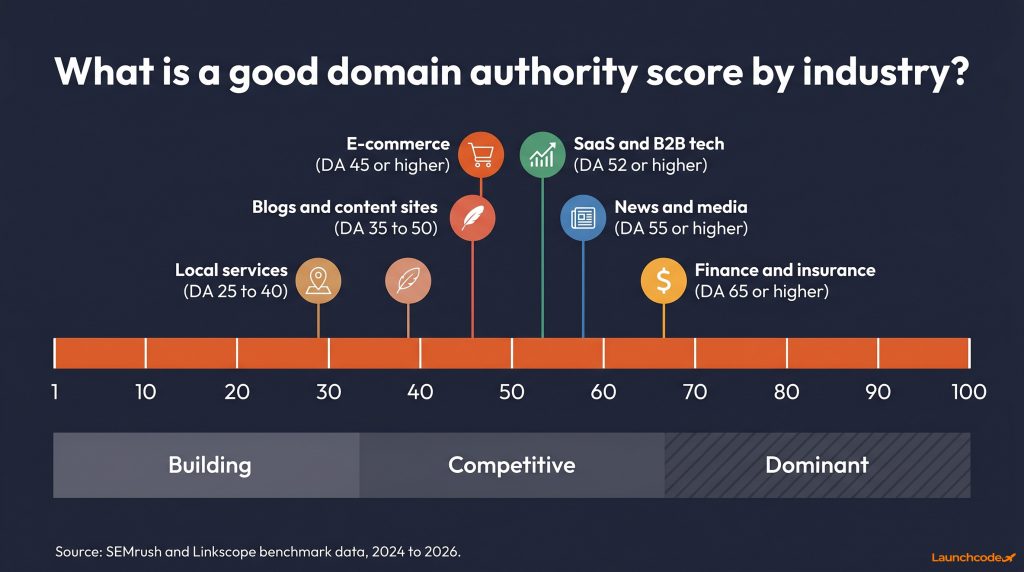
Target DA ranges vary significantly by vertical. A score of 35 is competitive for most local service businesses and weak for a national SaaS product. Industry type, competition density, and content depth all shift the threshold. Use these ranges as a starting framework, then validate against the sites actually ranking for your keywords.
Industry benchmark data from SEMrush and Linkscope’s 2024 to 2026 analysis gives a working reference:
| Industry | Average DA | Competitive target |
|---|---|---|
| Local services | 25 to 28 | 28 to 40 |
| Blogs and content sites | 32 | 35 to 50 |
| E-commerce | 35 | 45 or higher |
| SaaS and B2B tech | 38 | 52 or higher |
| News and media | 48 | 55 or higher |
| Finance and insurance | 58 | 65 or higher |
| Education and government | 56 or higher | 60 or higher |
Note that SEMrush Authority Score runs 15 to 20% lower than Moz DA on average, so if you use SEMrush as your primary tool, adjust these targets accordingly. An Authority Score of 30 to 35 is broadly equivalent to a Moz DA of 38 to 42.
A lower DA does not automatically mean lower rankings. Sites with DA scores between 30 and 45 regularly outrank higher-DA competitors when they demonstrate stronger topical depth on a specific subject, better on-page relevance, or fresher content targeting informational intent.
Research from Authority Hacker found that niche-focused sites reach DA 40 roughly 30% faster than generalist sites, averaging 18 months compared to 26 months for broad-topic domains. Depth beats breadth when it comes to both authority building and ranking for specific keyword clusters.
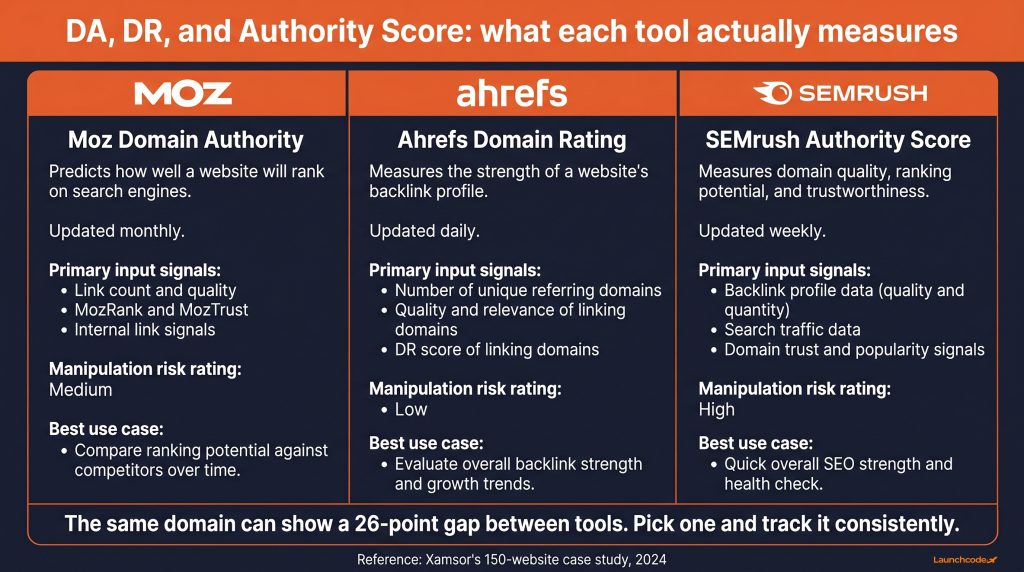
Moz DA, Ahrefs Domain Rating (DR), and SEMrush Authority Score all measure domain strength, but they use different formulas, different crawl data, and different signals. The same domain can show DA 45 from Moz, DR 52 from Ahrefs, and an Authority Score of 28 from SEMrush simultaneously. None of them is wrong. They answer different questions.
A case study from Xamsor covering 150 websites found an average gap of 26 points between the highest and lowest tool scores for the same domain. The most extreme example showed a 39-point range for the same site across tools.
| Metric | Provider | What it measures | Update frequency | Manipulation risk |
|---|---|---|---|---|
| Domain Authority (DA) | Moz | Backlinks, root domains, spam signals | Monthly | Moderate |
| Domain Rating (DR) | Ahrefs | Backlink profile strength, unique referring domains | Daily | Higher |
| Authority Score (AS) | SEMrush | Backlinks, organic traffic, spam patterns | Weekly | Lower |
| Trust Flow (TF) | Majestic | Link quality via proximity to trusted seed sites | Irregular | Lower |
Ahrefs DR and Moz DA correlate at 0.89, so they move in the same direction for most sites. SEMrush Authority Score runs 15 to 20% lower on average because it incorporates organic traffic as a signal. An Authority Score of 50 is roughly equivalent to a Moz DA of 40 to 43.
The right tool depends on the job:
Pick one metric and track it consistently. Comparing your Moz DA in January to your Ahrefs DR in March produces noise, not insight. The same principle applies if you switch from SEMrush to Moz mid-campaign.
DA and DR scores can be artificially inflated using paid link schemes. Research from Xamsor found that scores can be pushed to DA 50-plus for as little as $50 to $100 using low-quality link farms. SEMrush Authority Score proved the hardest to inflate across all four tools tested because it also requires real organic traffic to move meaningfully. When evaluating prospective link partners or domains for acquisition, check organic traffic alongside any authority score from any tool. A DA 55 or DR 55 site with near-zero traffic is a red flag, not a credential.
Referring domains are the primary driver. The count of unique websites linking to your domain explains 52% of DA variance across Moz, Ahrefs, and SEMrush alike. The quality of those referring domains accounts for another 31%. Domain age, content, and technical SEO make up the remaining 17%. That breakdown tells you exactly where to direct time and budget.
Ahrefs backlink research maps specific referring domain counts to DA tiers, making the growth curve concrete:
| DA tier | Typical referring domain count |
|---|---|
| DA 40 | 200 to 300 |
| DA 50 | 500 to 700 |
| DA 60 | 1,200 to 1,800 |
| DA 70 or above | 3,000 or more |
Moving from DA 50 to 60 does not simply require 200 more referring domains. It requires a net gain of 500 to 1,100 additional unique linking sites, and those links need to come from progressively higher-authority sources. The exponential curve is the biggest reason DA progress slows past the midpoint. You will see the same compounding pattern in Ahrefs DR and SEMrush Authority Score.
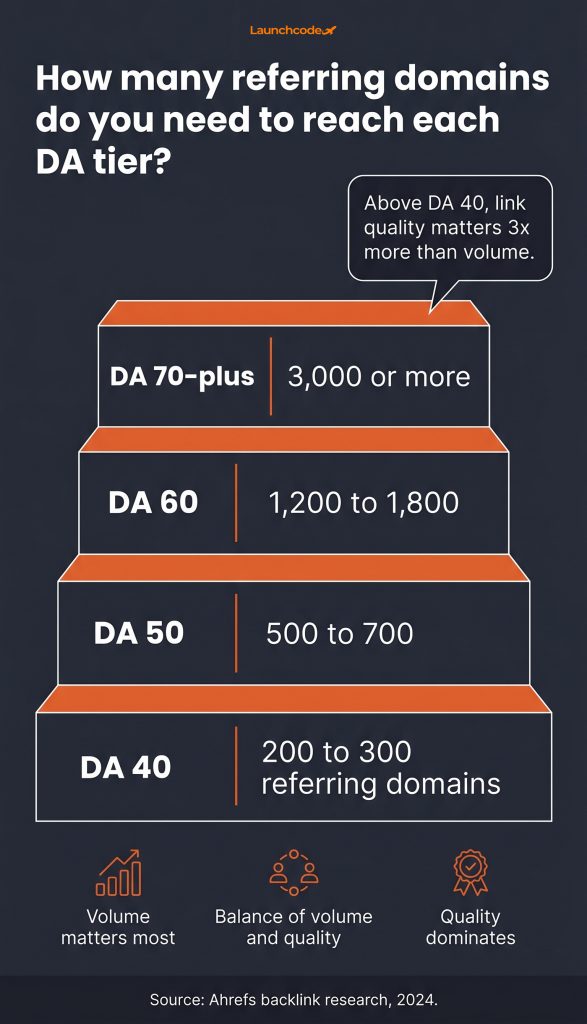
Below DA 40, the volume of unique referring domains matters most. Above DA 40, the calculus shifts. Link quality matters three times more than quantity at that threshold. Ten links from DA 70-plus domains produce more meaningful movement than 50 links from DA 20 to 30 sites.
This is where link vetting becomes critical. Ahrefs research shows that 90% of websites receive no organic traffic at all because they have no backlinks. The baseline task for any site trying to grow is to earn links from pages and domains that carry real authority and real traffic, not just a score in Moz, Ahrefs, or SEMrush.
The fastest path to DA improvement is a consistent program of earning high-quality backlinks from authoritative, relevant sites, paired with content that gives those sites a genuine reason to link. No single tactic moves DA overnight. Sites that grow authority fastest combine linkable content with structured outreach and a clean technical foundation.
Generic blog posts rarely earn external links. Original research, benchmark reports, data studies, and practical tools do. The content most likely to generate editorial backlinks makes other writers’ jobs easier: original statistics they can cite, frameworks they can reference, and resources they can point readers toward.
A practical model: publish one substantial linkable asset per quarter and build supporting content around it. That asset becomes the pitch material for digital PR outreach and the anchor point for link acquisition during that period.
“The teams that grow authority fastest aren’t publishing more content. They’re publishing content that other people need to reference. One solid original study outperforms 20 generic posts every time.”
Tanner Medina, Co-Founder and Chief Growth Officer, Launchcodex
Digital PR is the most reliable route to high-DA editorial backlinks in 2026. The process involves identifying journalists and publications covering your industry and pitching original data or expert perspective that adds value to their reporting.
Featured.com, which relaunched in April 2026 with the original HARO free email format, sends journalist queries three times daily. Responding to relevant queries within six hours significantly improves the chance of earning a mention and a backlink from publications including Forbes, Entrepreneur, and Inc., which typically carry DA scores above 70 and Authority Scores above 60.
Search engines evaluate topical depth, not only individual page quality. A site that covers a subject comprehensively, with a pillar page supported by detailed subtopic content, signals stronger expertise than a site with isolated standalone articles. This depth also earns links more naturally because the site becomes the reference point for that topic.
The hub and spoke model works well here: one comprehensive guide covering the core topic, with multiple supporting pieces addressing specific sub-questions. Each internal link between hub and spokes passes authority within the domain and helps search engines map your content hierarchy.
Toxic links and link decay both cost DA. A site that loses 10% of its referring domains sees an average DA drop of two to four points. Regular audits catch that drift before it compounds.
A practical audit process:
Technical SEO does not directly move DA, but a crawlable, fast-loading site earns more links because it signals professionalism and reduces friction for editors considering whether to reference you. Core Web Vitals, mobile performance, and logical site architecture are baseline requirements.
Internal linking distributes the equity already earned from external backlinks. Every new piece of content should receive links from existing pages with higher authority. This improves crawlability, reinforces topical signals, and passes domain equity to pages that need it most.
“When we audit a new site, the internal linking is almost always the fastest win. Most teams have pages sitting with zero internal links pointing to them. You’ve already earned the backlinks. You’re just not distributing the value.”
Derick Do, Co-Founder and Chief Product Officer, Launchcodex
With consistent effort, most sites see a five to ten point DA increase within six months. Moving from DA 15 to 30 is achievable in under a year with a disciplined link-building program. Moving from DA 50 to 60 typically takes 18 to 36 months because the referring domain requirements increase exponentially at that range. These timelines apply broadly whether you track progress in Moz, Ahrefs, or SEMrush.
Realistic timelines by starting point:
| Starting DA | Target DA | Realistic timeline |
|---|---|---|
| 0 to 15 | 25 to 30 | 6 to 12 months |
| 25 to 35 | 40 to 45 | 12 to 18 months |
| 40 to 50 | 55 to 60 | 18 to 36 months |
| 55 to 65 | 70 or above | 3 or more years |
The compounding nature of authority growth is real. B2B companies with 500 or more referring domains see approximately 34% more organic traffic than comparable sites with fewer. Early progress feels slow. Later progress accelerates because each new linking domain adds to an already-credible profile that gives other sites more reason to reference you.
Most DA growth stalls because of a handful of avoidable errors: paying for links that attract penalties, switching between tracking tools mid-measurement, or treating DA as the goal rather than a byproduct of real SEO. Each of these is common, and each produces measurable harm.
Paid link schemes appear to move DA quickly. They do not build real authority, and they create real risk. Google’s March 2024 core update explicitly targeted manipulative link patterns, aiming to reduce low-quality results by approximately 40 to 45%. Sites caught in link schemes face ranking drops and potential manual actions. A high DA or DR score sitting on top of zero organic traffic is easy for any practitioner to detect in a 10-second SEMrush or Ahrefs check. A link partner that fails that test is a liability.
Comparing Moz DA from one month to Ahrefs DR or SEMrush Authority Score the next produces noise, not insight. Each tool uses a different scale and a different dataset. Switching mid-measurement resets the baseline and makes it impossible to identify real progress. Pick one tool and measure consistently.
DA is a domain-level score. Most SEO wins happen at the page level. Ahrefs makes this point directly: focus on earning backlinks from strong pages on reputable sites to the specific pages you want to rank, not on inflating a site-wide score. DA improvement is a byproduct of doing page-level SEO well. It is not a strategy in itself. The same logic applies to Ahrefs DR and SEMrush Authority Score.
Links disappear when sites redesign, pages get deleted, or domains go offline. A backlink audit done once and then forgotten will miss the accumulating drift. Monthly monitoring of referring domain counts in Ahrefs, SEMrush, or Moz catches losses before they compound into a meaningful DA drop and gives you visibility into which content is losing links fastest.
Domain authority, Domain Rating, Authority Score: the name on the metric depends on which tool you use. What they all measure is the same thing, how competitive your backlink profile is relative to the sites competing for the same keywords. That is useful information when used correctly. It is not a performance metric, a client deliverable, or a strategic goal on its own.
The inputs that move any of these scores, high-quality referring domains, topical content depth, a clean link profile, and solid technical foundations, are the same inputs that drive real organic traffic and business results. B2B companies that reach 500 or more unique referring domains see measurably more traffic. Content that earns 100 or more backlinks reliably ranks in the top five positions for competitive terms. The score reflects those fundamentals. It does not replace them.
In 2026, authority signals carry increasing weight in generative AI systems as well. Citation tools and large language model search products tend to surface content from domains with established credibility and topical depth. The link-building and content work you do today to grow DA is the same work that positions your brand for AI-generated answer attribution.
For brands thinking about where authority building fits inside a broader SEO and GEO growth strategy, the starting point is a competitive authority audit: map your current DA, DR, or Authority Score against the sites ranking for your target keywords, build a link acquisition plan tied to ranking movement and traffic goals, and track one metric consistently over time. That is the process Launchcodex uses across every SEO engagement.
No. Google does not use Moz’s Domain Authority, Ahrefs’ Domain Rating, or SEMrush’s Authority Score in its algorithm. John Mueller has confirmed this publicly multiple times. These scores correlate with rankings because the underlying signals, quality backlinks and genuine content depth, overlap with what Google evaluates. The third-party scores themselves have no direct effect on search positions.
New sites start at DA 1 in Moz and a score of 0 in Ahrefs and SEMrush. Getting to DA 20 to 30 within the first year is realistic with consistent content production and a structured link-building program. For most local businesses, reaching DA 25 to 35 is enough to compete for local and niche search terms.
Because they measure different things with different data. Moz DA uses more than 40 signals including spam detection. Ahrefs DR focuses almost entirely on backlink profile strength. SEMrush Authority Score adds organic traffic as an additional signal and tends to run 15 to 20% lower than Moz DA for the same domain. The same site will show different numbers across all three tools. Pick one and track it consistently.
Not significantly. Referring domains explain 52% of DA variance. Technical improvements and content quality help at the margins, but the primary driver of meaningful DA, DR, or Authority Score growth is earning backlinks from unique, authoritative domains.
Moz DA updates approximately monthly. Ahrefs DR updates daily. SEMrush Authority Score updates weekly. The monthly Moz cycle means recent link-building activity may not appear in your DA score for several weeks, while Ahrefs and SEMrush will reflect gains faster.
Removing genuinely toxic links can prevent future DA drops and protect against algorithmic penalties, but it rarely produces significant gains on its own in Moz, Ahrefs, or SEMrush. The bigger impact comes from earning new high-quality links. Clean the profile to remove drag, then focus effort on building positive signal.


Real stories from the people we’ve partnered with to modernize and grow their marketing.