
Share:

AI marketing & automation


For years, site owners have had no clear way to measure whether their content is actually being cited when ChatGPT, Microsoft Copilot, or Google AI answers a question. Traffic drops, branded search spikes, and guesswork were the only signals. That is starting to change.
On April 27, 2026, Microsoft previewed four new AI reporting features for Bing Webmaster Tools at SEO Week in New York City. The announcement puts Bing ahead of Google on AI search transparency and raises a question every marketing leader should be asking: if you cannot measure your AI citation visibility, how do you know whether your content strategy is working?
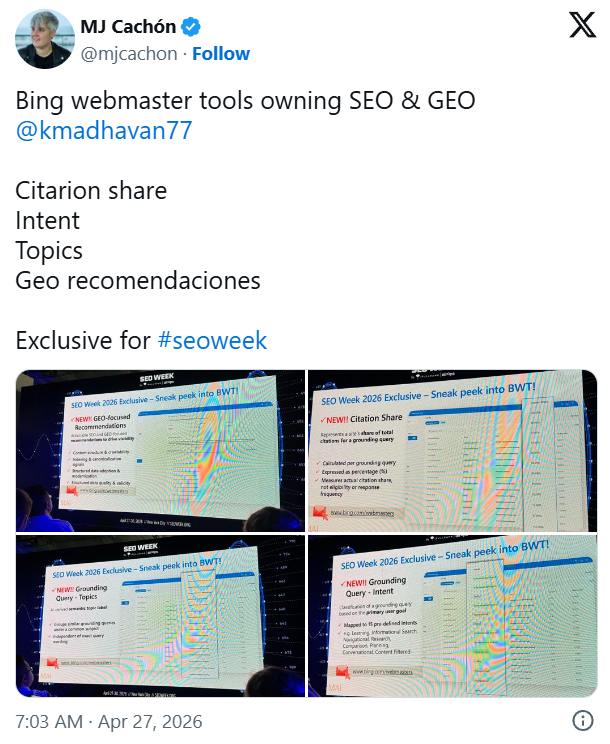
Microsoft previewed four new AI reporting features for Bing Webmaster Tools on April 27, 2026. Krishna Madhavan, Principal Product Manager at Microsoft AI and Bing, presented the features using slides shared by attendees on social media. The four additions are citation share, grounding query intent, grounding query topic labels, and GEO-focused recommendations. None are live yet, but the direction is clear.
SEO practitioner Azeem Ahmad, who attended the event, captured the moment plainly: “The gap between Bing’s transparency and Google’s is getting harder to ignore.”
This was not a sudden pivot from Microsoft. The company launched the Bing AI Performance report in public preview on February 10, 2026, giving site owners their first view of how often their content is cited across Microsoft Copilot and Bing AI summaries. In March 2026, the platform expanded that report to map grounding queries to the specific pages being cited. The SEO Week preview is the third step in a deliberate, phased build toward a full AI search optimization workspace.
Fabrice Canel, Principal Program Manager at Bing, confirmed the intent directly: “Just a taste of what’s coming soon. Stay tuned, bigger things are loading.”
| Feature | What it does | Status |
|---|---|---|
| Citation share | Shows the percentage of AI citations your site captures for a specific grounding query | Coming soon |
| Grounding query intent | Classifies queries into 15 predefined intent labels | Coming soon |
| Grounding query topic labels | Assigns a semantic topic label to each grounding query | Coming soon |
| GEO-focused recommendations | Surfaces guidance on content structure, crawlability, structured data, and indexing | Coming soon |
| AI Performance dashboard | Shows citation counts, grounding queries, and cited URLs | Live since Feb 2026 |
Citation share is a competitive metric, not a visibility metric. Citation count tells you how often your content appears in AI-generated answers. Citation share tells you what percentage of citations for a specific grounding query your site captures versus every other site cited for the same query. That is share of voice applied to AI search. The distinction changes what you measure and what you prioritize.
Raw citation counts tell you whether you are present in AI answers. Citation share tells you whether you are winning those answers against your competitors. The two numbers can look very different. A site with 200 citations per month that captures 6% citation share for its most important queries has a fundamentally different problem than a site with 50 citations that captures 48% share.
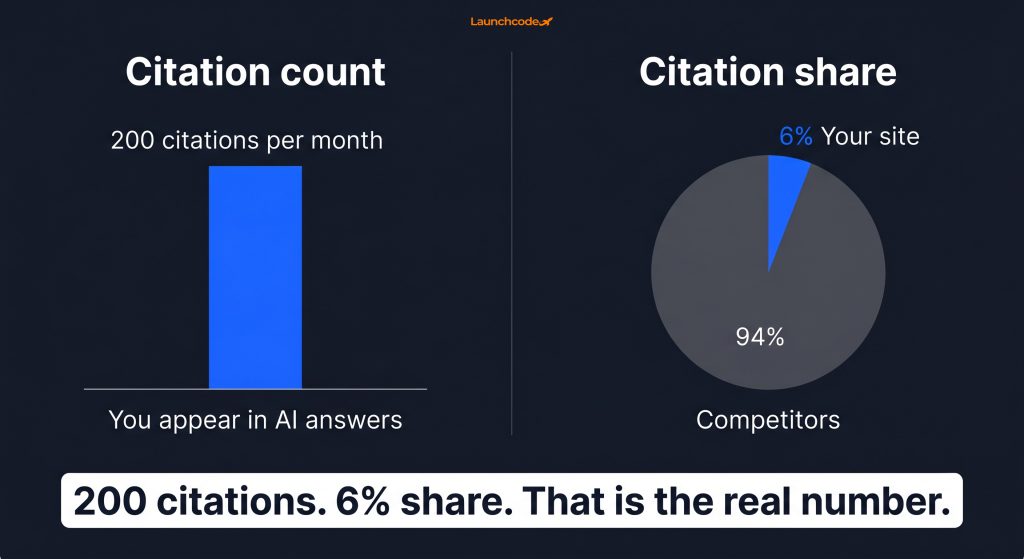
The current Bing AI Performance dashboard shows total citations and which pages earned them. That data is a useful starting point. Without competitive context, though, high citation counts can still mean low market relevance. A site could appear frequently for low-intent queries while a competitor dominates the queries that drive purchase decisions.
Citation share surfaces that gap. It shifts the question from “are we getting cited?” to “are we getting cited more than the competition?”
A regional accounting firm appears in 38 Bing Copilot answers over 30 days. That sounds meaningful. But when citation share data shows they captured only 5% of citations for the grounding queries tied to their core services, while a national competitor captures 62%, the picture changes entirely. The firm is present in AI answers but invisible relative to the competition. That insight changes the content brief from “keep producing articles” to “we need different content targeting these specific queries.”
The four features work together as a reporting and optimization layer. Citation share measures competitive positioning. Grounding query intent explains why a query triggered an AI answer. Topic labels group queries by subject so you can spot concentration and gaps in your coverage. GEO recommendations translate all of it into action. Together, they move Bing Webmaster Tools from a passive reporting interface toward a proactive AI search optimization workspace.
Grounding query intent will classify each grounding query into one of 15 predefined intent labels. Categories visible in the SEO Week slides include Learning, Informational Search, Navigational, Research, Comparison, Planning, Conversational, and Content Filtered. Different intent types reward different content formats. A query classified as Comparison rewards detailed, data-backed side-by-side content. A query classified as Planning rewards structured, step-by-step guidance. Knowing which intent types your citations fall under tells you whether your content format matches the reason the AI is retrieving it.
Topic labels add one more layer: a semantic grouping that shows which subject areas your content is being associated with across all grounding queries. If your citations cluster around a narrow topic range, you are likely missing citation opportunities in adjacent areas your site already covers.
The GEO recommendations feature is the most actionable of the four. Based on the SEO Week slides, it will surface guidance across four areas:
These are established technical SEO fundamentals. What makes them new is the framing: Microsoft is explicitly connecting these signals to AI citation eligibility, not just traditional search ranking. For teams running solid technical foundations, this is validation. For teams that have deprioritized technical SEO, this is a direct signal to act.
Microsoft has not confirmed how citation share percentages will be calculated, how the 15 intent categories map to every query type, or how GEO recommendations will be triggered and prioritized. No release dates have been set. All four features should be treated as confirmed development priorities, not shipped tools.
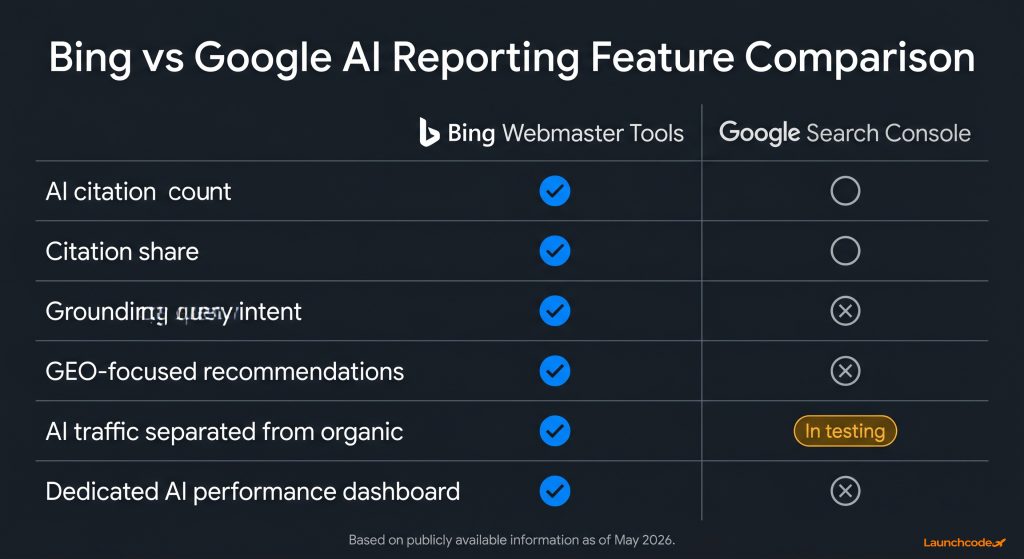
Google Search Console does not currently offer dedicated AI citation reporting. Traffic from AI Overviews and AI Mode is folded into the standard Search Console performance report under Web search, making it impossible to isolate how much organic visibility comes from AI-generated answers versus traditional results. Bing has had a dedicated AI performance dashboard since February 2026. Google does not.
Google Search Console remains the right tool for traditional organic performance. It tracks impressions, clicks, average position, Core Web Vitals, schema validation, and indexing health.
What it does not show: which pages are being cited in AI Overviews, how often AI Mode retrieves your content, what grounding queries trigger your pages to appear in AI answers, or how your citation performance compares to competitors.
That gap is material. According to Conductor’s analysis of 21.9 million queries, AI Overviews now appear in approximately 25% of Google searches, up from 13% in early 2025. That is one in four Google searches generating an AI-driven answer your current reporting cannot measure.
Google is aware of the gap. References to an “AI contribution pilot” appeared in Google’s support documentation on April 13, 2026, two weeks before the Bing SEO Week announcement. No public screenshots or detailed metrics are available, and no official launch has been confirmed.
When asked about AI visibility reporting in Search Console in February 2026, Google Search Advocate John Mueller offered a careful non-answer: “While I have nothing to announce, I can say that very few things online are permanent.” Whether Google moves at the same pace as Bing is an open question.
AI search traffic is a material channel today. Adobe Digital Insights tracked a 693% year-over-year surge in AI referral traffic to US retail sites during the 2025 holiday season. That traffic converts well. AI search visitors convert at 14.2% compared to 2.8% for Google organic visitors, according to Exposure Ninja’s 2026 research. That gap makes citation visibility a revenue question, not a ranking question.
“AI citation visibility is becoming the new organic share of voice. The businesses tracking it now will have a real data advantage when Bing’s reporting goes live for everyone else.” Tanner Medina, Co-Founder & Chief Growth Officer, Launchcodex
Ranking well in Google does not guarantee AI citation. Ahrefs research from August 2025 found that around 80% of LLM citations do not rank in Google’s top 100 for the original query. Traditional SEO rankings are not a reliable proxy for AI citation performance. The two systems pull from different signals, reward different content structures, and apply different trust criteria.
That is exactly why citation share data matters. Without it, a business that ranks well in Google has no reliable way to know whether it is winning or losing in AI search.
The GEO services market was valued at $848 million in 2025 and is projected to reach approximately $19.8 billion by 2034, expanding at a 50.5% CAGR. That growth is driven by the same shift Bing is responding to: businesses need a discipline built specifically for AI search visibility, separate from traditional SEO.
Gartner predicted that traditional search engine volume would drop 25% by 2026 due to AI chatbots and virtual agents. As that shift accelerates, brands investing in GEO already report 30 to 40% higher AI referral traffic compared to brands relying solely on traditional SEO.
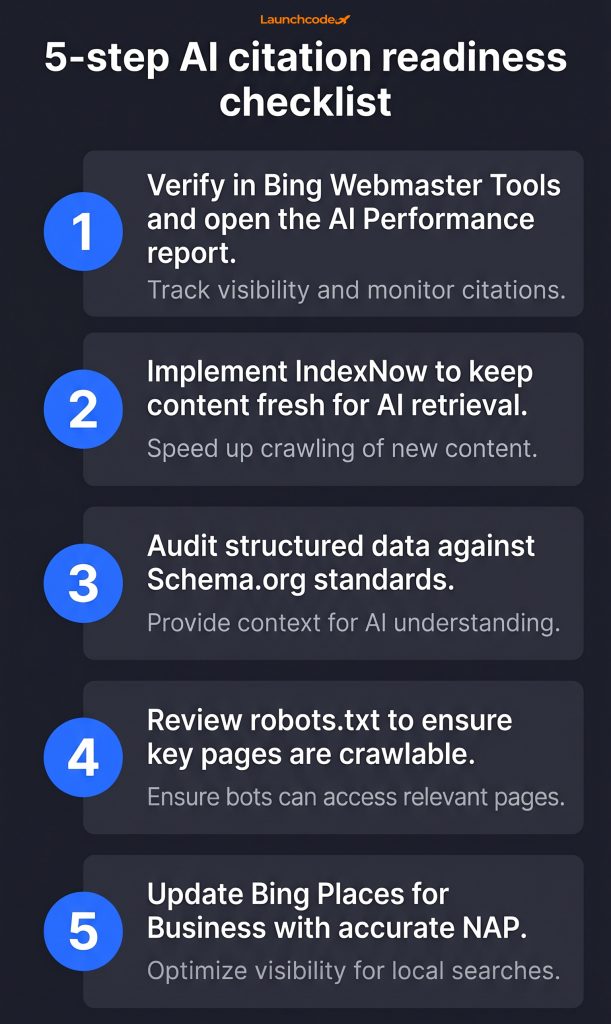
The Bing AI citation features are not live yet. But the technical and content signals that will determine your performance in those reports are being shaped right now. Sites that verify in Bing Webmaster Tools today and start collecting baseline AI Performance data will have historical context when citation share arrives. Sites that wait will start cold.
These steps align directly with the four GEO recommendation areas Bing previewed at SEO Week:
“Most teams are still measuring AI search with proxy signals like branded search volume and direct traffic spikes. Citation share gives you a direct, competitive number for the first time. That changes how you brief content, not just how you report on it.” Derick Do, Co-Founder & Chief Product Officer, Launchcodex
AI systems retrieve content differently from traditional crawlers. Pages that earn citations tend to be easy to quote, easy to summarize, and easy to verify. A few practical adjustments make a measurable difference:
For teams that want a structured starting point, Launchcodex’s SEO and GEO services include content architecture reviews built around AI retrieval signals, covering the same areas Bing’s GEO recommendations will address.
For most of the past two years, AI search has been nearly impossible to measure directly. Platforms generating answers did not tell you whether your content was used, how often, or against what competition. You were optimizing blind.
Bing is changing that. The four features previewed at SEO Week represent the first serious attempt by a major search platform to give site owners competitive, actionable data on AI citation performance. Citation share will likely become as standard a KPI as organic click-through rate. When it does, teams that have already built the right technical foundations and content structure will have a measurable advantage. Teams that have not will be catching up against a visible scoreboard.
Google will move eventually. The AI contribution pilot spotted in April 2026 suggests it is working toward something. But Bing has moved first and continues adding reporting layers at a consistent pace.
The practical priority right now is clear: verify in Bing Webmaster Tools, review your existing AI Performance data, close your technical gaps, and build content that AI systems can retrieve, quote, and trust. The reporting is coming. Make sure your content earns a share of it.
Citation share is an upcoming metric that will show the percentage of AI citations your site captures for a specific grounding query, relative to all other sites cited for the same query. It goes beyond raw citation counts to show competitive positioning inside AI-generated answers.
No. Citation share, grounding query intent, topic labels, and GEO-focused recommendations were previewed at SEO Week in April 2026 but have not launched. Microsoft has not confirmed release dates. The existing AI Performance dashboard, live since February 2026, is available now inside Bing Webmaster Tools.
Not yet. Google currently folds AI Overview and AI Mode traffic into the standard Web search performance report in Search Console. An “AI contribution pilot” was spotted in Google’s support documentation in April 2026, but no official feature has launched and no timeline has been shared.
A grounding query is the internal query an AI system uses to retrieve and verify supporting content before generating an answer. It may differ from the exact question a user typed. Understanding which grounding queries trigger your content tells you why your pages are being retrieved, not just that they were.
Verify your site in Bing Webmaster Tools and open the AI Performance report. This shows current citation counts, grounding queries, and which pages are being cited. That baseline data will become significantly more valuable once citation share and intent data are added.
AI-generated answers tend to reach users who have already done research and have a clear intent. By the time a user clicks through from an AI-generated response, they have typically received a synthesized answer and are looking for depth, a specific provider, or a next step. That intent level drives higher conversion rates across most verticals.


Real stories from the people we’ve partnered with to modernize and grow their marketing.