

Share:

AI marketing & automation


Shoppers are completing purchases inside AI conversations. They ask Google AI Mode to recommend a product, a Buy button appears on the result, and they check out without ever landing on a brand’s website. This is not a future scenario. It is live today for eligible US merchants through the Universal Commerce Protocol.
This guide covers what UCP is, how the checkout experience works, what your product data needs to look like before any of it matters, and how to handle the measurement and attribution challenges that come with selling on a surface you do not own. By the end, you will know what to do next and why the early access window still matters.
UCP is an open standard for agentic commerce, announced at the National Retail Federation conference on January 11, 2026. Google co-developed it with Shopify, Target, Walmart, Etsy, and Wayfair. More than 20 global partners endorsed it at launch, including Mastercard, Stripe, Visa, Adyen, The Home Depot, and Zalando. The protocol gives AI agents a structured way to discover products, execute checkout, and handle post-purchase interactions across any surface.
Before UCP, every AI platform that wanted to support commerce needed a custom integration with each merchant. The same checkout logic had to be rebuilt from scratch for every connection. UCP solves this by establishing a shared language. Merchants publish what their systems support. Agents negotiate and execute. The protocol handles the rest.
The commercial context is worth stating clearly. People shop across Google more than one billion times a day, and Google’s Shopping Graph indexes more than 50 billion product listings in real time. AI Mode pulls directly from this graph. When a shopper types “find a lightweight carry-on for a two-week trip,” the AI surfaces products, answers questions about dimensions and airline policies, and can now complete the purchase without routing the shopper anywhere else.
BCG estimates 15 to 20% of e-commerce transactions will be AI-mediated by 2028. McKinsey projects agentic AI will influence $3 to $5 trillion in global retail commerce by 2030. Three major agentic checkout protocols launched in the four months between September 2025 and January 2026: OpenAI’s Instant Checkout via the Agentic Commerce Protocol, Microsoft Copilot checkout via Shopify, and Google UCP. Merchants who treat this as a 2027 problem are already running behind.
UCP is not a rebranding of Google’s earlier checkout button. With the old checkout button, shoppers clicked through and completed the transaction on the merchant’s website. With UCP, the transaction happens directly on Google’s surface. The merchant remains the seller of record, owns the customer relationship, and handles fulfillment and post-purchase support. Google processes the payment through Google Pay using credentials the shopper already has stored in Google Wallet.
Ashish Gupta, VP/GM of Merchant Shopping at Google, put it this way: “The shift to agentic commerce will require a shared language across the ecosystem, and the Universal Commerce Protocol provides that framework.”
That shared language matters beyond Google alone. UCP works across AI Mode in Search, the Gemini web app, and eventually Gemini on mobile. It is also compatible with Agent2Agent (A2A), the Agent Payments Protocol (AP2), and the Model Context Protocol (MCP). A single UCP integration can serve multiple AI surfaces without rebuilding for each one.
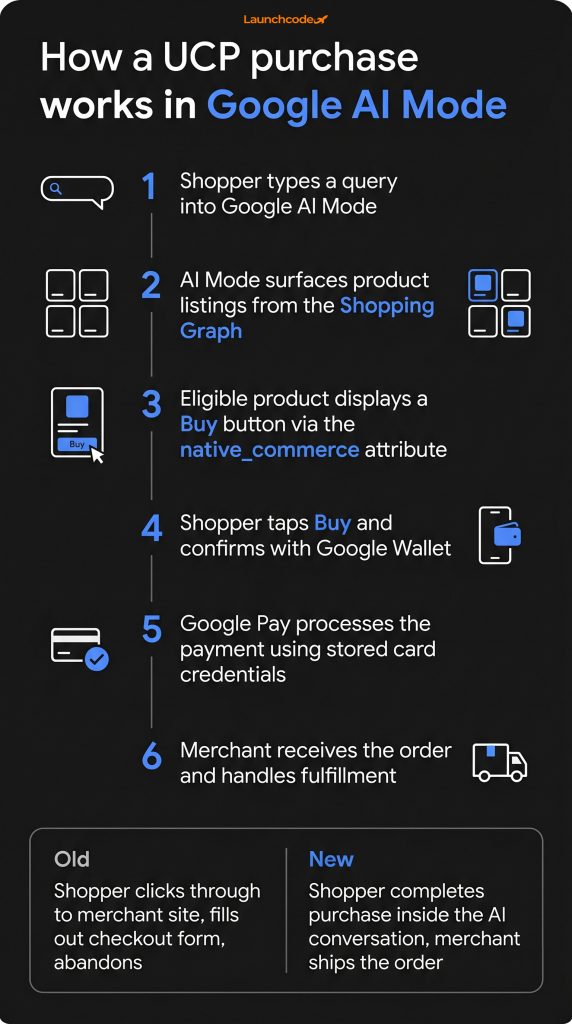
When a shopper researches a product in Google AI Mode and a merchant has integrated UCP and added the native_commerce attribute to their Merchant Center feed, a Buy button appears on the eligible product listing. The shopper checks out using Google Pay. The merchant receives the order, fulfills it, and manages the customer relationship from that point forward. The shopper never leaves the AI conversation.
Here is the end-to-end flow:
The entire experience happens inside Google’s interface. There is no redirect. The cart does not transfer to another tab. This design directly addresses a persistent problem in ecommerce: the average cart abandonment rate across all industries is 70.19%, representing an estimated $260 billion in recoverable US revenue. UCP removes the friction point where most of that abandonment happens.
AI Mode does not browse product pages the way a human does. It pulls from Google’s Shopping Graph, which indexes structured product data fed through Merchant Center. The graph evaluates pricing accuracy, inventory availability, product attributes, image quality, and return and shipping policies.
Merchants who publish clean, complete, and current data get recommended. Merchants who do not get skipped, regardless of how their website looks. Feed quality is not a technical afterthought for UCP. It is the foundation everything else depends on.
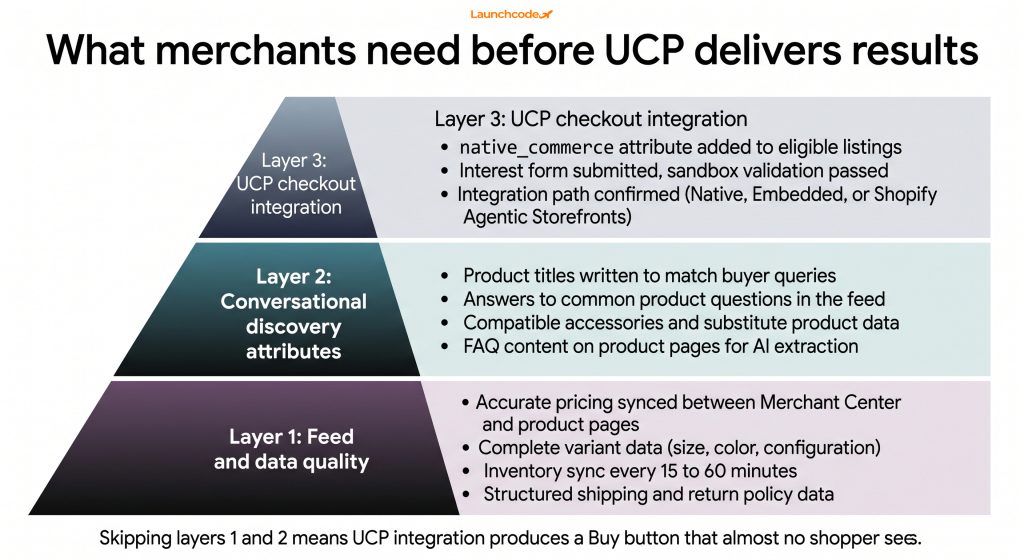
Without the native_commerce product attribute in your Merchant Center feed, your products will not display the Buy button in AI Mode. That attribute is the eligibility gate for UCP-powered checkout. But feed eligibility is only half the picture. If your product data is incomplete, AI Mode will not recommend your products in the first place, making the Buy button irrelevant.
There are two distinct layers to get right.
To be eligible for UCP checkout, merchants must:
Once approved, a dedicated UCP integration tab appears in the Merchant Center account. Google provides a sandbox environment to test identity linking and checkout APIs before going live.
A product can appear in AI Mode without the native_commerce attribute. It will not be purchasable there without a click-through. The attribute is what separates a visible listing from a transactable one.
In January 2026, Google announced dozens of new Merchant Center data attributes designed specifically for AI-mode discovery. These go beyond traditional keywords to include:
These attributes help AI Mode understand your catalog well enough to recommend it in response to conversational queries. They are separate from the native_commerce attribute, but equally important for visibility.
“The merchants who see the fastest UCP results are the ones who treat feed quality as a first-class project, not a cleanup task. Product data is your shelf placement in AI Mode.” Derick Do, Co-Founder and Chief Product Officer, Launchcodex
UCP offers two integration paths. The Native path is the default and requires the least implementation effort. Google hosts the full checkout experience using Google Pay. The Embedded path is an optional, separately approved option for merchants with complex branding requirements or custom checkout flows, delivered through an iframe. Most merchants will use Native.
| Integration path | Who it fits | Key strength | Watch out for |
|---|---|---|---|
| Native | Most merchants, Shopify brands, SMBs | Fastest to implement. Google handles checkout UI and payment flow. | Less control over checkout look and feel. |
| Embedded | Enterprise brands, merchants with complex checkout logic | Maintains custom branding and business-specific checkout requirements. | Requires separate Google approval. More technical lift. |
Shopify built UCP support directly into Shopify Admin through Agentic Storefronts. Shopify merchants do not need to build a custom REST API or MCP integration. They apply through the Shopify Admin, and Shopify handles the UCP handshake with Google. Vanessa Lee, VP of Product at Shopify, noted: “Shopify has a history of building checkouts for millions of unique retail businesses. We have taken everything we’ve seen over the decades to make UCP a robust commerce standard that can scale.”
Merchants on custom stacks, headless commerce platforms, or mid-market solutions have three options:
Salesforce confirmed it will implement UCP natively for Agentforce Commerce merchants, with Commerce Inc and Stripe also committing to UCP support. For brands on those platforms, native UCP will arrive without custom development work.
UCP is the transaction layer, but it is one piece of a broader Google agentic commerce suite. Business Agent and Direct Offers operate on the same AI Mode surface and amplify visibility and conversion before and after the Buy button appears. Merchants serious about AI Mode performance need all three working together.
Business Agent is a branded AI sales associate that merchants activate in Merchant Center. It lets shoppers chat directly with a brand inside Google Search, ask product questions, get recommendations, and eventually complete purchases, including agentic checkout. Business Agent launched on January 12, 2026, with initial retailers including Lowe’s, Michaels, Poshmark, and Reebok.
Eligible US merchants can activate and customize Business Agent through Merchant Center. Over the coming months, merchants will be able to train the agent on their own data, configure product offers, and embed agentic checkout directly into the conversational experience.
Direct Offers is a Google Ads pilot that allows advertisers to display exclusive discounts to high-intent shoppers inside AI Mode conversations. A merchant can configure a campaign to offer 20% off to a shopper actively researching a relevant product category.
Direct Offers is distinct from UCP but runs on the same surface. It works well as a conversion layer on top of AI Mode visibility, reaching shoppers who are engaged with a product conversation but have not yet committed to a purchase.
Google’s most recent UCP updates, published in April 2026, added three significant capabilities:
These updates move UCP significantly closer to a full commerce session. Merchants who integrate early will have loyalty and catalog data flowing into agent interactions before competitors who wait for broader rollout.
When a transaction completes inside Google AI Mode, the shopper never visits your website. The standard signals your measurement stack relies on, including pageviews, session data, exit-intent triggers, cart events, and retargeting pixels, do not fire. Merchants need a different attribution model for on-Google transactions, and they need to build it before UCP volume grows.
This is one of the most underaddressed challenges in current UCP coverage. Here is what changes and what to do about it.
“The brands that struggle most with UCP are the ones who treat attribution as an afterthought. Getting your measurement framework in place before volume arrives is what separates a clean rollout from a messy one.” Brittany Charles, SVP Client Services, Launchcodex
One data point worth noting: AI-sourced traffic was already converting 40 to 60% worse than traditional search traffic in late 2025 because users were getting answers without clicking through. UCP is the direct response to that pattern. It converts the AI session into a transaction rather than letting the intent disappear.
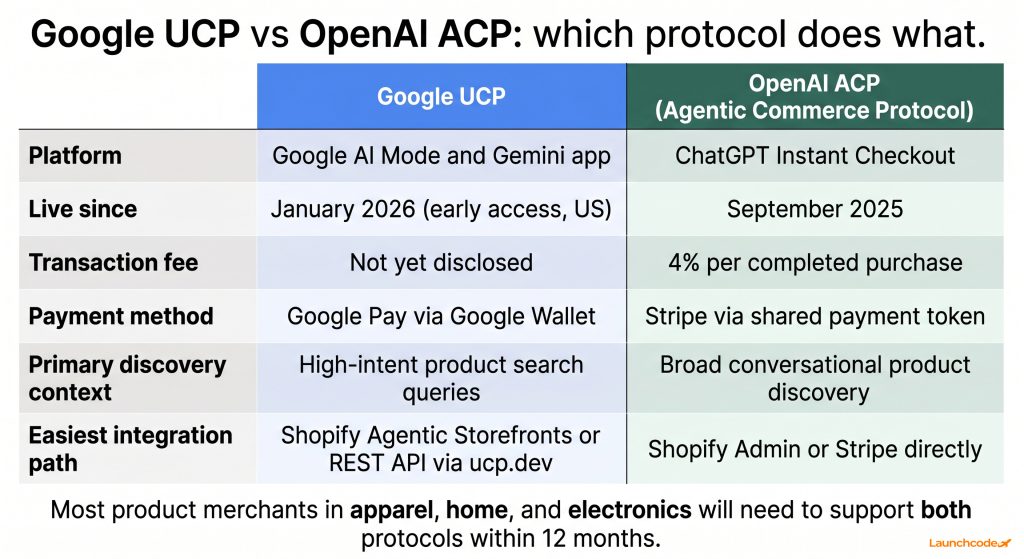
Most product merchants selling to US consumers will need to support both Google’s UCP and OpenAI’s Agentic Commerce Protocol (ACP) over time. The two protocols serve different discovery contexts and different user bases. Waiting for one to dominate is a mistake.
| Protocol | Platform | Live since | Transaction fee | Primary use case |
|---|---|---|---|---|
| UCP | Google AI Mode, Gemini | January 2026 (early access) | Not yet disclosed | High-intent search queries |
| ACP | ChatGPT Instant Checkout | September 2025 | 4% per transaction | Conversational product discovery |
OpenAI’s Instant Checkout launched in September 2025 and serves 900 million weekly ChatGPT users. It runs through the Agentic Commerce Protocol in partnership with Stripe. OpenAI charges merchants a 4% transaction fee on every completed purchase.
Google UCP has no disclosed per-transaction fee in its current early access phase. Standard payment processing fees apply through Google Pay, but no platform-level cut has been announced.
The two protocols serve different discovery contexts. ACP captures conversational product discovery in ChatGPT, where shoppers often start with broad questions. UCP captures high-intent queries in Google Search, where the user is already researching a specific product category. Brands in apparel, home, electronics, and similar physical goods categories should treat both as required infrastructure over a 12-month horizon.
UCP handles the transaction. Before any transaction is possible, AI Mode has to recommend your product. That recommendation depends on product data quality, structured content on your site, and generative engine optimization (GEO) signals that tell AI systems what your products are, who they are for, and why they fit a given query. Merchants who treat UCP as a purely technical integration, without addressing the upstream content layer, will integrate successfully and still see few recommendations.
One industry analyst covering the UCP launch noted that merchants “will also need to ensure that content on their site can be discovered by the LLMs themselves, meaning businesses and brands will need an answer engine optimization and generative answer optimization strategy in place.”
AI systems extract meaning from structured, specific, and unambiguous content. For product pages and Merchant Center feeds, this means:
Feed audits for clients preparing for AI Mode visibility consistently surface the same gaps: pricing inconsistencies between feed and site, missing variant data, and product descriptions written for human browsing rather than AI extraction. Fixing those gaps is the practical first step before UCP integration produces meaningful results.
Getting ready for UCP involves three parallel workstreams: feed preparation, technical integration, and measurement setup. Running them in sequence adds months. Running them in parallel compresses the timeline to the 6 to 8 weeks most eligible merchants need to reach sandbox validation.
If you sell physical products and run a Google Merchant Center account, three things are worth doing right now regardless of where you are in the UCP waitlist queue.
First, audit your feed for the attributes that determine whether AI Mode recommends your products at all. Pricing accuracy, complete variant data, and structured shipping and return policies are not UCP-specific requirements. They are the baseline for any AI surface to treat your catalog as trustworthy.
Second, add FAQ content to your top product pages. Short, specific questions and answers about compatibility, sizing, materials, and policies are among the most extractable content formats for AI systems. They cost little to produce and pay off across AI Mode, featured snippets, and voice search simultaneously.
Third, set up a server-side conversion event in GA4 for order completions that originate outside your website. You may not have UCP volume today, but the measurement infrastructure takes time to configure and validate. Build it before you need it.
UCP is in early access today. The protocol will expand to more merchants, more markets, and more AI surfaces over the next 12 months. The merchants who prepare their data, configure their measurement, and understand how agentic recommendations work will be the ones with a functioning presence on these surfaces when volume arrives. The ones who wait will be starting from scratch in a more crowded room.
UCP is an open standard co-developed by Google, Shopify, Target, Walmart, and Etsy that lets AI agents execute product discovery, checkout, and post-purchase interactions on behalf of shoppers. It enables merchants to sell directly inside Google AI Mode and the Gemini app without requiring shoppers to visit the merchant’s website.
No. Shopify is the simplest integration path but not the only one. Merchants on custom platforms can integrate via REST API using the spec at ucp.dev. MCP and A2A transport bindings are also available. Salesforce Agentforce Commerce and Stripe will add native UCP support in the coming months.
Google has not disclosed a per-transaction fee for UCP in its current early access phase. Standard payment processing fees apply through Google Pay. By comparison, OpenAI’s Agentic Commerce Protocol charges merchants a 4% transaction fee per completed ChatGPT Instant Checkout purchase.
It may. Shoppers who purchase through AI Mode will not visit your site. Existing session-based analytics, retargeting pixels, and cart abandonment flows will not capture these buyers. Set up server-side conversion tracking and a post-purchase email opt-in to preserve first-party data from UCP orders.
It is a product attribute added to your Google Merchant Center feed that signals UCP checkout eligibility. Only product listings that include this attribute display the Buy button in AI Mode. It is the required technical entry point for any merchant who wants to participate in UCP-powered checkout.
As of April 2026, UCP checkout is available for select US merchants in early access. Google has stated it will expand globally in the coming months and work with additional retailers on broader rollout.
The merchant receives the order through their standard backend, handles fulfillment, manages returns, and owns the post-purchase customer relationship. Google processes the payment but the merchant remains the seller of record. All customer data stays with the merchant.


Real stories from the people we’ve partnered with to modernize and grow their marketing.