

Share:

AI marketing & automation


Most agencies write briefs. Almost none write briefs that actually control performance. A vague document that outlines campaign goals and lists target demographics gets work started, but it tells a designer nothing about how to open the ad, which emotional trigger to hit, or what a passing result looks like. Creative that is misaligned at the brief stage looks fine and converts poorly.
This article gives you a complete performance creative brief template built specifically for paid social and paid search. It covers each field, explains why it matters, and shows the difference between a brief that produces winning creative and one that produces revision cycles.
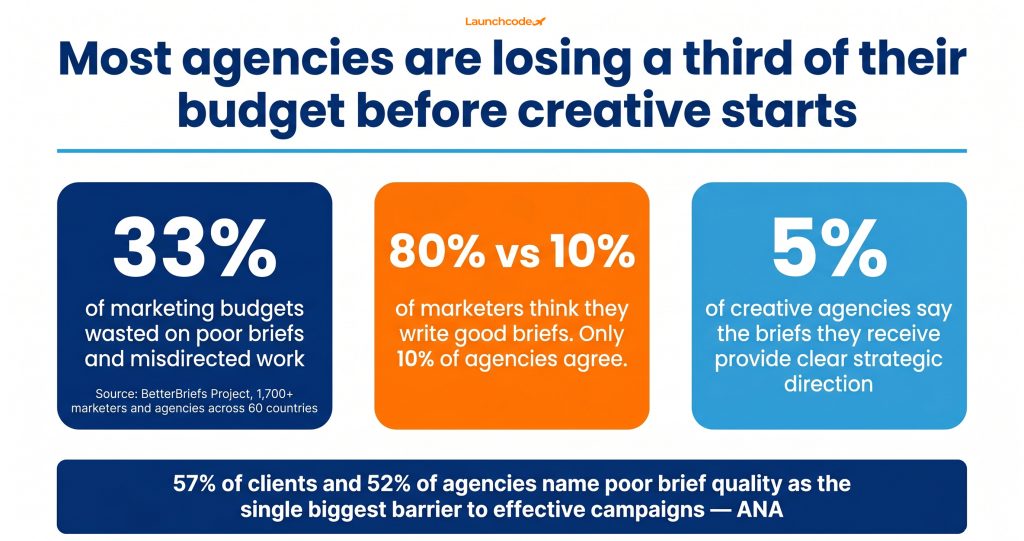
Most agencies treat the brief as paperwork. It is actually the document with the highest leverage over your ROAS. Research from the BetterBriefs Project, a global study of over 1,700 marketers and agencies across 60 countries, found that an estimated 33% of marketing budgets are wasted on poor briefs and misdirected work. For an agency managing $500,000 in client ad spend, that figure represents $165,000 in budget that produces nothing.
The perceptual gap makes the problem worse. In the same study, 80% of marketers said they write good briefs. Only 10% of agencies agreed. And only 5% of agencies said the briefs they receive provide clear strategic direction.
Poor creative briefs are also the most frequently cited roadblock to effective campaigns. The ANA found that 57% of clients and 52% of agencies name brief quality as the single biggest barrier to strong creative output, ranking it above working relationships and consumer insights. Gartner’s 2024 Marketing Technology Survey reinforced this, with 56% of CMOs citing poor briefing and feedback loops as top barriers to marketing effectiveness.
On the production side, the damage shows up in revision cycles. The BetterBriefs follow-up research found agencies averaging five rounds of rework per concept. That erodes margin, delays launches, and pushes creative teams toward safer, blander work. A structured brief template removes most of that friction before a single frame is shot.
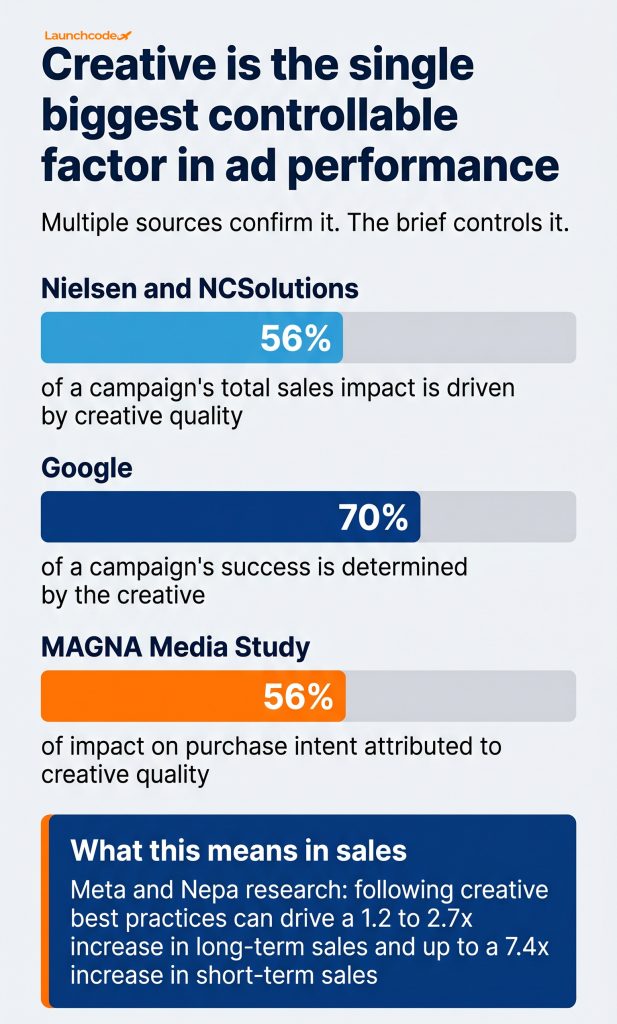
The brief matters because creative matters, and creative matters more than almost anything else in paid advertising. According to Nielsen and NCSolutions research, creative quality drives 56% of a campaign’s total sales impact, making it the dominant variable in ad performance. Google puts the figure even higher, reporting that creative determines 70% of a campaign’s success.
Meta’s own research with global market research firm Nepa confirmed that following creative best practices can drive a 1.2 to 2.7-times increase in long-term sales and up to a 7.4-times increase in short-term sales.
If creative is the primary driver of performance, the document that directs creative production is a revenue document.
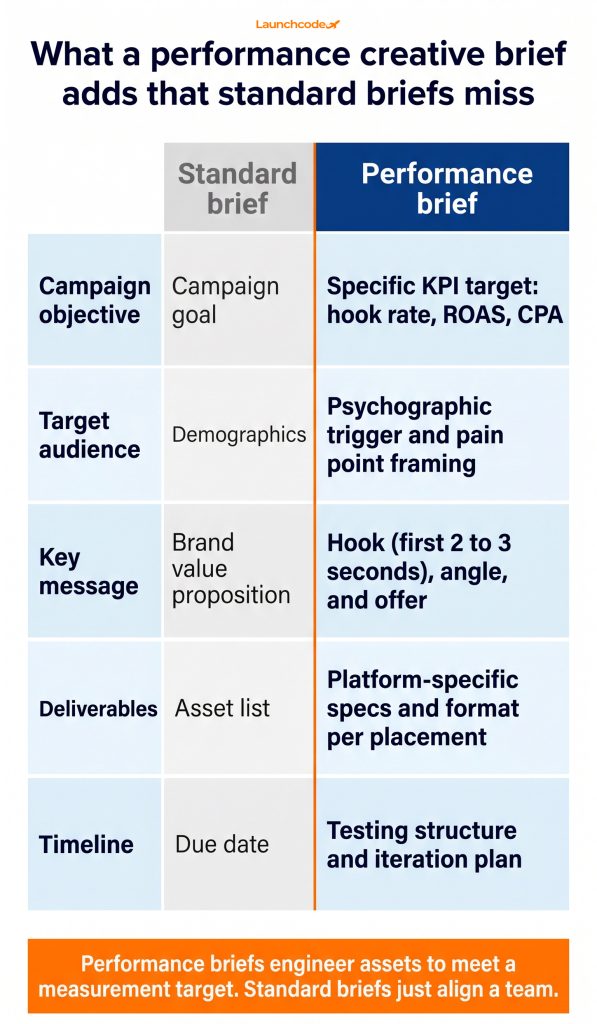
A standard creative brief aligns a team around a campaign. A performance creative brief engineers an asset to meet a specific measurement target. A standard brief might specify that a video should feel energetic and target women aged 25 to 34. A performance brief specifies hook timing, the emotional angle driving the open, the offer framing, the platform placement, the production quality floor, and the exact success benchmarks the asset will be measured against.
Most competing guides conflate the two. They describe how to write a creative brief and call it performance marketing. The fields they list, such as campaign objective, audience, key message, and deliverables, are correct but incomplete for paid social and paid search.
Here is what standard briefs omit and performance briefs require:
| Standard brief field | Performance brief addition |
|---|---|
| Campaign objective | Specific KPI target (hook rate, ROAS, CPA) |
| Target audience | Psychographic trigger and pain point framing |
| Key message | Hook (first 2 to 3 seconds), angle, and offer |
| Deliverables | Platform-specific specs and format per placement |
| Timeline | Testing structure and iteration plan |
Meta’s Andromeda AI system, rolled out globally in October 2025, changed how ads are distributed. The platform now matches creative to audiences using engagement signals rather than manual targeting. As growth expert Amanda Berg noted: “Your creative is now your targeting on Meta. It’s the job of your ad content to attract the right users out of that broad audience pool.”
This shift has a direct operational implication. Meta now recommends 10 to 20 unique creative concepts per campaign. The old standard was 3 to 5. Without a structured brief that enables fast, consistent production, agencies cannot hit that volume without quality dropping.
A performance creative brief is the only way to run a creative operation at the volume modern paid social requires.
A performance creative brief covers nine core areas: campaign objective, success metrics, audience profile, creative angle, hook direction, offer and CTA, brand and tone guidelines, platform and placement specs, and production references. Each field has a specific job. When one is missing, the creative team fills the gap with guesswork, and guesswork produces revisions.
Here is a field-by-field breakdown.
State the single business outcome this creative must support. Not “drive awareness.” Instead: “Generate direct response purchases at a CPA of $40 or below on Meta Advantage+ campaigns.”
Every other field in the brief connects back to this objective. If the objective is vague, the brief is vague.
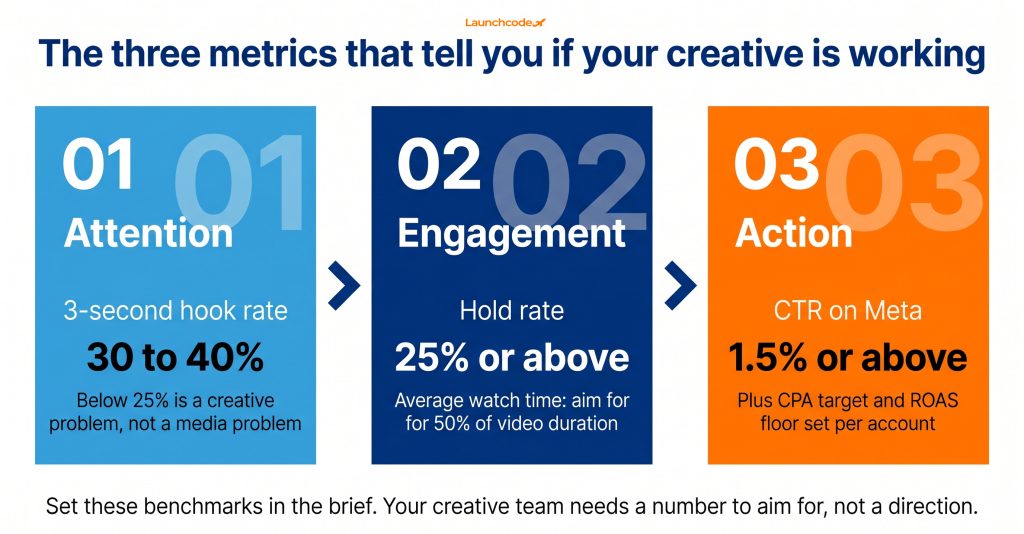
List the specific numbers that define a winning asset. Use the full three-stage creative performance framework tracked across Motion’s performance benchmarks:
Giving your creative team these benchmarks removes ambiguity. They know what a passing asset looks like before they start.
Go beyond demographics. As Stephanie Fierman, EVP at the Association of National Advertisers, stated in the ANA’s Better Creative Briefs research: “Demographics fail to capture the complexity of a market. You need to really target the emotional tribe you’re going after.”
Write this field in two parts:
Weak audience entry: “Women, 30 to 45, interested in fitness.”
Strong audience entry: “Women, 30 to 45, who have tried multiple fitness apps and failed to stay consistent. Core fear: they invest time and money but see no visible results. The ad speaks directly to that frustration.”
The angle is the strategic reason an ad converts. It is not the hook and not the offer. The angle is the emotional or logical lever underneath the ad.
Common performance angles:
One brief, one angle. Testing happens across briefs, not within them.
The hook covers the first 2 to 3 seconds of a video or the headline of a static. It determines whether the viewer scrolls past or keeps watching. It is the highest-leverage creative decision in paid social.
Specify the hook type and write a draft. Common types:
The brief should also note whether the hook will be text overlay, spoken audio, or both, and describe the visual composition of the first frame.
State the offer clearly: what the audience gets, at what price or commitment level, and what action they take next. The CTA must match the funnel stage.
Weak: “Learn more.” Strong: “Book a free 30-minute growth audit. No sales pitch.”
Link to or summarize the brand style guide. Include colors, fonts, logo usage, and approved messaging. Add a one-sentence tone description: “Confident and direct. No softening language. No corporate jargon.”
Include technical specs for every placement the creative will run in.
| Platform | Placement | Aspect ratio | Max video length | Copy limit |
|---|---|---|---|---|
| Meta | Feed | 1:1 or 4:5 | 30 seconds | 125 characters |
| Meta | Reels | 9:16 | 60 seconds | 125 characters |
| TikTok | In-feed | 9:16 | 60 seconds | 150 characters |
| Performance Max | Multiple | 6 to 60 seconds | 30 or 90 characters | |
| YouTube | Skippable in-stream | 16:9 | 15 to 30 seconds | 70 characters |
Leaving specs out of the brief is one of the most common causes of rework in production. Do not make designers guess.
Attach two to four example ads that show the tone, format, or style you are aiming for. References can come from competitor ad libraries such as Meta Ads Library or TikTok Creative Center, the client’s swipe file, or your agency’s library of winning assets. References eliminate interpretation errors faster than any written description.
Hook, angle, and offer are the three highest-impact fields in a performance creative brief. They are also the three most commonly left blank, vague, or collapsed into a single “key message” field that gives the creative team nothing to work with. Separating them forces clear thinking before production starts and gives every team member a specific job.
The angle answers: why should this person care? The hook answers: what do they see or hear in the first three seconds?
An ad targeting overwhelmed founders with a fear-of-missing-out angle could open with a dozen different hooks: a scroll-stopping statistic, a creator speaking to camera, a before-and-after visual, or a bold text overlay. The angle stays consistent. The hook is a production decision that belongs in the brief.
When teams write “key message” and fill it with the brand’s value proposition, they leave both decisions undefined. The designer picks a hook based on preference. The editor picks a visual style based on habit. The result is an ad that expresses the brand but does not stop the scroll.
“The hook is not your headline. It is the moment your ad earns the next three seconds. Most briefs I see collapse this into a tagline and call it done. That is where performance dies.” Georgia Callahan, Executive Creative Director
Most briefs state the product or service. A performance brief states the offer: what the audience gets, from whom, under what conditions, and what they do next.
For a B2B SaaS company, the product is software. The offer might be “a 14-day free trial with full feature access and a dedicated onboarding call.” The CTA is “Start your free trial.” These are different things, and both need to be in the brief. When the offer is missing, creative teams default to promoting the product, which rarely converts as well as promoting a specific, low-risk action.
A performance creative brief is not just a production document. It is a testing hypothesis. Every concept you brief is a bet: if this angle, hook, and offer reach this audience, they will convert at this rate. Treating the brief that way changes how you write it and how you organize creative production across a full month.
Meta’s Andromeda rollout means agencies now need to produce and test far more creative volume. Campaigns that previously ran 3 to 5 concepts now require 10 to 20. The business case for structured briefing is direct: a 10% improvement in creative performance delivers the same result as a 10% increase in media budget, without the added spend.
To brief for volume without losing quality, organize briefs into testing batches rather than single-asset documents.
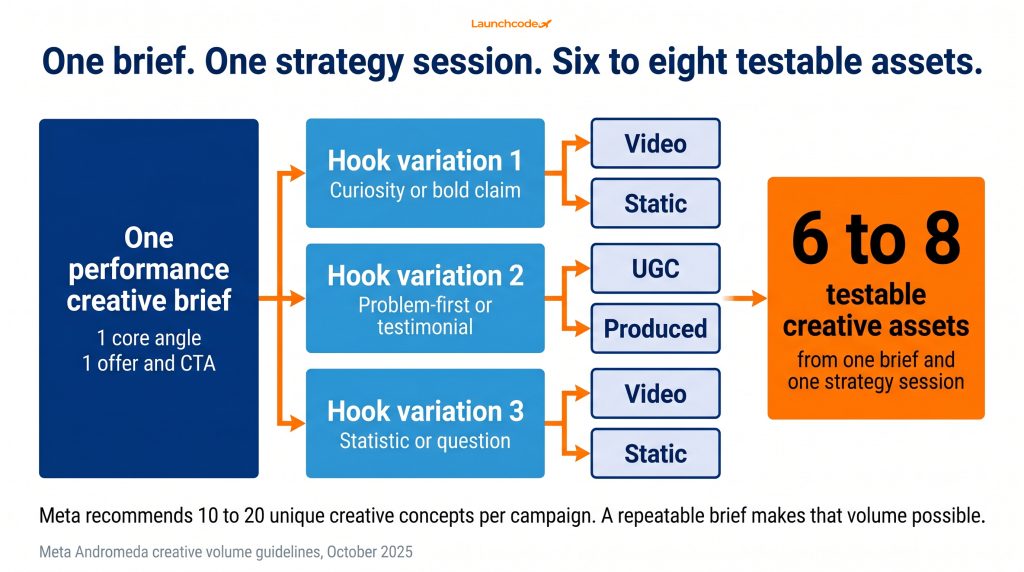
One testing batch covers:
This structure lets a creative team produce six to eight variations from a single strategy session. When results come in, you can isolate whether it was the angle, hook, or format that drove performance.
The brief should not end at production. Add a field that specifies what happens after the first performance review:
This field turns the brief from a one-way instruction document into a feedback loop. Over time, your agency builds a library of winning angles, hooks, and offers that inform every new brief you write.
The performance creative brief is owned by the creative strategist or media buyer on the account, not the client. Both parties must be involved, but the agency is responsible for translating client input into a testable creative hypothesis. When the client writes the brief alone, the result is almost always a description of what they sell, not a plan for what the audience needs to see.
The ANA’s research confirms that writing briefs collaboratively, with agency and client present, reduces revision cycles significantly. The agency must lead that conversation. It brings the platform knowledge, performance data, and creative testing experience the client rarely has.
“Most revision cycles we see trace back to one thing: the brief was never locked. The client thought it was directional. The team treated it as final. Setting that expectation upfront saves everyone three weeks.” Brittany Charles, SVP Client Services
Write the brief before any creative production begins. Many agencies start production based on a client email or verbal conversation and write the brief after the fact. That produces documentation but not direction.
The right sequence:
This sequence adds one step and removes four rounds of revision. When revision count drops below two, agencies see a measurable lift in both campaign speed and creative performance.
Below is the complete performance creative brief template. Every field gives designers, video editors, and UGC creators a specific answer before they open a project file. Copy it, adapt it to your agency’s tooling, and lock in the brief review step before production starts.
Campaign name: Brand: Date: Brief owner: Creative team:
What specific business outcome does this creative support?
Example: Generate direct response leads at a CPL of $35 or below on Meta Advantage+ campaigns.
| Metric | Target |
|---|---|
| Hook rate (3-second view rate) | 30 to 40% |
| Hold rate | 25% or above |
| CTR | 1.5% or above (Meta) |
| CPA | Set per account |
| ROAS floor | Set per account |
Demographics: Age range, platform, geography, income level if relevant.
Psychographic trigger: The specific fear, desire, or frustration this ad addresses. Write this in one to two sentences from the audience’s perspective.
What is the single emotional or logical lever this ad uses to drive conversion?
Choose one: Social proof / Transformation / Price framing / Authority / Urgency / Other
Describe the angle in one sentence. Example: “We show that business owners in this category are already solving this problem, creating social pressure and reducing skepticism.”
Hook type: Curiosity / Bold claim / Problem-first / Testimonial / Question / Statistic
Draft hook text: Write the opening line or text overlay.
Visual first frame: Describe what appears on screen in the first 2 to 3 seconds.
Hook delivery: Text overlay / Spoken / Both
Offer: What does the audience get, at what price or commitment level.
CTA copy: Exact words.
CTA destination: Landing page URL.
Funnel stage: Top of funnel / Mid-funnel / Retargeting.
Link to brand guide: URL or shared drive path.
Approved colors: HEX codes.
Approved fonts: Names.
Tone in one sentence. Example: “Direct and confident, never condescending. Short sentences. No corporate jargon.”
| Platform | Placement | Aspect ratio | Max length | Copy limit |
|---|---|---|---|---|
| Meta | Feed | 1:1 or 4:5 | 30 seconds | 125 characters |
| Meta | Reels | 9:16 | 60 seconds | 125 characters |
| TikTok | In-feed | 9:16 | 60 seconds | 150 characters |
| Add rows as needed |
Captions and subtitles required: Yes / No
Attach two to four reference ads that match the intended tone or format.
Reference 1: Link or file name. Reference 2: Link or file name.
Angle being tested: Describe the hypothesis.
Hook variations in this batch: List the planned hooks.
Format variations in this batch: Video / Static / UGC.
Kill metric: Example: Kill if hook rate falls below 25% after 2,000 impressions.
Iteration owner: Name.
The agencies scaling creative performance right now are not spending more on media. They are producing more testable creative, faster, from briefs that give every team member a specific job before a file opens.
The BetterBriefs Project research puts the global cost of poor briefs at over $200 billion in wasted ad spend annually. The solution is not a longer brief. It is a more specific one.
Start with the template above. Get the creative angle, hook direction, and success metrics right first. When a designer knows the angle, the hook, and the number the creative must hit, they are building toward a specific outcome rather than filling in blanks. As Pieter-Paul von Weiler of the BetterBriefs Project put it: “If the strategy is off, the brief is off, and everything that follows goes to shit.”
The brief is the first production decision you make on any campaign. Treat it that way.
For teams building this into a full paid media growth system, Launchcodex’s performance media service covers creative strategy, brief development, and testing frameworks as a connected workflow.
A performance creative brief is a structured document that gives designers, video editors, and UGC creators the information they need to produce paid ad assets measured by business outcomes such as ROAS, CPA, CTR, and hook rate. It differs from a standard creative brief by including specific fields for the hook, creative angle, offer details, platform specs, and success benchmarks.
A standard creative brief focuses on campaign goals, audience demographics, and brand messaging. A performance creative brief adds the fields that drive conversion: the creative angle, hook direction (the opening 2 to 3 seconds of the ad), specific KPI targets, platform placement specs, and a testing structure for iteration. Without these, creative teams fill the gaps with guesswork.
A complete performance creative brief includes: campaign objective, success metrics (hook rate, hold rate, CTR, CPA, ROAS), audience profile with psychographic trigger, creative angle, hook direction, offer and CTA details, brand and tone guidelines, platform and placement specs, production references, and a testing and iteration structure.
The creative strategist or media buyer on the account should own the brief. The client provides the campaign objective, offer details, and audience intel. The agency translates that input into a testable creative hypothesis. When the client writes the brief alone, it typically describes the product rather than the strategy needed to convert the audience.
After Meta’s Andromeda rollout in October 2025, Meta recommends 10 to 20 unique creative concepts per campaign, up from the previous standard of 3 to 5. Organize briefs into testing batches: one core angle, three hook variations, and two format variations. This structure produces six to eight testable assets from a single strategy session.
The hook is what appears or plays in the first 2 to 3 seconds of a video ad, or the headline of a static ad. It determines whether a viewer stops scrolling or keeps moving. A strong hook rate on Meta is 30 to 40%. Below 25% signals a creative problem, not a media buying problem. The brief should specify the hook type, a draft of the hook text, and the visual composition of the first frame.
A creative angle is the underlying emotional or logical lever an ad uses to drive conversion. It is distinct from the hook (how the ad opens) and the offer (what is being sold). Common performance angles include social proof, transformation, price framing, authority, and urgency. One brief covers one angle. Testing happens across multiple briefs, each with a different angle hypothesis.


Real stories from the people we’ve partnered with to modernize and grow their marketing.