Share:

AI marketing & automation


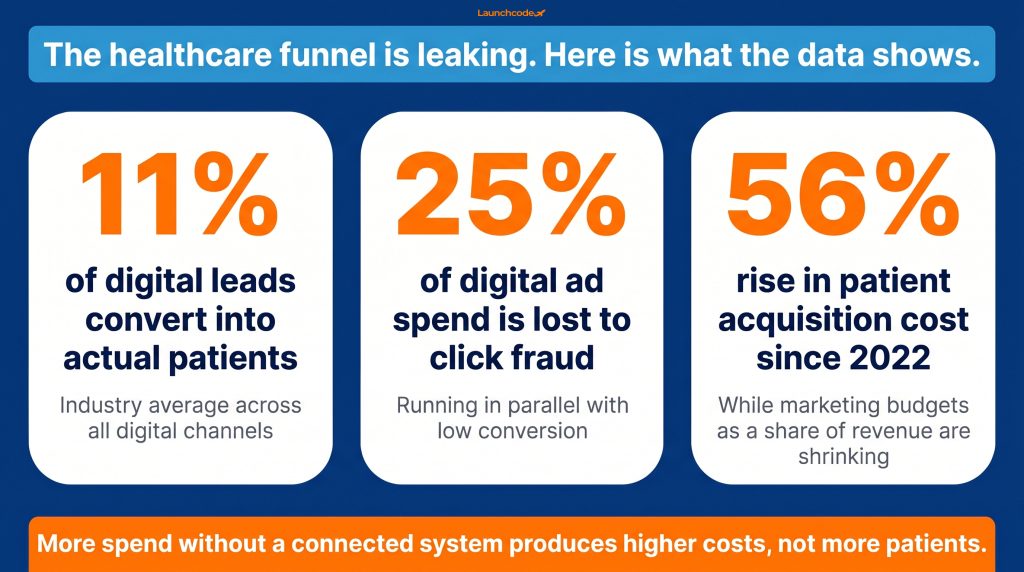
Healthcare systems are spending more on patient acquisition than at any point in history. Digital advertising spend across the industry reached $24.77 billion in 2025, a 13.3% year-over-year increase according to eMarketer. But more spending has not produced better results. Patient acquisition costs have risen roughly 56% since 2022, and most teams still cannot tell you which channel, campaign, or touchpoint actually produced a booked appointment.
This guide builds a complete picture of the patient acquisition funnel for health systems and multi-location groups. You will learn how each stage works, where volume most commonly leaks, how AI-powered discovery is reshaping the top of funnel, and how to measure the system in a way that satisfies both your marketing team and your CFO.
A patient acquisition funnel is the structured sequence of steps a prospective patient moves through before booking care. It starts the moment someone searches for a provider and ends, if the system is built correctly, with a retained patient who refers others. For health systems, the funnel is not a marketing metaphor. It is a revenue system with measurable stages, defined conversion rates, and identifiable failure points at every step.
Most organizations have pieces of a funnel but not a connected system. Paid ads drive traffic. A website exists. Reviews accumulate passively. Scheduling requires a phone call. Each piece runs in isolation, managed by different teams and measured by different tools. The result is a funnel that leaks volume at every stage, and nobody has enough visibility to fix it.
Research from Anzolo Medical puts a number on this problem: medical practices convert only 11% of inbound digital leads into actual patients, while simultaneously losing roughly 25% of their advertising budget to click fraud. That is not a channel problem. It is a system problem.
Most patient acquisition content is written for small clinics running Google Ads. Health systems operate at a fundamentally different scale. Multiple service lines, dozens of locations, complex referral networks, and strict compliance requirements all shape what a funnel can and cannot do.
At this scale, the funnel needs to be:
Physician referrals once anchored patient acquisition for most specialty groups and health systems. That model is structurally weakening. Referral-based acquisition dropped from 70% of new patients in 2020 to just 40% by late 2024, according to Anzolo Medical’s 2025 analytics benchmark report. The gap has to come from somewhere, and most organizations are filling it with digital spend without building the system to make that spend efficient.
This is not an argument against referrals. Referral patients still arrive with higher intent and lower acquisition cost than most digital sources. When organizations implement formal referral tracking and follow-up protocols, referral volume tends to increase by 20% to 30% according to the same research. The problem is that referrals alone cannot carry a growth target the way they did five years ago.
Health systems need a digital funnel that works, and they need a referral infrastructure that runs alongside it, not instead of it.
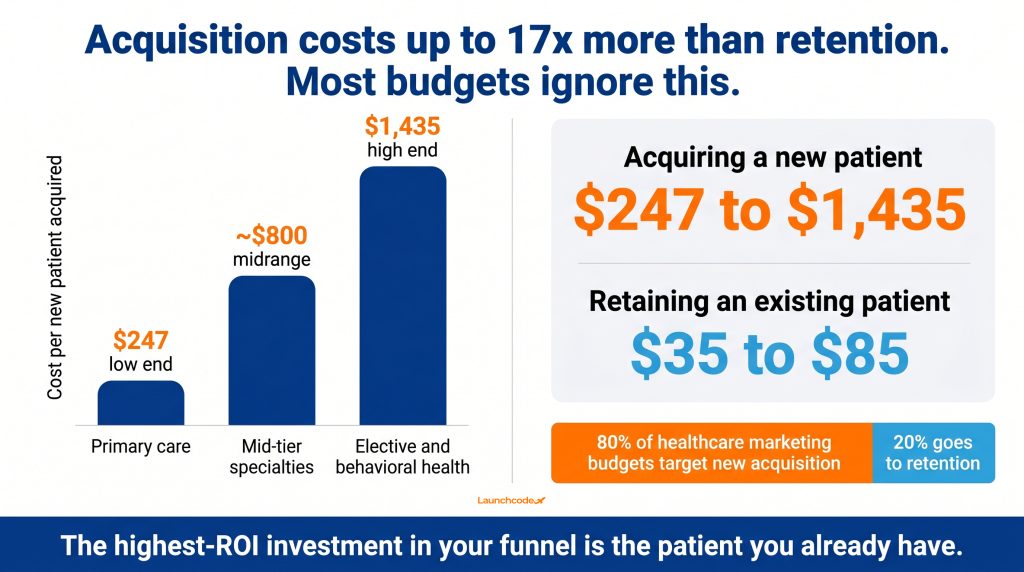
Patient acquisition cost varies significantly across specialty, location, and channel. The 2025 average cost per lead across all healthcare digital channels climbed to $53.53, while high-performing organizations achieved $30 per lead, according to Evokad’s healthcare marketing metrics report. The benchmark for a sustainable system is a 3:1 ratio of patient lifetime value to acquisition cost. Below 1:1, the organization loses money on every patient it acquires through marketing.
Most health systems are also misallocating spend in the wrong direction. Patient acquisition costs range from $247 to $1,435 per new patient depending on specialty, while retaining an existing patient costs only $35 to $85, according to Artisan Growth Strategies. Yet roughly 80% of healthcare marketing budgets target new patient acquisition. Retention and re-engagement remain largely underfunded despite delivering the highest return per dollar spent.
A modern patient acquisition funnel for a health system covers six stages: discovery, reputation, consideration, conversion, onboarding, and retention. Each stage has specific inputs, measurable outputs, and common failure modes. When one stage breaks, it creates pressure on every stage below it. Cost rises throughout, volume falls throughout, and no single tactic fixes it.
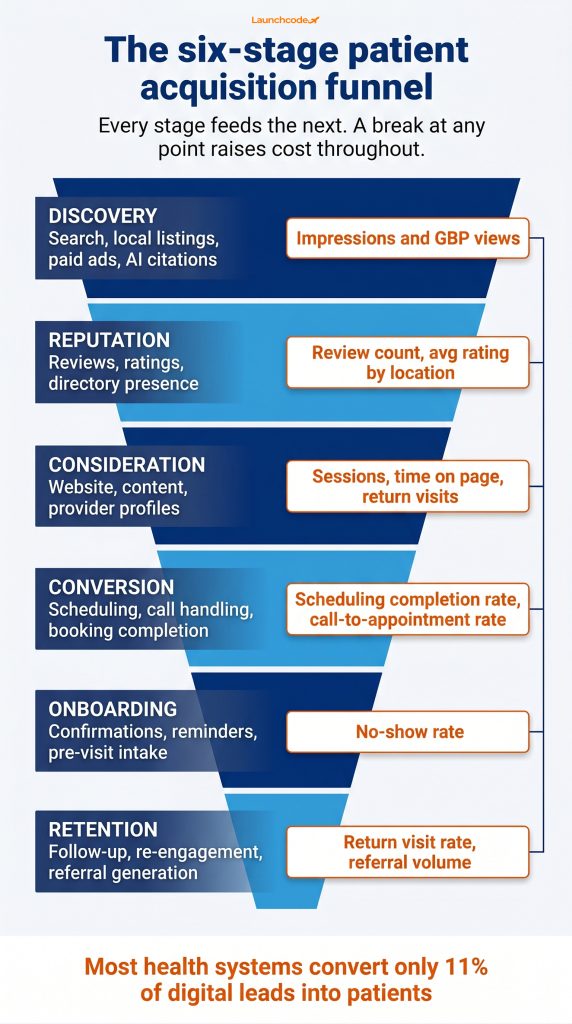
Each stage feeds the next. A strong discovery stage brings qualified traffic to your reputation check. A strong reputation converts that traffic into website visits. A clear consideration stage moves visitors toward scheduling. A frictionless conversion stage turns intent into booked appointments. Solid onboarding keeps those patients from canceling. And retention turns one visit into a long-term relationship and a referral source.
| Stage | What it covers | Key metric |
|---|---|---|
| Discovery | Search, local listings, paid ads, AI citations | Impressions, GBP views, ad reach |
| Reputation | Reviews, ratings, directory presence | Review count, average rating by location |
| Consideration | Website, content, provider profiles | Sessions, time on page, return visits |
| Conversion | Scheduling, call handling, booking completion | Scheduling completion rate, call-to-appointment rate |
| Onboarding | Confirmations, reminders, pre-visit intake | No-show rate |
| Retention | Follow-up, re-engagement, referral generation | Return visit rate, referral volume |
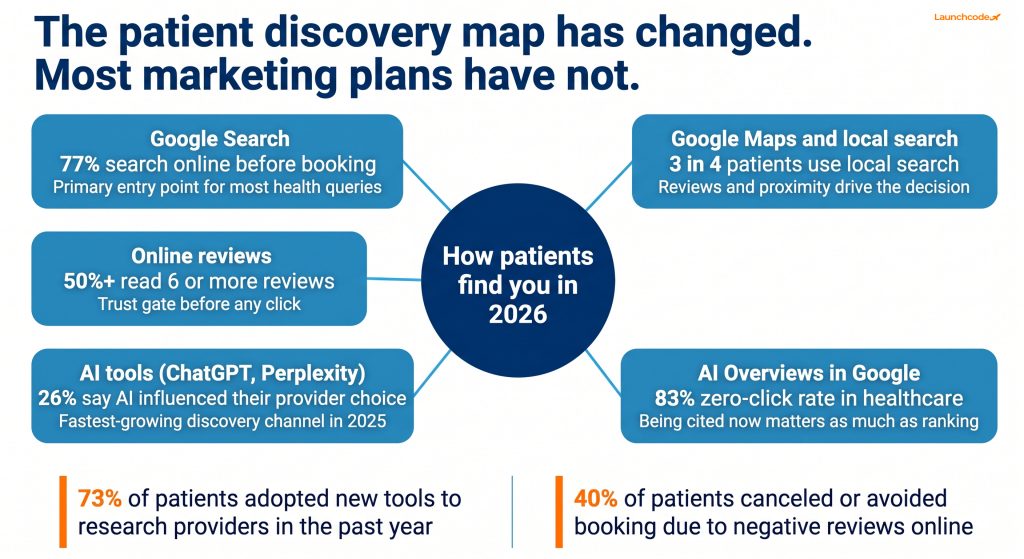
Discovery is where a patient first becomes aware of your organization. In 2026, this happens primarily through search. According to the 2025 Healthcare Marketing Benchmarks from InnerSpark Creative, 77% of patients search online before booking an appointment, and about three in four look specifically on Google Maps or local search.
The search environment has changed significantly. Healthcare now carries the highest zero-click rate of any sector measured. When Google AI Overviews appear on a healthcare query, 83% of searches end without a website click, according to Dataslayer’s 2025 analysis. Visibility inside AI-generated answers is now as important as ranking in traditional organic results.
Discovery inputs your system needs to manage:
Reputation functions as a gating stage. Patients who find your organization through search will check your reviews before taking any further action. A weak reputation stops the funnel before the website even loads.
The data is unambiguous. According to rater8’s 2025 patient behavior research, more than half of patients read at least six reviews before booking. For 40% of patients, a pattern of negative reviews will override a personal recommendation from a friend or family member. The economics follow reputation directly: two practices with identical ad budgets and market positions can see a 3x to 4x difference in patient acquisition cost based almost entirely on their Google Business Profile ratings.
Reputation inputs your system needs to manage:
Patients who pass the reputation check land on your website or service line content. This is where your organization needs to answer the questions still driving their search: Is this provider right for my condition? Do they accept my insurance? Can I get an appointment soon?
Content that performs in the consideration stage does specific work. It answers real patient questions in plain language. It features physicians and clinical staff because, as communications strategist Chris Rosica has noted, content featuring nurses and physicians builds more patient trust than polished production work. It demonstrates E-E-A-T, the Google quality framework covering experience, expertise, authoritativeness, and trustworthiness, which now functions as a threshold requirement for health content to rank at all.
Consideration content to build and maintain:
Conversion is where the funnel either works or fails. The patient is ready to book. Every additional step, form field, or hold time reduces the probability they complete it. Conversion in healthcare is not only digital. Phone conversion accounts for 39.2% of new patient bookings despite the broader shift toward digital, making it the most undertracked bottom-of-funnel stage in the industry.
Online scheduling needs to be:
Phone conversion requires equal investment. Calls that go unanswered, route incorrectly, or are mishandled by front desk staff are lost patients that your marketing spend already paid to generate. AI-powered call handling and attribution is closing this gap for health systems that have deployed it.
A booked appointment is not a converted patient until the patient shows up. No-show rates represent direct revenue loss and wasted acquisition spend. Automated reminders and pre-visit communication reduce no-show rates by approximately 25% to 30%, according to healthcare marketing benchmarks.
Onboarding stage essentials:
The funnel does not end at the visit. The retained patient is the most cost-efficient asset in the acquisition system. At $35 to $85 per patient for re-engagement versus several hundred dollars for initial acquisition, the post-visit relationship is the highest-ROI investment a health system can make.
Retention inputs:
AI is now part of how patients find providers, and it has moved faster than most marketing teams have adapted. By mid-2025, 26% of patients reported that AI tools influenced their provider selection, according to rater8’s research. The same report found that 73% of patients adopted new tools to research providers in the past year, including AI chatbots, voice assistants, and social platforms. This is the current behavior of roughly one in four patients.
GEO, or generative engine optimization, is the practice of structuring content so it appears cited inside AI-generated answers. In healthcare, this means appearing in Google AI Overviews, ChatGPT responses, and Perplexity answers when patients ask about conditions, symptoms, and local providers.
Organizations earning AI citations tend to share common characteristics:
Health systems relying solely on traditional blue-link SEO rankings are operating with incomplete visibility. The majority of high-intent healthcare search queries now trigger AI Overviews, and most of those end without a click to any website. Being listed is no longer enough. Being cited is the new standard.
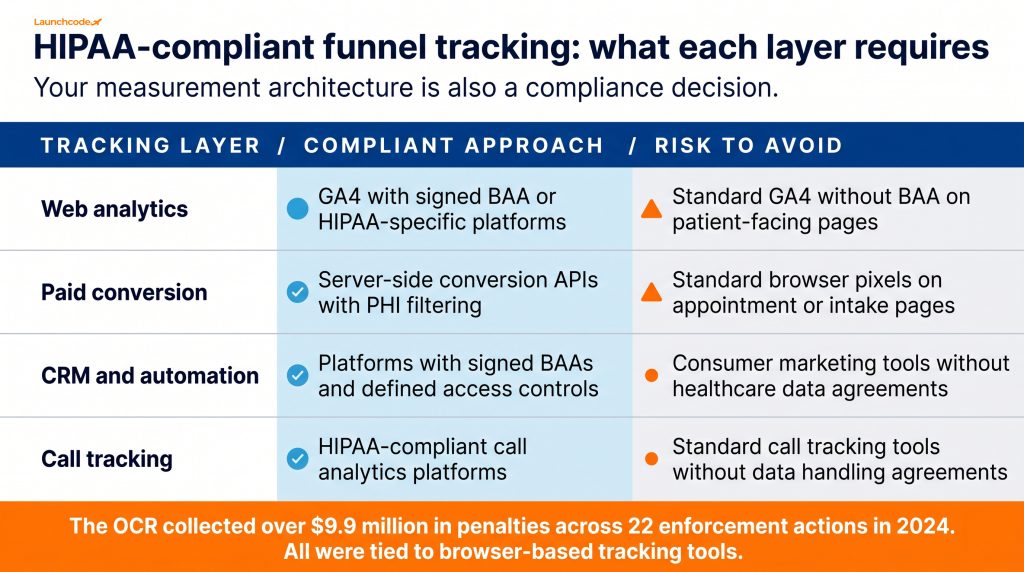
Every tool, pixel, and analytics platform in your marketing stack carries HIPAA risk if it touches patient data, and enforcement has sharpened considerably. The HHS Office for Civil Rights collected over $9.9 million in penalties across 22 enforcement actions in 2024, all tied to browser-based tracking tools on healthcare websites. These actions covered organizations using Google Analytics, Meta Pixel, and session replay software without Business Associate Agreements in place.
As OCR Director Melanie Fontes Rainer stated in official guidance: providers and HIPAA-regulated entities, including technology platforms, must consider the risks to patients’ health information when using tracking technologies. This is the active enforcement posture the agency has maintained through 2026, not a theoretical warning.
The consequence for funnel builders: every tool chosen for analytics, advertising, and automation must be evaluated for HIPAA compliance before deployment. This is not a legal team problem. It shapes which measurement approaches are available, which paid platforms can receive conversion data, and which automation tools can connect to patient workflows.
“The compliance stack is a product decision, not a legal one. Once you understand which tools can and cannot touch patient data, the rest of the measurement architecture follows from that constraint.” Derick Do, Co-Founder and Chief Product Officer, Launchcodex
| Layer | Compliant approach | Risk to avoid |
|---|---|---|
| Web analytics | GA4 with signed BAA or HIPAA-specific platforms | Standard GA4 without BAA on patient-facing pages |
| Paid conversion | Server-side conversion APIs with PHI filtering | Standard browser pixels on appointment or intake pages |
| CRM and automation | Platforms with signed BAAs and defined access controls | Consumer marketing tools without healthcare data agreements |
| Call tracking | HIPAA-compliant call analytics platforms | Standard call tracking tools without data handling agreements |
The March 2024 update to the HHS OCR tracking technologies guidance reinforced that liability extends to unauthenticated pages as well as logged-in patient portals. Even a general homepage or symptom information page can create compliance exposure if it captures IP address data alongside health-related interactions.
Note: HIPAA requirements in this area are active and evolving. Review current OCR guidance and consult legal counsel before modifying your tracking architecture.
Funnel measurement in healthcare requires tracking at each stage, not just at the bottom. Traffic, reviews, calls, appointment completions, no-show rate, and patient lifetime value are all part of the measurement picture. If you only track new patient volume, you cannot identify which stage is underperforming or why acquisition costs are rising.
Attribution is genuinely difficult in healthcare. The tools that make attribution straightforward in other industries carry PHI risk here. Server-side tracking, offline conversion imports tied to appointment data, and HIPAA-compliant call analytics platforms are the architecture most health systems need to build around.
Operating without attribution means making budget decisions on guesswork. A health system cannot optimize spend across channels it cannot measure. The measurement system must be built before scaling any paid channel.
Referrals are not dead. They are unmeasured. The organizations reporting 20% to 30% increases in referral volume after building formal referral systems are applying the same discipline digital marketers apply to paid channels: tracking inputs, responding to signals, and optimizing for throughput.
A referral system inside a modern health system funnel has three components:
Telehealth is also reshaping the referral and acquisition model. Organizations that use telehealth as a funnel entry point, rather than a separate service line, are seeing acquisition costs 30% to 45% lower than competitors treating virtual care as a distinct product, according to Emulent’s healthcare marketing projections report. A telehealth visit becomes a low-friction first touchpoint that converts naturally to in-person care.
The fastest way to find where your funnel is losing volume is to map patient counts at each stage and calculate the conversion rate between them. The stage with the largest drop-off is the highest-priority fix. Most organizations find the gap at conversion, where lead-to-appointment rates sit around 11%, or at discovery, where local search visibility is inconsistent across locations.
“The audit almost always surfaces the same finding: the conversion stage is bleeding volume, and nobody realized it because the team was only watching top-of-funnel numbers.” Tanner Medina, Co-Founder and Chief Growth Officer, Launchcodex
At Launchcodex, this audit runs before building any healthcare marketing program. The drop-off analysis tells us where to invest first and gives leadership a clear view of where the current system is losing value before any new spend goes in.
Building a patient acquisition funnel as a revenue system changes what health systems can actually control and predict. Every stage has a conversion rate. Every rate has a benchmark. Every gap between current performance and benchmark is a calculable revenue opportunity with a specific fix.
The organizations gaining ground in 2026 are not the ones spending the most on paid media. They are the ones with accurate attribution, consistent local reputation, structured content that earns AI citations, compliant tracking infrastructure, and scheduling experiences that do not lose patients at the final step.
The funnel framework in this guide gives health systems a starting point for each stage. The audit process gives a way to prioritize where to invest first. The metrics section gives the measurement layer to confirm what is working.
The next step is identifying which stage is leaking the most volume and building the system from there.
A patient acquisition funnel is the structured set of stages a prospective patient moves through from initial awareness to booked and retained care. For health systems, a functional funnel connects discovery, reputation, consideration, conversion, onboarding, and retention into a single measurable revenue system.
Costs vary significantly by specialty and channel. Across all digital channels, the 2024 average cost per lead was $286, and the 2025 average climbed to $53.53 per lead. Per-patient acquisition costs range from a few hundred dollars for primary care to over $1,000 for elective specialties. The sustainable benchmark is a 3:1 ratio of patient lifetime value to acquisition cost.
Both tools carry HIPAA risk when used on patient-facing pages without a Business Associate Agreement in place. HHS OCR guidance, updated in March 2024 and actively enforced through 2026, makes clear that standard tracking pixels can constitute a HIPAA violation even on unauthenticated pages. Healthcare organizations should use HIPAA-compliant analytics alternatives or obtain a signed BAA from any third-party vendor that processes web data.
Reviews now function as a gating stage in the funnel. More than half of patients read at least six reviews before booking. A pattern of negative reviews will cause 40% of patients to cancel or avoid booking even after a personal recommendation. A one-star improvement in a hospital’s average rating is associated with a 5% to 9% revenue increase, according to healthcare industry data from Guaranteed Removals and Press Ganey.
Generative engine optimization is the practice of structuring content so it appears cited inside AI-generated search answers. Healthcare has the highest zero-click rate of any sector when Google AI Overviews appear. Health systems that optimize for AI citation alongside traditional SEO maintain discovery visibility in a search environment where most high-intent queries no longer result in a website click.
Map a measurable metric to each stage: search impressions for discovery, review count and rating for reputation, website sessions for consideration, scheduling completion rate and call-to-appointment rate for conversion, no-show rate for onboarding, and return visit rate for retention. Calculate conversion rates between stages and compare against benchmarks. The stage with the largest drop-off is your highest-priority fix.


Real stories from the people we’ve partnered with to modernize and grow their marketing.