
Share:

AI marketing & automation


Most SEO conversations focus on ranking number one. But there is a position above rank one, and it is available to any page already on Google’s first page, regardless of domain authority or ad budget. That position is called position zero, and the brands that own it control the first impression in search.
This article explains exactly what position zero is, why it matters as AI Overviews and zero-click behavior reshape how users interact with search, and gives you a step-by-step process to win it. By the end, you will have a clear framework for identifying opportunities, restructuring content, and tracking results.
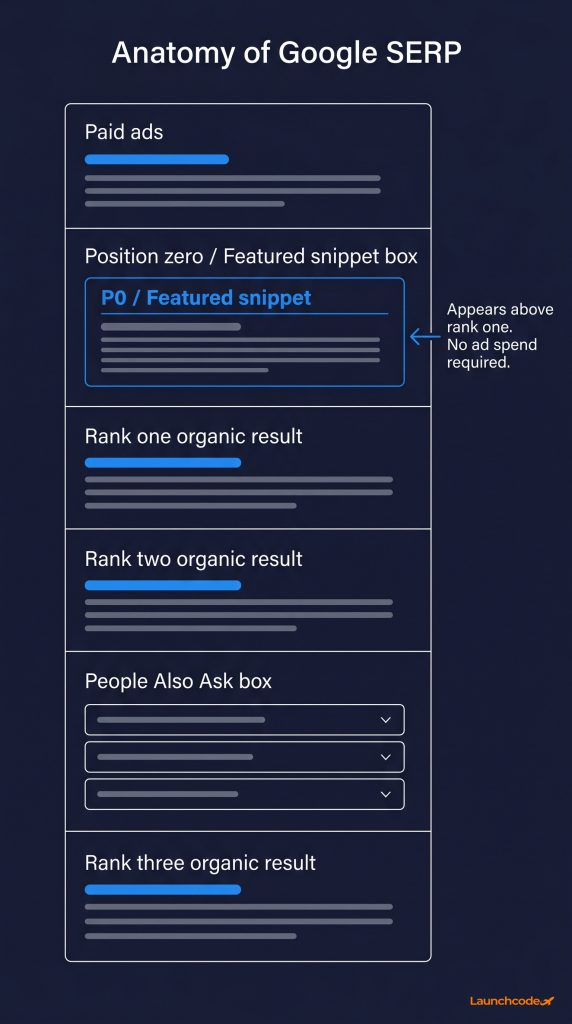
Position zero (P0) refers to the featured snippet box at the top of a Google search results page. It appears below any paid ads and above the first organic result. Google automatically pulls content from an indexed page, displays it in a formatted block, and attributes it to the source URL. It can appear as a paragraph, list, table, or video clip, depending on what best answers the query.
The featured snippet format has been part of Google Search since 2014. The nickname “position zero” came from the SEO community after it became clear that the snippet box sits in a visually distinct position above the traditional rank-one result. For the user, it means an instant answer. For the brand behind it, it means the first thing anyone sees when searching that topic is your content.
Google selects snippet content algorithmically. There is no opt-in, no ad spend, and no application. The algorithm scans pages already ranking on the first page, identifies passages that directly answer the query, and formats them as a snippet. Structure, clarity, and intent alignment are the deciding factors.
Not every search produces a featured snippet. Google tends to surface them for informational queries, especially ones that start with who, what, when, where, why, and how. Definition questions, process explanations, and comparison queries are the most common triggers.
Shopping queries, branded navigational searches, and purely local queries rarely trigger snippets. If someone searches “best CRM software pricing,” they are more likely to see a product carousel or ad units than a snippet. If someone searches “what is a CRM?” they almost certainly will see one.
Google’s AI Overviews reduce the organic click-through rate for position-one content by 58%, according to Ahrefs research published in December 2025. That makes the featured snippet box the most defensible territory on the results page. When you own the snippet, your content is visible before AI Overviews push organic links below the fold. The content that wins featured snippets is frequently the same content cited inside AI Overviews.
Ryan Law, Director of Content Marketing at Ahrefs, confirmed this in research on AI Overviews and organic CTR. The data is clear. Position one is being eroded by features that sit above it. The only sustainable response is to own those features rather than rank below them.
There is also the zero-click reality. According to SparkToro and Similarweb data, featured snippets in first position earn a 42.9% click-through rate, which is higher than the 39.8% CTR of a standard first organic result. Snippets do not suppress clicks as much as many assume. They filter for high-intent readers who want to learn more.
“Most clients we audit have page-one rankings they never converted into snippet positions. The gap between ranking and owning the answer box is almost always a formatting problem, not an authority problem.” Tanner Medina, Co-Founder & Chief Growth Officer
Snippet positions are not neutral. When a competitor owns the featured snippet for a category query in your space, every user who searches that term sees the competitor’s answer first. That is brand impression, authority signal, and awareness touchpoint all handed to someone else. Losing a snippet to a competitor is not a passive outcome. It is an active transfer of visibility.
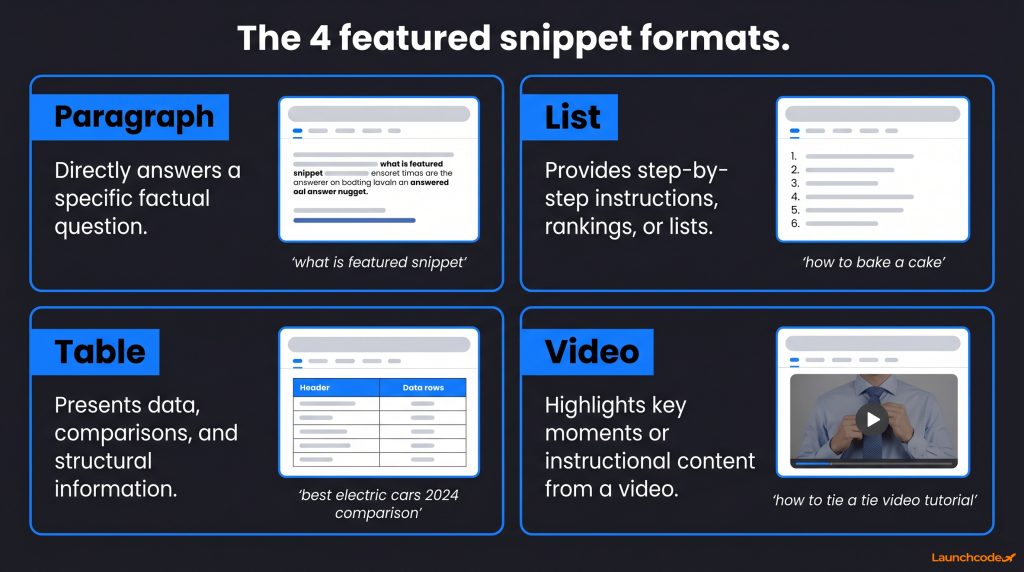
Google uses four main snippet formats: paragraph, list, table, and video. Each format maps to a different query type and requires a different content structure. Paragraph snippets are the most common by a wide margin, making up 70% of all featured snippets. Knowing which format a query typically triggers tells you exactly how to structure your content before you write a word.
Paragraph snippets answer definition and explanation queries. They are a single block of text, typically 40 to 60 words, pulled directly from a page. Semrush data shows the average definition snippet lands in that range. These are the easiest to target because the format is predictable and the optimization is clear: write a tight, direct answer under a question-based heading.
Example query type: “What is a conversion rate?” or “How does retargeting work?”
List snippets appear for how-to, step-based, and ranking queries. Google extracts either an ordered list (numbered steps) or an unordered list (bullets) from a page’s HTML. The heading for the list matters. Google reads the H2 or H3 above the list to understand what the list is answering.
Example query type: “How to improve page speed” or “Benefits of email segmentation“
Table snippets pull rows and columns from a properly marked-up HTML table. They are most common for comparison queries and data queries involving pricing, specifications, or schedules. For a table to be extracted cleanly, it needs proper <table>, <thead>, and <th> tags. A simple prose table will not perform as well as semantic HTML markup.
Example query type: “SEO vs SEM comparison” or “Email marketing open rates by industry”
Google surfaces video snippets when a query is best answered visually, such as a tutorial, demonstration, or step-by-step process. These are most often pulled from YouTube. The video title, description, and timestamp markers all influence whether Google selects a specific clip.
Example query type: “How to set up Google Tag Manager” or “How to fix a 404 error”
Start with pages already ranking in Google’s top ten. Those are the only pages eligible for a featured snippet. From that set, filter for queries that already trigger a snippet in the SERP and where your page is not the one Google has selected. That gap is your opportunity list. Tools like Semrush Position Tracking, Ahrefs Rank Tracker, and Google Search Console all surface this data without requiring manual SERP reviews.
Open Search Console and go to the Search Results report. Filter for queries with an average position between one and ten. Look for queries that include question words or process language. Those are the highest-probability snippet triggers. Export the list and cross-reference it against your page’s content structure.
If your page ranks in position three for “how to build a landing page” but the snippet belongs to a competitor, that is a direct optimization target. You already have the authority signal. You need to restructure the answer.
Semrush’s Featured Snippets tab in Position Tracking shows three categories:
Ahrefs Rank Tracker flags which of your tracked keywords produce snippets and which page currently holds them. Both tools let you filter by snippet type so you can prioritize paragraph targets first, which are the easiest wins for most content teams.
AnswerThePublic and AlsoAsked map the full question territory around a keyword. They pull from Google Suggest and the People Also Ask feature, giving you a list of actual user questions organized by intent. Each of those questions is a potential snippet target if you already have, or can build, a page that ranks for it.
The mechanics of snippet extraction are consistent across query types. Place a clear question as an H2 or H3 heading. Immediately below that heading, write a direct answer in 40 to 60 words. Use clean HTML structure throughout: <p> tags for paragraphs, <ol> or <ul> tags for lists, and <table> tags for comparisons. Articles with structured data appear as featured snippets 66% more often than unstructured content, and structured articles use an average of 14.5 heading tags.
Every snippet-ready section should lead with the answer, not build toward it. The inverted pyramid puts the most important information first, supporting detail second, and optional elaboration last.
Bad structure: Three paragraphs of context, then a definition buried at the bottom. Good structure: Definition in the first sentence. Supporting context in the next two to three sentences. Detail and examples in the rest of the section.
Google’s extraction algorithm rewards this structure because it mirrors how users scan content. The answer is immediately visible and easy to pull without surrounding noise.
Schema markup does not guarantee a snippet, but it improves eligibility significantly. FAQ schema (using JSON-LD) signals to Google that a section contains a question and its answer, making it a clean extraction target. HowTo schema marks up step-based content clearly. Article schema establishes the page’s context, author, and publication date, supporting EEAT signals.
For most content teams, FAQ schema is the highest-leverage starting point. It requires minimal technical work and directly marks up the question-and-answer pairs that drive paragraph snippets.
When a user asks Google Assistant, Siri, or Alexa a question, the device reads aloud the featured snippet from the top result. There is no visual list of options. There is one answer. Owning position zero means your brand is that answer. At the same time, the same content that wins traditional snippets is increasingly cited inside Google AI Overviews, which appeared in 13.14% of all U.S. desktop queries by March 2025, up 102% in two months.
Snippet-ready content has always been structured, direct, and intent-aligned. Those are exactly the properties that AI systems favor when generating summaries and selecting citations. Content optimized for P0 now functions as a feed for multiple answer layers: traditional snippets, AI Overviews, and voice responses.
This concern comes up often as AI Overviews expand. The answer is no, not for the query types that matter most to most businesses. For simple factual queries, definition queries, and how-to questions, Google continues to show traditional featured snippets because they are fast, direct, and require no AI processing. AI Overviews tend to appear for multi-source, complex questions where a single extracted answer is insufficient.
Google did cut featured snippets by approximately 35% between late 2024 and early 2025, according to recent SEO benchmarks. The snippets that remain are higher quality, more stable, and more valuable precisely because there are fewer of them. The bar is higher. The reward for clearing it is also higher.
Snippet strategy connects directly to generative engine optimization. At Launchcodex, we treat position zero optimization as a foundational layer of GEO work because the same structural principles apply across both. Clean structure, direct answers, schema markup, and entity-rich content perform well in traditional search and in AI-driven surfaces at the same time.
Snippet rankings are volatile. Google re-evaluates featured snippets constantly, and a page that holds P0 today may lose it within weeks if a competitor publishes a better-structured answer. Monitoring requires a consistent process: check snippet ownership weekly for high-priority queries, review CTR in Google Search Console monthly, and audit content formatting quarterly.
“When we take over an SEO engagement, one of the first things we check is whether a client’s competitors own snippet positions for the client’s core category queries. That is an immediate priority to address.” Brittany Charles, SVP, Client Services
| Tool | What it tracks | Best for |
|---|---|---|
| Google Search Console | Impressions, CTR, average position | Free baseline monitoring |
| Semrush Position Tracking | Snippet wins, losses, and gaps by keyword | Teams tracking competitive snippet coverage |
| Ahrefs Rank Tracker | Snippet type by keyword, competitor comparison | Deep competitive analysis |
| Moz Pro | Search visibility and zero-click patterns | Broader SERP share tracking |
If you lose a snippet, check the page that replaced you. Identify whether they changed the answer length, restructured the heading, added schema markup, or updated the data. In most cases, the fix is one of three things: tighten the answer to 40 to 60 words, restructure the heading to match the exact query phrasing, or update any figures that have become stale.
Snippets tied to statistics or industry data are especially volatile because any page with newer data can displace you. Set a calendar reminder to refresh data-heavy sections at least twice a year.
When your page holds both the featured snippet and the rank-one organic result, it appears twice on the same page. Research indicates this configuration produces a 20 to 30% increase in CTR compared to holding either position alone. That is the highest-value state in organic search. To reach and hold it, the page must satisfy both snippet criteria (structure, answer clarity) and traditional ranking criteria (authority, links, engagement).
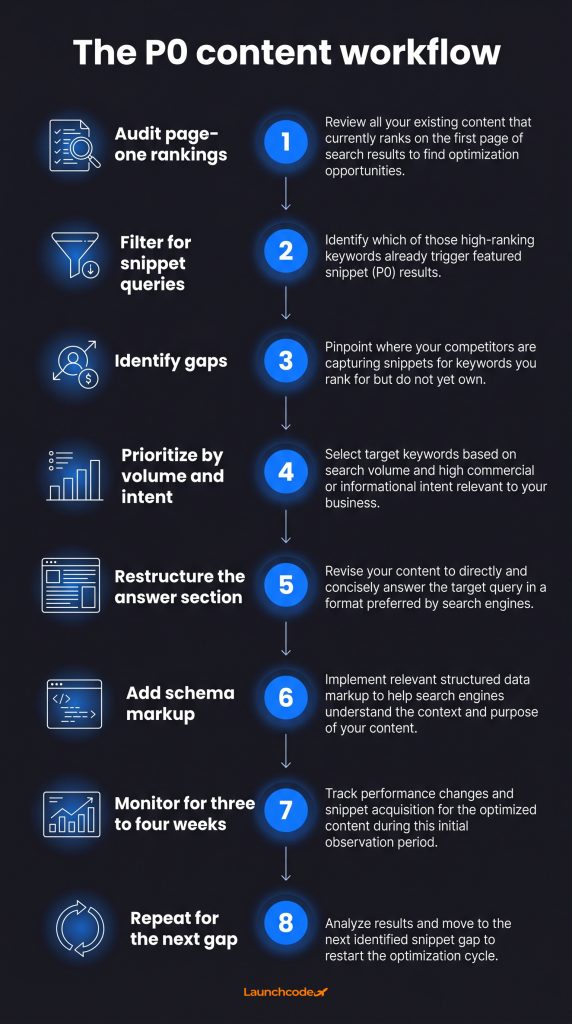
Winning one snippet is a tactic. Building a repeatable process is a strategy. The following framework applies across industries and content types.
This process works for content teams at any scale. It does not require enterprise tools or large budgets. It requires a clear audit, disciplined formatting, and consistent monitoring.
Position zero is the featured snippet box that appears at the top of a Google search results page, above all organic results and below paid ads. Google automatically pulls a short answer from an indexed page and displays it with the source URL. It comes in four formats: paragraph, list, table, and video.
Featured snippets in first position earn a 42.9% click-through rate, which is slightly higher than the 39.8% CTR of a standard rank-one organic result. They do not suppress traffic as much as commonly assumed. Users who want more detail after reading the snippet click through to the source page.
The ideal length is 40 to 60 words. Semrush data confirms this is the range Google extracts most consistently. Shorter answers lack enough context. Longer answers make it harder for Google to identify the clean extraction point.
No. You need to rank somewhere on the first page of results, typically in the top ten. Pages ranking in positions two through five often win the snippet box while a different page holds the rank-one organic result.
Yes. The content that wins featured snippets is frequently cited inside AI Overviews. Both features favor structured, direct, and entity-rich content. Optimizing for P0 improves your eligibility for traditional snippets and increases the likelihood your content is referenced in AI-generated summaries.
Google re-evaluates snippets roughly every two to four weeks. High-competition queries can change more frequently. Monitor weekly for priority keywords and set a quarterly content audit to refresh data, update statistics, and verify formatting still matches the current snippet format in the SERP.


Real stories from the people we’ve partnered with to modernize and grow their marketing.