


Link building guide: How to earn authority that moves rankings
Learn which link building tactics move rankings in 2026. Covers digital PR, HARO, linkable assets, anchor text strategy, and...


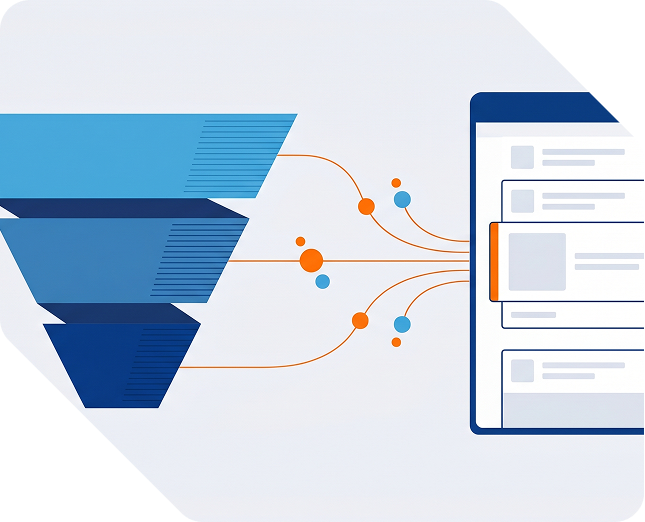


Most B2B marketing teams either skip Facebook entirely or run boosted posts and wonder why the sales team is not celebrating. The platform looks like a consumer venue. LinkedIn feels like the obvious professional channel. And yet, 70% of B2B buyers use Facebook to research vendors before making a purchase decision, and the average B2B conversion rate on Meta sits above the platform average for every industry combined.
The gap between teams that generate real pipeline from Facebook and teams that generate engagement reports comes down to structure. This article covers the five decisions that separate them: tracking foundation, audience strategy, funnel architecture, creative approach, and measurement. Get these right and Facebook becomes one of the most cost-efficient channels in your B2B stack.
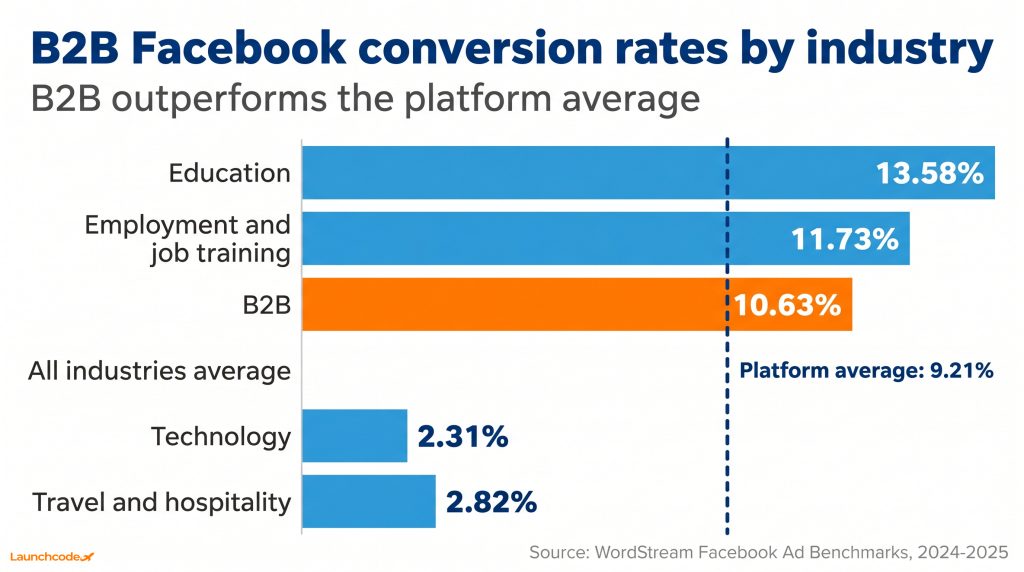
Facebook reaches more than 3 billion monthly active users and sits as the third most visited website globally, behind only Google and YouTube. For B2B, the numbers are more specific than most teams realize. According to B2B Facebook ad benchmark data from WordStream, the average conversion rate for B2B campaigns is 10.63%, above the all-industry platform average of 9.21%. The platform delivers. Most B2B campaigns are just not structured to capture that performance.
Ready to grow your organic traffic?
Get a free SEO audit from the Launchcodex team.
The common objection is that Facebook is where people go to watch videos, not buy enterprise software. That objection misses how B2B buyers actually behave. They are not in buyer mode exclusively on LinkedIn. They scroll Facebook during lunch, on their phones between meetings, and at home in the evenings. Research happens everywhere.
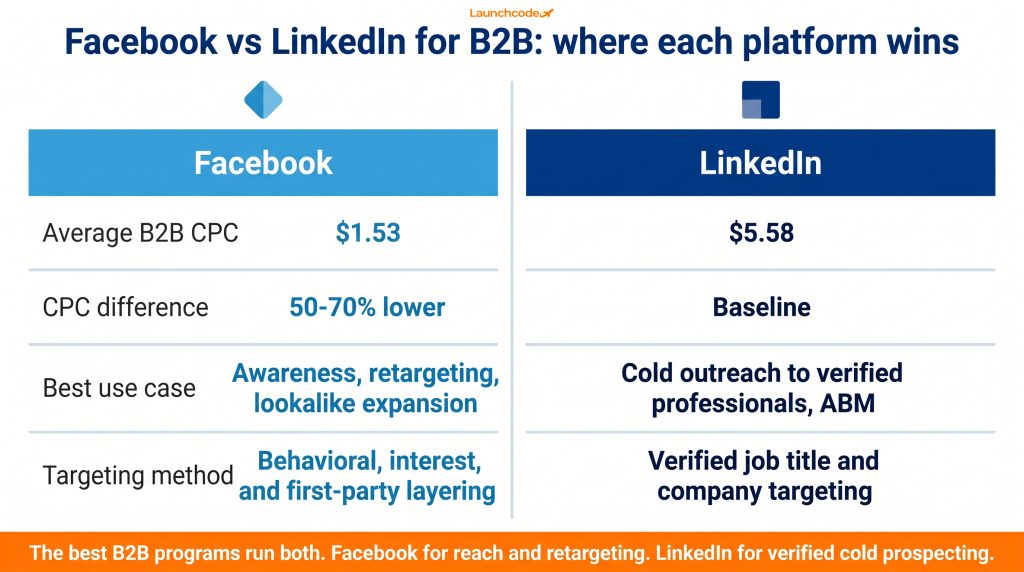
74% of B2B decision-makers spend more time on Facebook than the average user. That statistic argues for presence. Combined with Facebook CPCs that run roughly $1.53 for B2B campaigns versus $5.58 on LinkedIn, the economics of Facebook for awareness, retargeting, and lower-funnel nurture are difficult to ignore.
Neither platform replaces the other. They serve different moments in a long B2B buying cycle.
| Platform | Best use case | Key strength | Limitation |
|---|---|---|---|
| Awareness, retargeting, lookalike expansion | Low CPM and CPC, massive reach, strong AI optimization | Job title targeting is less verified than LinkedIn | |
| Cold outreach to verified professionals, ABM | Job title and company targeting, professional context | CPC 3-4x higher, smaller audience pool |
The best B2B programs run both. Facebook builds awareness and re-engages warm audiences at low cost. LinkedIn handles precise cold prospecting at premium CPCs when verified targeting justifies the spend. 28% of B2B content marketers already say Facebook delivers the best value of any channel outside LinkedIn. That number continues to grow as more teams test the pairing.
Before running a single B2B campaign, install both the Meta Pixel and the Conversions API. The Pixel captures browser-side behavior. The Conversions API sends server-side event data directly to Meta, bypassing browser restrictions from Apple's App Tracking Transparency framework and cookie blockers. Without both layers active, Meta's algorithm operates on incomplete data, optimization degrades, and attribution becomes unreliable.
This step gets skipped more often than any other in B2B Facebook setup. Teams launch campaigns, see inconsistent results, and blame the platform. The actual problem is usually measurement. If Meta cannot see what happens after a click, it cannot optimize delivery toward people who convert.
"The campaigns we see fail most often have not validated their tracking before launch. By the time the client notices results are off, weeks of spend are already gone." Brittany Charles, SVP, Client Services
Meta's algorithm requires approximately 50 conversion events per week, per ad set, to exit the learning phase. For most B2B campaigns with small audiences and long sales cycles, hitting that threshold is genuinely difficult. The fix is to optimize for higher-volume micro-conversions first, such as a content download or webinar registration, then layer bottom-funnel campaigns on top once the algorithm has enough signal.
One example of why this matters: a B2B SaaS company that tracked webinar registrations as a conversion event found that webinar attendees converted into paying customers at eight times the rate of general leads. Shifting campaign optimization toward that signal dropped their customer acquisition cost significantly. Without clean tracking, that insight never surfaces.
Facebook does not offer verified job title targeting the way LinkedIn does. B2B audience building on Meta requires layering. Combine Meta's "Business Decision Makers" behavioral segment with relevant job-title interest categories, high-income demographics, and industry filters to narrow the pool toward professional buyers. Then stack that with your own first-party data through Custom Audiences to give the algorithm a signal it can learn from.
Targeting precision is what separates B2B campaigns that generate qualified leads from campaigns that generate volume with no downstream value. Broad targeting on Facebook finds people. Layered targeting finds the right people.
Custom Audiences are built from data you already own. Upload your CRM contacts, create audiences from website visitors who viewed pricing or demo pages, and build segments from people who watched at least 50% of your video ads. These are your warmest segments and the highest-intent pools on the platform. To build a reliable 1% lookalike audience, you need at least 1,000 matched profiles in your seed list. A list of 500 to 1,000 closed-won accounts typically generates enough matches to work with.
Lookalike Audiences let Meta find new users who share behavioral and demographic traits with your best customers. Feed the algorithm a seed list of closed-won accounts or active customers, not just website visitors. ClipHire, a B2B recruitment platform, used this approach alongside funnel-specific creative to increase click-through rate by 492%.
Cold interest audiences work best at the top of funnel for awareness. Layer the Business Decision Makers behavioral segment with industry-specific interest categories. For example, an IT security company might combine Business Decision Makers with interests in cloud computing, enterprise software, and cybersecurity alongside a job-title interest layer for IT managers and CIOs.
Advanced B2B programs use LinkedIn engagement data to build Facebook retargeting pools. Export engaged users or matched account lists from LinkedIn, upload them as a Custom Audience on Meta, and retarget that warmed audience at Facebook's much lower CPMs. This approach combines LinkedIn's targeting precision with Facebook's cost efficiency. For targeting B2B decision-makers precisely on Meta, this cross-platform signal is one of the strongest available.
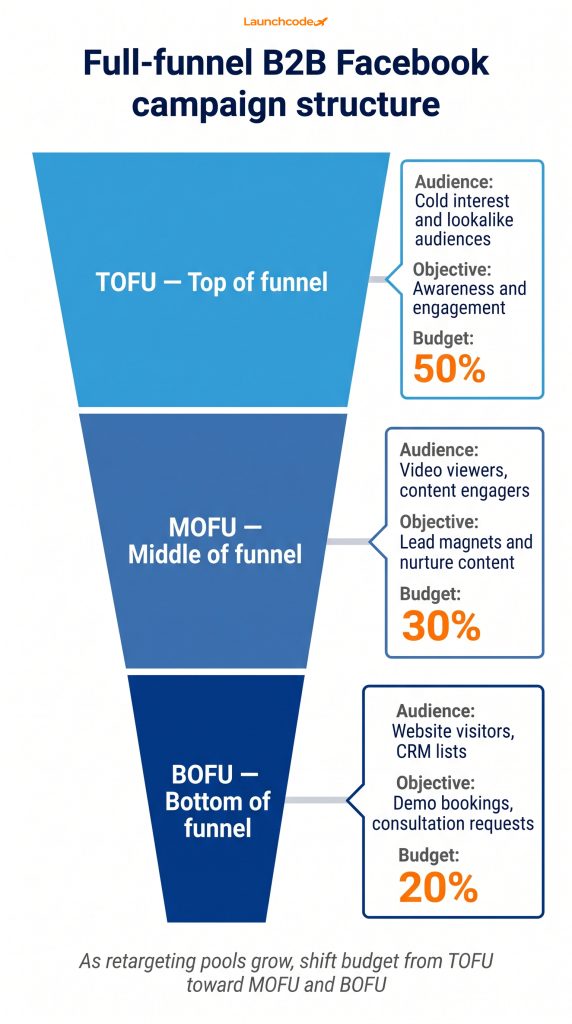
B2B sales cycles involve multiple decision-makers and weeks to months of consideration. Running only bottom-of-funnel conversion ads at cold audiences is the single most common reason B2B Facebook campaigns fail. A proper funnel runs three campaign layers simultaneously: awareness at the top, nurture in the middle, and conversion at the bottom. Each layer targets a different audience temperature with matched creative and a matched offer.
Facebook Ads expert Mojca Žove puts it plainly: "If you want to reach a larger audience but maintain a low cost per acquisition, you need to start thinking of a funnel."
Top of funnel (TOFU) campaigns target cold audiences. The goal is reach and engagement, not leads. Use short-form video, educational content, and lead magnets to introduce the brand. Optimize for video views or landing page visits. Build audiences from this layer for the next stage.
Middle of funnel (MOFU) campaigns retarget users who engaged with TOFU content. Serve social proof, case study snippets, and comparison content. Most B2B prospects need three to five touchpoints before they consider taking action. Optimize for lead form opens or content downloads.
Bottom of funnel (BOFU) campaigns target your warmest audiences: CRM contacts, demo page visitors, pricing page visitors, and leads who did not convert. Serve specific, time-relevant offers like a free audit, demo booking, or limited consultation. Optimize directly for the conversion event.
A practical starting split for most B2B programs:
| Funnel layer | Audience | Budget allocation | Primary objective |
|---|---|---|---|
| TOFU | Cold interest and lookalike | 50% | Awareness and engagement |
| MOFU | Video viewers, content engagers | 30% | Lead magnets and nurture content |
| BOFU | Website visitors, CRM lists | 20% | Demo bookings, consultation requests |
As retargeting pools grow from TOFU and MOFU activity, shift budget toward MOFU and BOFU. Lead generation campaigns consistently outperform traffic-based campaigns by 321% on conversion rate. Structuring the funnel correctly is what puts budget in front of the right objective type at the right time.
Most B2B creative on Facebook looks like a LinkedIn company post dropped into the feed: formal tone, logo-forward design, feature-heavy copy. It performs poorly. What converts in B2B Facebook ads is problem-first creative. Open with a pain point, skip the brand introduction, and compress the solution into the final five seconds. Sound-off video under 30 seconds, social proof carousels with specific metrics in the first card, and native-looking static ads consistently outperform polished corporate creative in B2B feeds.
The guidance from practitioners at Straight North is direct: "Don't lead with your company name or credentials. Instead, highlight a challenge your audience faces daily."
Short-form video (15-30 seconds) is the strongest format at top and middle of funnel. Open with the pain point as on-screen text with no reliance on sound. Name the problem in the first three seconds. Show the solution in the last five. Video engagement campaigns show 71% higher conversion rates than standard traffic campaigns on the same platform.
Social proof carousels work well at MOFU and BOFU. Put a recognizable client logo or a specific result metric in the first card. Buyers stop for proof faster than they stop for design. Each subsequent card should answer a different objection or show a different use case.
Native-looking static ads often outperform heavy-production creative for B2B audiences. A clean, text-forward creative that looks like an organic post reduces the visual signal that triggers ad-skipping behavior in professional audiences.
B2B audiences on Facebook are small. A typical B2B retargeting pool might contain only a few thousand users. Without creative rotation, ad fatigue sets in fast. Benchmark data puts B2B campaign frequency at around 2.51 before performance drops. Run at least four to five creative variants per campaign and refresh prospecting creative every two to four weeks. Retargeting creative should rotate every one to two weeks given the smaller pool sizes.
Facebook can generate leads at low cost. That is both its strength and its trap. Native lead ads produce high volume but low qualification by default because the prefilled form removes friction entirely. The result is a CRM full of names that sales cannot close. The fix is to add qualification inside the funnel, not just at the form level.
Practitioners at Involve Digital put it plainly: "Meta CPL should always be evaluated at the qualified lead or customer acquisition level, not the raw lead level." Raw CPL on Facebook looks attractive compared to most channels. Qualified CPL is the number that tells you whether the channel is earning its budget.
| Format | Best use case | Strength | Risk |
|---|---|---|---|
| Native lead ads | MOFU offers, newsletters, content downloads | Low friction, mobile-friendly, no page load | Lower lead quality, limited form logic |
| Landing page | Demo requests, consultations, high-value offers | Better qualification, full messaging control | Higher drop-off if page is slow or weak |
For high-value B2B conversions like a discovery call or a product demo, a well-built landing page typically produces better qualified leads than a native lead form. Reserve lead ads for mid-funnel offers where volume and email capture matter more than immediate sales readiness.
Meta Advantage+ uses AI to automate audience targeting, placement selection, and creative testing. According to Meta's own case studies, these campaigns improve ROAS by 15-30% compared to manually optimized campaigns. For B2B, the picture is more nuanced. Advantage+ performs well once your campaign has sufficient conversion volume and a clean signal to learn from. Without that foundation, the automation has nothing to optimize toward and can spend budget inefficiently on irrelevant audiences.
The learning phase threshold for meaningful Advantage+ optimization is approximately 50 conversions per week, per ad set. Most B2B campaigns do not reach that threshold on a weekly basis because audience sizes are smaller and buying cycles are longer. This is not a reason to avoid the tool, but it is a reason to sequence it correctly.
Use Advantage+ when:
Keep manual targeting when:
One practical approach is to run Advantage+ campaigns alongside manual campaigns and compare CPL, lead quality, and downstream pipeline metrics across both. Let the data determine the mix.
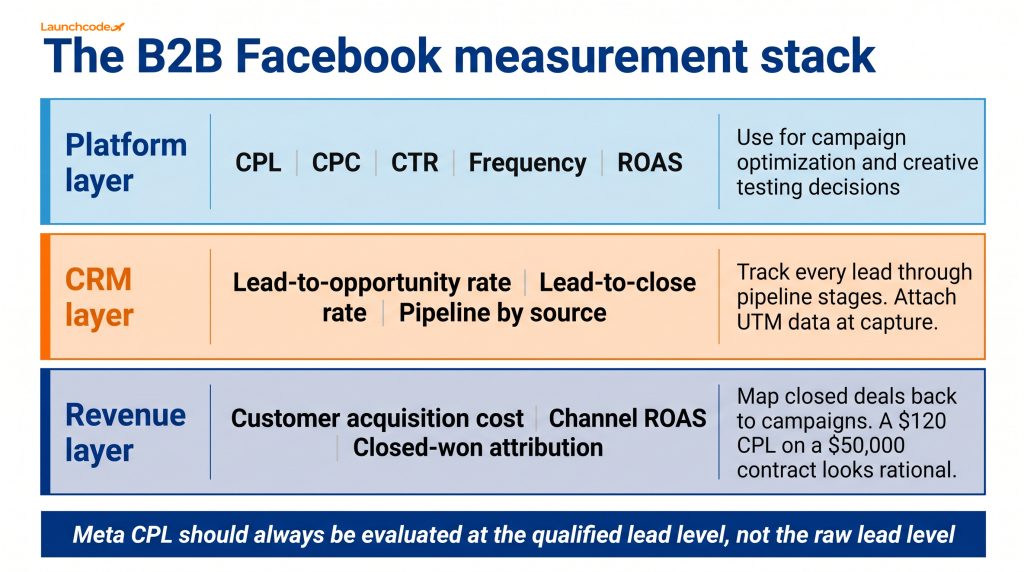
The metrics that matter in B2B Facebook are not impressions, reach, or even raw leads. They are qualified leads, cost per qualified lead, pipeline influenced, and closed-won revenue attributed to the channel. Most B2B teams measure Facebook at the top layer and make budget decisions on incomplete data. A proper measurement framework tracks every lead from the first Facebook impression to a closed deal.
B2B retargeting campaigns on Meta achieve 1.2-1.8% CTR compared to 0.6-1.0% for cold prospecting campaigns. Those numbers are useful for campaign-level diagnostics. But they do not tell you whether Facebook is generating revenue. That requires CRM attribution, not just ad platform reporting.
Build measurement in three layers:
Platform layer. Track CPL, CPC, CTR, frequency, and ROAS inside Meta Ads Manager. Use these for campaign optimization and creative testing decisions.
CRM layer. Sync every lead to a CRM with campaign and ad set data attached as UTM parameters or direct API fields. Track each lead's progression through your pipeline stages. Calculate lead-to-opportunity rate and lead-to-close rate by campaign source.
Revenue layer. Map closed-won deals back to the Facebook campaigns that touched them. Use this data to calculate true customer acquisition cost and channel-level ROAS. If a Facebook lead becomes a $50,000 contract, the $120 CPL that looked expensive on the platform report suddenly looks rational.
B2B paid CPL across all channels averages $310 according to First Page Sage research covering multiple years of data. Meta CPL for comparable B2B categories runs significantly lower on a raw lead basis. The trade-off is that Meta leads require more downstream qualification work than LinkedIn leads. Teams that account for this in their sales process often find that Facebook's economics are favorable even at higher disqualification rates, because the volume and CPM efficiency give the funnel more top-line input to work with.
"B2B teams get burned on Facebook when they optimize for CPL and ignore what happens downstream. The channel works when you hold it accountable at the revenue level." Tanner Medina, Co-Founder and Chief Growth Officer
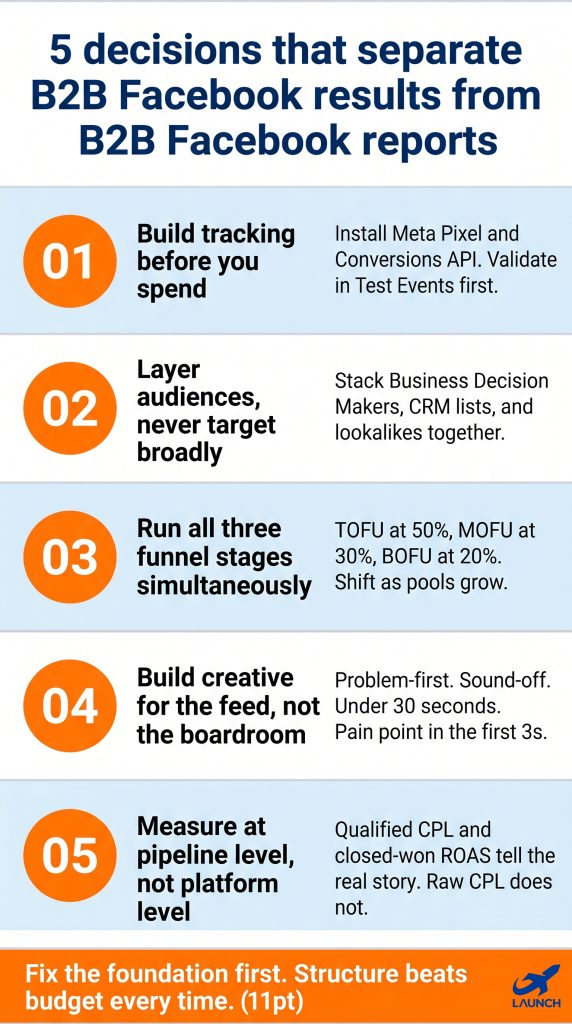
B2B teams that generate real revenue from Facebook are not doing something exotic. They make five decisions correctly: they build tracking before they spend, they layer audiences instead of targeting broadly, they run three funnel stages simultaneously, they create content built for the feed rather than the boardroom, and they measure at the pipeline level rather than the platform level.
At Launchcodex, the consistent finding across B2B campaigns is that tracking and audience structure do the most heavy lifting. Creative matters, but poorly structured audiences and broken attribution will undermine even strong creative. Fix the foundation first.
The cost efficiency argument for Facebook in B2B is real. CPCs that run 50-70% below LinkedIn equivalent audiences compound quickly when you are running awareness and retargeting at scale. The platform rewards structure, patience, and a willingness to optimize toward revenue outcomes rather than surface metrics. Build it that way and Facebook earns its place in the B2B growth stack alongside LinkedIn, not instead of it.
To see how this framework applies to your specific campaigns and pipeline goals, our performance media services cover paid social strategy and execution for B2B programs across Meta, LinkedIn, and beyond.
Yes. The average B2B conversion rate on Facebook ads is 10.63%, above the platform average of 9.21%. 70% of B2B buyers use Facebook to research vendors, and the platform reaches decision-makers at a CPC that runs 50-70% below LinkedIn equivalents.
Short-form video under 30 seconds performs best at the top and middle of funnel. Social proof carousels with specific metrics work well at MOFU and BOFU. For high-value conversions like demos, landing pages typically produce better lead quality than native lead forms.
Layer Meta's "Business Decision Makers" behavioral segment with job-title interest categories, industry filters, and high-income demographics. Stack this with Custom Audiences built from your CRM and website visitors to give the algorithm a strong first-party signal to learn from.
Test Advantage+ once your campaigns generate at least 50 conversions per week. Below that threshold, the algorithm does not have enough signal to optimize effectively. Use manual targeting for retargeting sequences where audience precision matters more than broad exploration.
CPL varies significantly by vertical and audience size. B2B SaaS paid CPL across all channels averages $310. Meta CPL for comparable categories typically runs lower on raw volume, though leads require more downstream qualification. Evaluate CPL at the qualified lead level, not the raw lead level.
Add a qualifying question to your lead form. Send conversion offers only to retargeting audiences, not cold traffic. Sync lead data to your CRM in real time and track lead-to-close rates by campaign. Optimize for micro-conversions like webinar registrations that correlate with downstream sales outcomes, not just form fills.



Learn which link building tactics move rankings in 2026. Covers digital PR, HARO, linkable assets, anchor text strategy, and...
Google removed Business Profile messaging in 2024. In 2026, it returns as an AI chatbot that answers customers and hands off...
Most healthcare marketers track activity, not outcomes. Learn the five most common ROI measurement failures in healthcare ma...