



Breaking Google news: GBP messaging is back, now with an AI chatbot for your business
Google removed Business Profile messaging in 2024. In 2026, it returns as an AI chatbot that answers customers and hands off...





Nearly half of all marketers, 49% per HubSpot, now say search traffic has decreased because of AI Overviews and Google AI Mode. Clients are asking questions about GEO. Vendors are pitching LLMO. Recruiters are posting AEO roles. The vocabulary around AI and search is expanding faster than most teams can track, and the definitions vary depending on who is using them.
This glossary covers 25 terms organized into five groups: the strategy labels, how AI search works mechanically, what visibility and measurement mean now, the content and authority signals that drive citations, and the technical signals AI crawlers use. Each definition connects to a real outcome, not just a textbook explanation.
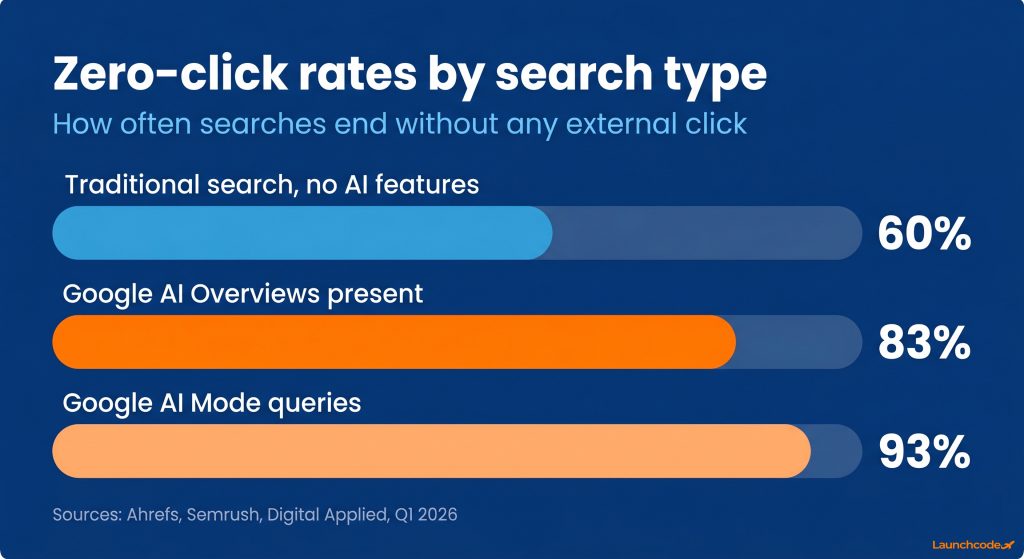
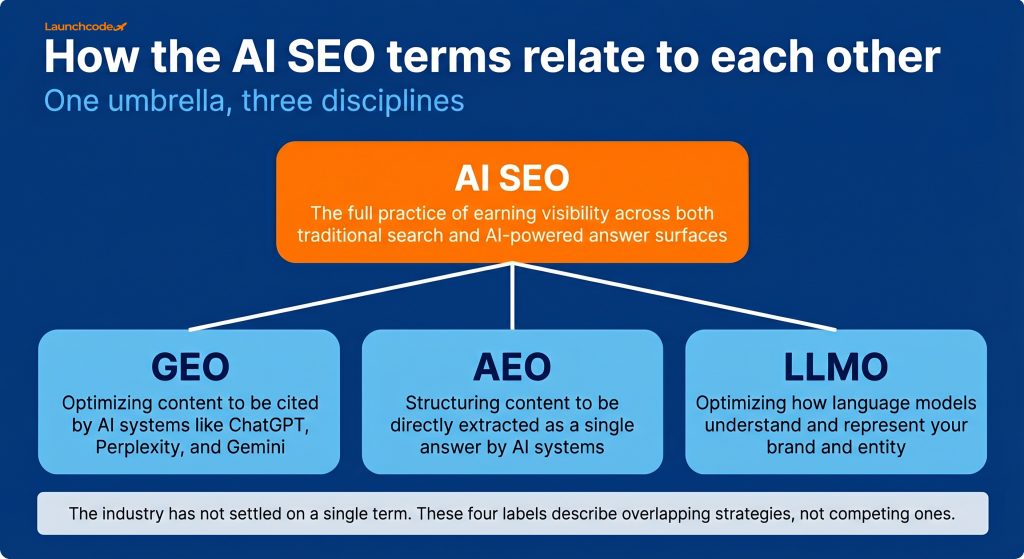
The industry has not settled on a single term for optimizing content for AI search. GEO, AEO, LLMO, and AI SEO are all in active use, and they describe overlapping but slightly different things. Understanding the distinctions matters because they point to different tactics and measurement approaches. For most marketing teams, AI SEO is the right umbrella term to use internally.
Ready to grow your organic traffic?
Get a free SEO audit from the Launchcodex team.
AI SEO is the practice of making content discoverable, extractable, and trustworthy across both traditional search rankings and AI-powered answer surfaces. It does not replace SEO. It builds on SEO fundamentals, including content quality, technical structure, and authority, and extends them to cover how AI systems interpret, summarize, and cite information.
AI SEO optimizes for visibility across all AI-influenced search experiences, from classic SERPs to AI-generated summaries and conversational interfaces.
Think of it as the container. GEO, AEO, and LLMO all sit inside it.
GEO is the practice of optimizing content so that AI systems like ChatGPT, Perplexity, and Gemini cite or reference it in generated answers. Where traditional SEO targets a ranked list of links, GEO targets inclusion in synthesized AI responses.
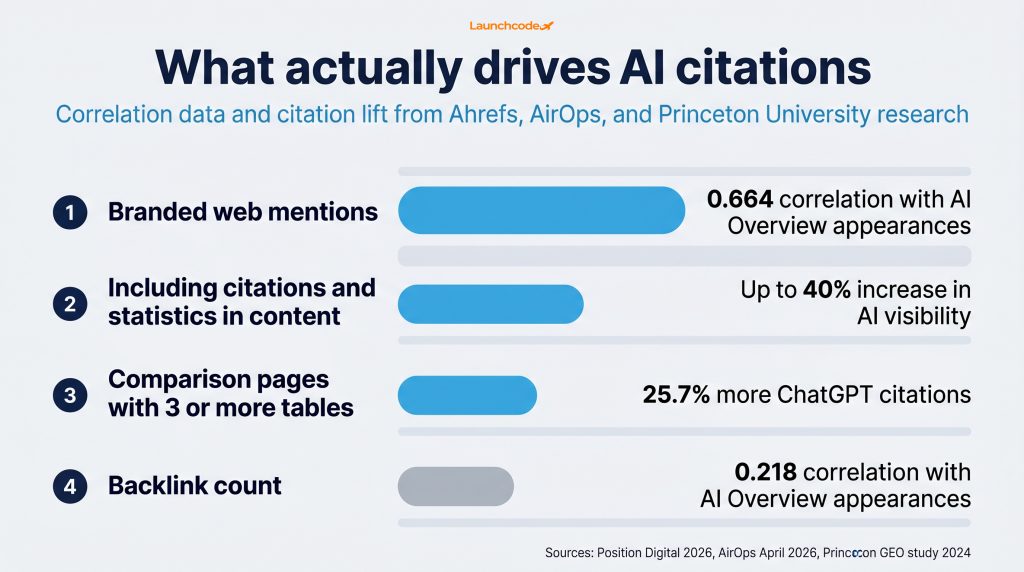
A Princeton University study found that content using citations, expert quotes, and statistics improved AI visibility by up to 40%. The shift in framing is meaningful. Instead of asking "how do I win the click?", GEO asks "how do I provide the fact an LLM will quote?"
One concrete implication: LLMs cite only 2 to 7 domains per response on average, compared to the 10 blue links in a traditional SERP. Competition for AI citation is more concentrated than competition for organic rankings.
"When a client asks whether they should invest in GEO or keep doing SEO, the honest answer is both. The content that earns AI citations is the same content that earns organic rankings. What changes is the format and structure."
Tanner Medina, Co-Founder and CGO, Launchcodex
AEO focuses specifically on structuring content to be extracted as a direct answer to a query. It targets featured snippets, AI Overviews, voice search results, and similar surfaces where AI lifts a passage directly from a page rather than synthesizing across multiple sources.
AEO relies on question-aligned headings, FAQ structures, clear definition blocks, and plain-language phrasing. It is more tactical and page-level than GEO, which operates at the brand and content program level.
The distinction matters in practice. A single well-structured FAQ page is an AEO tactic. A content program that builds topical authority and earns citations across ChatGPT responses is a GEO strategy.
LLMO focuses on how language models understand and represent a brand across both their training data and live retrieval. It covers brand entity clarity, the accuracy of how AI describes a company, and whether AI systems confidently recommend a brand when users ask relevant questions.
LLMO is the most brand-focused of the four disciplines. A company running LLMO work might audit how ChatGPT describes their product category, identify gaps in brand representation, and create content that corrects or strengthens those representations over time.
| Term | Best used for | Primary goal |
|---|---|---|
| AI SEO | Internal strategy conversations and leadership alignment | Unified framework across all AI and search surfaces |
| GEO | Explaining the shift to generative discovery | Citation in synthesized AI answers |
| AEO | Page-level optimization and tactical execution | Direct answer extraction by AI systems |
| LLMO | Brand representation and entity accuracy | How AI understands and describes a brand |
Search everywhere optimization is the expanded definition of SEO for 2026. Instead of targeting only Google's blue links, it covers brand visibility across ChatGPT, Perplexity, TikTok search, YouTube, Reddit, voice assistants, and every other surface where your audience discovers information. The goal is consistent presence wherever a search happens, not dominance on a single platform.
The shift in language reflects a real shift in behavior. A buyer researching a SaaS product might start on Google, check Reddit for opinions, ask ChatGPT for a comparison, and watch a YouTube review before making a decision. Each of those surfaces is a search. A brand that only optimizes for Google is invisible at every other step.
Practically, search everywhere optimization means your content strategy, entity signals, and brand messaging need to work across formats and platforms, not just for the crawler that visits your sitemap.
AI marketing is the practice of integrating AI tools and systems across the full marketing function, from content creation and keyword research to campaign optimization, email personalization, and search visibility. It is broader than AI SEO. It covers how AI tools improve output quality, speed, and precision across every channel, and how marketing programs must adapt as AI reshapes how audiences find and evaluate brands.
AI marketing operates on two tracks. The first is internal: using AI tools like language models, predictive analytics, and automation platforms to produce better work faster. The second is external: understanding that your audience is now using AI to make decisions, which changes how content needs to be structured, where it needs to appear, and how brand authority needs to be built across AI platforms.
An AI SEO agency specializes in optimizing brand content and digital infrastructure for visibility across both traditional search engines and AI-powered answer surfaces. It combines technical SEO, GEO strategy, content architecture, entity optimization, and AI visibility tracking into a unified program. The core difference from a traditional SEO agency is that deliverables target citation in AI-generated answers, not just position in a ranked list of links.
What to look for when evaluating an AI SEO agency: clear measurement of AI citation rates and share of voice alongside traditional rank reporting, technical capability to audit and fix AI crawlability issues, content programs built around topical authority and extractable snippet formats, and a demonstrated understanding of how RAG systems select sources. Agencies that bolt "AI" onto existing SEO deliverables without changing their methodology are selling rebranded services, not a new capability.
A GEO agency specializes specifically in generative engine optimization, helping brands earn citations in AI-synthesized responses across ChatGPT, Perplexity, Google AI Overviews, and similar platforms. GEO agencies audit AI visibility, optimize content structure for RAG retrieval, build topical authority, and track share of voice across AI platforms as their primary performance metric.
GEO work requires a different skill set than traditional link building or on-page optimization. It involves understanding how AI systems evaluate source credibility, how content structure affects citation likelihood, and how to measure brand presence in environments where there are no rank positions to track. A GEO agency that cannot explain how it measures AI visibility before and after its work has no way to prove the value of what it delivers.
Omnichannel marketing is the practice of delivering a consistent brand message and experience across all marketing channels, including search, social, email, paid media, and AI platforms. In the AI SEO era, that consistency matters beyond user experience. When a brand appears with the same name, description, and positioning across multiple channels, it strengthens entity definition in the knowledge graph and increases the likelihood that AI systems represent the brand accurately.
Inconsistency across channels creates confusion for AI systems. A brand with different positioning language on its website, LinkedIn page, and press coverage gives AI models conflicting signals about what that brand actually does. That ambiguity can lead to hallucinated or inaccurate brand descriptions in AI-generated responses. Omnichannel consistency is no longer just a marketing principle. It is a technical requirement for accurate AI brand representation.
AI keyword research covers two distinct needs. The first is adapting traditional keyword research to account for how AI systems interpret and categorize queries. The second is mapping the conversational prompts your audience types into ChatGPT, Perplexity, and other AI platforms, which tend to be longer, more specific, and more intent-rich than traditional keywords. Both inputs shape content structure and topical cluster design.
Traditional keyword research tools like Semrush and Ahrefs still have value for Google rankings, but they do not capture the prompt behavior happening in AI platforms. A user who types "what is the best CRM for a five-person sales team" into Perplexity is asking a more specific and more commercial question than the keyword "CRM software" ever captured. Identifying those prompt-level questions and writing content that answers them directly is where AI keyword research diverges from traditional practice.
AI search does not rank pages the way Google has historically worked. Instead, it retrieves information, synthesizes it across multiple sources, and generates a response. Understanding the mechanics, including RAG, query fan-out, training cutoffs, and how prompts differ from keywords, changes how you approach content structure and publishing strategy.
An AI Overview is Google's AI-generated summary panel that appears above organic results for qualifying queries. These summaries pull from multiple web sources and present a synthesized answer directly on the results page.
As of Q1 2026, AI Overviews appear in roughly 25% of all US searches, based on Conductor's analysis of 21.9 million queries. For informational queries, that rate rises to nearly 40%.
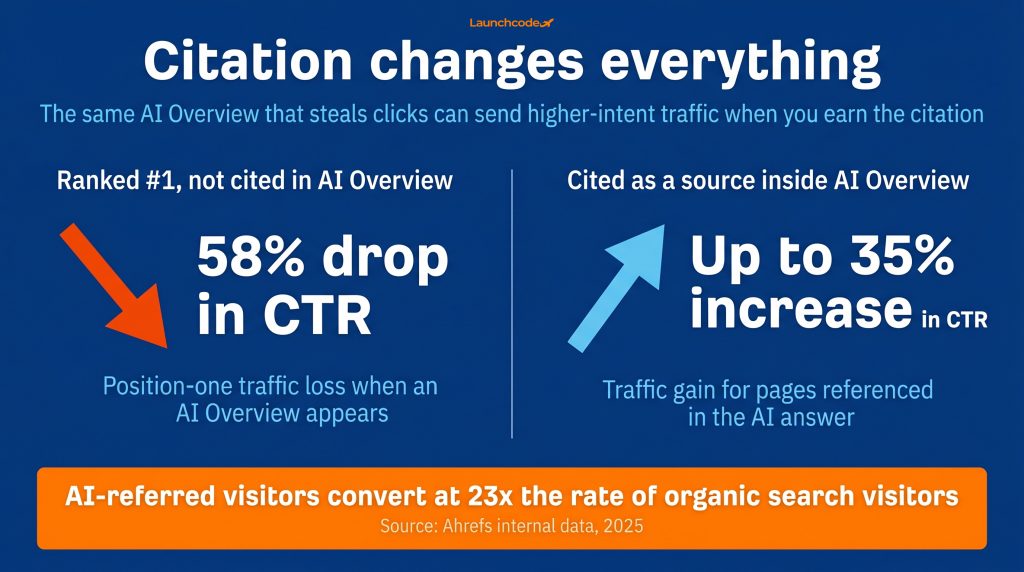
The business implication is direct. Position-one organic CTR drops by up to 58% when an AI Overview is present, per Ahrefs research from December 2025. Impressions can stay flat or grow while clicks fall. That gap between impressions and clicks is the fingerprint of the zero-click era.
Being cited inside an AI Overview reverses the effect. Pages referenced as sources can see CTR increases of up to 35%, per multiple CTR studies. The question shifts from "how do I rank?" to "how do I get cited?"
Google AI Mode is a dedicated conversational search experience within Google, separate from the standard results page. It uses a deep research approach to synthesize information across many sources and hold multi-turn conversations with users.
AI Mode produces a 93% zero-click rate on queries, the highest of any Google surface. It also tends to cite different sources than AI Overviews, which means your brand can appear in one surface and not the other. Tracking both surfaces separately matters for accurate AI visibility reporting.
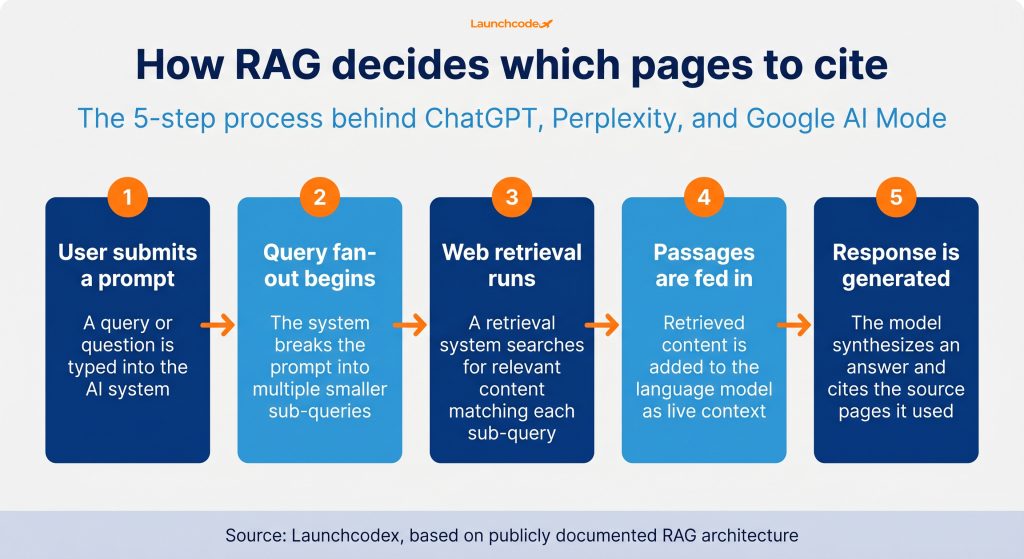
RAG is the technical process by which AI systems retrieve real-time web content and combine it with their trained knowledge to generate accurate, sourced answers. It is the core mechanism behind how Perplexity, ChatGPT Search, and Google AI Mode decide which pages to cite.
Here is how it works:
For content teams, RAG means structure matters as much as substance. Pages that are fast-loading, clearly organized, and accessible to AI crawlers are more likely to be retrieved and cited. Pages behind paywalls, JavaScript-rendered content, or blocked bot access are invisible to RAG systems regardless of content quality.
Query fan-out is the process by which an AI system breaks a single user prompt into multiple smaller sub-queries and searches for each independently before synthesizing a response.
For example, if a user asks "What is the best project management tool for remote marketing teams?", the AI might run separate searches for "best project management tools 2026," "project management for marketing teams," and "remote team collaboration software" before combining findings into one answer.
This matters for your content strategy because AI systems are not matching pages to a single keyword. They look for content that satisfies multiple related questions. Topical depth beats keyword density.
A training data cutoff is the date beyond which a specific AI model has no built-in knowledge. GPT-4's cutoff is April 2024. Newer models have more recent data, but every model has a fixed knowledge horizon.
Content published after a model's cutoff date can only reach users through live retrieval via RAG, not through trained knowledge. Two implications follow:
Publishing a consistent cadence of updated, structured content is the practical response to this dynamic.
A hallucination is when an AI model produces confident, fluent output that is factually incorrect. In a search context, hallucinations can affect how a brand is described, what products it offers, and how its positioning is represented.
For brands, the risk is reputational. A prospect who asks an AI about your product and receives a hallucinated answer may never click through to verify. Monitoring how AI systems describe your brand, and publishing accurate, structured content that corrects the record, is part of any serious AI SEO program.
A prompt is the full message a user types into an AI system. Prompts behave differently from traditional search keywords in two important ways.
First, they are longer. The average AI prompt runs around 20 words, compared to two to three words for a typical Google query. Second, small wording changes in a prompt can change which brand the AI recommends or which sources it cites. Optimizing for prompts means writing content that answers the specific, conversational questions your audience actually asks, not just the short-tail keywords they type into Google.
Organic rank is no longer the primary measure of search success. AI search requires a new set of metrics: AI citation rate, share of voice across AI platforms, zero-click displacement, and the quality of AI referral sessions. These metrics tell a different story than position tracking, and often a more business-relevant one.
An AI citation is a reference to a source URL or brand within an AI-generated answer. It is the new equivalent of a top-10 ranking. When ChatGPT or Perplexity cites a page, that brand earns visibility regardless of where it ranks in traditional organic results.
One critical data point: ChatGPT Search cites pages ranking at position 21 and above in roughly 90% of cases, per multiple tracked studies. AI citation and organic ranking are largely independent signals. A page that ranks on page two of Google can still earn consistent AI citations if its content is structured and authoritative.
The citation is the new click. Earning it requires content quality, structural clarity, and authority signals, not just a strong rank.
AI visibility measures how often a brand or URL appears in AI-generated answers across platforms like ChatGPT, Perplexity, Google AI Overviews, and Gemini. Track it by running a defined set of target prompts across AI platforms and measuring how frequently your brand is mentioned or cited.
Tools like Semrush's AI Visibility Toolkit, Profound, and LLMrefs now offer structured tracking for this metric. Most e-commerce brands currently sit at 0 to 5% AI visibility in their category, per benchmark data from early 2026. For B2B and SaaS brands, both the opportunity and the urgency are higher.
Share of voice in AI search is the percentage of AI-generated mentions your brand earns compared to competitors for a defined set of prompts. Measure it by running those prompts consistently and counting brand appearances across AI responses.
SOV gives your team a competitive benchmark that organic rank never provided cleanly. Your brand can rank third on Google for a category keyword but appear in 60% of AI answers when users ask about that category. The inverse is equally common: ranking first on Google does not guarantee AI presence.
Zero-click search is a search session that ends on the results page without the user clicking through to any external website. The AI or SERP feature answered the query completely on the page.
Zero-click rates reach 83% when Google AI Overviews are present and 93% for AI Mode queries. For traditional queries without AI features, the baseline is around 60%. These numbers come from synthesized research across Ahrefs and Semrush datasets.
The common mistake is treating zero-click as a pure loss. Your brand earns awareness and trust when cited in an AI answer, even without a click. The better question is not "did we get the click?" but "did we get the citation, and is our brand represented accurately?"
AI referral traffic is web sessions that originate from users clicking links within AI-generated answers. These sessions appear in GA4 as traffic from chatgpt.com, perplexity.ai, and similar platforms.
The volume is still small relative to organic, but the trajectory and quality are notable. LLM-referred traffic grew 527% year over year across 19 tracked GA4 properties, rising from 17,076 to 107,100 sessions, per Previsible research published through Search Engine Land. AI-referred visitors convert at up to 23 times the rate of organic search visitors, per Ahrefs internal data. B2B SaaS companies specifically report 6 to 27 times higher conversion rates from this traffic segment.
Every click from an AI answer represents a buyer already further along in their decision-making than the average organic visitor.
LLM visibility measures how often and how accurately a brand appears in responses generated directly by large language models like GPT-4, Claude, and Gemini, independent of real-time web retrieval. It is shaped primarily by a brand's presence in the training data those models were built on, by how clearly the brand is defined as an entity, and by how consistently its positioning appears across trusted sources on the web.
LLM visibility is distinct from AI Overview visibility. Google AI Overviews rely heavily on real-time retrieval from the web. Responses from ChatGPT or Claude without web search enabled draw primarily from training data, which has a fixed cutoff date. A brand that earns strong LLM visibility has appeared consistently in the sources those models were trained on, including industry publications, press coverage, and authoritative third-party sites, before that cutoff.
Tracking LLM visibility means running a consistent set of prompts directly in ChatGPT or Claude without web search enabled, then auditing how the model describes your brand, your category, and your competitors.
AIO citations are the source links that appear inside a Google AI Overview. They show as small linked chips within or below the AI-generated summary, and they represent the pages Google's system selected as most relevant and trustworthy for that query. Earning an AIO citation gives a page direct visibility at the top of the SERP, even if it does not rank in the traditional top results.
AIO citations and organic rankings are related but not the same. About 76% of pages cited in AI Overviews also rank in the top 10 organic results, but 40% of citations come from pages outside the top 10. That gap is the opportunity. A page optimized for AIO citation, with clear answer blocks, structured data, and strong topical authority, can earn top-of-page visibility on queries where it has never ranked traditionally.
The number of AIO citations a brand earns across its target queries is a trackable metric that belongs in every SEO reporting dashboard alongside rank positions and organic traffic.
Multiple source confirmation is the process by which AI systems verify a claim by finding it supported across several independent, credible sources before including it in a response. A fact stated by one source is less likely to be surfaced than the same fact appearing across three or more authoritative publications. Content that is consistent with, and referenced by, multiple trusted sources earns higher citation rates and lower hallucination risk.
For brands, this has a direct content implication. Publishing original data, claims, or positioning that no other source has verified leaves that information in a weaker position for AI retrieval. Brands that earn press coverage, third-party analysis, and mentions in authoritative industry publications create the kind of multi-source confirmation that AI systems treat as a credibility signal.
It also explains why content that contradicts well-established facts is often ignored or corrected in AI responses: the weight of confirmation from multiple independent sources overrides a single contrary claim.
Citation patterns are the observable regularities in how AI systems select and credit sources across responses. Research shows AI systems consistently favor content that uses direct, definitive language; includes specific data points with named sources; sits under clear headings that match the question being asked; loads quickly; and comes from domains with demonstrated topical authority in their category. Understanding these patterns for a specific topic helps content teams design pages that match what AI systems have learned to trust.
Studying citation patterns for a target topic is practical work. Run twenty to thirty relevant prompts across ChatGPT and Perplexity, record which URLs appear most frequently, and analyze the structure and content of those pages. The shared characteristics are your citation pattern benchmark. Pages that match those characteristics outperform pages that do not, regardless of their traditional SEO metrics.
Prompt-triggered visibility is the specific brand presence a brand earns when a user types a particular type of prompt into an AI system. Different from general AI visibility, it is measured at the prompt level. A brand might earn strong visibility for "best AI SEO agency for B2B companies" but no visibility for "top digital marketing agencies in the US" even if both are relevant queries. Identifying which prompts trigger your brand's appearance shapes both content strategy and share of voice tracking.
The practical method is prompt mapping. Build a library of 30 to 50 prompts that represent the questions your target audience asks when researching your category. Run those prompts across ChatGPT, Perplexity, and Google AI Mode monthly. Record which prompts trigger brand mentions, which trigger competitor mentions, and which return no brand-level citations at all. The gaps in that map are your content priorities.
Third-party AI citations are mentions or references to a brand, page, or piece of content that appear in AI-generated responses on platforms the brand does not control, such as ChatGPT, Perplexity, Claude, or Gemini. These are the primary currency of AI visibility. A brand that earns consistent third-party citations across multiple AI platforms has established the kind of cross-platform authority that reinforces entity clarity, builds trust signals, and drives high-intent AI referral traffic.
Third-party AI citations are earned, not placed. They result from consistently publishing accurate, structured, well-sourced content that AI systems retrieve as a trustworthy answer to their users' questions. The brand that shows up in ChatGPT's answer to a category question without paying for placement has built a citation-worthy authority profile. That is the output of a functioning GEO program measured over months, not weeks.
AI share of voice is the percentage of AI-generated responses in a given topic or category that mention or cite your brand, measured relative to competitors. Track it by running a consistent set of category-level prompts across ChatGPT, Perplexity, Google AI Mode, and Gemini, then counting how often your brand appears compared to others. It is the AI-era equivalent of share of voice in paid media, applied to organic AI visibility.
AI share of voice differs from traditional share of voice in one important way: it is not purchased. A brand with a large paid media budget can dominate traditional share of voice through ad spend. AI share of voice is earned through content authority, entity clarity, and citation patterns. A smaller brand with a tightly focused content program and strong topical authority can outperform a much larger competitor in AI share of voice for a specific category.
AI systems select sources based on signals that overlap with traditional SEO but weight them differently. Branded web mentions matter more than backlinks. Content structure matters more than keyword density. Topical depth matters more than domain authority scores. Understanding these shifts changes how you brief, structure, and publish content.
E-E-A-T is Google's quality evaluation framework. In the AI era, it is assessed differently than traditional SEO assumes. AI systems evaluate E-E-A-T primarily through off-site validation: which publications mention or link to your brand, which third-party platforms reference it, and what the broader web says about its credibility.
Author bios and credentials pages still matter, but they are table stakes rather than differentiators. What builds real E-E-A-T is consistent coverage in authoritative publications, active citations in industry discussions, and a track record of content that earns references from trusted sources over time.
Entity SEO is the practice of optimizing for how search engines and AI models understand and represent a brand, person, or concept as a distinct, clearly defined entity in their knowledge graphs.
An entity is anything Google or an AI system can identify as a unique, real-world thing: a company, a person, a product, a place, a concept. Brands with poorly defined entities, ambiguous names, or inconsistent descriptions across the web are harder for AI systems to represent accurately. That ambiguity costs citations.
Practical entity SEO means keeping your brand name, description, and category consistent across your website, Google Business Profile, LinkedIn, press coverage, and third-party directory listings. Consistency across these signals is what allows AI systems to represent your brand with confidence.
A knowledge graph is a structured database of entities and the relationships between them. Google's Knowledge Graph is the backbone of how the search engine understands who a brand is, what it does, and how it connects to related concepts, people, and industries.
For AI search, knowledge graph data helps determine which brands get confidently recommended and which get passed over. Brands that appear clearly and consistently in the knowledge graph are more likely to surface in AI answers for relevant queries.
Structured data, specifically schema markup, is the primary technical tool for feeding accurate entity information into the knowledge graph.
Topical authority measures how deeply and consistently a website covers a subject area. AI systems use it to evaluate which sources deserve to be cited when answering questions on that topic.
A site that publishes one article on AI search and 200 articles on fashion has weak topical authority on AI search, regardless of its domain authority score. A site that consistently publishes accurate, structured, well-cited content on AI search builds the kind of topical authority that earns repeated citations. Content clusters mapped to the real questions your audience asks at each stage of the buyer journey are the practical way to build it.
An extractable snippet is a self-contained block of content that provides a direct, complete answer to a specific query. It can be pulled and surfaced by an AI system without requiring the full page context to make sense.
A strong extractable snippet:
Every FAQ entry in this article follows that structure. Glossary definitions, definition blocks, and FAQ sections are the most naturally extractable content formats on any page.
Semantic search interprets the meaning and intent behind a query rather than matching exact keywords. It is the foundation of how modern search engines and AI systems process language.
In practice, a page about "how to reduce customer churn" can appear in AI answers for "retention strategies for SaaS" even without using those exact words, because the topics are semantically related. For your content team, this shifts the goal from keyword frequency to topic coverage. Writing about a subject comprehensively, with definitions, examples, and related concepts, performs better than fitting a keyword into every paragraph.
Structured data is code added to a webpage that explicitly tells search engines and AI systems what type of content is on the page and how the elements relate to each other. Schema markup is the standardized vocabulary used to write that code, maintained at Schema.org.
Research from AirOps published in April 2026 found that structured content significantly improves ChatGPT citation rates. Comparison pages with three tables earn 25.7% more citations. Shortlist pages with sentences averaging 10 words or fewer earn 18.8% more citations. Content format is a ranking signal for AI systems, not just a design preference.
Common schema types for AI SEO include FAQ schema, Article schema, and Organization schema. Validate all implementations using Google's Rich Results Test before deployment.
Trust signals are the on-site and off-site indicators that tell AI systems a source is credible and worth citing. They include consistent HTTPS, clear authorship with verifiable credentials, citations to primary sources within content, accurate and current information, structured data markup, and a track record of mentions in authoritative third-party publications. AI systems weight trust signals heavily because their reputation depends on citing accurate, reliable sources.
Trust signals work in aggregate. A single strong signal, such as one Forbes mention, is less impactful than a pattern of consistent signals across many authoritative sources over time. The most effective trust-building programs combine technical signals (HTTPS, schema markup, fast load times) with content signals (sourced data, named authors, clear methodology) and off-site signals (press coverage, industry citations, third-party reviews).
In the AI SEO context, authority is the perceived expertise and credibility of a source on a specific topic, as evaluated by AI systems when deciding which pages to cite. It is built through topical depth, consistent publishing on a subject area, citations from other credible sources, and a clearly defined entity in the knowledge graph. Unlike domain authority scores, AI systems evaluate authority holistically, considering how often a brand is referenced, by whom, and in what context across the broader web.
Branded web mentions have a 0.664 correlation with AI Overview appearances, far above backlink count at 0.218, per Position Digital research. That gap reflects the difference between link-based authority and citation-based authority. AI systems are less interested in whether a page has inbound links and more interested in whether a brand is consistently discussed and referenced in the right context by the right sources.
Content verification is the process by which AI systems cross-check information before including it in a generated response. AI systems compare claimed facts against their training data and retrieved sources, identify contradictions, and favor content that aligns with the broader web consensus on a topic. Content that contains factual errors, overstated claims, or information that contradicts well-established data is less likely to be cited and more likely to be omitted or corrected in AI-generated answers.
The practical implication is that accuracy is a ranking factor for AI systems, not just a quality standard. A page that makes an unverified claim about a competitor, overstates a statistic, or uses outdated data can actively hurt citation rates for that page, even if the rest of the content is strong. Every factual claim in content targeting AI visibility should link to a verifiable primary source.
An AIO snippet is a short, self-contained content block formatted specifically for inclusion as a cited passage inside a Google AI Overview. The ideal structure opens with a direct answer to a specific question, states one concrete fact or data point, uses plain language with no assumed knowledge, and sits under a heading that matches the query it answers. Pages with multiple AIO-optimized snippets have more entry points for citation across different queries.
The structural rules are precise. AirOps research from April 2026 found that shortlist pages with sentences averaging 10 words or fewer earn 18.8% more ChatGPT citations, and comparison pages with three or more tables earn 25.7% more. For AIO snippets specifically, Google's retrieval system favors passages between 40 and 80 words that can be pulled cleanly without surrounding context. FAQ sections, definition blocks, and step-by-step process summaries consistently produce the strongest AIO snippet candidates.
AI search engines send their own bots to crawl and index content. If those bots are blocked, slowed, or unable to access a page, that content is invisible in AI answers regardless of traditional SEO performance. Technical AI readiness is now a prerequisite.
LLMs.txt is a Markdown file placed at your site's root domain (yourdomain.com/llms.txt) that gives AI crawlers a structured map of your most important pages, with short descriptions of each. It serves a similar purpose to a sitemap, but designed for language models rather than traditional crawlers.
Implementing LLMs.txt helps AI systems find and correctly interpret your priority content without having to work through the full site architecture on their own. For larger sites with complex structures, it can meaningfully improve how AI systems represent and cite your content.
Schema markup is structured data code added to a webpage to explicitly define the content type, entities, and relationships on that page using the shared vocabulary maintained at Schema.org. For AI systems, schema serves a different function than for traditional search engines. Rather than triggering rich results in a SERP, schema for AI helps retrieval systems rapidly identify what a page is about, who created it, and whether it is a credible source worth citing in a generated answer.
The schema types most relevant to AI SEO are FAQ schema, Article schema, Organization schema, and Person schema. FAQ schema is particularly valuable because it maps question-and-answer pairs directly in machine-readable format, giving AI retrieval systems a clean extraction path. Organization and Person schema strengthen entity definition, which helps AI systems confidently identify and represent a brand. All schema implementations should be validated in Google's Rich Results Test before deployment and updated whenever the underlying content changes.
JavaScript rendering is a critical technical risk for AI visibility. AI crawlers, like traditional search engine bots, often cannot execute client-side JavaScript when indexing a page. If a site relies on JavaScript to render its core content, AI bots retrieve a blank or incomplete page and skip it entirely. Server-side rendering (SSR) or static site generation (SSG) ensures that AI crawlers receive fully formed HTML when they access a page, making the content available for retrieval and citation.
This issue is more common than most teams realize. Sites built on React, Vue, or other JavaScript-heavy frameworks frequently render content client-side by default. A technical SEO audit for AI readiness should include rendering tests using tools like Google's URL Inspection tool or a manual fetch with JavaScript disabled. Any page where content disappears or becomes incomplete without JavaScript execution has a JavaScript rendering problem that directly limits AI visibility.
AI crawlability is the degree to which AI bots can access, retrieve, and process your site's content. A site with strong AI crawlability has no blocking rules for known AI crawlers such as GPTBot, PerplexityBot, ClaudeBot, and Googlebot-Extended. Its key pages render fully in HTML, load quickly, and are not locked behind paywalls, login walls, or JavaScript-dependent rendering. A site with poor AI crawlability can rank well in traditional search while being completely absent from AI-generated answers.
AI crawlability audits are a distinct checklist from traditional technical SEO audits. The steps are:
Canonicalization is the process of identifying and signaling which version of a URL is the definitive one when multiple URLs serve similar or identical content. A canonicalized page carries a canonical tag pointing to the preferred URL, telling both search engines and AI crawlers which version to index and credit. For AI SEO, proper canonicalization prevents AI retrieval systems from splitting topical signals across duplicate or near-duplicate pages, which dilutes citation authority and reduces the likelihood of any single version being selected as a source.
Common canonicalization problems that affect AI visibility include paginated archive pages without proper canonical handling, product pages with URL parameters generating duplicate versions, HTTP and HTTPS versions of the same page both being crawlable, and blog category pages duplicating content from individual post pages. Each of these scenarios creates a signal-splitting problem that makes it harder for AI systems to confidently cite a single authoritative source for a given topic.
Before investing in content optimization for AI, confirm that AI bots are not blocked in your robots.txt file. Several common configurations, particularly aggressive bot-blocking rules in Cloudflare or similar CDN security settings, inadvertently prevent AI crawlers from accessing content.
"The biggest mistake I see is treating AI crawlability as an afterthought. If your technical setup blocks AI bots, the best content in the world will not get cited. Fix the access problem first, then optimize the content."
Derick Do, Co-Founder and CPO, Launchcodex
Check that:
A page that earns strong traditional SEO rankings but sits behind a login wall is completely invisible to RAG-based retrieval systems.
| Tool | Primary use | Best for |
|---|---|---|
| Semrush AI Visibility Toolkit | Track brand mentions and citations across AI surfaces | Teams already on Semrush |
| Profound | Enterprise AI visibility tracking and GEO performance reporting | Mid-market to enterprise brands |
| LLMrefs | Track AI visibility across 10-plus AI search engines | Agencies and practitioners managing multiple clients |
| Google Search Console | Traditional organic performance tracking, supplemented by AI-specific analysis | All teams as a baseline |
| Google Rich Results Test | Validate schema markup before deployment | Technical SEO leads and developers |
| Perplexity | Manual prompt testing to check if your brand appears in category-level AI answers | Quick citation audits and competitor monitoring |
The vocabulary of AI search is still evolving. GEO and AEO are not yet fully standardized terms, the tools for measuring AI visibility are newer than most SEO dashboards, and the naming debate will continue. The underlying shifts in traffic behavior, though, are already measurable. Brands are seeing impressions hold steady while clicks fall. GA4 is showing referral sessions from chatgpt.com and perplexity.ai. Conversion rates from those sessions are materially higher than organic.
The brands showing up in AI answers in 2026 are not the ones chasing acronyms. They are the ones publishing accurate, structured, cited content that AI systems can retrieve, trust, and quote. Branded web mentions correlate with AI Overview appearances at 0.664, far above backlink count at 0.218, per Position Digital research. The brand that earns the most consistent, accurate mentions across trusted sources earns the citations.
Your starting point is a content audit. Check that your priority pages are crawlable by AI bots, structured with clear headings and definition blocks, and backed by citations, statistics, and named sources. Then start tracking how your brand appears when users ask AI systems about your category. That data will shape every strategy conversation that follows.
GEO (Generative Engine Optimization) targets citation in AI-synthesized answers across platforms like ChatGPT and Perplexity. AEO (Answer Engine Optimization) targets direct extraction of a specific answer by AI systems, typically for featured snippets or AI Overviews. GEO operates at the content program level. AEO is a page-level tactic. Both are components of AI SEO.
Yes, but not on its own. About 76% of URLs cited in Google AI Overviews also rank in the top 10 organic results, so traditional ranking still helps for that surface. ChatGPT Search cites pages at position 21 and above in roughly 90% of cases. Strong AI visibility and strong organic rankings are increasingly independent of each other.
Zero-click search is when a user gets their answer directly on the results page and does not click through to any website. Zero-click rates reach 83% when AI Overviews appear. The response is a strategy shift: optimize for citation inside AI answers, track brand mentions alongside traffic metrics, and pay close attention to AI-referred traffic quality. That traffic converts at up to 23 times the rate of organic search visitors.
RAG (Retrieval-Augmented Generation) is the process AI systems use to search the web in real time, retrieve relevant content from specific pages, and use that content to generate an accurate, cited answer. It is how ChatGPT and Perplexity decide which pages to reference. If your content is well-structured, fast-loading, and accessible to AI crawlers, it is more likely to be retrieved and cited.
LLMs.txt is a Markdown file at your site's root that gives AI crawlers a map of your most important pages with short descriptions. It helps AI systems understand your site structure without having to figure it out on their own. It is a quick technical implementation and a practical early step for any brand building AI visibility.
Run a defined set of target prompts across ChatGPT, Perplexity, and Google AI Mode and record how often your brand is mentioned or cited. Track AI referral traffic in GA4 using a segment for sessions from chatgpt.com, perplexity.ai, and similar domains. Share of voice across AI platforms is the emerging KPI that most closely mirrors traditional rank tracking.




Google removed Business Profile messaging in 2024. In 2026, it returns as an AI chatbot that answers customers and hands off...
Most healthcare marketers track activity, not outcomes. Learn the five most common ROI measurement failures in healthcare ma...
Learn how tattoo artists rank in Google's local map pack and get recommended by AI tools like ChatGPT and Perplexity in 2026...