
Share:

AI marketing & automation


Most marketing teams know their Gen Z numbers are off. Impressions look fine. Click-through rates are acceptable. But conversion is weak, retention is weak, and the audience that does engage leaves as quickly as it arrives. The problem is not the creative. It is the model underneath it. The funnel assumes a brand can guide a customer from awareness to purchase in a predictable sequence. Gen Z never agreed to that sequence.
This article covers why the traditional AIDA framework fails with this generation, how Gen Z actually discovers and buys, and what brands need to build in its place. The replacement is not a new funnel. It is a different operating model built around trust, platform-native content, community, and systems that work without a defined start or end.
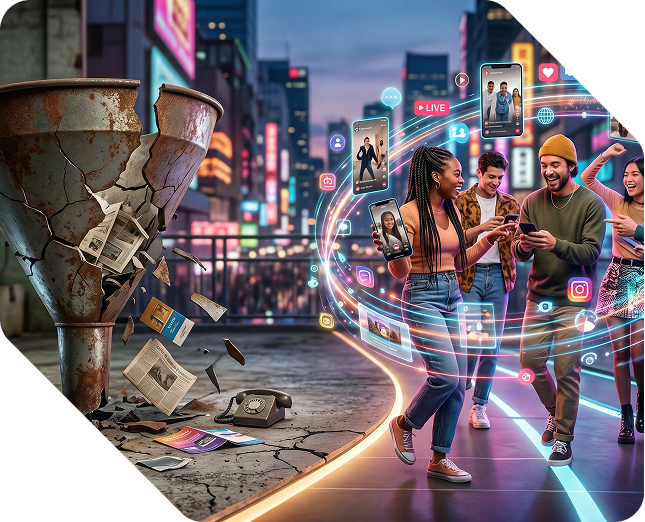
The AIDA model assumed brands controlled the path. Gen Z moved the path somewhere brands were not looking. The linear sequence of awareness, consideration, and conversion no longer describes how this generation shops, researches, or decides. It describes how brands wish they shopped. The gap between those two realities is where most campaigns fail.
The AIDA framework, developed in the 1890s, was built for limited media channels. Brands ran a TV spot, a print ad, or a direct mail piece. Consumers moved through predictable stages because they had few alternatives. That world no longer exists.
Gen Z grew up with TikTok, Instagram, Reddit, and YouTube all open simultaneously. Deloitte’s 2025 Digital Media Trends report found that Gen Z spends 6.9 hours daily with media and entertainment content, and 89% are second-screen users consuming multiple feeds at once. Discovery, comparison, and purchase can all collapse into a single scrolling session.
Gen Z finds products through algorithm-driven feeds, creator recommendations, and peer reviews, not brand-placed ads. A single TikTok from a micro-creator can outperform a six-figure awareness campaign. The brand does not get to decide when or how it appears.
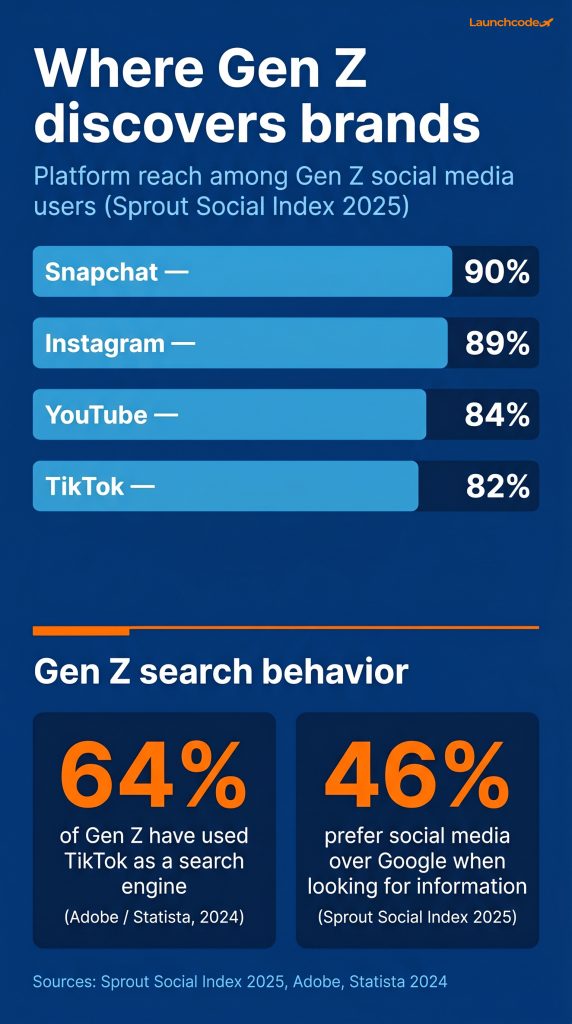
Research happens on TikTok and Reddit, not on a brand website. According to the Sprout Social Index 2025, 46% of Gen Z prefers social media over traditional search engines when looking for information. They check comments before they check product pages.
Fast Company reported that 50% of consumers do brand research after they make a purchase. For Gen Z, the post-purchase moment is when advocacy, content creation, and community participation begin. A funnel that ends at checkout misses the most valuable part of the relationship.
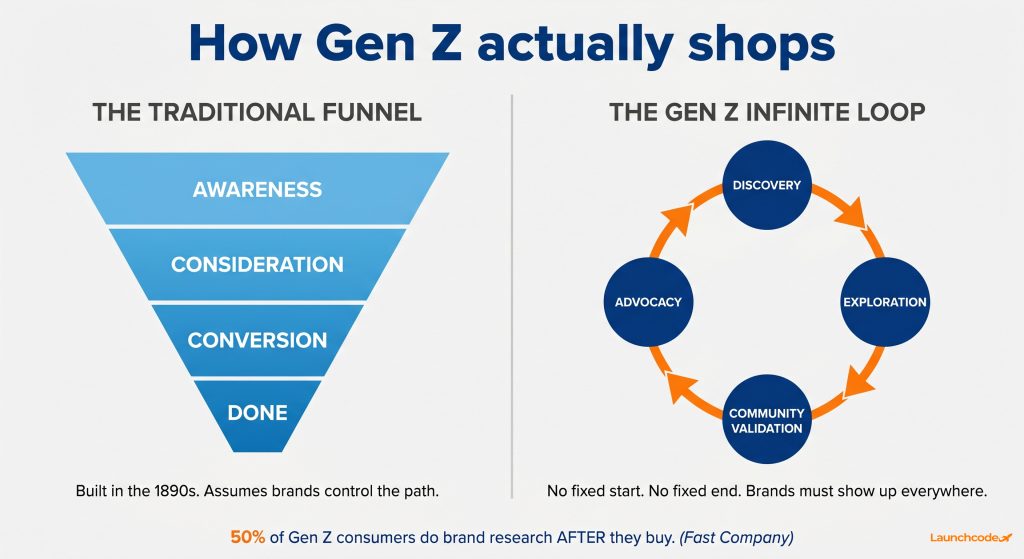
Gen Z follows an infinite loop, not a funnel. Discovery leads to exploration. Exploration leads to community validation. Community validation leads to purchase or rejection. After purchase, the loop continues through advocacy, shared content, and ongoing loyalty signals. There is no fixed starting point and no defined end. Brands need to be present at every point in the loop, not just the top and bottom.
Youth culture agency Archrival, whose research formed the basis for Vogue Business’s foundational reporting on this topic, put it plainly: “Zs are letting their algorithms take the wheel and drive their path to discovery.” That single observation changes almost everything about how campaigns should be structured.
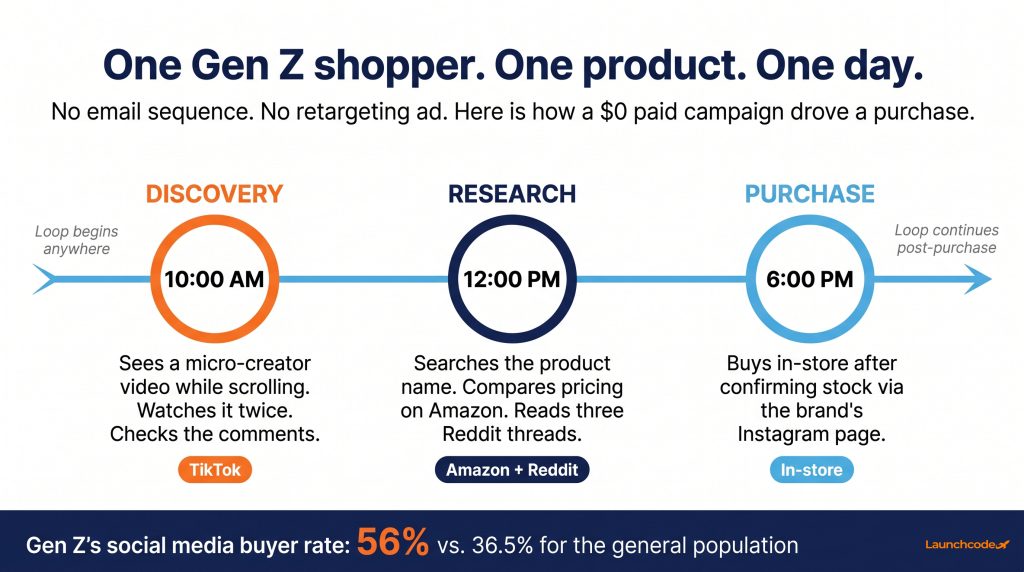
Consider a concrete example from Revenue Memo’s 2024-2025 analysis, compiled from Bank of America, Deloitte, and EMARKETER data. A Gen Z shopper discovers a product on TikTok at 10 a.m. By noon, they are comparing prices on Amazon. By evening, they buy in-store. No email nurture sequence touched them. No retargeting ad closed the deal. The brand’s comment section, creator partnerships, and TikTok product page did the work.
This is not an edge case. It is the norm. Gen Z’s social media buyer rate is 56%, versus 36.5% for the general population.
| Traditional funnel stage | What Gen Z does instead |
|---|---|
| Awareness via paid ads | Discovery via algorithm feeds and creators |
| Consideration via landing page | Research via TikTok search, Reddit, and reviews |
| Conversion via ad click | Purchase via social commerce or in-store after social proof |
| Retention via email | Advocacy via UGC, comments, and community participation |
Brands that map campaigns to the left column get poor returns. Brands that build for the right column get compounding results.
Gen Z treats TikTok, Instagram, and YouTube as search engines. They do not Google a product category and click an ad. They search on TikTok, watch a creator review, check the comments for dissenting opinions, and make a decision based on what other people say, not what the brand says. This changes where brands need to invest for visibility.
Adobe’s 2024 research, published by Statista, found that 64% of Gen Z in the United States have used TikTok as a search engine, the highest rate of any generation. The platform breakdown from the Sprout Social Index 2025 is clear: 89% of Gen Z social media users are on Instagram, 84% on YouTube, and 82% on TikTok. Snapchat reaches 90% of the Gen Z demographic, including 13 to 17 year olds.
TikTok introduced Search Ads Campaigns in September 2024, recognizing that its platform had become a genuine intent-based search tool, not just an entertainment feed. Brands can now target users based on what they are actively searching, not just what the algorithm serves them.
Brands that only invest in Google Search are invisible to a large share of Gen Z at the moment of discovery. Short-form video content, optimized for TikTok’s search function with clear captions and keyword-relevant speech, now functions as top-of-funnel search presence for this audience.
ChatGPT and Google’s AI Overviews are becoming product discovery tools across all generations. Among the broader population, AI now outranks TikTok as an alternative to Google for product recommendations. Generative engine optimization (GEO), the practice of structuring content to appear in AI-generated responses, is already shaping first-page visibility for brands reaching Gen Z.
“Most brands we work with are investing heavily in Google Search while Gen Z is starting product research on TikTok and ChatGPT. If you are not optimizing for those surfaces, you are missing the first touchpoint.” Tanner Medina, Co-Founder and Chief Growth Officer
Gen Z has a well-calibrated filter for corporate content. They have been exposed to more advertising than any previous generation and they recognize production polish, scripted messaging, and paid promotion quickly. What earns trust is not production quality. It is evidence that real people use and believe in a product.
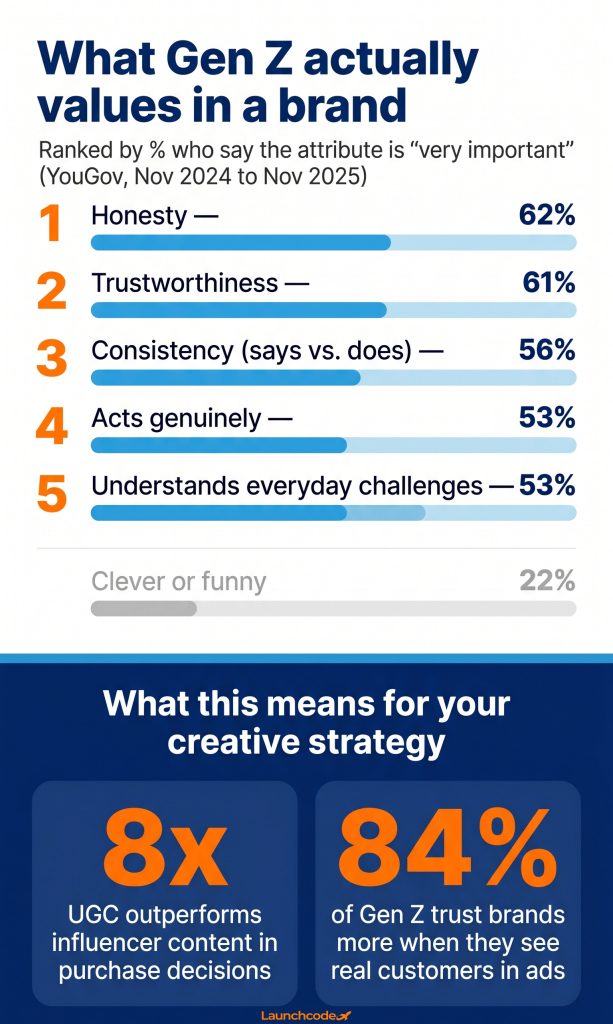
YouGov’s 2024 to 2025 research found that 62% of Gen Z say honesty is very important in a brand, 61% say trustworthiness, and 56% say consistency between what a brand says and does. Only 22% said being clever or funny is very important. The hierarchy is clear: credibility before personality.
Data from inBeat Agency shows that 84% of Gen Z trust brands more when they see actual customers in ads. UGC is also considered 8 times more effective than influencer content in driving purchase decisions. A wall of customer reviews and organic community content outperforms a polished brand video.
Most brands interpret authenticity as a tone choice. They make content feel more casual, add lo-fi edits, and use trending audio. That is not what Gen Z responds to. For this generation, authenticity means consistent values, transparent sourcing, real people in real situations, and a brand that behaves the same way in its comment section as it does in its ad creative.
From Day One’s 2025 analysis found that sponsored influencer posts can actually drive down brand engagement, while unsponsored or organic influencer content builds brand reputation more effectively. The difference is not the disclosure label. It is whether the content feels like genuine enthusiasm or a fulfilled contract.
Gen Z consumers are 3.1 times more likely to buy a product recommended by a creator they follow than from a traditional paid ad, according to Pulse Advertising’s 2025 research. But not all creator partnerships work equally. The activation model, the creator’s genuine alignment with the brand, and the content format all determine whether the partnership builds trust or erodes it.
32% of Gen Z make purchases based on influencer recommendations, compared to 21% of millennials. The channel works. The execution is what separates effective programs from wasted spend.
Stephanie O’Neill, Head of PR at Gymshark, explained the model directly: “It’s all about being authentic. Gymshark’s philosophy is to sponsor influencers who create fitness content wearing their clothing, rather than content that deliberately advertises the product.” Gymshark builds long-term partnerships with creators who already live the brand’s world. The content follows naturally.
The right creator for Gen Z marketing is not the one with the most followers. Gen Z expert Larry Milstein, writing for Later, put it this way: “It could be a creative, an artist, a thought-leader, or an activist. Find people you believe can serve as ambassadors and tap into their networks in a way that feels less transactional and more authentic.”
Practical selection criteria:
Gen Z audiences are aware of sponsorship requirements. The FTC mandates clear disclosure of paid partnerships. Proper labeling with ad or sponsored is not optional, and this audience will not forgive a brand that omits disclosure and gets called out later. Brands running creator programs need a clear disclosure process built into every brief.
Gen Z buys into communities before they buy products. Brands that create genuine belonging, through owned communities, comment culture, or ambassador programs, build audiences that generate their own acquisition, advocacy, and repeat purchase. This is not a content strategy. It is a distribution model.
Amanda Edelman, COO of Edelman’s Gen Z Lab, framed it clearly in Fast Company: “At the end of the day, consumers don’t want to be pushed through a funnel. They want a relationship.”
Edelman’s 2024 Trust Barometer Special Report found that nearly 6 in 10 Gen Z consumers feel a connection with other people who use the same brands they do. Brands are signals of identity and community membership for this generation, not just products.
Glossier built its early growth almost entirely through an ambassador program that turned engaged customers into content creators. The brand provided tools and incentives. Customers provided content, advocacy, and peer recruitment.
Duolingo took a different route. By building a social team that creates content in the style of a Gen Z creator rather than a brand marketing department, the language learning app reached over 10 million TikTok followers by 2024. The content does not advertise the product. It participates in the same cultural conversation as the audience.
“The clients who build community before they build campaigns consistently outperform the ones who go straight to paid. It takes longer to set up, but the compounding effect is real.” Brittany Charles, SVP Client Services
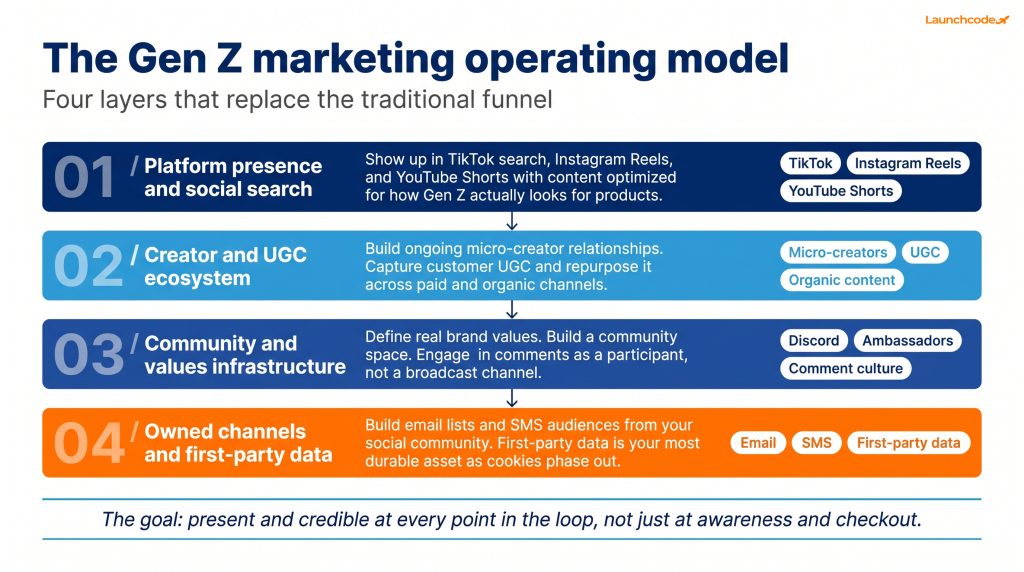
Replacing the funnel does not mean removing structure. It means replacing a linear, brand-controlled sequence with a flexible, always-on operating model built around platform presence, community content, creator relationships, and owned audience channels. The goal is to be present and credible at every point in the loop, not just at awareness and checkout.
The operating model has four connected layers.
Build and maintain content across TikTok, Instagram Reels, and YouTube Shorts. Optimize content for TikTok search using keyword-relevant captions and in-video speech. Your brand should appear in social search results for the questions your audience is already asking.
Build ongoing relationships with micro-creators in your category. Develop a UGC capture system that encourages customers to create content and makes it easy to repurpose that content across paid and organic channels. Do not rely on one-off influencer posts. Build a content engine from genuine community content.
Define your brand’s actual values and back them with consistent behavior across all channels. Build a community space, whether that is a Discord, a branded hashtag, or an ambassador program. Engage in comment sections as a genuine participant, not a broadcast channel.
Algorithm-driven discovery reaches millions but gives you no direct control over who sees what or when. Brands that build email lists, SMS audiences, and loyalty programs from their social communities create a direct line that no platform change can sever.
As third-party cookies continue to phase out across major browsers, first-party data from engaged community members becomes the most valuable asset in the marketing stack.
Standard last-click attribution does not work in a non-linear journey. If Gen Z discovers your brand on TikTok, validates it through Reddit, and converts via a direct search three weeks later, your analytics will credit the direct search. That tells you almost nothing useful. Measuring Gen Z marketing performance requires a broader attribution model and a different set of leading indicators.
Metrics to track alongside conversion:
41% of Gen Z still identify as impulse buyers according to Strike Social’s 2024 research, which means direct-response creative and limited-time offers still convert. But they only convert after trust is established through the layers above. Cold direct-response ads to a cold Gen Z audience do not perform. Warm audiences built through community and creator content do.
The funnel actively works against the kind of trust-first, community-driven relationship this generation requires before they consider a brand credible. Brands that keep investing in top-of-funnel awareness and bottom-of-funnel conversion without building the trust layer in between will see weak results regardless of media spend.
The brands winning with Gen Z have made three structural changes. They moved content creation from brand-produced to creator and community-sourced. They moved discovery from paid placement to platform-native presence and social search. And they moved their measure of success from conversion rate alone to a broader set of relationship signals.
Gen Z spending power in the U.S. has already reached $360 billion and is projected to grow to $12.6 trillion globally by 2030. These are not future customers. They are current ones. And 93% of parents report that their Gen Z children influence household spending decisions, which means your Gen Z strategy affects a far larger total addressable market than the generation itself.
At Launchcodex, we help brands build the full operating model behind this kind of strategy, from creative and content systems to the data infrastructure and automation that make always-on community marketing scalable. If your current approach relies on a funnel your audience has already abandoned, it is worth examining what the replacement actually looks like in practice.
The traditional funnel assumes a linear path from awareness to purchase. Gen Z does not follow that path. They move between discovery, research, community validation, and purchase in any order, often within minutes. A funnel-based approach misses most of those interactions because it is designed around stages that Gen Z collapses or skips entirely.
Instagram, YouTube, and TikTok reach the largest share of Gen Z social media users, at 89%, 84%, and 82% respectively according to the Sprout Social Index 2025. TikTok is the most important platform for discovery and social search. YouTube is critical for longer-form research content. Reddit is growing fast and functions as a peer validation channel.
Yes, but only when the creator has genuine alignment with the brand and the content feels organic rather than produced. Gen Z consumers are 3.1 times more likely to buy based on a creator recommendation than a traditional paid ad. The model that works is long-term creator partnerships built around authentic content, not one-off sponsored posts.
The infinite loop is the framework that replaces the traditional funnel for Gen Z. Instead of a linear sequence, it describes a continuous cycle of discovery, exploration, community validation, purchase, and advocacy. There is no fixed start or end point. Brands need presence and credibility at every stage of the loop, not just at awareness and conversion.
Track a combination of leading and lagging indicators. Leading indicators include UGC volume, comment sentiment, community growth, and social share of voice. Lagging indicators include assisted conversions in multi-touch attribution models and direct revenue from owned channels like email and SMS. Last-click attribution alone will consistently undervalue social and community-driven marketing.
Yes, but only after trust has been established. 41% of Gen Z identify as impulse buyers, so direct-response tactics and limited-time offers can convert effectively. Cold direct-response ads to a cold Gen Z audience perform poorly. The creative layer needs trust infrastructure underneath it to work.



Real stories from the people we’ve partnered with to modernize and grow their marketing.