




Schema that supports thought leadership, authorship, and AI citations
Learn how to use Person, Article, Organization, and FAQPage schema to encode authorship, build entity authority, and improve...





Most brands publish content, list their team members, and claim thought leadership. AI search systems do not accept those claims on face value. Systems like Google AI Overviews, Bing Copilot, ChatGPT, and Perplexity look for structured signals: a named expert with verifiable credentials, an article tied to that expert and a known organization, and explicit topic declarations that match the query at hand.
This article covers the schema types that build authorship credibility for AI systems, how to connect them into a coherent entity graph, what the evidence actually says about citation impact, and how to maintain the system as part of a standard content operation.
Schema markup gives AI systems a structured form to fill out instead of a blank canvas to interpret. It encodes what your content is, who wrote it, when it was published, and how it connects to known entities. That structured context improves how AI systems understand and process your content. It does not guarantee that AI systems will cite you. The distinction matters.
Ready to grow your organic traffic?
Get a free SEO audit from the Launchcodex team.
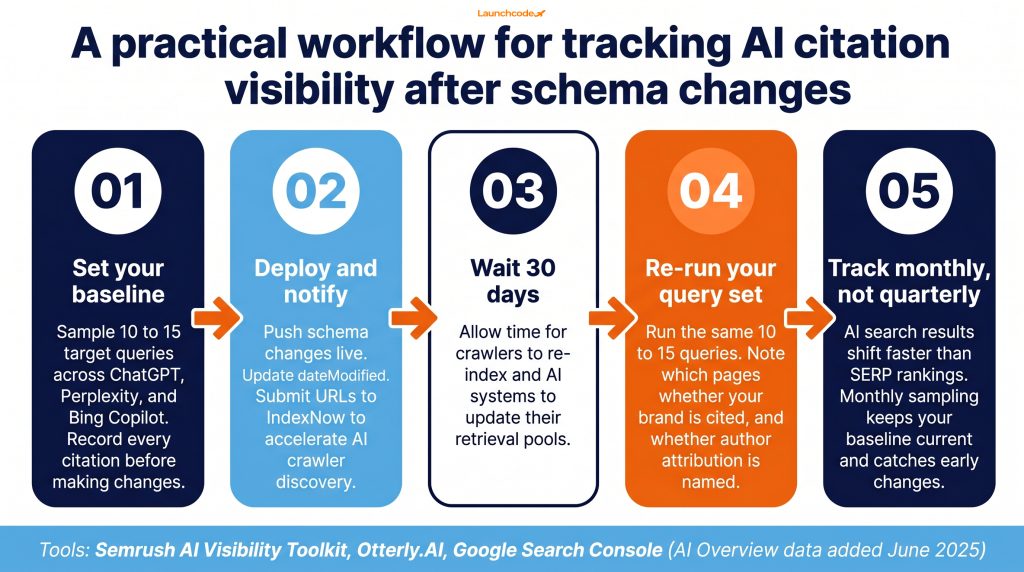
A May 2026 Ahrefs study analyzed six million URLs and found that AI-cited pages are almost three times more likely to have JSON-LD than non-cited pages. That looks significant until you read the next finding: tracking 1,885 pages that added schema showed citation rates barely moved as a result. The gap is correlation, not causation. Well-maintained sites implement schema correctly. They also publish stronger content, build more authority, and earn more backlinks. Schema is one signal among many. It does not replace the others.
The only major AI platform to officially confirm schema usage is Microsoft Bing. Fabrice Canel, Principal Product Manager at Microsoft Bing, stated at SMX Munich in March 2025 that "Schema markup helps Microsoft's LLMs understand content." Since ChatGPT search relies on the Bing index, this confirmation extends further than it first appears. Google confirmed in April 2025 that structured data gives an advantage in search results, but separately stated that no special schema is required for AI Overview eligibility.
Aimee Jurenka, SEO and AI visibility strategist at RicketyRoo, put the role of schema plainly in Search Engine Land: "Schema markup is infrastructure, not a magic bullet. It won't necessarily get you cited more, but it's one of the few things you can control that platforms such as Bing and Google AI Overviews explicitly use."
Schema structures the signals your content already creates. It does not generate them.
A late 2025 experiment by SearchVIU tested eight scenarios across five AI systems: ChatGPT, Claude, Gemini, Perplexity, and Google AI Mode. Researchers placed product data exclusively in JSON-LD with no matching visible text on the page. The result: zero of five systems extracted the data. Hidden Microdata and hidden RDFa failed the same test.
The analysis from West Operators suggests schema is most likely processed during the parsing phase, working as an attention and recognition layer on top of visible content. It reinforces what the text says. It does not replace it.
The practical rule: every claim in your schema must match something visible on the page.
Schema cannot compensate for thin content, weak topical authority, or low domain credibility. A December 2024 study by Search Atlas found no correlation between schema coverage and LLM citation rates across OpenAI, Gemini, and Perplexity. Sites with comprehensive schema did not consistently outperform sites with minimal or none.
Schema is one layer in a system. Your content quality, topical coverage, and external mentions do the heavy lifting. Schema organizes the signals those other factors already create.
The schema types that matter for thought leadership, authorship, and AI citation readiness fall into four categories: Organization, Person, Article or BlogPosting, and FAQPage. Each layer builds on the previous one. Organization anchors your brand entity. Person encodes your experts. Article ties content to those experts. FAQPage structures answers for direct AI extraction.
| Schema type | What it declares | Primary benefit | Implement on |
|---|---|---|---|
| Organization | Brand entity, location, logo, social profiles | Anchors entity identity across all pages | Homepage and sitewide JSON-LD |
| Person | Author name, job title, expertise, external profiles | Creates a verifiable, citable expert entity | Author profile pages |
| Article / BlogPosting | Headline, author, publisher, dates, topic | Ties content to a real author and organization | Individual blog posts and articles |
| FAQPage | Question and answer pairs | Enables direct extraction into AI-generated answers | FAQ sections and dedicated FAQ pages |
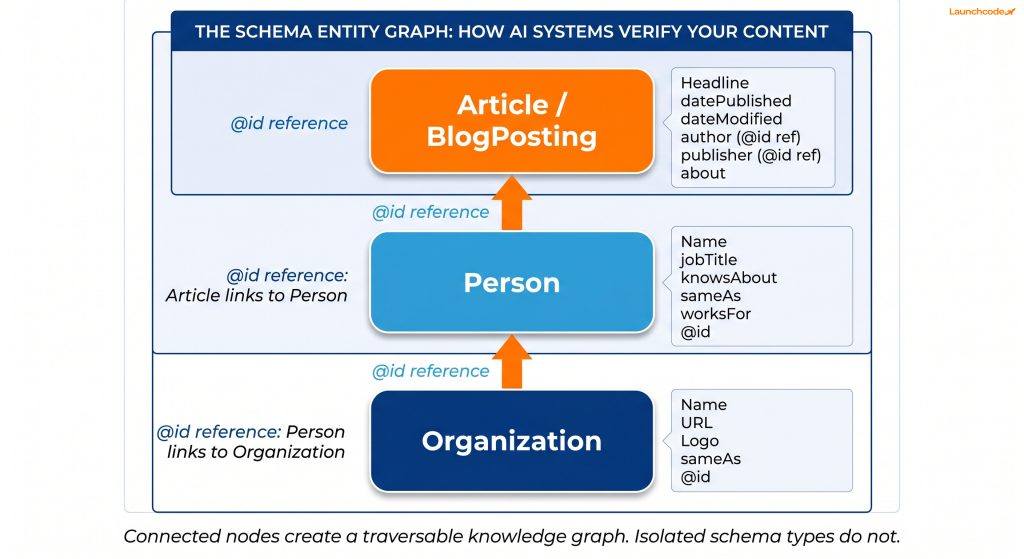
Most sites implement one or two of these in isolation. The citation opportunity comes from connecting all four into a linked entity graph using stable @id values. That graph is what AI systems traverse when verifying that a source is credible enough to cite.
A Person node in JSON-LD creates a machine-readable expert entity that AI systems use to identify and surface credentialed authors in topic-specific answers. The key distinction is between an author declared as a plain string and an author declared as a full node. A string tells an AI system a name. A node gives it an entity it can verify, connect, and cite.
The difference in JSON-LD looks like this:
Weak: "author": "Tanner Medina"
Strong:
"author": {
  "@type": "Person",
  "@id": "https://launchcodex.com/blog/author/tanner-medina/#person",
  "name": "Tanner Medina",
  "jobTitle": "Co-Founder and Chief Growth Officer",
  "url": "https://launchcodex.com/blog/author/tanner-medina/",
  "knowsAbout": [
    "generative engine optimization",
    "technical SEO",
    "AI search visibility",
    "content strategy",
    "schema markup and structured data"
  ],
  "sameAs": [
    "https://www.linkedin.com/in/tannermedina"
  ],
  "worksFor": {
    "@id": "https://launchcodex.com/#organization"
  }
}The string version is a dead end. The node version connects to a stable URL, lists specific expertise, links to an external profile for verification, and points to an organization. AI systems use that full picture to weight the expertise behind a cited claim.
"We treat every author's Person schema node the same way we treat a professional bio. If you would not publish a LinkedIn profile without a job title, a list of specialties, and a work history, you should not publish an author schema node without the same level of detail. Specificity is what makes the entity verifiable."
Tanner Medina, Co-Founder and Chief Growth Officer, Launchcodex
Mohit, co-founder of ReSO and an AI search optimization practitioner, makes the specificity requirement clear: "The knowsAbout property should list specific topics using concrete terms. Enterprise SEO and technical content strategy are more useful than vague descriptors like marketing or digital strategy. AI systems use these specifics to verify author credentials and identify thought leaders when responding to specialist queries."
Map each author's knowsAbout values directly to the topics they actually write about. An author who covers AI automation and technical SEO should list those exact phrases, not broader terms like "technology" or "digital marketing." The closer the knowsAbout values match the queries your content targets, the stronger the entity signal.
The sameAs property links your author entity to external authoritative references. These give AI systems checkpoints outside your own domain to confirm that the person is real and matches the credentials you claim in the schema.
Prioritize these sameAs targets in order of trust signal strength:
You do not need all of these. One or two strong sameAs links outperform a long list of low-authority profiles. LinkedIn is the minimum for most B2B thought leaders.
Article schema does three things: it identifies the content type, ties the content to a named author with verifiable credentials, and connects that author to a known publisher. The connection happens through @id references. When you link an Article node to a Person node to an Organization node, you build the entity graph that AI systems use to assess citation worthiness.
Grégory Stoos, schema practitioner and author of the AISO Hub implementation guide, frames the authorship requirement directly: "Article schema clarifies who wrote your content, when it was published, and what it covers. Search and AI assistants need clear authorship and dates to trust and cite content."
Each node in your schema graph needs a stable, unique @id URI. The Article node references the Person and Organization nodes by their @id values. This creates a traversable graph rather than a set of isolated declarations.
{
  "@type": "BlogPosting",
  "@id": "https://yourdomain.com/blog/post-slug/#article",
  "headline": "Your article title",
  "datePublished": "2026-05-16",
  "dateModified": "2026-05-16",
  "author": {
    "@id": "https://yourdomain.com/blog/author/firstname-lastname/#person"
  },
  "publisher": {
    "@id": "https://yourdomain.com/#organization"
  },
  "about": [
    { "@type": "Thing", "name": "Schema markup" },
    { "@type": "Thing", "name": "Generative engine optimization" }
  ],
  "mainEntityOfPage": {
    "@type": "WebPage",
    "@id": "https://yourdomain.com/blog/post-slug/"
  }
}The about property declares the main topics the article covers. This removes ambiguity about what the content addresses and gives AI systems a direct topic declaration to match against queries.
One B2B SaaS brand implemented Article, Person, and Organization schema with populated about and mentions properties across 15 blog posts. Perplexity citation share rose from 9% to 22% over the following period. Demo conversions on the cited posts increased 11%, according to the AISO Hub case study review.
The schema alone did not drive those results. The team simultaneously cleaned author bio pages, populated dateModified fields, and ensured every schema claim matched visible page content. The schema organized the signals. The content quality and operational discipline made the signals worth organizing.
dateModified tells AI systems when the content was last reviewed and updated. Stale dates signal that content may be outdated, which reduces citation confidence in fast-moving topic areas. Treat dateModified as a required field to update any time you refresh content, add new data, or correct information.
Fabrice Canel at SMX Munich extended his schema guidance to freshness, noting that generative AI systems value fresh content "partly as a reference check of their LLM training data," and recommending the IndexNow API to push updated content to AI search systems without waiting for a standard crawl cycle.
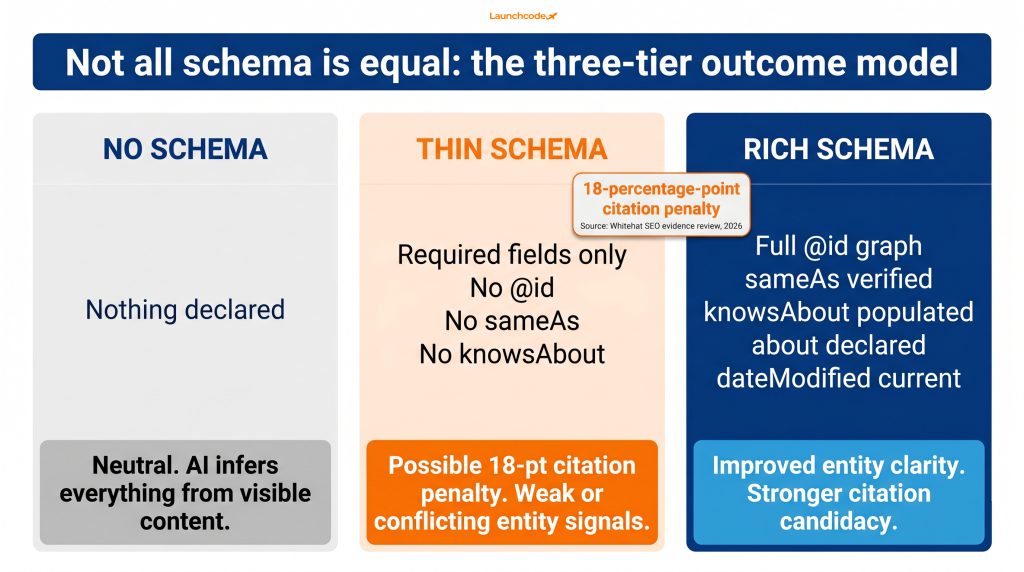
Implementing schema with only the minimum required fields and skipping sameAs, about, and knowsAbout properties does not produce a neutral result. Research reviewed by Whitehat SEO found that generic schema with only required fields produced an 18-percentage-point citation penalty compared to having no schema at all. Thin schema signals a low-effort implementation and reduces AI confidence in the content.
A schema node that declares a Person but provides no knowsAbout, no sameAs, and no @id is barely more informative than a string. It tells the AI system that a person exists but gives it no way to verify who they are or what they know. That incomplete signal can actively confuse the entity matching process.
| Schema quality | What it includes | Likely outcome |
|---|---|---|
| No schema | Nothing | Neutral. AI infers everything from visible content. |
| Thin schema | Required fields only, no @id, no sameAs, no knowsAbout | Possible citation penalty. Weak or conflicting entity signals. |
| Rich schema | Full @id graph, sameAs, knowsAbout, about, dateModified | Improved entity clarity. Stronger citation candidacy when content quality is strong. |
Do not deploy schema until you can populate the properties that matter. A half-complete Person node is not better than no Person node. Schema depth signals content investment. Shallow schema signals the opposite.
JSON-LD adoption on mobile pages climbed from 34% in 2022 to 41% in 2024, according to the HTTP Archive Web Almanac 2024 structured data chapter. A significant portion of that growth is generic implementation with minimal properties. As adoption increases, the brands that populate schema fully have a clearer structural advantage over those that treat it as a checkbox task.
FAQPage schema structures question-and-answer content in a format that matches how AI retrieval pipelines extract information. Each question-and-answer pair becomes a discrete, extractable chunk. AI systems can surface these chunks directly in generated answers without needing to parse surrounding context. The optimal answer length for AI extraction is 40 to 60 words.
FAQPage schema is particularly effective for thought leadership content because it creates answer-shaped passages that AI systems can attribute directly to your brand. A well-structured FAQ at the end of a long technical article gives AI systems clean, citable passages that would otherwise require them to extract meaning from longer prose.
Questions should match the actual phrasing your audience uses when asking about the topic. Each answer should follow this format:
A note on implementation: Google deprecated HowTo rich results and restricted FAQ rich results to government and health sites in late 2024. FAQPage schema no longer triggers the FAQ accordion in standard Google search results for most sites. Its value now sits primarily in the AI extraction pipeline, not in traditional rich results.
Rank Math Pro handles FAQPage schema generation natively through its FAQ block in the WordPress editor. Each question-and-answer pair added to the block is automatically marked up in JSON-LD. The output can be edited directly or extended via WPCode if you need to add custom properties or override the generated markup for specific posts.
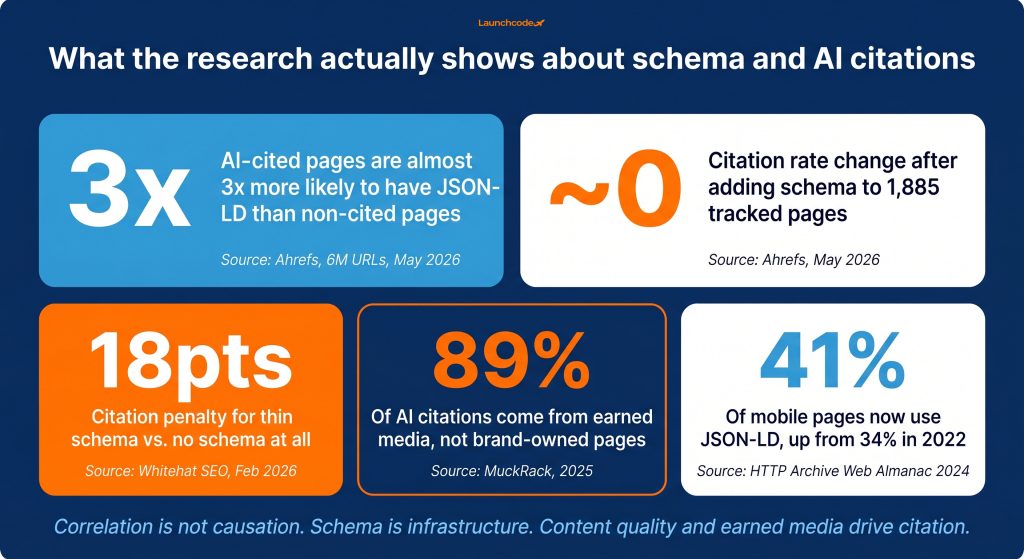
The most reliable way to track AI citation impact is manual prompt sampling. Query ChatGPT, Bing Copilot, and Perplexity monthly using the questions your target audience asks. Record which pages appear, which are cited, and which are ignored. Build a private tracking spreadsheet. This gives you a baseline that no commercial tool currently provides automatically.
Semrush's AI Visibility Toolkit tracks brand and content citations across AI platforms. Otterly.AI monitors AI citations and brand mentions in generative results. Neither provides the granular before-and-after schema correlation you would want from a controlled experiment. They give you directional signals.
Google Search Console added AI Overview data under the Web search type in June 2025. It does not separate AI Overview performance from standard search performance, but watching impression patterns after schema changes can surface directional shifts.
A research benchmark from Data World found that LLMs grounded in knowledge graphs achieve 300% higher accuracy compared to those relying on unstructured data alone. This supports the case for connected schema graphs over isolated types.
Schema markup tells AI systems where to point the credit when they cite a claim. It does not build the authority that makes a claim worth citing in the first place. Both are required. Neither replaces the other.
Up to 89% of AI citations come from earned media: third-party publications, trade press, and external coverage, not brand-owned pages. Your thought leadership content earns citations when it appears in respected publications, gets referenced by credible authors, and generates the external signals that AI systems treat as independent validation.
Schema on your owned content prepares the attribution infrastructure. When an AI system encounters a claim from your brand in an external publication and traces it back to your domain, a well-structured entity graph makes that connection clear and verifiable. Person nodes with sameAs links let the system confirm that the author in the external article and the author on your site are the same entity. Organization nodes confirm the publisher relationship.
A Surfer SEO study of 173,902 URLs found that pages ranking for fan-out queries, the follow-up questions AI systems generate internally when building comprehensive answers, are 161% more likely to be cited than pages ranking only for the main query. Entity-rich schema supports the kind of topic coverage that earns fan-out query visibility. It declares what your content covers, who it connects to, and why the source is credible enough to include in a multi-part answer.
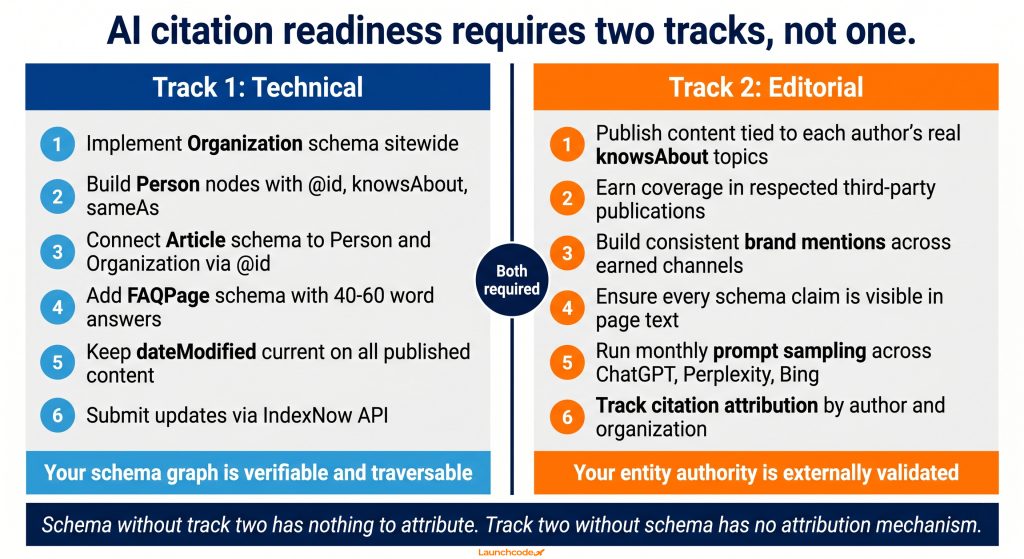
Track one is technical: implement Organization, Person, Article, and FAQPage schema correctly, connect the nodes via @id, populate sameAs and knowsAbout fully, and keep dateModified current. Launchcodex applies this pattern across client sites using Rank Math Pro for base schema generation and WPCode for custom extensions, treating the schema layer as a standard part of every site build.
Track two is editorial: publish content in your team members' real areas of expertise, get that content referenced by credible external sources, and build the external mention footprint that AI systems use to validate the entities your schema declares.
"The schema graph is only as useful as the content strategy behind it. When an author has a strong Person node and then writes consistently on the topics listed in their knowsAbout, the two signals reinforce each other. One without the other is incomplete."
Derick Do, Co-Founder and Chief Product Officer, Launchcodex
Schema without track two is attribution infrastructure with nothing to attribute. Track two without schema is authority with no clear ownership signal attached to it. The brands that build both create the conditions where AI citation becomes consistent.
No. A May 2026 Ahrefs study tracked 1,885 pages that added schema and found citation rates barely moved. Strong content, topical authority, and earned media coverage are the primary drivers. Schema improves how AI systems understand and verify your content. It does not substitute for the signals that make content worth citing.
Person schema with a full @id node, specific knowsAbout values, and sameAs links to LinkedIn or Wikidata. It creates a verifiable author entity that AI systems use to identify and surface credentialed experts in topic-specific answers. Without it, your author is a name, not an entity.
An author string ("author": "Jane Smith") provides a name with no entity AI systems can verify or connect to other data. An author Person node uses a stable @id URL, links to external profiles via sameAs, and lists expertise via knowsAbout. The node creates a citable entity. The string does not.
Query ChatGPT, Bing Copilot, and Perplexity monthly using questions your target audience would ask. Record which pages are cited. Tools like Semrush's AI Visibility Toolkit and Otterly.AI track brand mentions across AI platforms. Google Search Console shows limited AI Overview impression data under the Web search type as of June 2025.
It can hurt. Research reviewed by Whitehat SEO found that schema with only required fields and no sameAs, about, or knowsAbout properties produced an 18-percentage-point citation penalty compared to having no schema. Thin schema signals a low-quality implementation and may reduce AI confidence in the content.
Not for most sites. Google restricted FAQ rich results to government and health sites in late 2024. FAQPage schema still has value for AI retrieval pipelines, where it creates discrete, extractable answer chunks. Implement it for AI extraction, not for the Google FAQ accordion.




Learn how to use Person, Article, Organization, and FAQPage schema to encode authorship, build entity authority, and improve...
Google's second broad core update of 2026 is rolling out now. Here is what it is, how to measure impact accurately in Search...
SEO now means Search Everywhere Optimization. Learn why Google rankings no longer guarantee traffic, what GEO and AEO mean, ...