
Share:

AI marketing & automation


Your Google rankings held steady, but your traffic dropped. That is not a reporting error. It reflects a structural shift in how people search. AI Overviews now answer questions before anyone scrolls to the results. TikTok is where millions of buyers research products. ChatGPT processes hundreds of millions of queries every day. Google rankings are now only one piece of a much larger visibility picture.
This guide explains what Search Everywhere Optimization means, why it matters right now, and how to build a strategy that earns visibility across the platforms where your buyers actually look. You will leave with a clear framework, platform-specific guidance, and the content tactics that get brands cited in AI-generated answers.
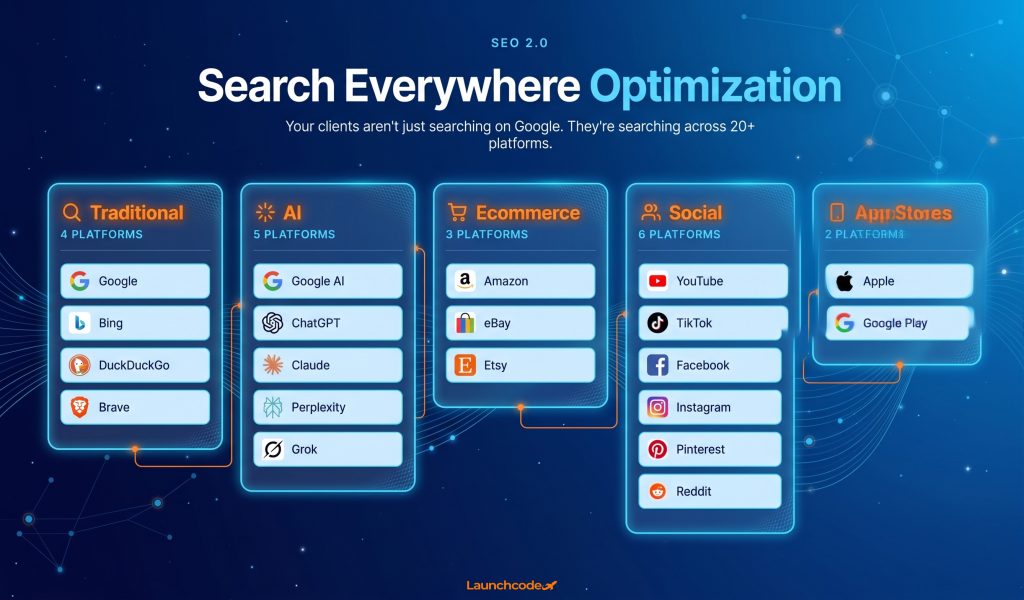
Search Everywhere Optimization is the practice of making your brand discoverable across every platform where people search for information, products, or answers. It keeps traditional SEO as its foundation and adds layers on top: AI answer engines, video platforms, social search, voice, and community forums. The term was coined by Ashley Liddell at Deviation and championed publicly by Rand Fishkin of SparkToro. As Fishkin wrote in March 2026: “Search is a behavior, not a channel.”
Traditional SEO asked one question: how do we rank on Google? Search Everywhere Optimization asks a different one: where does our audience go when they have a problem, and how do we show up there with authority?
The answer is no longer just Google. SparkToro and Datos analyzed 41 websites with significant search activity and found that 23 of them held more than 0.1% of search market share. That list spanned traditional engines, AI tools, e-commerce platforms, and reference sites. Search is genuinely distributed.
Three forces converged at the same time.
First, Google itself changed. AI Overviews now appear on roughly 48% of all Google searches, according to BrightEdge data from February 2026. Those AI-generated summaries answer the question before the user scrolls to any result. Ranking first still matters, but it no longer guarantees a click.
Second, AI platforms scaled fast. ChatGPT now has over 900 million weekly active users as of February 2026, up from 300 million in December 2024. Perplexity attracted roughly 170 million global monthly visitors and processed 780 million queries in a single month in 2025. These are mainstream search behaviors, not edge cases.
Third, younger buyers changed their habits. Seventy-seven percent of Gen Z use TikTok to discover products, and 41% now use social platforms before traditional search engines when looking for information. This behavior is not limited to consumer brands. B2B buyers under 35 research vendors the same way.
Old SEO: rank pages on Google and Bing.
Search Everywhere Optimization: earn visibility across every search surface your audience uses, including:
The strategy does not abandon traditional SEO. It expands it. Rand Fishkin summarized the shift in a May 2025 SparkToro post: “Search Everywhere Optimization is good enough. In a few years, I doubt you’ll even need to explain that you help brands influence people outside of just Google rankings. Everyone will assume the ‘E’ in SEO always stood for Everywhere.”
Google rankings still matter, but they no longer deliver the traffic they once did. Between 58.5% and 68% of Google searches now end without a single click to any website, according to Similarweb research corroborated by SparkToro and BrightEdge. Limor Barenholtz of Similarweb put it directly: “The search results page is no longer a gateway, it’s the destination.” The main driver is AI Overviews, which answer the question above the organic results and remove the need for most users to click at all.
When an AI-generated summary appears at the top of the results page, users get what they need without clicking anything. According to zero-click search data from Click-Vision, queries that trigger an AI Overview have an 83% zero-click rate. Queries processed in Google AI Mode have a 93% zero-click rate.
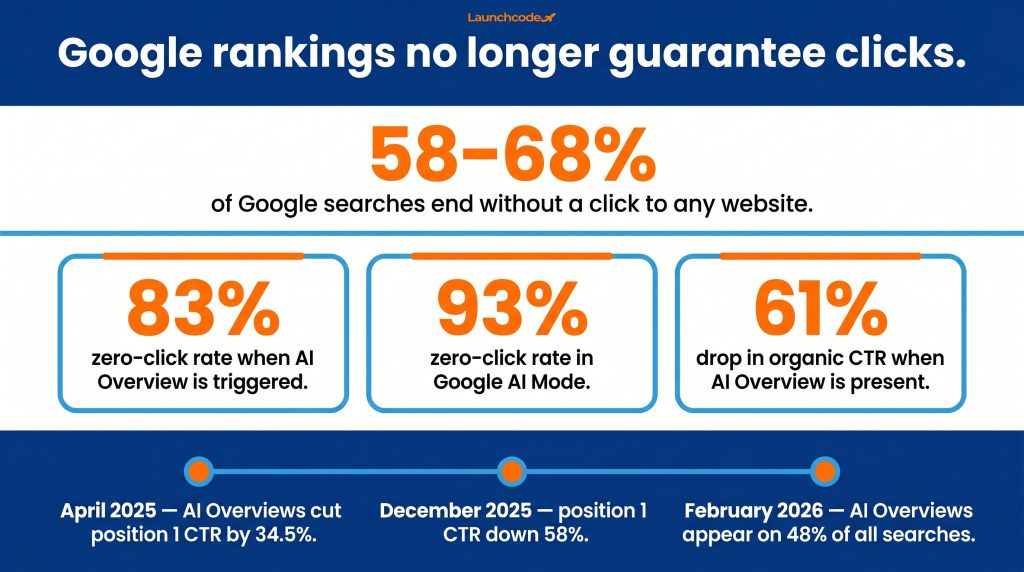
The click-through rate data is specific and serious.
Seer Interactive studied 25.1 million organic impressions and found that organic CTR fell from 1.62% to 0.61% when an AI Overview was present, a 61% decline. Paid search CTR fell 68% under the same conditions. Ahrefs tracked the compounding effect over time: AI Overviews reduced CTR for position one by 34.5% in April 2025. By December 2025, that number had worsened to 58%. The damage doubled in eight months.
Informational content took the hardest hit. According to Ahrefs data from November 2025, 99.9% of informational keywords now trigger an AI Overview. If your business publishes how-to guides, explainers, or educational content to drive traffic, the environment has changed fundamentally.
Gartner predicted in 2024 that traditional search volume would drop 25% by 2026. By the start of 2026, some sectors had already lost 40 to 70% of organic traffic in a single year.
Publishers felt the impact first. Global publisher traffic from Google fell 33% between November 2024 and November 2025. For content-heavy businesses, that is not a rounding error. It is a structural loss that requires a structural response.
The practical implication: you still need to rank on Google. But appearing in the AI-generated summary above the results is now a separate objective with its own tactics. Ranking without citation visibility means your brand is on the page but invisible to the majority of users who read the AI summary and leave.
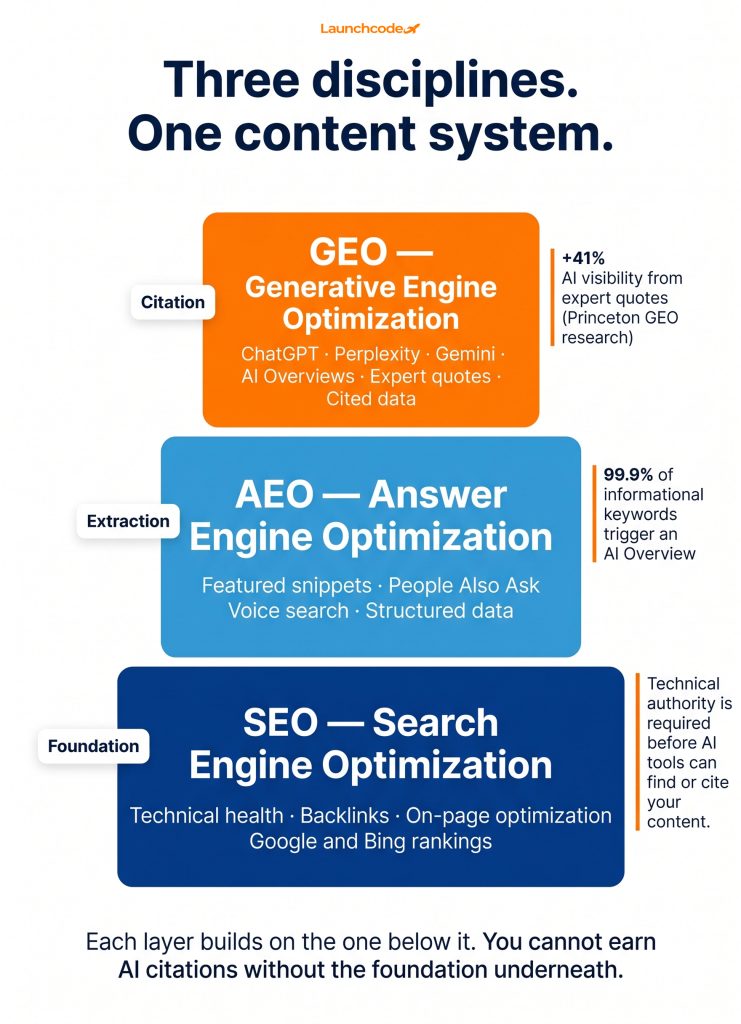
SEO, AEO, and GEO are not competing strategies. They are three layers of the same discipline. SEO builds the foundation: technical health, backlinks, on-page optimization, and rankings in traditional search results. AEO structures your content for direct answer extraction in featured snippets, People Also Ask boxes, and voice results. GEO optimizes content to be cited by generative AI tools like ChatGPT, Perplexity, and Gemini when they synthesize answers from multiple sources.
Each layer builds on the one below it. You cannot earn AI citations if AI tools cannot find and trust your content. They cannot trust your content if your site lacks technical authority and clean indexing. The table below shows where each discipline operates and what it requires.
| Discipline | Full name | Primary target | Core tactic |
|---|---|---|---|
| SEO | Search Engine Optimization | Google and Bing organic results | Technical health, backlinks, on-page optimization |
| AEO | Answer Engine Optimization | Featured snippets, PAA, voice search | Question-based headings, concise direct answers, structured data |
| GEO | Generative Engine Optimization | ChatGPT, Perplexity, Gemini, AI Overviews | Expert quotes, data citations, entity authority, synthesis-friendly structure |
GEO emerged from academic research. Princeton researchers published the foundational study on Generative Engine Optimization and found that specific content tactics measurably improve AI visibility. Adding expert quotes improved AI citation rates by roughly 41%. Adding statistics improved visibility by about 30%. Adding inline citations also improved visibility by about 30%.
These are measurable signal inputs that AI systems respond to consistently. The content recipe is specific: expert attribution, cited data, and structured answers in plain language.
Most teams treat SEO, AEO, and GEO as separate programs with separate owners. The SEO team handles rankings. The content team writes without a GEO brief. No one owns AEO structure.
That approach costs you the compounding benefit. Content optimized for GEO (structured, data-rich, expertly attributed) also satisfies the signals that support AEO (clear direct answers, question-based headings) and strengthens SEO (E-E-A-T, entity relevance, link-worthy depth). One content system that serves all three layers outperforms three systems that operate without coordination.
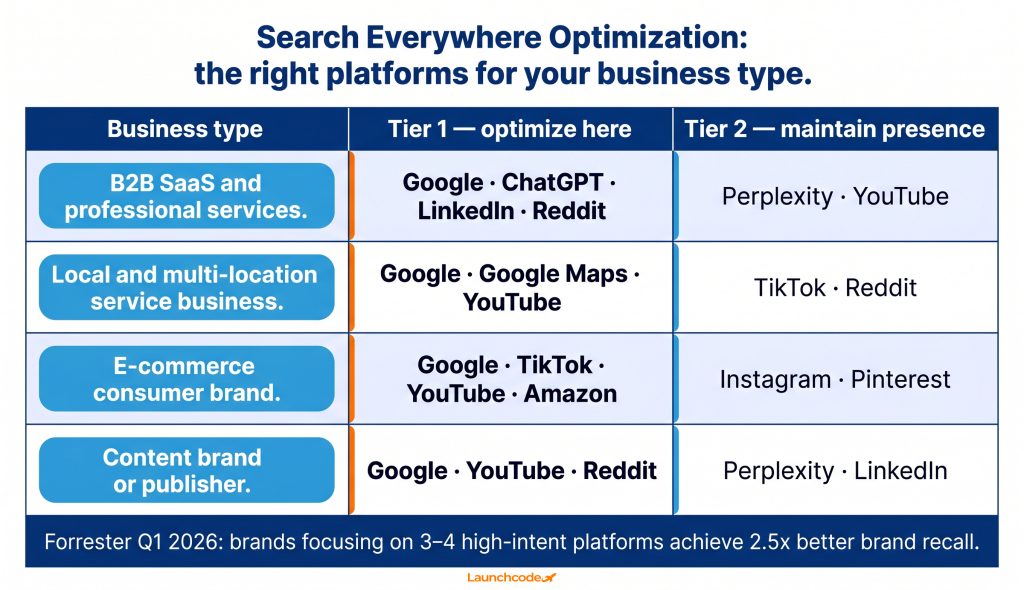
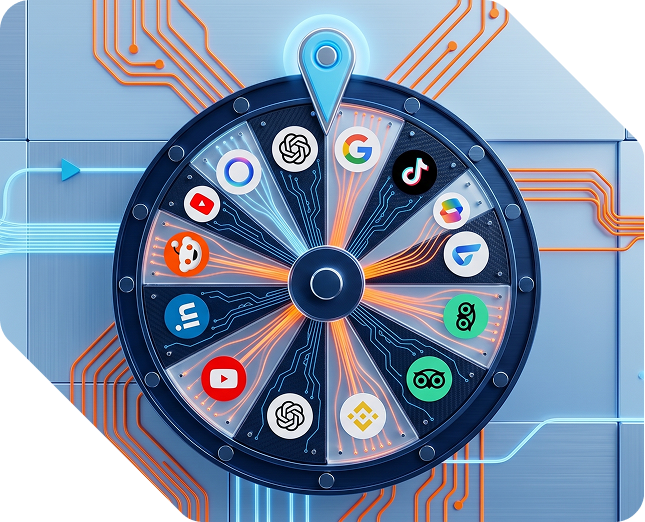
Search behavior is now fragmented across more than 20 platforms. Google still holds the largest share, but a complete picture of where your audience searches depends heavily on industry, buyer age, and query type. A B2B buyer researching a software vendor uses ChatGPT, LinkedIn, and Google in the same session. A Gen Z consumer looking for a product recommendation goes to TikTok first. Treating all audiences as Google-first is now a strategy built on the wrong assumption.
Understanding which platforms your specific audience uses is the starting point for any Search Everywhere strategy. Different platforms serve different intent. The match between platform and intent determines where you invest.
| Platform | Primary search intent | Best for |
|---|---|---|
| Transactional, high-stakes research | All business types | |
| ChatGPT | Synthesis, comparison, research assistance | B2B, SaaS, professional services |
| Perplexity | Cited research, fact-finding | Research-heavy or technical audiences |
| YouTube | How-to, product reviews, tutorials | Consumer brands, SaaS, education |
| TikTok | Discovery, lifestyle, product research | Consumer brands, local businesses, Gen Z audiences |
| Community validation, unfiltered peer reviews | B2B research, consumer trust signals | |
| Amazon | Product-first search | E-commerce and physical products |
| Google Maps and local | Local intent, proximity search | Multi-location brands, local service businesses |
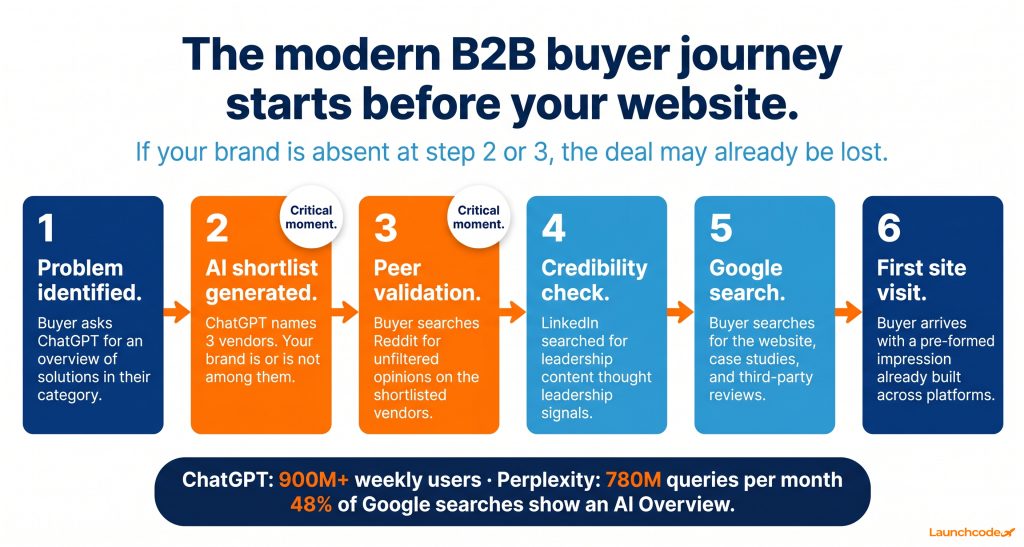
The modern B2B buying process rarely starts on your website. A realistic research path looks like this:
If your brand is absent at step two or three, the buyer may never reach step six. The marketing team may never know the deal was lost before the first touchpoint.
On TikTok, YouTube, and Instagram, search functions are built directly into the platform. Users search by keyword within the app and expect results that feel native to that surface. Content designed for Google rarely transfers without deliberate adaptation.
For TikTok, this means short-form video that answers a specific question in the first three seconds, uses the target keyword in the spoken audio and caption, and earns engagement signals quickly. For YouTube, it means keyword-rich titles, transcript-based closed captions, and chapter markers that help the platform’s search index understand structure. For Reddit, it means genuine participation in relevant communities. Reddit threads that rank in Google are also indexed by AI systems during training and retrieval.
Traditional SEO is not dead. It is the prerequisite for everything else. Without technical health, crawlability, quality backlinks, and on-page optimization, your content will not rank in Google, will not get indexed by AI tools, and will not appear in AI Overviews. The brands that replaced foundational SEO with volume-based AI content are now seeing lower rankings, weaker citation rates, and declining trust signals.
Rand Fishkin addressed this at SEO Week 2025. He noted that SEOs are best positioned to lead the shift to multi-platform visibility because the core discipline has always been about understanding search intent and matching it with the best content. The platforms changed. The principle did not.
Every component of foundational SEO still matters. Here is what to keep and why.
Update your keyword strategy. Informational long-tail queries are now largely answered by AI Overviews before anyone clicks. Prioritize queries with transactional or commercial intent, where users are closer to a buying decision and where AI summaries are less likely to fully satisfy intent on their own.
Update your content metrics. Rankings and impressions are upstream signals. Leads, pipeline, and conversion are the metrics that tell you whether your search strategy is actually working.
Leave behind thin content written purely for keyword density. AI systems and updated Google algorithms both penalize content that lacks depth, specificity, or real expertise. Every page needs a reason to exist beyond the keyword it targets.
“Most of the clients we work with have solid technical SEO in place. What they’re missing is the citation layer. You can rank on page one and still be invisible to half your audience if your content is not structured for AI extraction.” Tanner Medina, Co-Founder & Chief Growth Officer
Search Everywhere Optimization does not mean publishing on every platform. That approach dilutes resources and rarely builds meaningful authority anywhere. Forrester research from Q1 2026 found that mid-market B2B brands focusing on three to four high-intent platforms achieve 2.5x better brand recall than brands that spread budget too thin. The goal is focused depth, not scattered presence. Start with your audience, not the platform list.
The most common mistake is treating “Search Everywhere” as an instruction to be everywhere simultaneously. It is an instruction to understand every place your audience searches and then choose where your investment compounds.
Use this three-step process to choose where to focus.
| Business type | Tier 1 platforms | Tier 2 platforms |
|---|---|---|
| B2B SaaS or professional services | Google, ChatGPT, LinkedIn, Reddit | Perplexity, YouTube |
| Local or multi-location service business | Google, Google Maps, YouTube | TikTok, Reddit |
| E-commerce consumer brand | Google, TikTok, YouTube, Amazon | Instagram, Pinterest |
| Content brand or publisher | Google, YouTube, Reddit | Perplexity, LinkedIn |
Teams that launch on six platforms simultaneously run into the same problems. Content quality drops because volume demands overwhelm the team. Analytics become hard to interpret because too many variables change at once. No single channel builds enough authority to rank or earn citations.
The brands that succeed with Search Everywhere Optimization pick fewer channels than they want, build repeatable content processes on those channels, and expand only when they have clear evidence of traction.
Content earns AI citations when it is specific, expertly attributed, and clearly structured. AI systems like ChatGPT, Perplexity, and Google AI Overviews synthesize answers from sources they can verify and extract from. Vague, generic, or poorly structured content gets filtered out of AI responses even when it ranks well in traditional search. The same content signals that earn AI citations also improve organic rankings and reader trust.
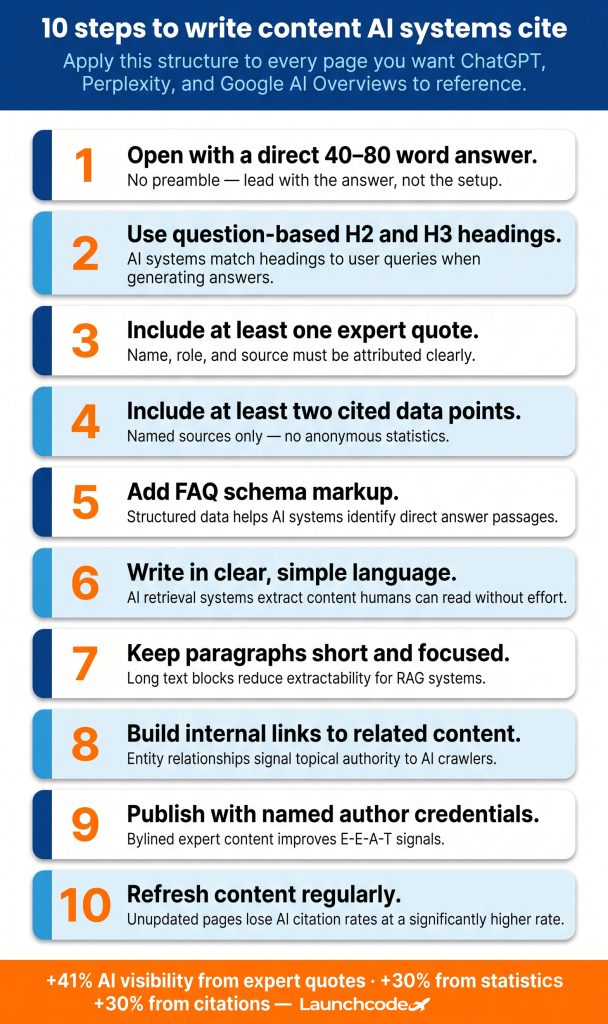
Princeton’s GEO research establishes the content recipe. Include expert quotes with attribution, data with named sources, and inline citations. Each element measurably improves AI visibility. The formula is not complicated, but it requires deliberate execution on every page.
Apply this structure to every page you want AI systems to cite.
AI systems do not cite content they cannot verify from multiple signals. Your content needs external validation: brand mentions on credible third-party sites, consistent business information across directories, and citations in publications your audience reads.
Digital PR is now an SEO function. A feature in an industry publication, an expert quote in a trade outlet, or a well-sourced article that earns mentions in other credible content all create the off-site signal layer that AI systems use to validate whether your brand is worth referencing. This is entity SEO in practice: building your brand’s presence in the knowledge graph by appearing consistently and accurately across the right sources.
A growing set of platforms now track how brands appear in AI-generated answers. Key options for 2026 include:
No platform can guarantee placement in AI-generated answers. What these tools provide is visibility into where you currently appear and where gaps exist.
Agentic SEO is the practice of optimizing your content and site structure for AI agents that search, compare, and transact on behalf of users. Gartner predicts that 90% of B2B purchasing will run through AI agents by 2028. The AI agents that will power those decisions are being trained on the web right now, and whether they can read and trust your content is being determined today.
An AI agent researching vendors for a B2B purchase will check your pricing page, your service descriptions, your case studies, and your structured data. If those pages are unclear, outdated, or missing structured markup, the agent moves to a competitor that is easier to process and evaluate.
Make sure these elements are in place across your site.
B2B buyers are already using AI tools to shortlist vendors before a single sales conversation begins. A realistic buying path at a mid-size company today looks like this: the evaluator asks ChatGPT to compare options in a category. ChatGPT generates a shortlist. The evaluator checks LinkedIn for leadership credibility. They read Reddit threads for peer validation. Then they visit one or two of the sites that made the cut.
If your brand does not appear in the AI-generated shortlist, you are not in the conversation. The deal was lost before the buyer ever landed on your site.
“We see a lot of B2B sites with strong design and weak structure. The content looks good to a human visitor, but a structured query from an AI agent returns nothing useful. That gap closes deals before they open.” Derick Do, Co-Founder & Chief Product Officer
Search Everywhere Optimization is not a future strategy. The shift is already underway. Organic traffic from Google is down across nearly every category. Click-through rates on ranked pages continue to fall as AI Overviews absorb more query intent. ChatGPT, Perplexity, and Gemini process billions of queries every month from buyers who may never visit your website at all.
The brands that adapt now are not abandoning SEO. They are expanding it. Technical health stays as the foundation. Structured, citable content serves as the engine. Platform presence on the right two to four channels provides the distribution layer.
At Launchcodex, our SEO and GEO services are built around exactly this model. We start with a cross-platform visibility audit: where your buyers search, where your brand currently appears, and where the gap is. That gap is your roadmap. The work that follows is technical, content-driven, and platform-specific, with clear deliverables and measurable outcomes at every stage.
If your traffic has dropped or your rankings are not converting, visibility has moved and the strategy needs to catch up.
SEO traditionally stands for Search Engine Optimization. The term has evolved to mean Search Everywhere Optimization, reflecting that search now happens across Google, AI tools like ChatGPT and Perplexity, social platforms like TikTok and YouTube, and community forums like Reddit. The core discipline remains the same. The platform scope has expanded.
Yes. Technical SEO, backlinks, and on-page optimization are the foundation of both organic rankings and AI visibility. Without them, AI tools cannot find, index, or trust your content. What has changed is that traditional SEO alone is no longer sufficient. You need to layer in GEO and AEO tactics to appear in AI-generated answers and on non-Google platforms.
GEO stands for Generative Engine Optimization. It is the practice of structuring content so that AI tools like ChatGPT, Gemini, and Perplexity cite it when generating answers. SEO focuses on ranking in traditional search results. GEO focuses on being selected and synthesized by AI systems. The two are complementary layers, not competing strategies.
Include expert quotes with attribution, specific statistics with named sources, and inline citations throughout your content. Use question-based headings, open each section with a direct answer paragraph, and add FAQ schema markup to your pages. Build third-party brand mentions through digital PR and community participation. According to Princeton GEO research, these tactics can improve AI visibility by 30 to 41%.
Focus on two to four platforms where your specific audience actively searches. Forrester research from Q1 2026 found that mid-market B2B brands focusing on three to four high-intent platforms achieve 2.5x better brand recall than those spreading budget across more channels. Choose platforms based on where your audience actually searches, not where your competitors are posting.
For most B2B brands with buyers over 35, TikTok is not a priority. B2B brands targeting younger buyers in tech, creative, or consumer industries should consider it seriously. YouTube video search is relevant for B2B brands in almost every category and is a stronger starting point for most.
Agentic SEO is the practice of making your content and site structure readable and usable by AI agents that search, compare, and transact on behalf of users. It requires clean schema markup, structured product and service information, consistent data across directories, and clearly defined outcomes in your case studies and service pages. Gartner predicts that 90% of B2B purchasing will run through AI agents by 2028.


Real stories from the people we’ve partnered with to modernize and grow their marketing.