




Tattoo shop SEO: Ranking on Google, Maps, and AI search
Most tattoo shops rank on one search surface and miss the other two. This guide covers Google organic, Maps, and AI search w...




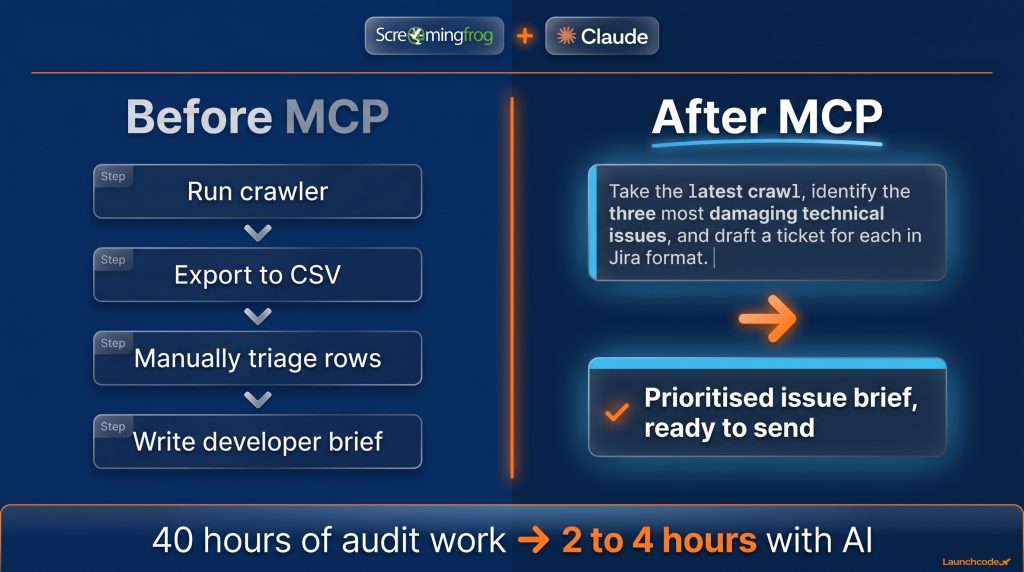
Technical SEO audits have always had the same bottleneck. The crawler collects the data. You export it to a spreadsheet. You manually triage hundreds of rows. Then you write a remediation brief for the developer. That four-step sequence takes hours, and most of it is mechanical work, not strategic thinking.
Screaming Frog changed that on May 19, 2026, when version 24.0 shipped with a native Model Context Protocol (MCP) server. You can now connect the SEO Spider directly to Claude and run the entire audit, from crawl initiation to issue prioritisation to developer ticket creation, using plain English. This guide walks through exactly how to set it up, what it enables, and where the current limits are.
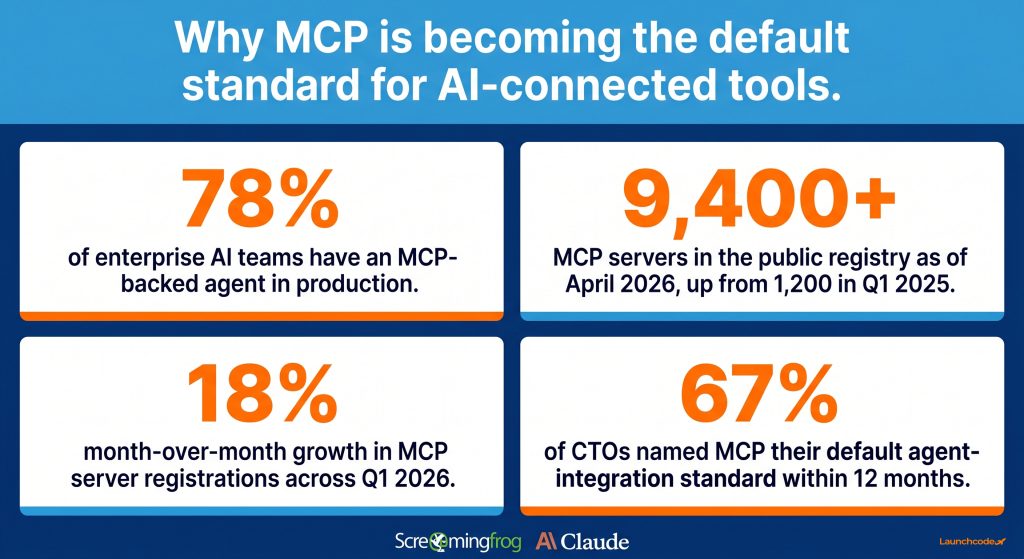
MCP is an open, vendor-neutral protocol that lets AI assistants discover and call external tools in a standardised way. Anthropic released it in November 2024. By April 2026, 78% of enterprise AI teams had at least one MCP-backed agent in production, and the public MCP server registry had grown from 1,200 servers in Q1 2025 to over 9,400, with month-over-month growth tracking at 18%. This is the connectivity standard the SEO industry is building on.
Ready to grow your organic traffic?
Get a free SEO audit from the Launchcodex team.
MCP adoption research from Digital Applied found that 67% of CTOs named MCP their default agent-integration standard within 12 months of first exposure. The protocol is now governed by the Agentic AI Foundation (AAIF) under the Linux Foundation, co-founded by Anthropic, Block, and OpenAI, with support from Google, Microsoft, AWS, and Cloudflare. That governance structure makes it a long-term standard, not a vendor experiment.
Before MCP, connecting an AI model to Screaming Frog meant exporting CSVs, uploading them manually, and hoping the context window could handle the data volume. MCP changes the architecture entirely. Once a server is registered, the AI client can list available tools, decide which to call, and read the results directly into the conversation.
With Screaming Frog v24.0, the crawler becomes one of those tools. You ask Claude to run a crawl, and Claude tells the SEO Spider to do it. No CLI flags. No file exports. No spreadsheets in between. The protocol uses JSON-RPC 2.0 as its communication layer and runs locally on your machine, so crawl data stays inside your environment throughout.
"MCP is the connective layer that lets you build repeatable, AI-native processes across your entire SEO stack. Once you think about it that way, one integration compounds into many." Derick Do, Co-Founder and Chief Product Officer, Launchcodex
Screaming Frog released SEO Spider version 24.0 on May 19, 2026. The headline feature is a native MCP server that lets Claude, LM Studio, Cursor, and other AI clients control the crawler using natural language. The release also adds Auto Compare Crawls, an uncrawlable links detection filter, email crawl export attachments, real-time AI model validation, and Java 25 support. The MCP server is maintained in-house by Screaming Frog Ltd and uses Node.js as its runtime.
Dan Sharp, Screaming Frog's founder, wrote in the official v24.0 release post that the integration is "not a replacement for an experienced SEO professional, obviously," but that it makes daily workflows significantly more efficient. The community response on launch day confirmed it. One verified user commented on the release: "Just updated and the MCP server is incredible. Letting Claude handle the export and visualisation step while I focus on the actual analysis is going to change my whole audit workflow."
The MCP server gets the attention, but three other features in v24 combine naturally with it:
The uncrawlable links feature deserves specific attention. Google cannot pass PageRank through any of those link types. Sites built on JavaScript-heavy frameworks or older CMS templates often have dozens of them. Pairing the v24 detection filter with Claude analysis gives you a prioritised fix list without any manual row-by-row triage.
There are two types of Screaming Frog MCP servers. The official one ships with v24 and is maintained by Screaming Frog Ltd. A separate ecosystem of community alternatives, compared in depth by Claudio Novaglio's SEO AI Lab, are Python-based wrappers on the Screaming Frog CLI. The most-used community server, bzsasson/screaming-frog-mcp, had 43 GitHub stars as of May 19, 2026.
For production use, the official server is the right choice. It is documented, actively maintained, and will expand based on user feedback. Community servers are useful for developers building custom tooling around the CLI.
This setup requires three things: a paid Screaming Frog license, version 24.0 of the SEO Spider, and either Claude Desktop or Claude Cowork installed on the same local machine. The free Screaming Frog tier caps crawls at 500 URLs and blocks saving, scheduling, and JavaScript rendering. None of the core MCP audit workflows function reliably without the paid license.
Prerequisites checklist:
The SEO Spider must remain open and running during any MCP session. The connection drops if you close the application. This is a local service, not a cloud integration.
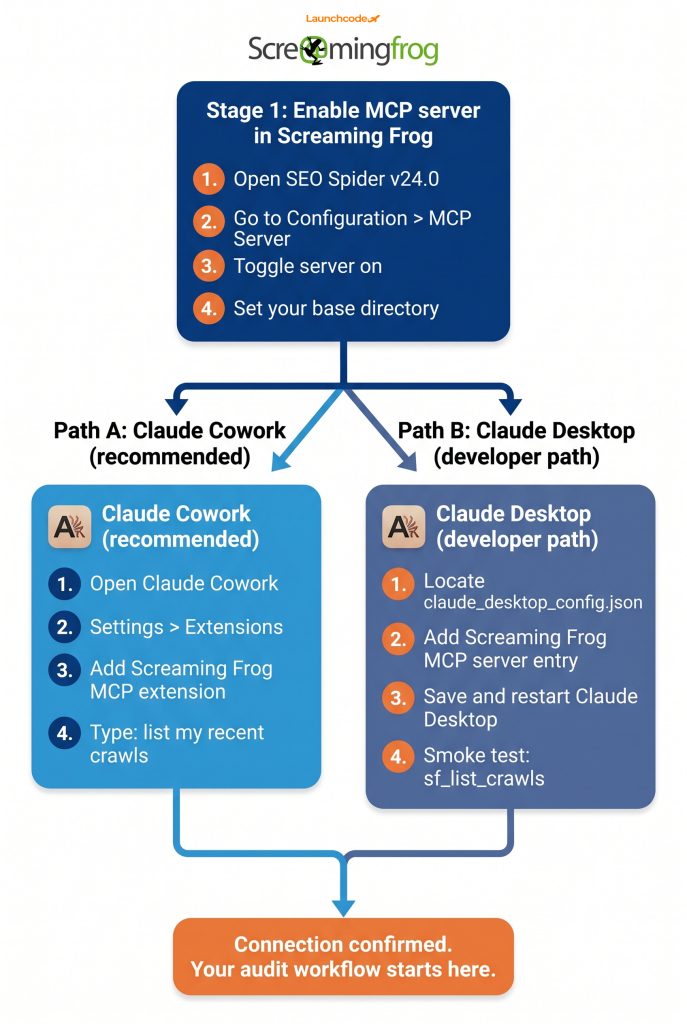
Setup has two stages: enable the MCP server inside Screaming Frog, then register it in your Claude client. The registration path differs between Claude Desktop and Claude Cowork. Either path takes under 15 minutes once prerequisites are in place. Claude Cowork requires no config file editing. Claude Desktop requires one JSON edit and a restart.
Every export, script, or screenshot Claude produces will land in this folder.
If Claude returns a list of your saved crawl projects, the connection is live and ready.
If Claude confirms your base path and lists your recent projects, setup is complete.
| Problem | Cause | Fix |
|---|---|---|
| Tools not appearing in Claude Desktop | JSON syntax error in config file | Validate JSON before saving; one misplaced comma disables all servers |
| Connection drops mid-session | SEO Spider closed or idle | Keep the Spider open throughout any MCP session |
| Stale crawl path error on Windows | Interrupted crawl left a lock file | Delete the crawl.seospider file from the SF install directory |
| Large crawl times out | Default timeout too short for site size | Increase SF_EXPORT_TIMEOUT_SECONDS in the MCP config |
The integration changes what SEO audits produce. The audit and the action plan now happen inside the same conversation window. Ridho Putradi S'Gara at Search Agency, who installed the integration on launch day, described the shift: "The technical audit moves from a sequence of clicks into a conversation. The reporting moves from a deck of screenshots into a live discussion with someone who has already read the data."
Research published by AIRankVision found that what once took 40 hours of human effort on a technical SEO audit can now be processed and analysed by AI in 2 to 4 hours. The Screaming Frog MCP is the tooling layer that makes that reduction real in practice, not just a theoretical benchmark.
"The moment we saw Claude turn a crawl into a prioritised developer brief, it was clear this belongs in every client engagement. The output is ready to action, and that changes how fast we move." Tanner Medina, Co-Founder and Chief Growth Officer, Launchcodex
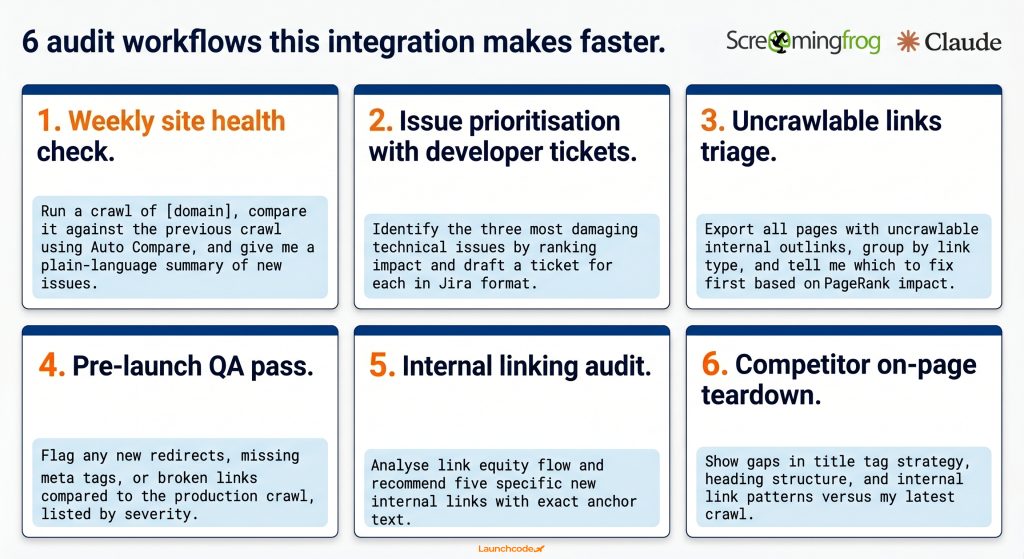
Run a crawl, compare it to last week, and produce a one-page summary of new and resolved issues.
Prompt to use: "Run a crawl of [domain], compare it against the previous crawl using Auto Compare, and give me a plain-language summary of new issues and anything that has been fixed since last week."
A process that previously took 30 minutes of manual comparison becomes a 3-minute prompt and review.
Identify the most damaging technical issues and turn them into actionable developer briefs.
Prompt to use: "Take the latest crawl, identify the three most damaging technical issues by potential ranking impact, and draft a ticket for each in Jira format."
A firsthand test by Derick Do, CPO at Launchcodex, confirmed the output from this prompt was usable enough to send to a developer without significant rewriting.
Surface link elements Google cannot follow and prioritise them by page importance.
Prompt to use: "Export all pages with uncrawlable internal outlinks from the latest crawl, group them by link type, and tell me which to fix first based on PageRank impact."
This pairs the new v24 detection filter with Claude's prioritisation logic. Fixing uncrawlable links restores internal link equity flow to pages that need it.
Catch deployment errors before they reach production.
Prompt to use: "Crawl [staging URL], flag any new redirects, missing meta tags, or broken links compared to the current production crawl, and list them by severity."
This catches the class of issues that manual QA misses, especially on large migration or redesign launches.
Move internal linking from a quarterly project to a monthly conversation.
Prompt to use: "Pull the internal link graph from the latest crawl, analyse link equity flow, and recommend five specific new internal links to add with the exact anchor text to use."
Prompt to use: "Crawl [competitor domain], export key on-page elements, and compare them against my latest crawl for [your domain]. Show gaps in title tag strategy, heading structure, and internal link patterns."
This gives content and SEO teams a structured competitive baseline in one session, without manual side-by-side work in spreadsheets.
Screaming Frog v24.0 exposes both the bulk page content export and the embeddings export through MCP. That means Claude can pull the body content of every URL in a crawl, generate embeddings, and group pages by semantic similarity inside a single conversation. No Python scripts. No custom code. For content teams dealing with cannibalisation and content sprawl across hundreds of URLs, this is the most underused capability in the v24 release.
Content cannibalisation happens when multiple pages on a site compete for the same search query. Identifying it at scale previously required either expensive specialist tooling or a custom embedding script. The v24 MCP workflow removes both barriers.
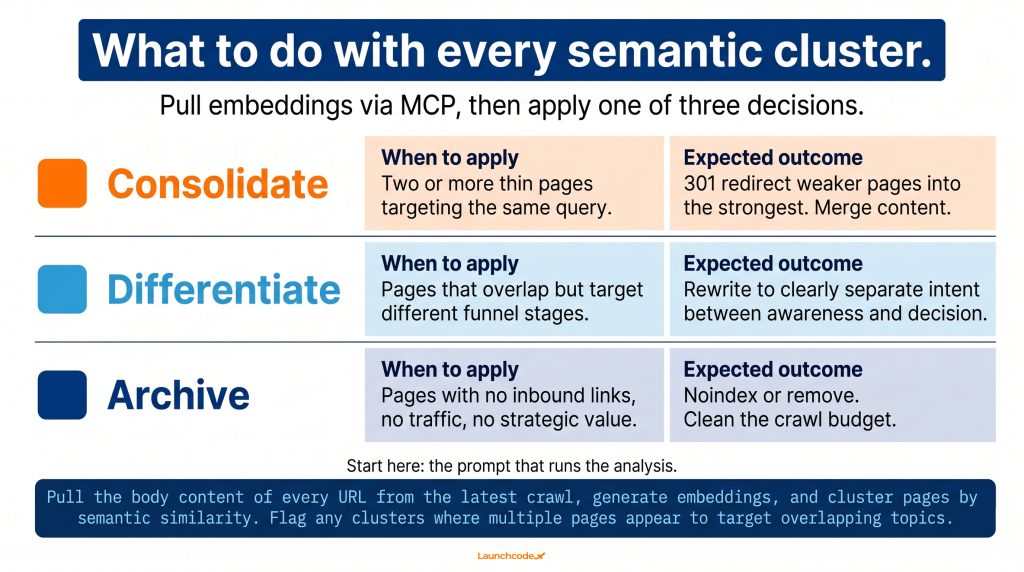
Start with this: "Pull the body content of every URL from the latest crawl of [domain], generate embeddings, and cluster pages by semantic similarity. Flag any clusters where multiple pages appear to target overlapping topics."
Claude returns a grouped list. Content teams then apply one of three decisions to each cluster.
| Decision | When to apply | Expected outcome |
|---|---|---|
| Consolidate | Two or more thin pages targeting the same query | 301 redirect weaker pages into the strongest; merge content |
| Differentiate | Pages that overlap but target different funnel stages | Rewrite to clearly separate intent (awareness vs decision) |
| Archive | Pages with no inbound links, no traffic, no strategic value | Noindex or remove; clean the crawl budget |
This analysis feeds directly into the kind of content structure work that affects both traditional ranking signals and visibility in AI-generated search results. A site with clean topical structure is easier for both Google and AI systems to cite accurately.
Not every Screaming Frog feature is available through MCP yet. Screaming Frog has committed to expanding the feature surface based on user feedback, but the current version has real gaps. The most significant: the SEO Spider must remain open on your machine for any session to work. This is not a background cloud service.
An AllGreatThings agency team that crawled a live 973-URL client site through the MCP on May 19, 2026 put it plainly: "Screaming Frog's MCP server does not replace technical SEO judgment. It removes friction between investigation, evidence collection, and reporting."
Current confirmed limitations as of May 27, 2026:
The Screaming Frog and Claude integration is a practical time-saver today and a signal of where the broader SEO stack is going. Screaming Frog is among the first desktop crawlers to ship a first-party MCP server. More tools will follow. The MCP registry grew from 1,200 to over 9,400 servers in under 14 months. Every major AI platform now supports the protocol.
Agencies that build structured, repeatable MCP-native audit workflows now will compound the efficiency advantage as more tools, including Google Search Console connectors, Ahrefs integrations, and CRM-linked reporting layers, add their own MCP servers. A technical audit that today runs across Screaming Frog and Claude could, within six months, pull GSC performance data, link metrics, and CMS page data into the same conversation window.
There is also a GEO dimension to this work. At Launchcodex, technical SEO and GEO strategy are built on the same foundation: clean site structure, crawlable links, clear content hierarchy, and accurate entity signals. A site that passes a thorough technical audit is better positioned to be cited in AI-generated search answers, where thin content, cannibalised pages, and uncrawlable links create visibility gaps.
The setup described in this guide takes under an hour. The time savings start on the first audit you run. The prompt library, crawl comparison workflows, and semantic clustering routines are repeatable assets your team builds once and runs every week.
MCP is an open standard that lets AI assistants like Claude connect to and control external tools. For SEO, it means Screaming Frog can pass crawl data directly to Claude without manual exports or copy-paste steps. The result is faster audits, less manual triage, and action plans that come out of the same session as the crawl.
Yes. The free version is capped at 500 URLs and blocks saving, scheduling, and JavaScript rendering. Most production audit workflows require the paid license at $259 per year per user.
Yes. Screaming Frog v24.0 provides installers for Windows, macOS Apple Silicon, macOS Intel, and Linux. The MCP registration path differs slightly by Claude client but the server itself is cross-platform. Windows users should use absolute paths with proper escaping in the claude_desktop_config.json.
No. The integration removes friction from data collection, export, and triage steps. A human still needs to review output, apply business context, and make strategic decisions. Dan Sharp stated this directly in the v24 release: it is not a replacement for an experienced SEO professional.
As of v24.0, Claude can access crawl summaries, individual URL data, broken links, redirect chains, on-page elements, internal link graphs, bulk page content exports, and embeddings exports. Not all SEO Spider features are currently exposed. Screaming Frog is expanding the feature set based on user feedback.
No. The MCP server runs locally on your machine and writes to a base directory you define. Data stays within your local environment during any MCP session.
A firsthand test on May 19, 2026 crawled a 973-URL client site to 100% queue completion in roughly 13 minutes. Queue completion does not always mean all downstream processing is finished, especially when connected APIs like Ahrefs or Google Search Console are enabled. Larger sites will take proportionally longer.




Most tattoo shops rank on one search surface and miss the other two. This guide covers Google organic, Maps, and AI search w...
Screaming Frog v24.0 ships with a native MCP server. Learn how to connect it to Claude in under 15 minutes, run technical SE...
Learn how AI lead scoring works, what signals it uses, and how to set it up for your team. Includes a tool comparison table,...