
Share:

AI marketing & automation


Most sales teams don’t have a lead volume problem. They have a prioritization problem. Reps spend hours chasing contacts who downloaded a resource and then disappeared, while actual buyers who visited the pricing page three times this week sit at the bottom of the queue. The result is a pipeline that looks active but converts poorly.
AI lead scoring addresses the root cause. Instead of assigning fixed points to individual actions, machine learning models evaluate hundreds of signals together and update each prospect’s likelihood to convert in real time. This article explains how the technology works, what data it requires, which tools fit which budgets, and how to confirm that your model is improving revenue outcomes.
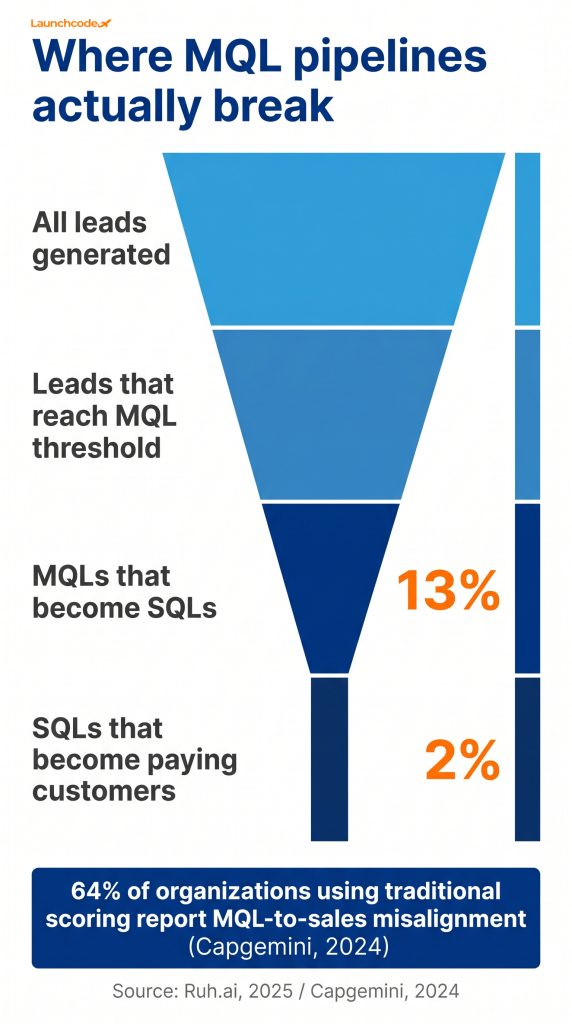
Traditional lead scoring assigns points to actions, not to intent. A contact downloads an eBook and earns 10 points. They open an email and earn five more. Accumulate enough points and the lead gets handed to sales, regardless of whether that contact is close to buying. Capgemini’s 2024 research found that 64% of organizations using this approach experienced misalignment between their MQLs and actual sales outcomes.
The logic sounds reasonable at first. Weight the actions that seem meaningful, set a threshold, hand off what clears it. The problem is that those point values are assumptions, not data. Someone on the marketing or ops team decided that attending a webinar is worth 15 points. That decision gets baked into the model. When buyer behavior shifts, no one updates the rules. The model keeps scoring against patterns that no longer reflect how buyers move.
The downstream numbers confirm the failure. Across B2B industries, average MQL-to-SQL conversion sits at just 13%, and only 2% of all MQLs ever become paying customers. That is a scoring accuracy problem, not a lead quality problem.
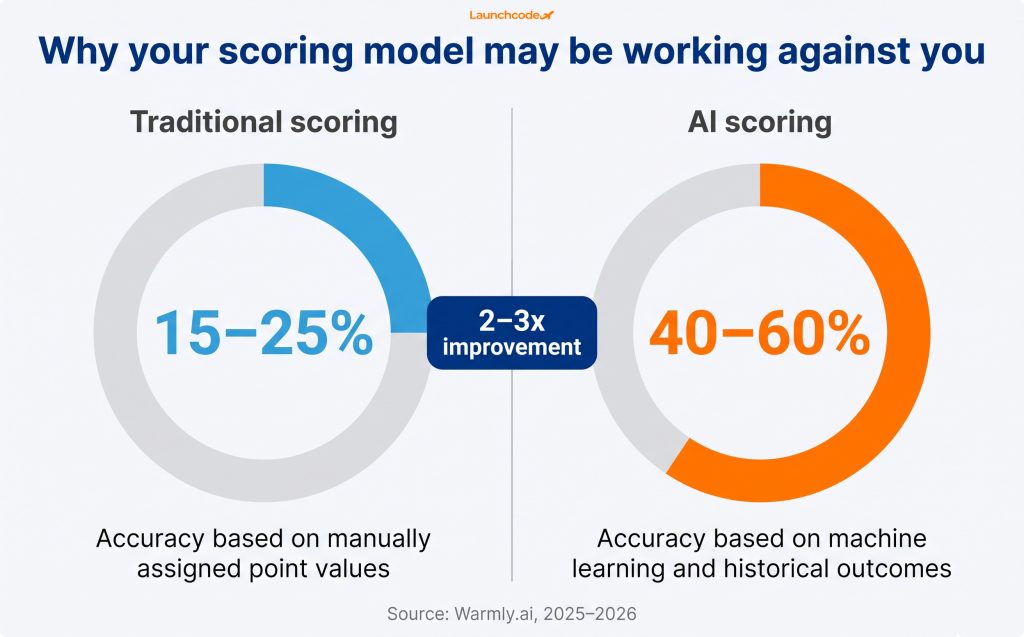
AI lead scoring uses machine learning to analyze your historical CRM data, identify the patterns that preceded closed deals, and apply those patterns to score new leads automatically. The model does not need a human to decide what a pricing page visit is worth. It learns that from outcomes. Traditional manual scoring achieves 15 to 25% accuracy. AI scoring reaches 40 to 60%, a two to three times improvement.
The shift is from assumption to evidence. Instead of asking what actions seem like buying signals, AI scoring asks which patterns your actual closed customers shared, and which new leads most closely match those patterns.
A 2024 Deloitte Insights report found that companies using AI for lead scoring saw a 20 to 30% increase in conversion rates and up to 35% improvement in marketing ROI. A 25% improvement in conversion rate across a pipeline of a thousand leads is a materially different revenue outcome.
Most AI scoring platforms follow this cycle:
The model improves over time. Every new closed deal adds training data. Every disqualified lead teaches the system what not to prioritize.
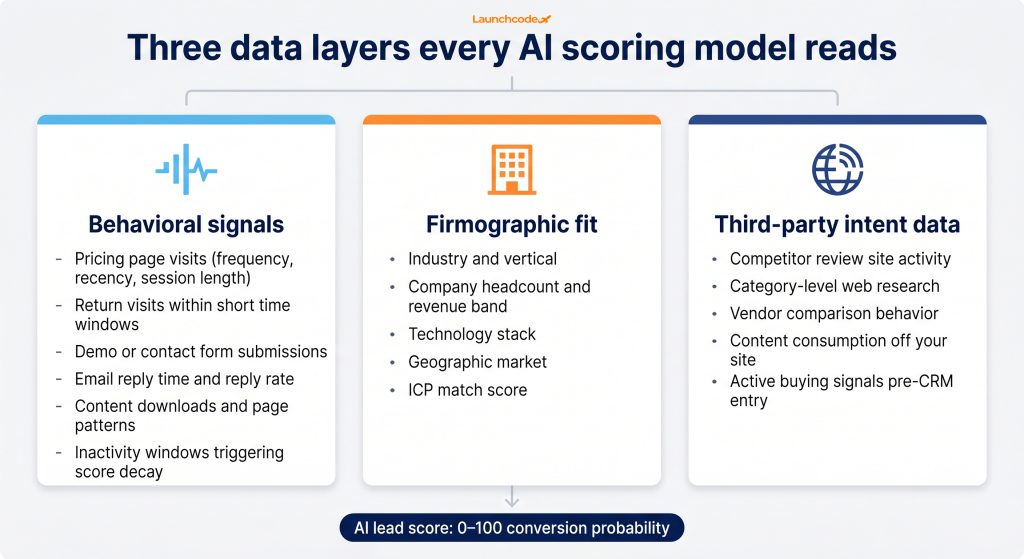
AI models do not just track what a prospect did. They look at the sequence, timing, and combination of actions across multiple data sources. A contact who visits the pricing page once is different from one who visits it three times over five days after reading two case studies. The model knows the difference because it has seen both patterns play out in your historical data.
These come from your website, email platform, and marketing automation tools:
Even the highest engagement score means little if the company is the wrong size, in the wrong industry, or outside your target geography. AI models weight firmographic match against your ICP alongside behavioral signals. Common inputs include industry and vertical, company headcount and revenue band, technology stack, and geographic market.
According to the 6sense 2025 B2B Buyer Experience Report, 61% of the buying journey is already complete before a prospect ever contacts a sales rep. Buyers research solutions, read competitor reviews, and consume content long before they appear in your CRM. Intent data platforms track this research activity across the broader web. When a prospect from a target account compares vendors on a review site, reads articles about your product category, and visits a competitor’s pricing page, that activity registers as a high-intent signal, even if they have never touched your website.
AI models apply score decay automatically. When a lead stops engaging, their score drops. When data quality flags appear, such as a generic email domain or mismatched firmographic data, the model adjusts accordingly. This keeps the priority queue clean without manual review.
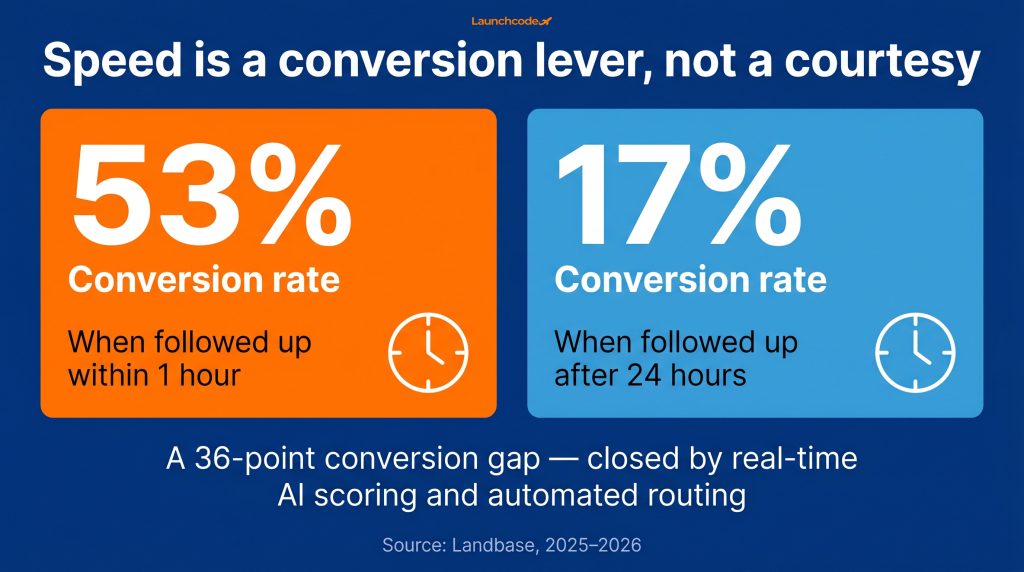
If your scoring model updates every four to twelve hours, you are already behind. A prospect who visits your pricing page at 10pm should trigger a rep task by 9am. A batch update the following afternoon means that window is gone. Leads contacted within the first hour convert at 53%, compared to 17% for follow-ups after 24 hours. That is a structural revenue gap, not a marginal difference.
Batch scoring was an acceptable compromise when real-time data processing was expensive and technically complex. It is no longer either. Modern AI scoring platforms process behavioral events as they happen and update lead priority immediately.
For teams using GoHighLevel as their CRM, this is achievable without enterprise budgets. Workflow automation can route leads, create tasks, and trigger outreach sequences the moment a scoring threshold is crossed, all within the same platform that manages pipeline and communications.
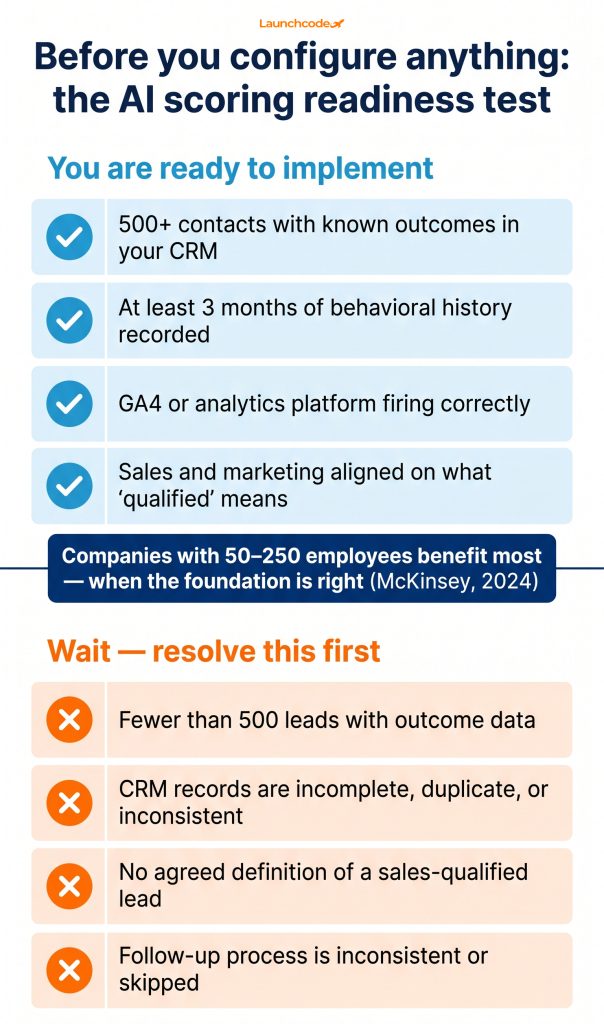
Most AI scoring implementations fail because of what went into the model, not because of the model itself. Garbage data produces garbage scores. Scores no one trusts produce no behavior change. According to McKinsey’s “The State of AI in 2024” report, B2B companies with 50 to 250 employees benefit disproportionately from predictive lead scoring, but only when the foundation is solid. Work through this checklist before selecting any tool.
“The scoring model is only as useful as the data feeding it. Before you configure anything, audit what your CRM actually captures and what it is missing. Most teams discover gaps in behavioral data that explain why their pipeline quality is inconsistent.” Derick Do, Co-Founder and Chief Product Officer, Launchcodex
Data readiness is necessary but not sufficient. The other half of the readiness problem is organizational. Before configuring any model, both teams must agree on the conversion event the model should optimize for, whether that is opportunity creation, pipeline stage advancement, or closed-won revenue. Teams that skip this step build a model that answers the wrong question.
The KPI misalignment problem runs deeper than most revenue leaders expect. If marketing is measured on MQL volume and sales is measured on closed revenue, the incentives pull in opposite directions. Marketing sends more leads to hit their number. Sales ignores them because most are not worth pursuing. AI scoring surfaces the right leads more accurately, but acting on those leads requires shared accountability metrics across both teams.
Implementation does not require a data science team. It requires clean data, a defined ICP, alignment on outcomes, and the right tool for your existing stack. Most teams can reach a functional model in four to eight weeks. Follow these steps in order and do not skip the pilot phase.
The right tool depends on your CRM, your data volume, and your budget. Enterprise platforms offer deeper intent data and account-level intelligence. SMB-friendly options offer faster setup and simpler integration. A hybrid model combining hard ICP filters with machine-learned scoring works well for most growth-stage teams. Pricing shown is based on publicly available vendor information as of early 2026 and may change.
| Tool | Best for | Key strength | Starting price | Watch out for |
|---|---|---|---|---|
| HubSpot Predictive Scoring | SMB and mid-market HubSpot users | Native CRM integration, fast setup | $90 to $150 per seat per month | Requires 500+ contacts and 3 months history before activating |
| Salesforce Einstein | Enterprise Salesforce teams | Deep behavioral and intent signal analysis | $215+ per user per month | High complexity, requires clean Salesforce data throughout |
| 6sense | Mid-market to enterprise ABM programs | Account-level intent data, buying committee scoring | $25,000 to $100,000+ per year | Not practical without a dedicated RevOps function |
| MadKudu | B2B SaaS teams with strong data | Transparent model logic, explainable scores | From $999 per month | Requires clean data and some technical setup |
| Clay | RevOps teams building custom models | Enrichment-first, highly customizable scoring | $149 to $800 per month | Requires more manual configuration than plug-and-play tools |
| Apollo.io | SMB outbound sales teams | All-in-one: data, scoring, and outreach sequences | From $49 per user per month | Less suited for purely inbound scoring use cases |
| Warmly | Teams needing real-time action triggers | Signal-layered scoring with workflow automation | $799 to $1,999 per month | Best suited for teams with existing outreach infrastructure |
| Launch Portal | SMBs and agencies managing client pipelines | All-in-one CRM with real-time scoring triggers, pipeline automation, and workflow-based routing | Available through Launchcodex | Scoring logic requires proper workflow configuration to activate fully |
Many teams, especially those without a dedicated RevOps function, benefit from combining hard rules with AI-learned scoring. Set non-negotiable filters first, such as “must be in North America” or “company must have more than 10 employees,” and let the AI model handle the remaining differentiation. This reduces noise without requiring the model to do all the filtering from scratch, and it makes score logic easier to explain to skeptical sales reps.
A scoring model that generates numbers but does not change pipeline outcomes is not working. The most common failure mode is treating the score as the output rather than the input. Track these metrics monthly to confirm that scoring is improving revenue results rather than adding a score field to your CRM.
“MQL-to-SQL conversion rate is the first number I look at when evaluating whether a scoring system is doing its job. If sales is not accepting more of what marketing sends, the model has not changed the behavior. That is the actual test.” Tanner Medina, Co-Founder and Chief Growth Officer, Launchcodex
Most pipeline problems are not lead generation problems. They are prioritization problems that compound over time. Reps burn out chasing bad leads. Marketing and sales argue over quality. Revenue stalls even as volume grows.
AI lead scoring reframes the question. Instead of asking how to generate more leads, the right question is how to ensure the right lead reaches the right rep at the right moment. Answering that question well requires three things working together: clean data gives the model signal to learn from, sales-marketing alignment ensures the model optimizes for outcomes both teams care about, and real-time routing turns scores into action before buying intent fades.
Companies using AI for lead scoring achieve 138% ROI on lead generation compared to 78% for companies operating without scoring. The difference is not the model itself. It is the system around the model.
At Launchcodex, building that system means connecting data infrastructure, CRM configuration, AI automation, and workflow design into a loop that improves over time. If your pipeline generates leads but loses revenue somewhere between marketing and sales, our AI automation and data infrastructure services are a practical place to start.
AI lead scoring uses machine learning to automatically rank sales prospects by their likelihood to convert. The model analyzes historical CRM data, behavioral signals, firmographic fit, and third-party intent data to assign each lead a probability score. Scores update in real time as new data flows in, replacing the manual point systems used in traditional scoring.
Traditional scoring assigns fixed points to specific actions. AI scoring learns patterns from your actual historical outcomes. It identifies which combinations of behavior and firmographic fit preceded closed deals, then applies those patterns to new leads. Traditional manual scoring typically achieves 15 to 25% accuracy. AI scoring reaches 40 to 60%.
Most AI scoring platforms require a minimum of 500 contacts with known outcomes and at least three months of behavioral history before the model can generate reliable scores. With fewer than 500 historical leads, statistical patterns are too thin to produce accurate predictions. Clean your CRM and collect outcome data before activating any model.
For SMB teams or those without a dedicated RevOps function, Apollo.io and HubSpot Predictive Scoring offer the fastest setup and the most accessible pricing. Apollo.io starts at $49 per user per month and combines data enrichment with scoring and outbound sequences. HubSpot’s scoring is native to the CRM, which reduces integration complexity and setup time.
Track MQL-to-SQL conversion rate, lead-to-opportunity conversion rate, sales acceptance rate, and pipeline velocity month over month. Confirm that leads in the highest score tier convert at meaningfully higher rates than those in lower tiers. If the gap is narrow, the model’s signals are inaccurate and need retraining on updated outcome data.
No. AI scoring improves prioritization accuracy, but it cannot fix misaligned incentives. If marketing is measured on MQL volume and sales is measured on revenue, that organizational conflict will undermine the model regardless of its technical quality. Both teams must agree on the conversion event the model optimizes for before any scoring configuration begins.


Real stories from the people we’ve partnered with to modernize and grow their marketing.