
Share:

AI marketing & automation


Marketing teams today manage more channels, more customer data, and more expectations than any previous generation, usually with the same headcount. Manual execution cannot keep pace with the volume of signals a modern customer generates across email, ads, web, and social. The gap between what customers expect and what teams can realistically deliver keeps widening.
AI marketing automation closes that gap. It handles the data analysis, timing decisions, and personalization that would otherwise require an analyst and a marketing manager working in parallel on every contact. This guide explains what AI marketing automation is, how it differs from what most teams already have, where it delivers the strongest returns, and what you need in place before you build.
AI marketing automation is the use of machine learning, predictive analytics, and natural language processing to run marketing tasks automatically with minimal human input at each step. Unlike traditional rule-based systems, AI does not follow a script you write in advance. It analyzes customer behavior across channels, identifies patterns, and adjusts its decisions in real time based on what the data shows. The system gets more accurate over time because it learns from every interaction.
Traditional automation follows fixed if-then logic. If someone downloads a PDF, send an email three days later. That rule fires identically for every contact, regardless of whether they opened every previous email or none of them. There is no adjustment, no learning, and no personalization beyond what you manually configured.
AI changes the underlying model. Instead of executing pre-written rules, the platform continuously analyzes behavioral signals: what pages a contact visited, which emails they opened, when they typically engage, and how similar contacts behaved before converting. It uses those signals to predict the best next action, content, and timing for each individual.
The process has four core components that work together:
In most organizations, AI marketing platforms connect directly to a CRM so automation can respond to real-time updates in customer profiles. As IBM explains in their breakdown of AI marketing automation, the system analyzes incoming data to determine the most effective timing, content, and channel for every individual interaction, rather than following a script someone pre-defined.
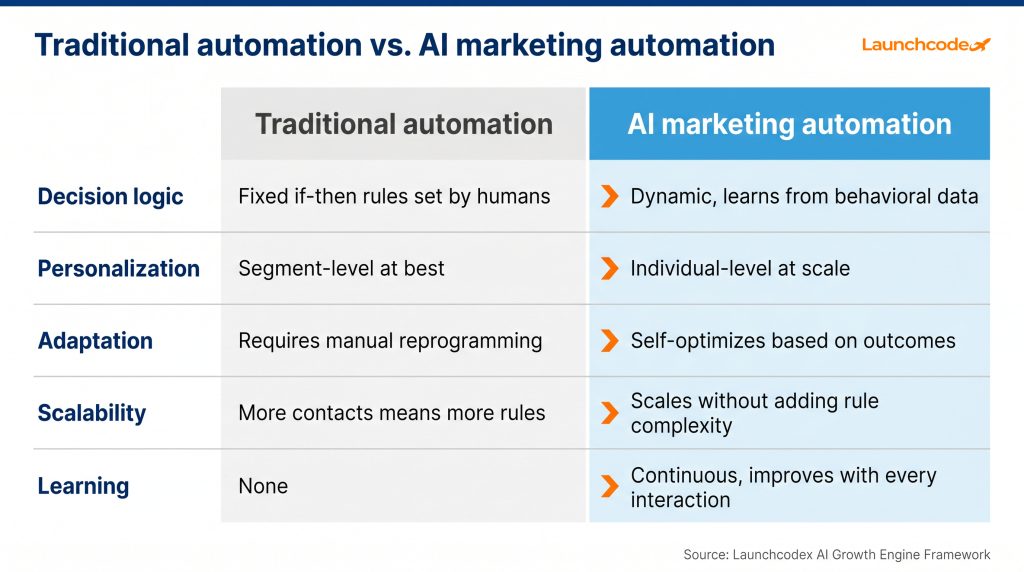
| Dimension | Traditional automation | AI marketing automation |
|---|---|---|
| Decision logic | Fixed if-then rules set by humans | Dynamic, learns from behavioral data |
| Personalization | Segment-level at best | Individual-level at scale |
| Adaptation | Requires manual reprogramming | Self-optimizes based on outcomes |
| Scalability | More contacts means more rules | Scales without adding rule complexity |
| Learning | None | Continuous, improves with every interaction |
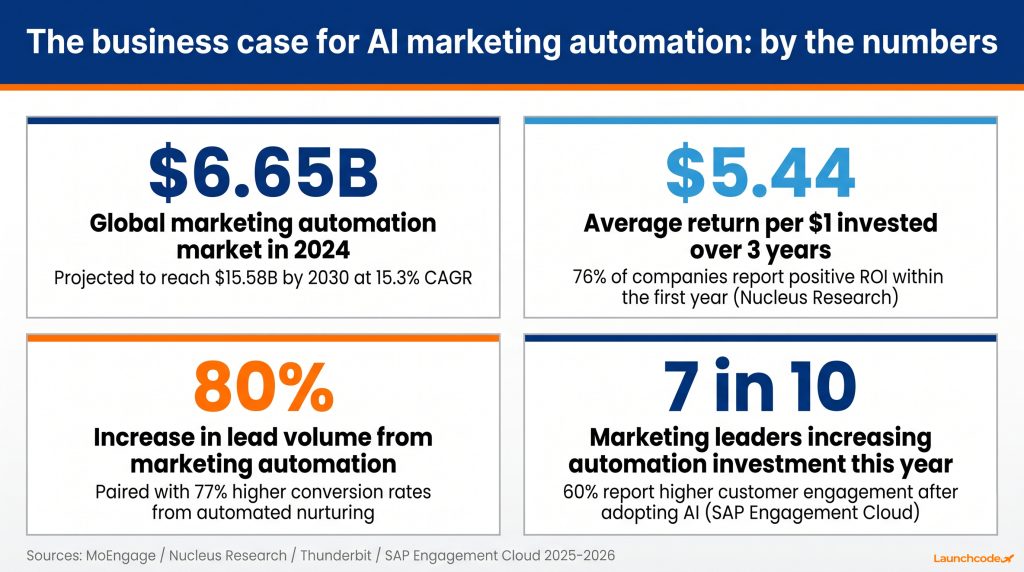
The global marketing automation market reached $6.65 billion in 2024 and is projected to hit $15.58 billion by 2030, a compound annual growth rate of 15.3%. That growth reflects one straightforward reality: the technology delivers consistent returns. Nucleus Research reports that companies see an average $5.44 return for every dollar invested over three years, and 76% report positive ROI within the first year. This is no longer an experimental category.
Businesses using marketing automation also see an 80% increase in lead volume and 77% higher conversion rates from automated lead nurturing and scoring. Those gains compound when automation runs across the full funnel rather than a single channel.
Seven in ten marketing leaders plan to increase automation investment this year, and 60% of marketers report higher customer engagement after adopting AI, according to SAP Engagement Cloud research.
Teams that rely on manual execution face compounding disadvantages. They cannot personalize at the volume modern customers expect. They lag on response timing. Their reporting looks backward rather than forward. They also spend human hours on tasks that AI handles automatically, which reduces the time available for strategy and creative decisions.
McKinsey data shows that 71% of consumers expect personalized interactions from brands, and 76% express frustration when those expectations are not met. That is not a preference. It is a baseline standard that manual processes cannot consistently meet at scale.
AI marketing automation is only as good as the data it runs on. Before selecting a platform or building a workflow, audit your current data quality. Fragmented records, duplicate contacts, inconsistent event tracking, and siloed systems will all undermine AI performance regardless of how sophisticated the platform is. Data readiness is the work that comes before automation, not after it.
Most competitor guides skip this step. It is also where most implementations fail. One senior practitioner writing for Marketing Rewired puts it plainly: “Predictive personalization is not a plug-and-play tool. It’s a discipline. AI helps you go beyond rules-based personalization and move into self-optimizing experiences. But it still needs human oversight.”
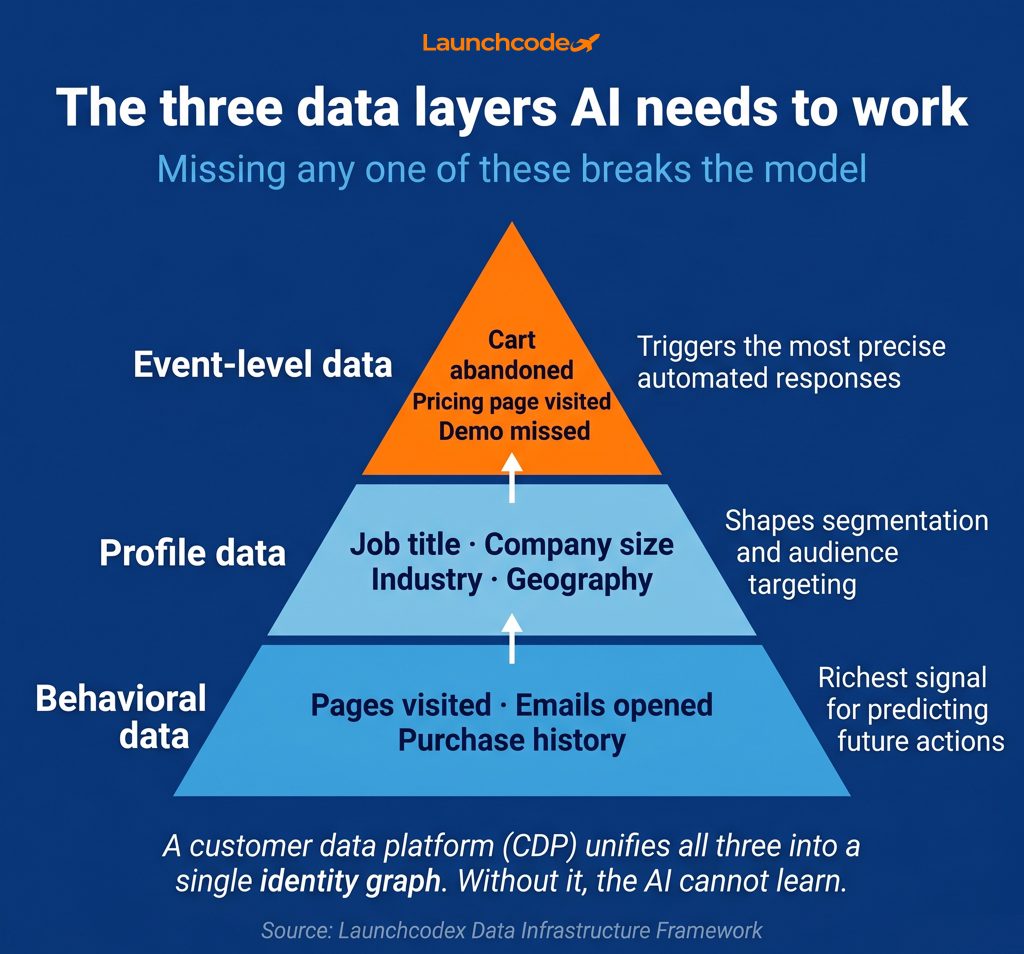
AI systems require three layers of data to function accurately:
A customer data platform (CDP) unifies these layers into a single identity graph. Without it, data from your website, CRM, email platform, and ad accounts sits in separate systems. The AI cannot learn from disconnected data.
Most teams encounter four recurring problems when starting with AI automation:
The fix is a structured data audit before any automation build. Map what data you collect, where it lives, how clean it is, and whether it can be unified into a single contact record. Once that is in place, AI automation can deliver what the platforms promise.
“Every client we onboard with broken or siloed data gets the same advice: fix that before you touch the automation layer. The platform is not the problem. The data almost always is.” Tanner Medina, Co-Founder and CGO, Launchcodex
According to a 2025 Statista survey on AI in marketing, B2B marketers identify audience targeting, analytics and reporting, and personalization as the most effective applications of AI in marketing automation. The use cases that deliver the strongest measurable returns are behavioral email triggers, predictive lead scoring, dynamic personalization, and paid media optimization. Starting with one of these four produces faster results than attempting a full-stack build at launch.
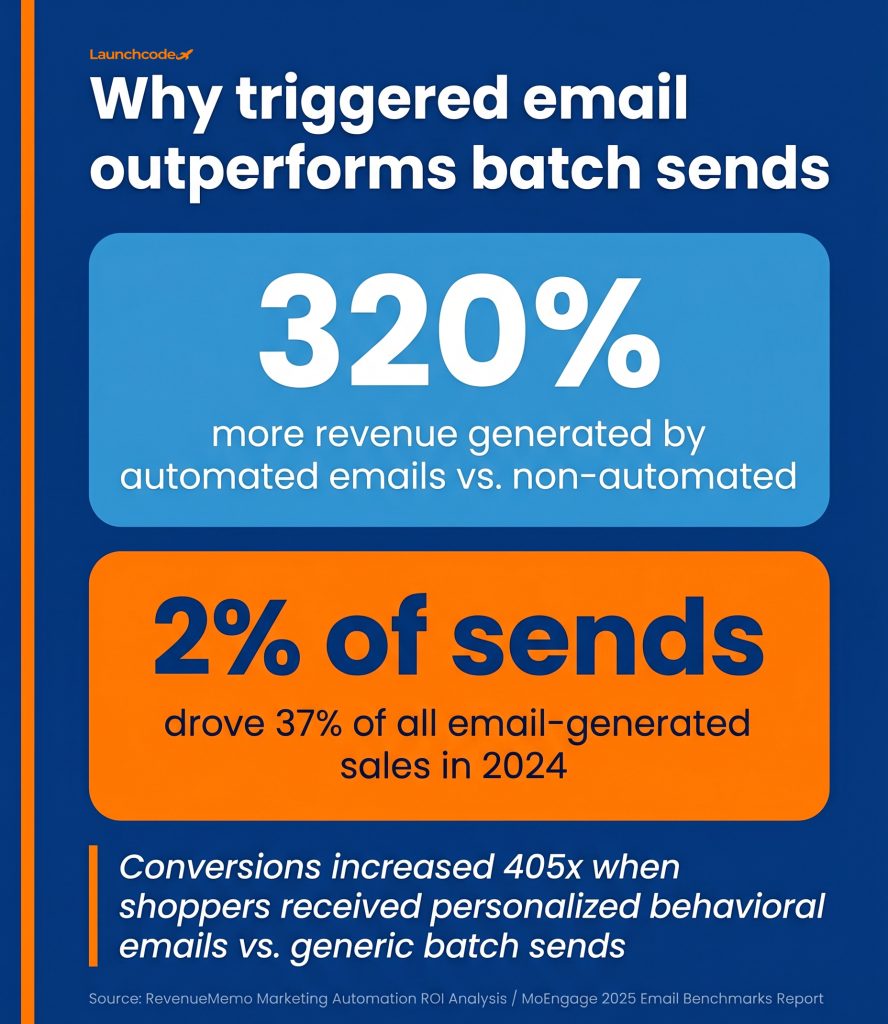
Email remains the highest-performing automated channel by a wide margin. According to a comprehensive marketing automation ROI analysis, automated emails generate 320% more revenue than non-automated emails. Automated messages made up just 2% of total email sends in 2024 but drove 37% of all email-generated sales.
The reason is behavioral triggers. Instead of a batch send to your full list every Tuesday, AI fires based on what a specific contact actually does. They abandon a cart: a triggered email follows within minutes with the exact items they viewed. They visit a pricing page three times in a week: the sequence escalates automatically. They go quiet after 90 days: a re-engagement workflow starts without a human noticing.
The MoEngage 2025 Email Benchmarks Report found that conversions increased 405 times when shoppers received personalized behavioral emails compared to generic batch sends. That single data point captures the business case for trigger-based email.
Manually scoring leads wastes sales team time on contacts unlikely to convert. AI changes this by analyzing thousands of behavioral and profile signals simultaneously to rank each lead by their actual probability of closing.
The results are specific. A 2025 AI in marketing statistics analysis found that AI-based lead scoring improves conversion efficiency by 31% compared to traditional scoring methods, and predictive models increase qualified lead volume by 36%.
Sales reps stop working from cold lists and start focusing on the contacts the model identifies as high-intent. This is one of the fastest ways to improve pipeline quality without adding headcount.
Traditional segmentation groups thousands of contacts into a single bucket: “SMB buyers in the software industry.” AI enables hyper-personalization, where each contact receives unique content, offers, and timing based on their individual behavior rather than their demographic category.
Joe Hsieh, founder of Retention Commerce, describes where this is heading: “AI systems will take the full context of a customer’s relationship with the brand and generate messaging that feels handcrafted for that individual.” See the full expert perspective in Klaviyo’s 2026 marketing automation trends analysis.
Companies using AI across at least three core marketing functions report a 32% increase in ROI compared to those using it in a single channel. Integration across email, ads, web, and CRM multiplies the impact of each individual use case.
Google Performance Max, which optimizes bidding, placements, and creatives across search and display using AI, now powers 58% of paid search campaign optimization. AI programmatic platforms adjust bids in real time based on live engagement signals and budget pacing, a shift covered in the IAB’s State of Data 2025 report.
Teams using AI-driven retargeting have seen an 18% rise in return on ad spend. Real-time budget reallocation driven by predictive feedback loops has delivered a 25% ROI increase in campaigns that apply it consistently.
Agentic AI is the next stage of marketing automation. Unlike standard automation that executes tasks you pre-define, an AI agent reasons across multiple steps, makes decisions, and takes action across platforms without waiting for human input at each stage. Marketers set the objective and guardrails. The agent determines how to achieve them. Gartner predicts that by 2028, 33% of enterprise software applications will include agentic AI, up from less than 1% in 2024. That shift is already entering mainstream platforms.
HubSpot, Salesforce Einstein, and ZoomInfo’s GTM Workspace all launched AI agent capabilities in 2024 and 2025. This is not a speculative future product category. It is infrastructure being built into the tools many marketing teams already pay for.
A practical example: an AI agent receives a single goal, to increase qualified lead volume from paid campaigns by 20% this quarter. Given that goal and defined guardrails, the agent:
The marketing team reviews the summary, adjusts guardrails if needed, and focuses on strategy and brand decisions the agent cannot make.
Salesforce’s analysis of AI marketing automation and the shift to agentic systems captures the role change clearly: rather than defining every rule in advance, marketers set objectives and guardrails while the AI agent determines how to achieve them. The marketer moves from rule-setter to goal-setter.
Ben Zettler, founder of Zettler Digital, a retention and paid media agency, frames the competitive pressure plainly: “Automation won’t just trigger messages. It’ll generate and evolve them. The winners will be brands that know how to train AI on their tone, not just prompt it.”
Teams that understand agentic AI now and start building the infrastructure to support it, clean data, clear goals, and defined guardrails, will have a meaningful head start as these capabilities become standard across every major platform.
“With agentic AI, the infrastructure decisions you make now determine how much the agent can actually do. How data flows, what goals you set, and where guardrails sit matter more than which platform you pick. Most teams underestimate that setup work.” Derick Do, Co-Founder and CPO, Launchcodex
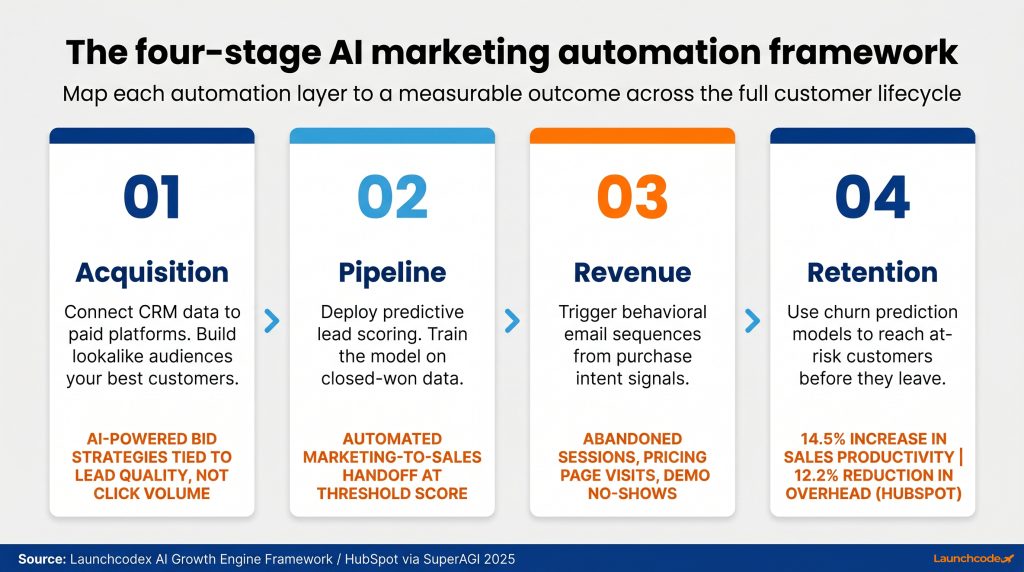
Start with the use case that will deliver measurable results fastest, not the most ambitious one. Most teams waste their first six months implementing AI automation that is too complex for their current data quality. Pick one channel, define a clear outcome, build the data layer to support it, and measure before expanding. A four-stage approach tied to the full customer lifecycle gives each implementation phase a clear owner and a clear metric.
This framework maps to four stages of the customer lifecycle:
Use AI to improve ad targeting and content distribution. Connect your CRM data to your paid platforms in Google Ads or Meta Ads to build lookalike audiences from your actual best customers rather than demographic assumptions. Deploy AI-powered bid strategies tied to lead quality, not just click volume. Expect two to four weeks of campaign data before the model has enough signal to optimize meaningfully.
Deploy predictive lead scoring. Connect your CRM, email platform, and website tracking into a unified view. Train the scoring model on your historical closed-won data. Set a clear threshold score for sales-ready leads and build an automated handoff workflow between marketing and sales so no high-intent contact goes unworked.
Build behavioral email sequences triggered by purchase intent signals. Abandoned sessions, pricing page visits, demo no-shows, and re-engagement patterns are the highest-value triggers to start with. Personalize based on behavior and profile data, not just first name merge tags. Test one trigger sequence at a time and measure lift before adding the next.
Use churn prediction models to identify customers at risk before they disengage. Automate proactive outreach with personalized content or success check-ins timed to when the model predicts drop-off. According to HubSpot data cited by SuperAGI’s AI marketing automation case study analysis, companies using marketing automation through a structured full-funnel approach see a 14.5% increase in sales productivity and a 12.2% reduction in marketing overhead.
Most teams run into one or more of these:
AI marketing automation that touches personal data is subject to GDPR, CCPA, CAN-SPAM, and CASL depending on where your contacts are located. European regulators issued fines exceeding 2.92 billion euros in 2024, with many penalties targeting adtech and marketing automation practices. Compliance belongs in the build from day one, not as an afterthought.
Under GDPR and CCPA, every automated marketing workflow needs:
Privacy-enhancing technologies are becoming standard tooling for compliance in this space. Differential privacy allows analysis of customer trends without exposing individual-level data. Federated learning trains AI models without transferring raw customer data off-device. Both are now available as built-in features in platforms like MoEngage and Klaviyo.
Beyond compliance, AI marketing automation introduces three operational risks:
Blake Imperl, SVP of Marketing at Digioh, frames the broader strategic risk clearly: “With rising CACs and disappearing cookies, the smartest brands in 2026 will focus on activating data across the funnel, turning quiz and preference data into personalized journeys that convert.” That requires owning your data and using it responsibly.
The teams getting the strongest results from AI marketing automation are not the ones with the most tools. They are the ones that built a system: clean data feeding a connected stack, behavioral triggers aligned to real customer signals, and human oversight focused on strategy while AI handles volume, timing, and optimization.
As Christina Inge, author of Marketing Analytics and a Harvard marketing instructor, puts it: “Your job will not be taken by AI. It will be taken by a person who knows how to use AI.”
Start with one use case. Define a clear business outcome. Audit your data before touching a platform. Measure from day one. Expand to the next stage of the funnel once that first use case performs consistently.
At Launchcodex, we build AI automation systems across the full customer lifecycle using our AI automation services, from acquisition through retention. The foundation is always the same: strategy first, clean data second, automation third. That order matters more than which platform you choose.
The marketing automation market is growing at 15.3% annually because the returns are consistent and replicable. The brands building this infrastructure today will be the hardest to catch in two years.
Traditional automation follows fixed if-then rules set in advance by a human. AI marketing automation learns from customer behavior and adapts its decisions in real time. The AI adjusts timing, content, and channel based on what the data shows, without requiring manual rule updates every time conditions change.
Costs vary widely by platform and list size. Entry-level platforms like ActiveCampaign start below $100 per month for small contact lists. Mid-market platforms like HubSpot and Klaviyo scale with contact volume and feature tier. Enterprise platforms like Salesforce Marketing Cloud use custom pricing. The relevant benchmark is ROI: Nucleus Research reports a $5.44 average return per dollar invested over three years.
Start with tasks that are high-volume, repetitive, and directly connected to revenue. Behavioral email triggers (abandoned sessions, welcome sequences, re-engagement workflows) and predictive lead scoring deliver the fastest measurable returns and require the least organizational change to implement.
Not necessarily at the start, but data unification is the prerequisite for accurate AI. If your email platform, CRM, web analytics, and ad data operate in separate silos with no shared contact identity, AI cannot build reliable behavioral profiles. Some all-in-one platforms like HubSpot and Klaviyo provide native data unification. A standalone CDP becomes valuable as your stack grows more complex.
No. SMBs run AI-powered email sequences, lead scoring, and behavioral personalization on platforms like ActiveCampaign, Klaviyo, and HubSpot at costs that fit smaller lists and budgets. The starting framework is the same regardless of company size. What scales is the data volume and platform complexity, not the underlying approach.
In the US, CAN-SPAM governs automated commercial email. In California, CCPA applies to how you collect and use consumer data. In the EU and UK, GDPR sets strict rules on data processing, consent, and retention periods. In Canada, CASL covers commercial electronic messages. If you run automated marketing across multiple geographies, you need suppression processes and data governance policies built into your stack before you scale.


Real stories from the people we’ve partnered with to modernize and grow their marketing.