





What is white label digital marketing and is it right for your agency
White label digital marketing lets your agency sell partner-delivered services under your own brand. See the real margins, r...





Most agency owners run into the same problem. A client asks for a service you do not staff, or three new accounts land in the same month and your team is already full. Hiring a specialist takes months. Turning down the work costs revenue. A survey reported by Marketing Week found that 48.7% of marketers outsourced parts of their marketing because they lacked the skills in-house, ahead of shrinking teams and cost saving.
White label digital marketing is one answer to that problem. This article explains what the model is, how the money works after your own time, where it creates risk, and how AI search changed the math. By the end, you will have a clear way to decide if it fits your agency right now.
White label digital marketing is an arrangement where one company delivers a service and another sells it under its own brand. Your agency signs the client, owns the relationship, and keeps the margin. A fulfillment partner does the work behind the scenes. The client sees your brand on every report, email, and dashboard. They never meet the partner.
Ready to grow your organic traffic?
Get a free SEO audit from the Launchcodex team.
The model is common because it solves a capacity problem without fixed overhead. You add a service in days, not the months it takes to hire and train. The global digital marketing market was valued at roughly 456.7 billion dollars in 2025 and is projected to reach about 1.2 trillion dollars by 2034, according to IMARC Group. More demand means more client requests than most agencies can staff for.
You agree on a wholesale rate with the partner. You set your own client price. The partner delivers the work to your standards and timeline. You review it, brand it, and present it as your own. You handle client calls, strategy, and reporting. The partner stays invisible.
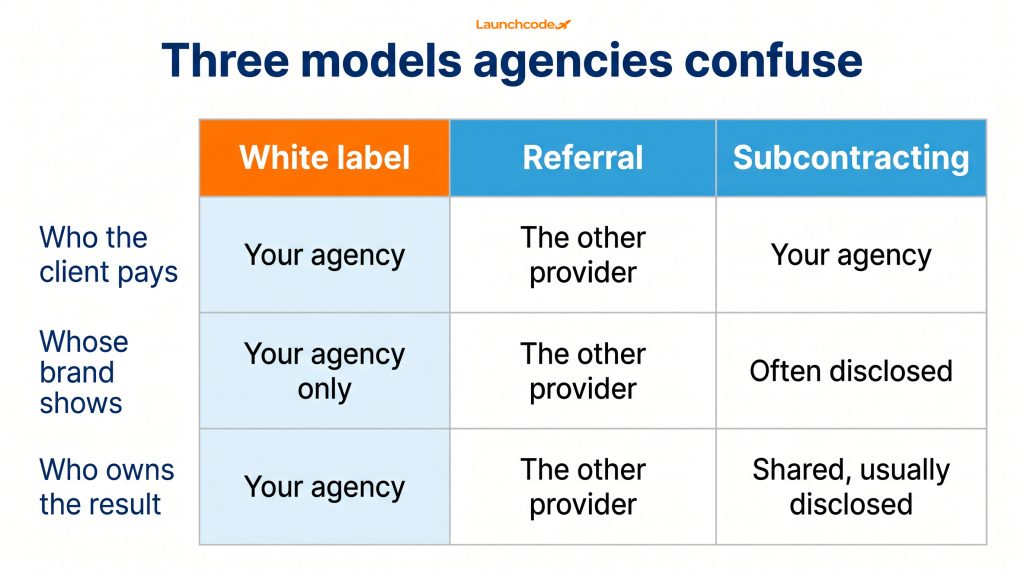
Agencies confuse three models, and the wrong one creates trust or legal problems. Here is the difference.
| Model | Who the client pays | Whose brand shows | Who owns the result |
|---|---|---|---|
| White label | Your agency | Your agency only | Your agency |
| Referral | The other provider | The other provider | The other provider |
| Subcontracting | Your agency | Often disclosed | Shared, usually disclosed |
White label keeps you in control and keeps the margin. A referral hands the client away for a one-time fee. Subcontracting sits in the middle and is often disclosed. Pick white label when you want the relationship and the recurring revenue to stay yours.
Agencies most often white label SEO, paid media, content production, web development, and AI search work. These services share two traits. They need specialist skills, and demand for them is steady. The global white label SEO market alone was valued at about 1.68 billion dollars in 2025 and is forecast to reach 2.88 billion dollars by 2032, per QY Research.
Some services resell cleanly. Others need close oversight. Knowing the difference protects your margin and your brand.
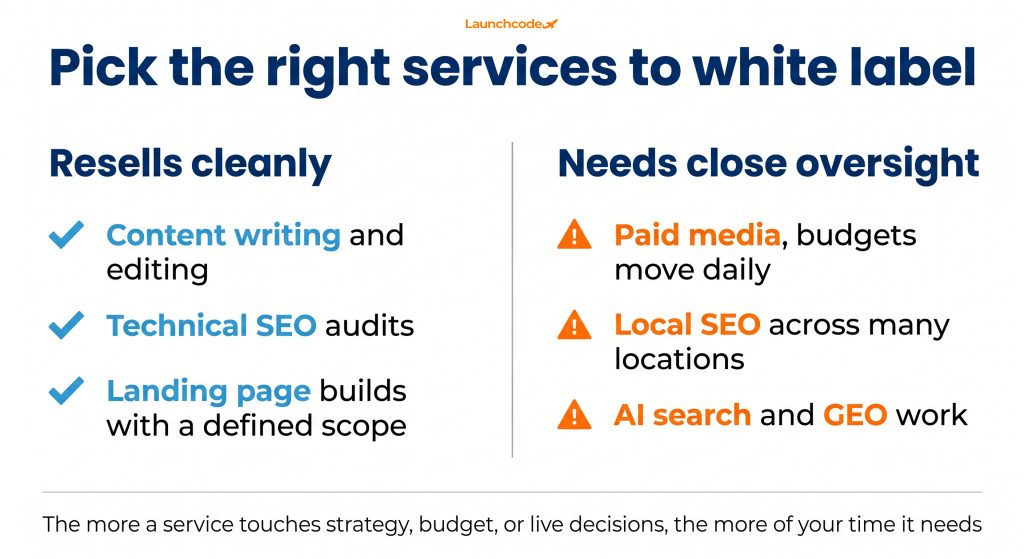
The rule is simple. The more a service touches strategy, budget, or live decisions, the more of your own time it needs, even when a partner runs the execution.
Most agencies mark up white label services by 20% to 50%, and some add 2x to 3x on higher-touch work. That headline number is not your profit. Your real margin is what remains after you pay the partner and count your own account management time. Skip that second step and a profitable-looking deal can leave you working for almost nothing.
Markup is the multiplier you put on the partner cost. Margin is what you keep after every cost, including your hours. Agencies that confuse the two underprice and stall.
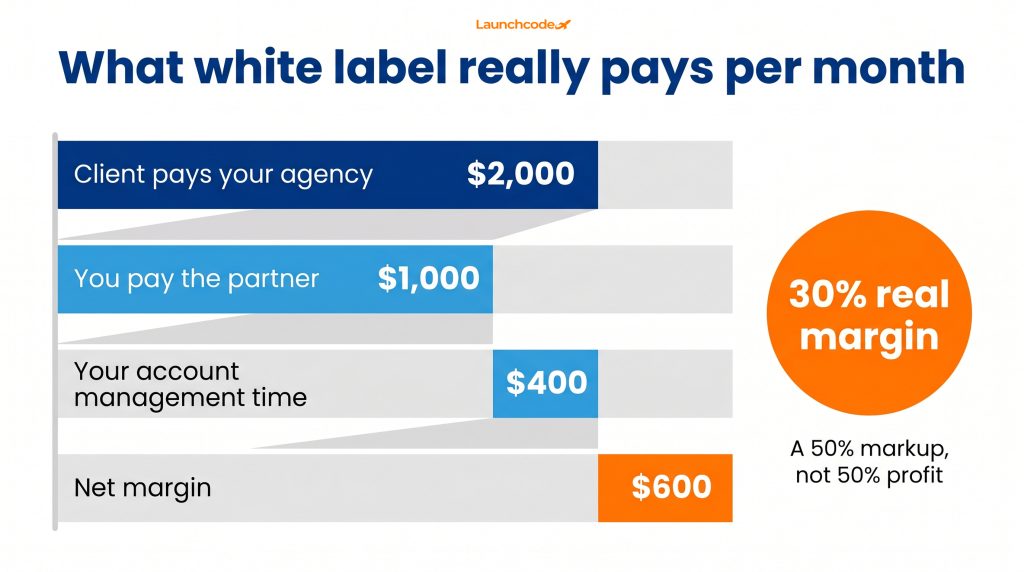
Say you sell a service for 2,000 dollars a month and pay your partner 1,000 dollars. That looks like a 50% margin. Now add your time.
| Line item | Amount per month |
|---|---|
| Client pays your agency | 2,000 dollars |
| You pay the partner | 1,000 dollars |
| Your account management time | 400 dollars |
| Net margin | 600 dollars, about 30% |
A 50% markup became a 30% margin once real hours entered the math. Healthy resale margins commonly land near 25% to 35% on low-touch services and 35% to 50% on higher-touch work like paid media. Margin figures vary by market and scope, so run your own numbers before you quote.
"The agencies that lose money on white label almost always priced on markup and forgot their own hours. I tell every team to add account management time to the cost line before quoting, even if it is only five hours a month." Tanner Medina, Co-Founder and Chief Growth Officer
The biggest white-label risk is silent. You stay the agency of record, so the client blames you for weak work, missed deadlines, or a result that fails to grow their business. A bad partner can erode trust you spent years building, and you may not see it until a client leaves. Control the model, or it will control your reputation.
Most failures trace back to a handful of avoidable mistakes.
A practical fix is a fixed quality gate. At Launchcodex, partner delivered work passes an internal quality check against the client brief before anything reaches the client. That single step catches most problems while they are still cheap to fix. Build your own version of that gate before you take on volume, not after a client complains.
"We run every partner deliverable through a fixed checklist against the client brief before it ships. That one gate catches most issues while they still cost nothing to fix, and it keeps a weak vendor from ever touching the client relationship." Derick Do, Co-Founder and Chief Product Officer
AI search made white label more useful, not less. Generative engine optimization, or GEO, is a new discipline most in house teams cannot staff. The skills sit close to SEO but differ in practice, and the talent barely exists to hire. That gap is where a vetted partner adds the most value, as long as you keep strategy and oversight in your hands.
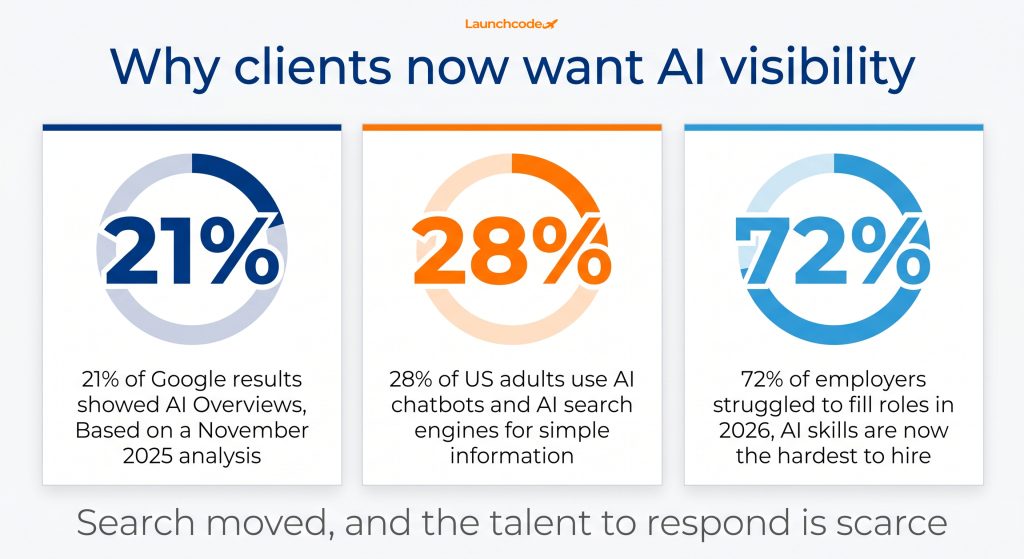
Search behavior has shifted. AI Overviews appeared on about 21% of Google results in a November 2025 analysis reported by HR Brew, and roughly 28% of US adults now use AI chatbots and AI search engines for simple information, per the same reporting. Clients want visibility inside AI answers, and they expect their agency to deliver it.
Hiring for these skills is hard. The ManpowerGroup 2026 Talent Shortage Survey found that 72% of employers struggled to fill roles, and AI skills became the single hardest capability to find worldwide for the first time. Digiday reported that agency leaders now treat AI fluency as an expectation rather than a bonus. When you cannot hire the skill, a specialist partner closes the gap in days.
"Clients started asking us about showing up in AI answers within the last year. Most in house teams have nobody who has shipped GEO work, so a vetted partner fills that gap faster than a six-month hire ever could." Tanner Medina, Co-Founder and Chief Growth Officer
AI work carries new rules for regulated clients. A summary from Frase notes that FINRA's 2026 guidance treats AI-generated content as supervised firm communications subject to recordkeeping and fair dealing rules. For healthcare, finance, and legal clients, that raises the bar for partner vetting and is a reason some sensitive work should stay in-house.
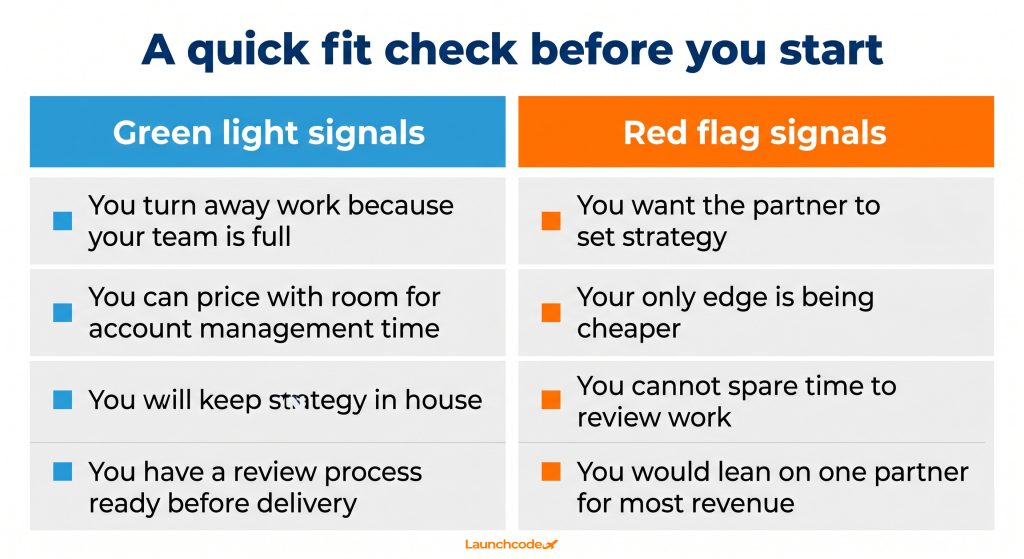
White label fits when demand outpaces your team, when you can own strategy and quality control, and when your margins survive the added oversight. It does not fit when you plan to hand off thinking, compete on the lowest price, or skip review to save time. The model rewards control and punishes shortcuts.
Use these signals to decide.
White label work is invisible to the client by design. Whether to tell them a partner is involved is an ethics and positioning choice, not a legal default. Some agencies disclose a specialist network and frame it as a strength. Others present fully in house delivery. Decide your stance early and apply it consistently, because clients dislike surprises more than they dislike outsourcing.
White label digital marketing is a capacity tool. It does not fix a broken agency, and it does not replace the thinking you sell. It earns its place when client demand outruns your team and you keep control of strategy, quality, and the client relationship. The numbers work, the demand is real, and AI search created a clear gap that partners can fill faster than hiring. The agencies that win with it treat partner work as their own and refuse to ship anything they would not put their name on.
Your next step is small. Pick one service where demand already outpaces your team. Run the real margin math, including your own hours. Then test one vetted partner on a single account with a fixed review step in place. If the margin holds and the quality clears your gate, scale from there.
Yes. The model is a standard business arrangement. You sell a service a partner fulfills, under your own brand. Disclosure to the client is an ethics choice, not a legal requirement, though clear contracts with your partner protect both sides.
Outsourcing is the broad act of hiring outside help. White label is a specific form where the partner stays invisible and the work carries your brand. With a plain freelancer, the client may know who did the work. With white label, they see only you.
It depends on your market, but higher-touch services like paid media often support larger markups because clients value oversight and fast response. Run a margin example with your own hours included before you commit to any service.
Small agencies and solo consultants use it the most. The model lets a lean team offer a full-service menu without hiring. The key is keeping strategy in-house and reviewing every deliverable before it reaches the client.




White label digital marketing lets your agency sell partner-delivered services under your own brand. See the real margins, r...
A step-by-step local SEO playbook for dental practices. Optimize your Google Business Profile, build reviews, and rank for d...
A data-backed e-commerce marketing guide to acquire, convert, and retain customers as one profit loop. Benchmarks, checkout ...