




EU AI Act 2026: New disclosure rules for chatbots and AI content
Article 50 of the EU AI Act requires chatbot and AI content disclosure starting August 2026. Learn what it requires, who it ...




Most local businesses know they should show up when someone nearby searches for what they sell. Far fewer know what local SEO actually includes, what drives rankings now, or where to start. That gap costs real revenue, because 76 percent of people who run a nearby search visit a business within 24 hours, according to Think with Google.
This guide breaks local SEO into the parts that matter in 2026. You will learn how local rankings work, how to set up your Google Business Profile, why reviews compound over time, how to show up in AI search, and how to measure results against calls, direction requests, and leads. You get a prioritized plan, not a generic definition.
Local SEO is the practice of earning visibility when people search for products or services near them. It covers your Google Business Profile, your website, your reviews, and the listings that mention your business across the web. In 2026 it spans two surfaces at once, Google search and AI assistants like ChatGPT, Gemini, and Perplexity.
Ready to grow your organic traffic?
Get a free SEO audit from the Launchcodex team.
Local search is a primary channel, not a side one. Nearly 46 percent of all Google searches now carry local intent, up from about 30 percent in 2019, based on compiled local search data. For a business with a physical location or a defined service area, local search is often the main way new customers find you.
Traditional SEO competes for rankings on any search, anywhere. Local SEO competes for visibility tied to a place, like "plumber near me" or "pediatric dentist in Austin." The mechanics overlap, but local search weighs three things traditional SEO does not: your Google Business Profile, your physical proximity to the searcher, and your review profile.
Local SEO matters most for businesses that serve a geographic market. That includes restaurants, clinics, law firms, contractors, retailers, and multi location brands. The opportunity is wide open, because just 35 percent of small and mid-sized businesses have a Google Business Profile and only 40 percent have a dedicated website. Acting on the basics still separates you from most competitors.
Google names three factors for local ranking: relevance, distance, and prominence. Relevance is how well your profile matches the search. Distance is how close you are to the searcher. Prominence is how well known and trusted you appear, based on reviews, links, and mentions. You cannot change distance, but you can strengthen relevance and prominence directly.
This framework comes straight from Google's own local ranking guidance. It sets honest expectations. A closer competitor with a weaker profile can still outrank you for some searches, and a stronger, more relevant business can win across a wider area.
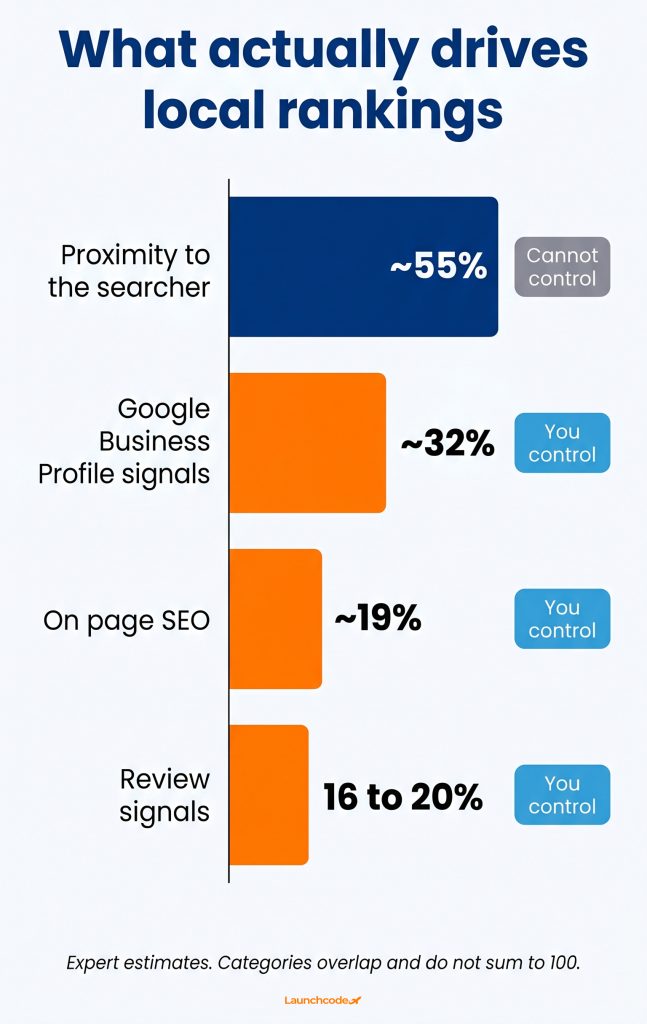
Expert surveys put rough weights on these signals. The numbers below come from the 2026 Local Search Ranking Factors survey results. Treat them as expert estimates, not published Google figures, and note that the categories overlap and do not sum to 100.
| Ranking factor | Estimated weight | Can you control it? |
|---|---|---|
| Proximity to the searcher | About 55 percent | No, but new locations expand reach |
| Google Business Profile signals | About 32 percent | Yes |
| Review signals | 16 to 20 percent | Yes |
| On page SEO | About 19 percent | Yes |
In Whitespark's survey, local search experts rate the primary Google Business Profile category as the most important factor for ranking in the local pack. Pick the category that matches your core business, not a broad parent category. A med spa should choose med spa, not spa. This one field tells Google what searches you belong in.
Some owners chase proximity hacks like fake addresses or keyword stuffing in the business name. These break Google's guidelines and risk suspension. Distance is structural, set by where you operate. The reliable path is to widen your reach through stronger prominence and, when it makes business sense, additional verified locations.
Your Google Business Profile powers the local pack and Google Maps, and it is the fastest thing most businesses can improve today. A complete, accurate profile makes customers 2.7 times more likely to see you as reputable. Work through verification, core details, categories, services, photos, and regular posts in that order.
Profile completeness is an ongoing signal, not a one-time task. Google rewards profiles that stay active with fresh photos, posts, and recent reviews.
Consider a three location dental group with thin profiles and few recent reviews. After the team completed each profile, fixed the categories, and started posting weekly, calls and direction requests from the profiles climbed over the next quarter. This is the kind of work where a structured SEO and GEO process pays off, because the gains come from consistency, not a single change.
"Across three or four locations, the profiles that win are the ones with matching categories, real photos, and a fresh post every week. The boring consistency is the work." Derick Do, Co-Founder and Chief Product Officer
Reviews shape rankings and buying decisions at the same time. They feed prominence in Google's algorithm, and they decide whether a customer trusts you. 97 percent of consumers read reviews for local businesses, and 47 percent will not use a business that has fewer than 20 reviews. Volume, rating, recency, and your response rate all matter.
Reviews are not a vanity metric. They feed Google's prominence signal and shape the first impression a customer forms.
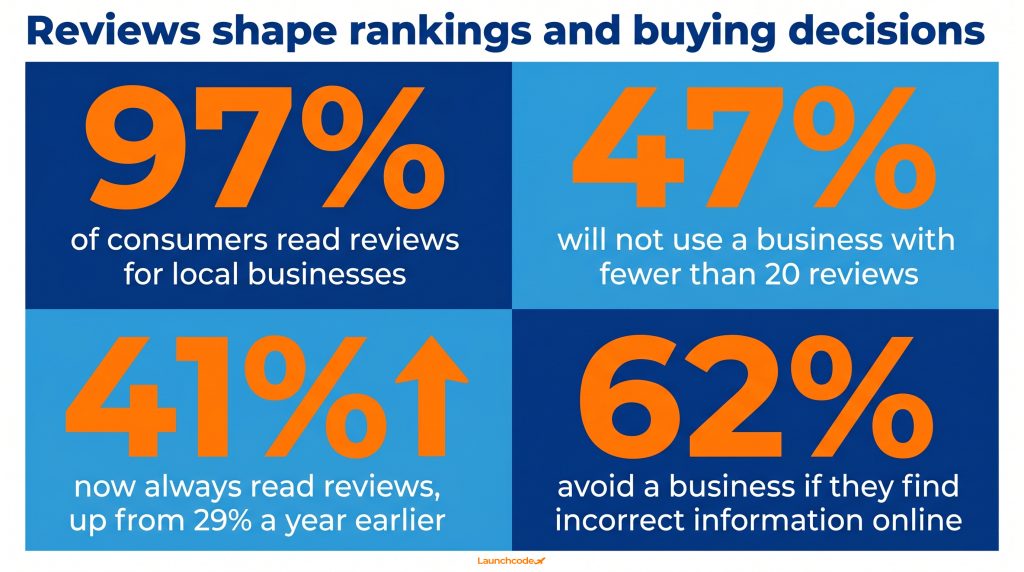
Review reading is intensifying. In the 2026 Local Consumer Review Survey, 41 percent of consumers now always read reviews before choosing a business, a sharp jump from 29 percent the year before. A steady flow of recent reviews has become one of the clearest trust signals you can build.
Darren Shaw, founder of Whitespark and the person behind the annual ranking factors survey, argues that review recency now belongs near the top of local ranking factors. A burst of reviews followed by silence loses value fast. Joy Hawkins of Sterling Sky reaches a similar view through controlled local studies. Keep reviews coming.
"Review velocity is the lever most owners ignore. When a client moves from two reviews a month to ten, the profile's call volume usually climbs within a quarter." Tanner Medina, Co-Founder and Chief Growth Officer
A practical note: do not pay for or incentivize customer reviews, since that breaks platform rules. You can reward your own staff for earning reviews the right way.
NAP stands for your name, address, and phone number. Citations are the listings across the web that mention them, on directories, maps, and review sites. When this data conflicts, rankings suffer and trust erodes. 62 percent of consumers will avoid a business if they find incorrect information about it online.
Consistency decides whether Google and AI tools trust your business details.
Directories like Yelp, Tripadvisor, Apple Maps, Bing Places, and the Better Business Bureau do two jobs. They reach consumers directly, and they feed the data that search engines and AI assistants read about you. Conflicting addresses or old phone numbers create doubt in both systems.
After a move or rebrand, many businesses update Google and forget the long tail of older directories. Those stale listings keep circulating wrong details for months. Treat citation cleanup as part of any address or name change, not an afterthought.
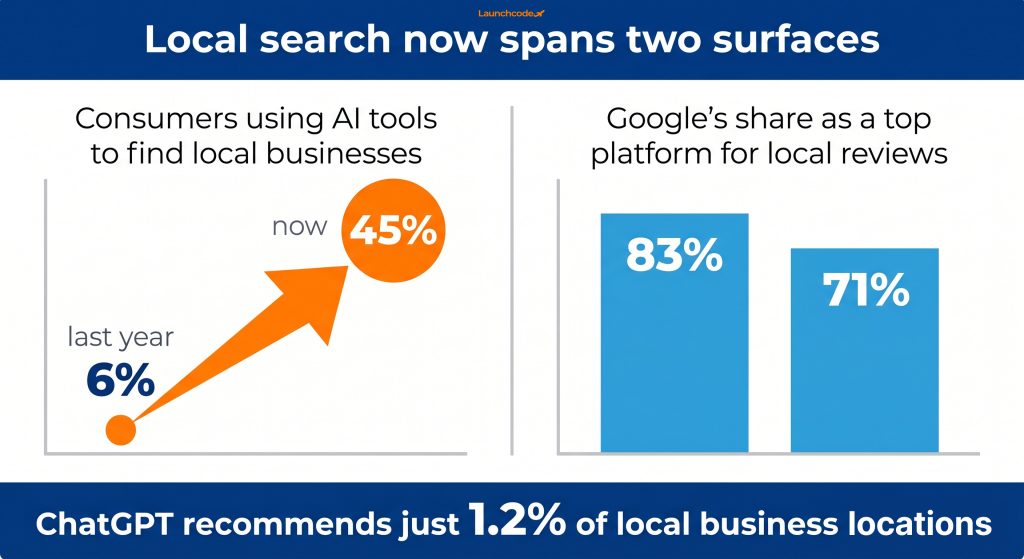
Nearly half of consumers now use AI tools to find local services, which makes AI visibility a core part of local SEO. AI assistants build their own shortlist from your website, listings, reviews, and mentions on trusted sources. Ranking well on Google does not move you onto that list automatically. The two systems pull from overlapping but different inputs.
This is the biggest change in local search in years, and most guides still treat it as a footnote.
In the 2026 Local Consumer Review Survey, AI use for local recommendations jumped from 6 percent to 45 percent in a single year, while Google's share as a top platform for finding local reviews fell from 83 percent to 71 percent. At the same time, SOCi's 2026 Local Visibility Index found ChatGPT recommends only about 1.2 percent of local business locations. Most businesses are invisible there.
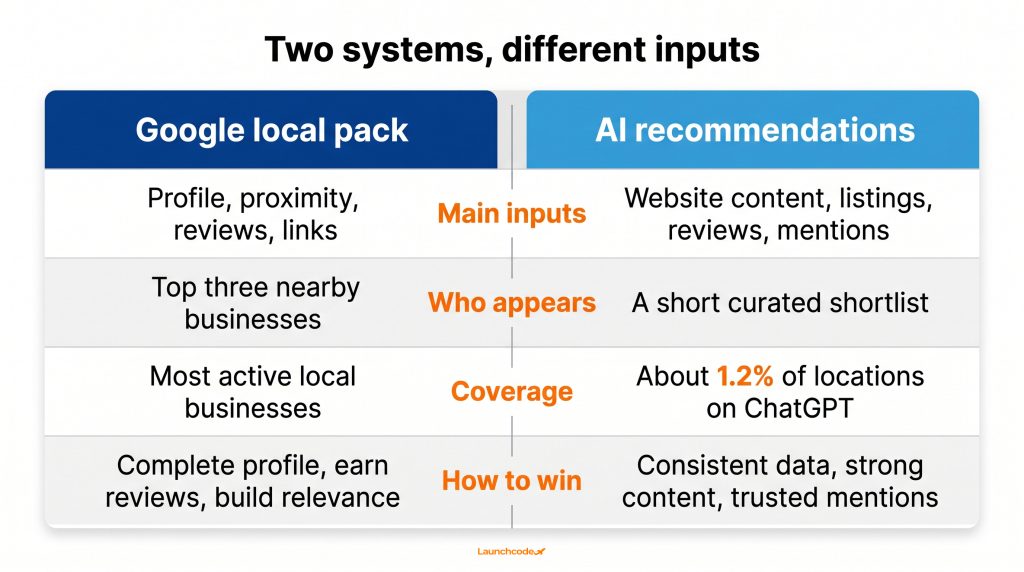
Data compiled by BrightLocal shows that less than half of the businesses leading Google local results also appear in AI recommendations. The reason is structural. AI tools weigh your website content, the accuracy of your listings, your reviews, and your presence on trusted third-party sources. The table below shows where the two systems differ.
| Google local pack | AI recommendations | |
|---|---|---|
| Main inputs | Profile, proximity, reviews, links | Website content, listings, reviews, third-party mentions |
| Who appears | Top three nearby relevant businesses | A short curated shortlist |
| Coverage | Most active local businesses | About 1.2 percent of locations on ChatGPT |
| How to win | Complete profile, earn reviews, build relevance | Consistent data, strong on-page content, trusted mentions |
"When we test a client in ChatGPT and Perplexity, the ones that appear almost always have consistent listings and detailed service pages feeding the answer. Thin sites stay invisible." Derick Do, Co-Founder and Chief Product Officer
Steady, accurate information across the web is what feeds both Google and AI, which is why this overlaps with AI automation and data work for businesses managing many locations.
On-page SEO carries real weight in local results, estimated at nearly 19 percent of ranking influence. Your website should tell Google and AI tools clearly who you serve, where, and what you do. That means dedicated service pages, location pages, and content that names your areas and answers local questions in plain language.
A complete profile makes you eligible to appear. Strong website content decides whether you rank above competitors.
Generic city pages with swapped names read as thin to both search engines and AI systems. Write each page for the real customers in that area. Name the neighborhoods you serve, the problems you solve, and the proof that you do the work, such as photos and real reviews.
Measure local SEO against business outcomes, not vanity metrics. Track calls, direction requests, website clicks, and booking actions from your Google Business Profile, plus rankings for your core local searches and the leads they produce. These connect directly to revenue, unlike raw impressions alone.
If you cannot tie activity to leads or calls, you cannot tell which work to repeat.
"We report on calls and direction requests from the profile, not impressions. Those map to booked jobs, so they tell us which work to repeat." Tanner Medina, Co-Founder and Chief Growth Officer
A practical note: rankings move slowly, since top local pages have an average age of well over two years. Treat local SEO as a compounding effort, not a quick switch.
Local SEO in 2026 means winning on two surfaces. Google still drives most local searches, but AI assistants now shape nearly half of local decisions, and the businesses that show up in both win more customers. The same fundamentals feed both systems.
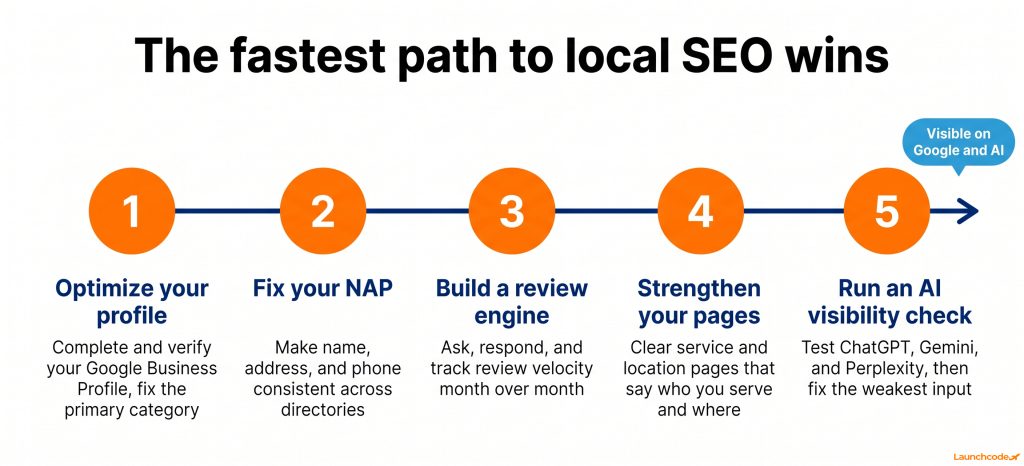
Start with the work that controls the most and costs the least. Complete and verify your Google Business Profile, fix your primary category, and clean up your NAP across directories. Build a steady review engine and respond to every review. Strengthen your service and location pages so your website states clearly who you serve and where. Then run a simple AI visibility check and fix the weakest input. Done in that order, these steps compound, while shortcuts and hacks stop working. For businesses managing many locations, this is the kind of structured program Launchcodex builds and ships, rather than only advises on.
SEO competes for rankings on any search. Local SEO competes for visibility tied to a place, like "near me" searches, and adds your Google Business Profile, proximity, and reviews as major factors.
Expect months, not days. Profile and listing fixes can show movement within weeks, but rankings build slowly. Top local pages tend to be years old, so consistency matters more than speed.
There is no fixed number, but aim past 20 quickly, since 47 percent of consumers avoid businesses with fewer than that. Beyond volume, focus on a steady flow of recent reviews and fast responses.
Make your details consistent everywhere, strengthen your website content, and earn reviews and mentions on trusted sources. AI tools build their own shortlist from those inputs, so accurate, rich information across the web is what gets you surfaced.
No. A complete profile is the fastest win, but reviews, NAP consistency, on-page content, and AI visibility all work together. Leaning on the profile alone leaves you exposed as more searches shift to AI.




Article 50 of the EU AI Act requires chatbot and AI content disclosure starting August 2026. Learn what it requires, who it ...
Local SEO is how nearby customers find you on Google and AI tools like ChatGPT. Learn how rankings work, how to optimize you...
White label digital marketing lets your agency sell partner-delivered services under your own brand. See the real margins, r...