




How to optimize your Google Business Profile for maximum visibility
Learn which Google Business Profile fields actually rank in 2026, which ones to skip, and how to win the map pack and AI sea...




Most local businesses lose customers before a single click. Their profile sits claimed but stale, buried below the map pack, while nearby competitors take the calls. The gap is not effort. It is knowing which tasks change rankings and which ones waste an afternoon.
This guide gives you a prioritized plan based on 2026 data from Whitespark, BrightLocal, and Google itself. You will learn how Google ranks local businesses, which profile fields earn rankings, which ones do not, and how to stay visible as AI reshapes local search. Work through it in order, and you can act on the signals that matter this week.
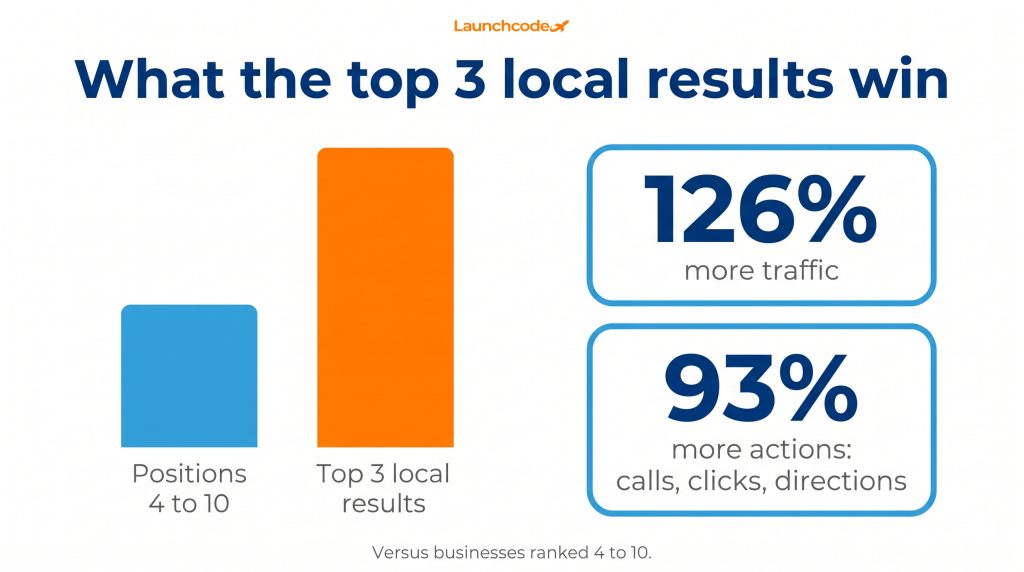
Your Google Business Profile is the front door to local search. It controls how you appear in the map pack, Maps, and AI-driven results, and the top three placements take most of the action. According to SOCi benchmark data, businesses in the top three local results earn 126 percent more traffic and 93 percent more actions, such as calls and direction requests, than businesses ranked 4 to 10.
Ready to grow your organic traffic?
Get a free SEO audit from the Launchcodex team.
Local intent moves fast. 76 percent of people who search "near me" on a phone visit a business within a day, based on Think with Google data, and 60 percent of smartphone users have contacted a business directly from search results. A weak profile costs you inside that same day window.
The opening is bigger than most owners assume. BrightLocal's 2026 research found that only 35 percent of small and mid-sized businesses even have a Google Business Profile. A complete, well-managed profile puts you ahead of most local competitors before you touch a single advanced field.
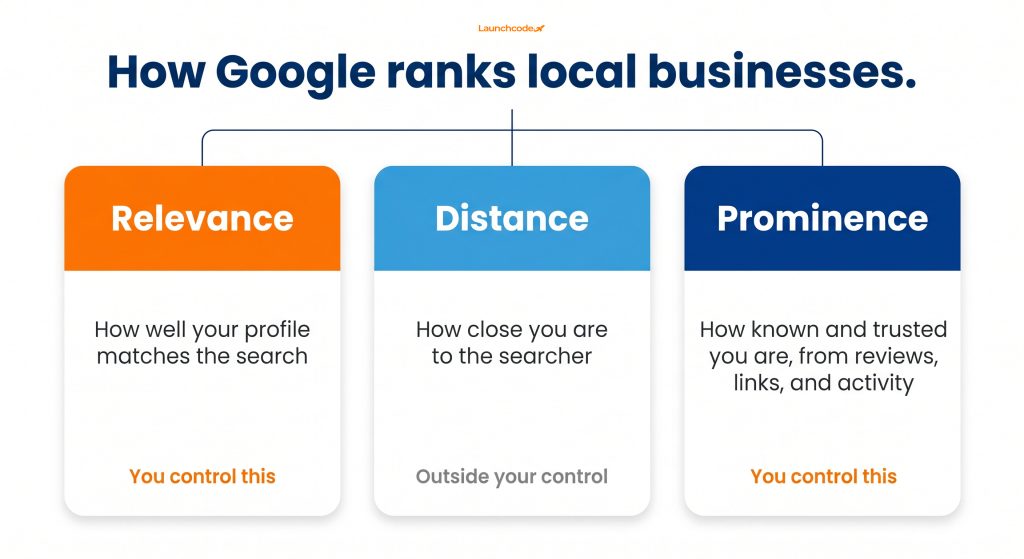
Google ranks local businesses on three factors: relevance, distance, and prominence. Relevance is how well your profile matches the search. Distance is how close you are to the searcher. Prominence is how well known and trusted you are, shaped by reviews, links, and activity. You can influence relevance and prominence. You cannot change the distance.
Distance depends on where the searcher stands when they type the query. A plumber in one neighborhood will not rank for someone fifteen miles away, no matter how strong the profile. Set realistic expectations here and focus on your true service radius.
Relevance and prominence respond to your work. Google's own guidance states that "more reviews and positive ratings can help your business's local ranking," and that complete, accurate information helps you match more searches. The profile itself carries the most weight. Per the Whitespark 2026 Local Search Ranking Factors study, 8 of the top 10 local pack factors come from the profile, with the primary category as the single strongest signal.
Many owners chase backlinks and citations before they finish the profile. That order is backwards. Fix the profile first, since it holds most of the ranking weight, then build off profile signals like links and listings.
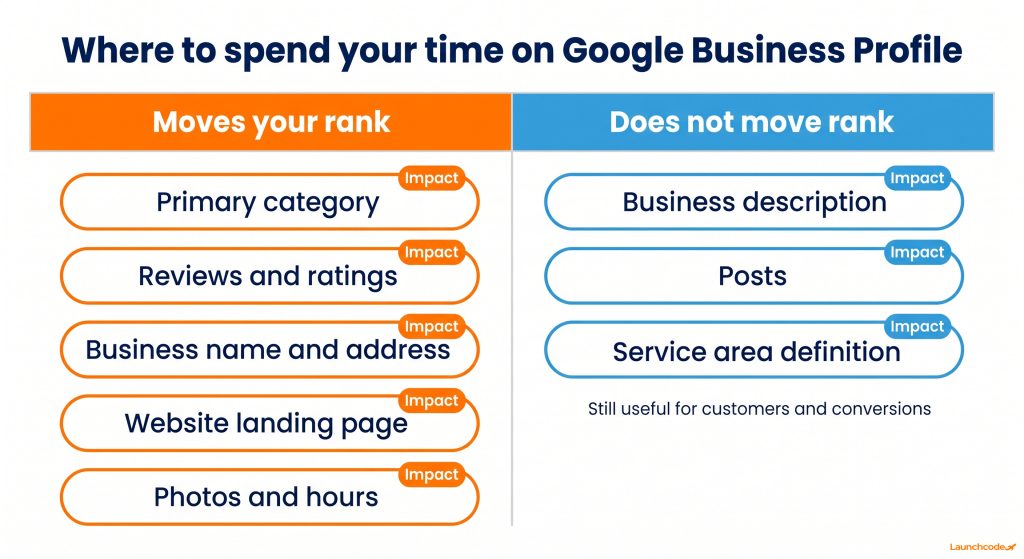
Spend your time on the fields that rank and ignore the ones that do not. The business name, primary category, address, landing page, and reviews carry real ranking weight. Google has confirmed the business description plays no role in ranking, and posts and service area definitions do not move position either. They still help engagement and conversions, just not rank.
This is the gap most guides skip. They list every field as equally important, so owners pour hours into keyword-stuffed descriptions and daily posts that do nothing for position. Use the table below to set priorities.
| Profile element | Ranking impact | Why it still matters |
|---|---|---|
| Primary category | High | Top local pack signal, defines what you rank for |
| Reviews and ratings | High | Drives rank and conversions, rising in weight |
| Business name and address | High | Core relevance and trust signals |
| Website landing page | High | Connects profile relevance to your site |
| Photos and hours | Moderate | Supports relevance and engagement |
| Business description | None for rank | Helps customers understand you, aids conversion |
| Posts | None for rank | Keeps profile active, lifts click through |
| Service area definition | None for rank | Informs customers, but rank uses your address |
Audit your profile against this table once a quarter. Put the high-impact items on a fixed schedule, such as a weekly review request and a monthly category check. Treat the description and posts as conversion tools, not ranking tools, so you write them for customers rather than search engines.
Claim your profile, verify ownership, and fill in every field before you optimize anything advanced. Verification unlocks editing, messaging, and insights, and it tells Google you are a legitimate business. A complete profile earns more visibility on its own. Birdeye found that a complete profile averages about 1,803 monthly views and roughly 66 new reviews per location each year.
Verification can take a few days and sometimes requires video or document proof. Start early so a delay does not block the rest of your work.
Your name, address, and phone number, often called NAP, must match across your website, directories, and social profiles. Inconsistent data confuses Google and weakens prominence. Pick one exact format and use it everywhere. Audit your listings with a tool like BrightLocal or Semrush Listing Management to find missing or conflicting entries, then fix old records from past addresses or rebrands, since duplicates split your ranking signals.
Your primary category is the most important ranking choice you make. Select the single category that best describes your core business, then add secondary categories for other real services. BrightLocal's category study found that businesses with four additional categories hold the highest average map ranking at 5.9. Choose categories that are accurate, not aspirational.
A bakery that also serves coffee should set "Bakery" as primary and add "Coffee shop" as secondary. Each accurate category makes you eligible for more relevant searches. Irrelevant categories dilute your relevance and can trigger filtering.
"When we audit a stalled profile, a wrong primary category is the first thing we find. Switching it to match what people actually search often lifts map pack visibility within weeks." Tanner Medina, Co-Founder and Chief Growth Officer
Keep your name exactly as it appears in the real world. Adding keywords like "Smith Plumbing Emergency Drain Repair" violates Google guidelines and risks suspension or forced reverification. If a keyword belongs in your real name, register a legal DBA or trade name first, then update the profile to match the registered name. That keeps you compliant while capturing the keyword.
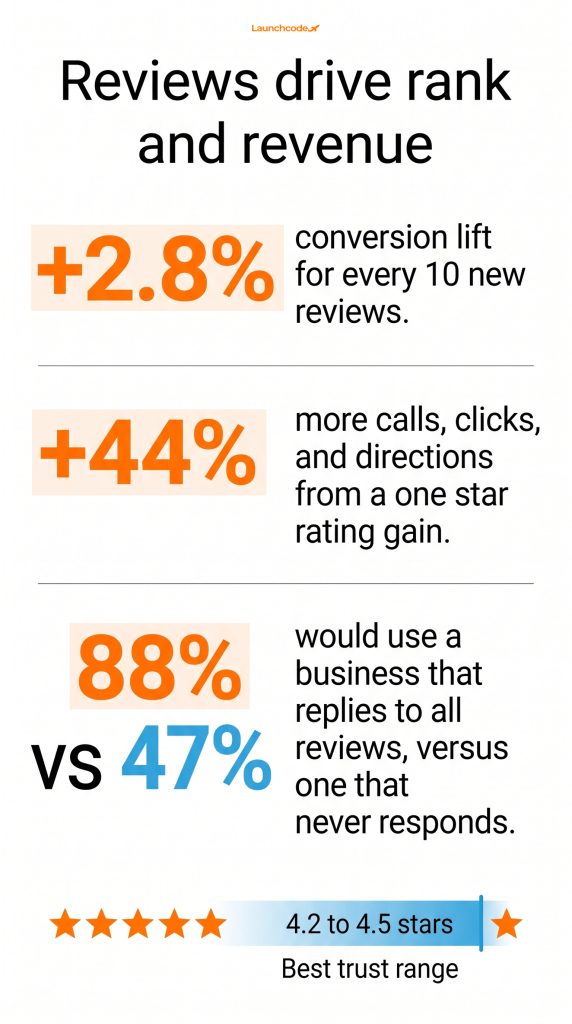
Reviews drive both rankings and conversions, and recency matters as much as volume. Earn new reviews on a steady schedule, respond to every one, and aim for a believable rating rather than a perfect score. SurfSigma's reporting on BrightLocal data shows the strongest trust range sits between 4.2 and 4.5 stars, with consumers weighing the most recent reviews most heavily.
Review reliance is rising, not fading. BrightLocal's 2026 survey found that 41 percent of consumers now always read reviews when browsing for businesses, up from 29 percent the year before. The same research shows consumers now use an average of six review sites, and Google's share as a review source slipped from 83 percent in 2025 to 71 percent in 2026. Google still leads by a wide margin, so it stays your priority, while a wider presence helps.
Replying to reviews is a trust and engagement signal. BrightLocal found that 88 percent of consumers would use a business that replies to all of its reviews, compared to just 47 percent for a business that never responds. Reply to negative reviews calmly and offer to fix the issue in public.
SOCi benchmark data shows the payoff. Every 10 new reviews lifts a profile's conversion rate by about 2.8 percent, and improving a rating by one star raises calls, clicks, and direction requests by 44 percent.
"A steady cadence beats a one-time push every time. We set clients on a goal of ten new reviews a month, and the conversion lift compounds across the year." Tanner Medina, Co-Founder and Chief Growth Officer
Photos and engagement signals keep your profile active, and Google now watches how people interact with it. Clicks, calls, direction requests, and photo views feed prominence. Add real photos regularly, keep hours current, and make sure your phone number and website work. These actions do not replace categories and reviews, but they reinforce a profile that already ranks.
The 2026 Whitespark research points to engagement, credibility, and customer experience rising in weight. Profiles that look active outperform those that owners set up once and abandon.
A multi-location service brand we have worked with at Launchcodex saw map pack visibility climb after the team corrected primary categories across locations and built a weekly review and photo routine. The fix was not exotic. It was the high-impact basics, done consistently across every profile.
AI search pulls from your reviews, profile freshness, website content, and consistent data across the web. To get surfaced, keep your profile complete and active, earn recent reviews, and make sure your website clearly describes your services and location. The same signals that win the map pack also feed AI Overviews and conversational search.
This is where most guides go quiet. AI systems answer more local questions directly now, comparing options by sentiment, recency, and content. BrightLocal's research describes AI as becoming a mainstream tool for how people find local businesses and services.
"AI systems reward consistency. When a client's website, profile, and citations all say the same thing, we see them surface in AI answers far more often than competitors with mismatched data." Derick Do, Co-Founder and Chief Product Officer
Local search expert Darren Shaw of Whitespark notes that profile services moved from a local SEO "myth" in 2023 to a confirmed ranking factor in 2026. The lesson holds for AI too. The factors that signal a real, active, trusted business are the ones that win across search and AI surfaces.
The fastest gains come from the high-impact basics, done in order. Set an accurate primary category, finish every core field, fix your NAP across the web, and build a steady review and response habit. Leave the description and posts for customers, not rank. Then keep the profile active with fresh photos and answers, and align your website so AI systems can trust and surface you.
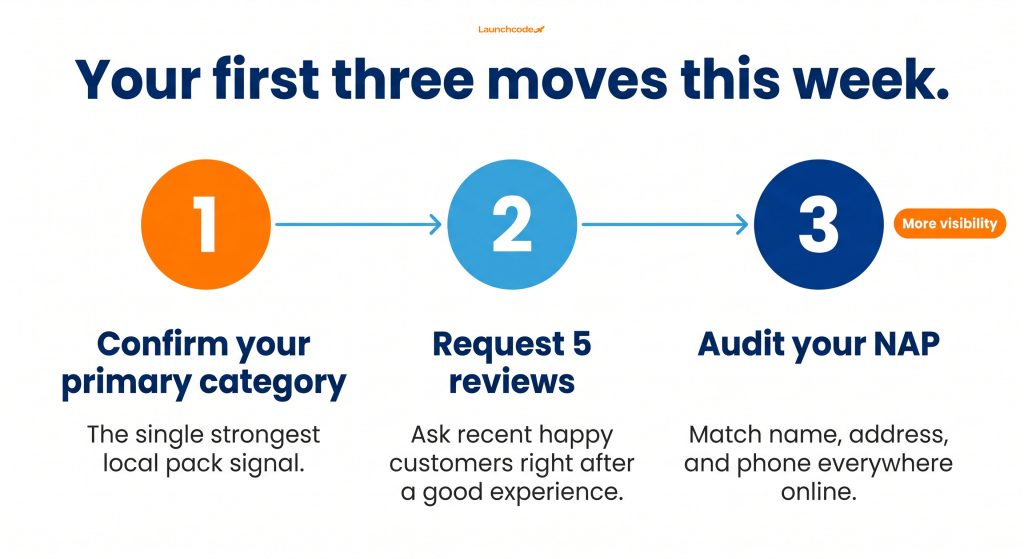
Pick three actions this week. Confirm your primary category, request five reviews from recent customers, and audit your name, address, and phone for consistency. Those moves alone separate profiles that grow from profiles that stay invisible. If you manage many locations and want a structured audit framework, that is the kind of work the team at Launchcodex builds and ships for local and multi-location brands.
Most profiles show movement within a few weeks of consistent work, though competitive markets take longer. Verification and review velocity often gate early progress, so start both right away.
No. Google has confirmed the description does not factor into ranking. Write it for customers to explain what you do and why you fit their needs, since it still supports conversions.
There is no fixed number. Recency, response rate, and a believable rating between 4.2 and 4.5 stars matter more than a single large count. Aim for steady new reviews rather than one big push.
Only if they are part of your real, registered name. Adding keywords you do not legally hold risks suspension. Register a DBA first if a keyword genuinely belongs in your name.
Posts do not move ranking position. They keep your profile active and can lift click-through and engagement, so they are worth doing for conversions, not for rank.




Learn which Google Business Profile fields actually rank in 2026, which ones to skip, and how to win the map pack and AI sea...
Article 50 of the EU AI Act requires chatbot and AI content disclosure starting August 2026. Learn what it requires, who it ...
Local SEO is how nearby customers find you on Google and AI tools like ChatGPT. Learn how rankings work, how to optimize you...