





EU AI Act 2026: New disclosure rules for chatbots and AI content
Article 50 of the EU AI Act requires chatbot and AI content disclosure starting August 2026. Learn what it requires, who it ...




If your business runs a chatbot, publishes AI-generated images or video, or produces AI-assisted marketing content that reaches customers in the EU, a new legal requirement now applies to you. Article 50 of the EU AI Act took effect on August 2, 2026, and it requires clear disclosure any time a person interacts with AI or views AI-generated content, according to the European Commission. Fines for noncompliance reach 15 million euros or 3 percent of a company's global turnover, whichever is higher.
This guide breaks down what the rule requires, who it applies to, and what compliant disclosure looks like for chatbots, ads, and content. It also covers a point most compliance guides skip. Most brands still are not disclosing AI use consistently, even though most consumers say they want them to. That gap is the real opportunity.
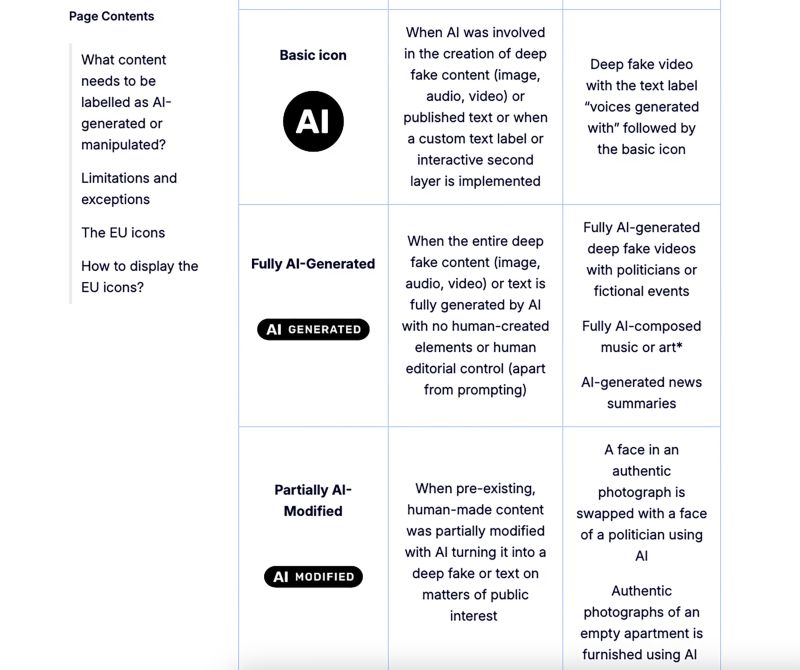
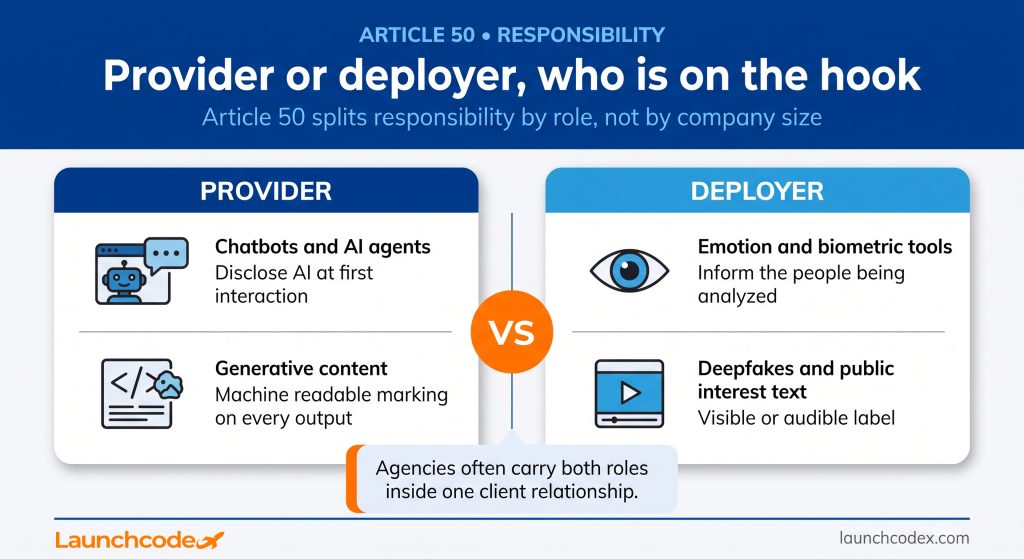
Article 50 creates four separate disclosure duties. Chatbots and AI agents must tell users they are AI. Generative AI systems must mark their output so it can be detected as artificial. Emotion recognition and biometric tools must inform the people they analyze. Deepfakes and AI-generated public interest text must be labeled unless a human reviewed the content and takes editorial responsibility for it.
Ready to grow your organic traffic?
Get a free SEO audit from the Launchcodex team.
These obligations apply now, across all 27 EU member states. A narrower duty, machine-readable marking for generative systems already on the market before August 2026, was pushed to December 2, 2026, according to Cooley. Everything else applies today.
| Scenario | Who is responsible | What is required |
|---|---|---|
| Chatbots and AI agents | Provider | Disclose AI at first interaction |
| Generative content, text, image, audio, video | Provider | Machine-readable marking |
| Emotion recognition or biometric categorization | Deployer | Inform the people being analyzed |
| Deepfakes and AI-generated public interest text | Deployer | Visible or audible label unless human edited |
A provider builds or supplies the AI system. A deployer is the business putting it to use with its own customers. If you built your own chatbot, you are the provider. If you licensed a chatbot tool and configured it for your website, you are usually the deployer, and you still carry disclosure responsibility for how that tool interacts with your customers.
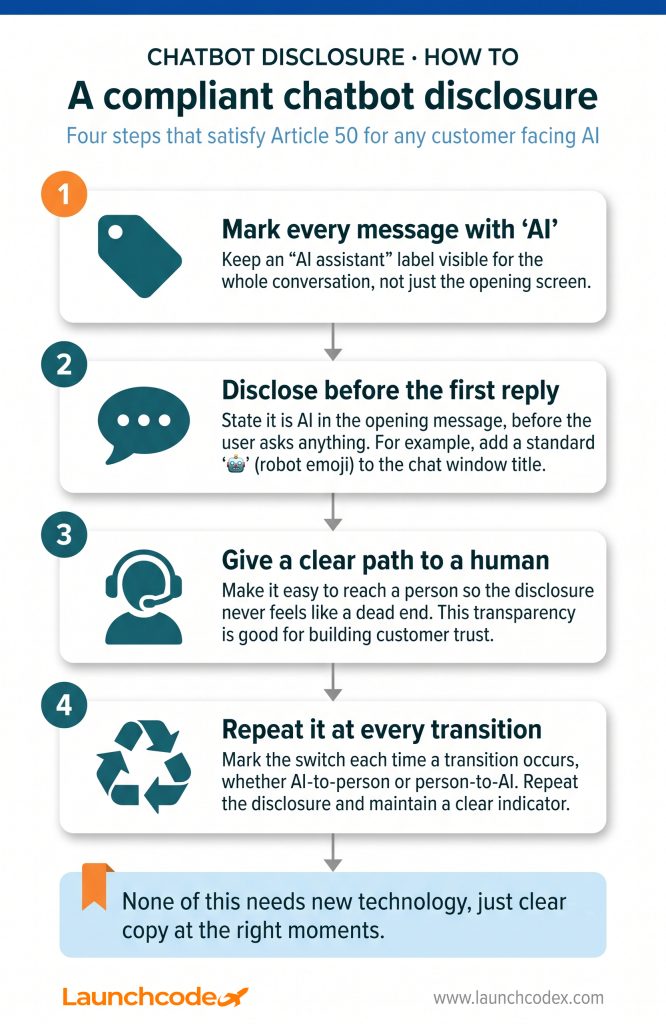
A compliant chatbot disclosure tells the user they are talking to AI before or at the start of the conversation, in wording a person actually notices. A line buried in your terms and conditions does not count. The disclosure needs to sit inside the conversation itself, ideally paired with a persistent label and a clear path to a human.
Building this into a chatbot takes four steps.
A first message like "Hi, I'm an AI assistant. I can help with most questions, and I can bring in a teammate anytime" satisfies the timing requirement on its own. Paired with a persistent label, that covers most ordinary customer service bots.
Many businesses assume a small icon or a generic "chat with us" label is enough. The exception for interactions that are already obvious to a reasonably well-informed person is narrow, and regulators read it narrowly. Relying on it instead of a plain language disclosure carries real risk.
"We build the disclosure into the chatbot's first message at the code level, not as a copy edit after launch. It takes one sprint to fix across every bot a client runs." Derick Do, Co-Founder and Chief Product Officer
AI-generated images, video, or audio that resemble a real person, place, or event count as a deepfake under Article 50 and need a visible or audible label. This covers AI-generated spokespeople and video ads, not only obvious fake news content. A persistent visual label, an opening disclaimer, or an audible cue at the start of playback all satisfy the requirement.
The law defines a deepfake as AI-generated or manipulated image, audio, or video content that resembles an existing person, object, place, entity, or event and would falsely appear authentic. Clearly fantastical content, dragons or people flying, falls outside that definition.
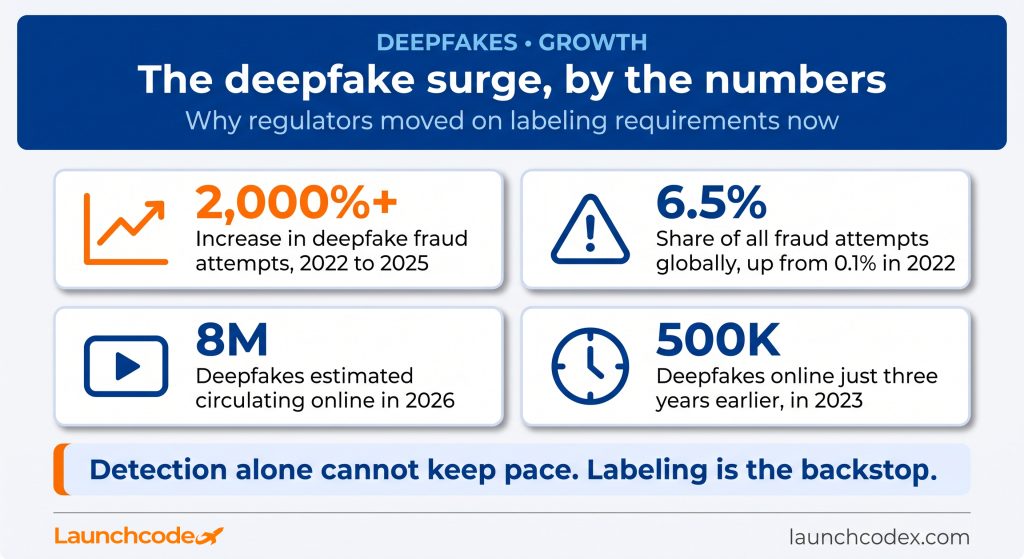
The volume of this content has grown fast enough to explain why regulators acted. Deepfake fraud attempts have increased more than 2,000 percent over the past three years and now make up about 6.5 percent of all fraud attempts globally, according to Sumsub data reported by StationX. Online deepfake volume has grown just as fast, from roughly 500,000 in 2023 to an estimated 8 million in 2026, per Eftsure.
"Every AI video pipeline we build now has a label step built into the export settings. It is a five-minute fix if you plan for it early instead of retrofitting it later." Derick Do, Co-Founder and Chief Product Officer
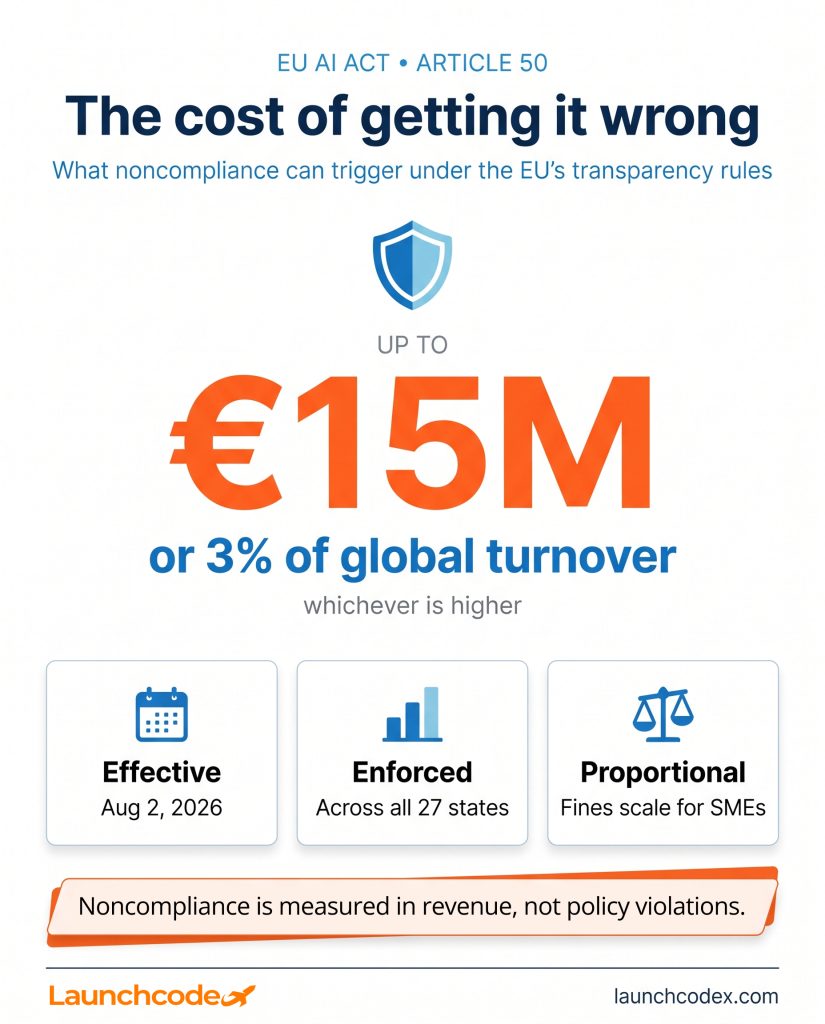
Noncompliance with Article 50 can trigger fines up to 15 million euros or 3 percent of a company's worldwide annual turnover, whichever is higher, with proportionality built in for small and medium-sized businesses. National market surveillance authorities, the EU's AI Office, and the European Data Protection Supervisor share enforcement, so the specific agency involved depends on the type of AI system.
| Enforcer | When it applies |
|---|---|
| National market surveillance authorities | Most day-to-day chatbot and content disclosure cases |
| European AI Office | Systems under its direct supervision |
| European Data Protection Supervisor | Cases where an EU institution is the provider or deployer |
Nearly 190 organizations, including Google, Meta, Microsoft, Anthropic, OpenAI, and Mistral, signed the EU's voluntary Code of Practice on Transparency of AI-Generated Content by the end of July 2026, with about half of the signatories being small or newer companies. Signing does not replace the legal obligation, but it gives regulators a recognized benchmark for good compliance, and it shows where the market is heading.
Yes, if your AI output reaches people in the EU. Article 50 applies based on where an AI system's content or interaction reaches users, not where the company that built or deployed it is headquartered, according to Bird and Bird's analysis of the final Commission guidelines. A US business with EU customers, EU site traffic, or ads running in EU markets is in scope.
Applying this in practice is rarely a clean yes or no. Bird and Bird's own read of the guidelines describes it as a case-by-case decision with limited options for standardised approaches, which means agencies running paid media or content for clients with any EU reach should treat this as a live question, not a footnote.
"Most of our clients run ads or content that reaches EU users without realizing it. That is the blind spot worth checking first, before you worry about anything else in this article." Tanner Medina, Co-Founder and Chief Growth Officer
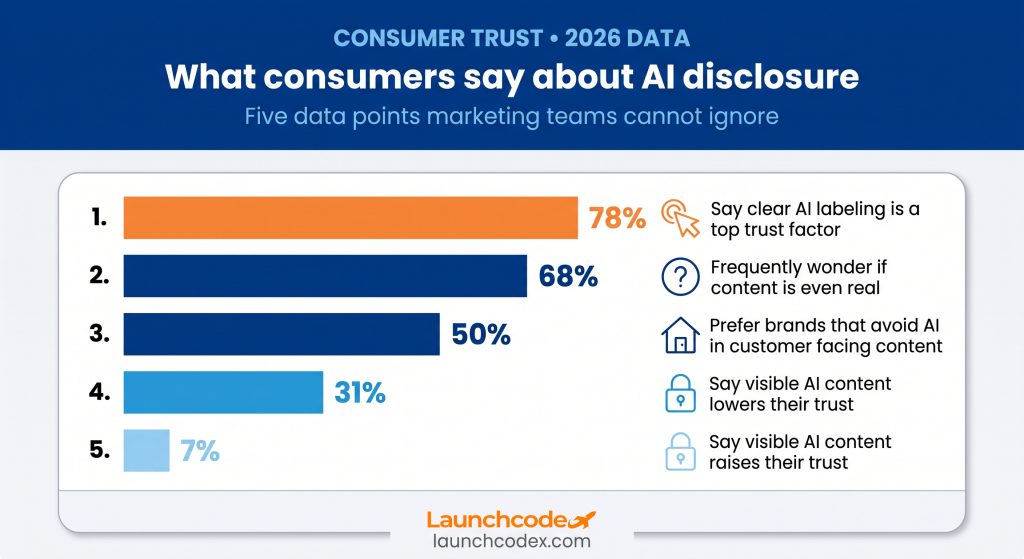
Most brands are not disclosing AI use consistently, and most consumers say they want them to. A 2026 Gartner survey of 1,539 US consumers found 50 percent would rather give their business to brands that avoid generative AI in customer-facing content, and 78 percent rate clear AI labeling as very important or the most important factor in maintaining trust. That gap is the real opportunity.
As Gartner's Emily Weiss put it, marketers should treat GenAI as a trust decision as much as a technology decision. The same research found 68 percent of consumers frequently wonder whether the content in front of them is real, a sign the anxiety is widespread rather than niche, according to a separate Gartner finding.
Disclosure alone is not a guarantee, though. Only 7 percent of consumers say visible AI-generated content makes them trust a brand more, while 31 percent say it makes them trust the brand less, per eMarketer's coverage of Klaviyo and Datalily's 2026 research. Disclosure is the legal floor. Content quality still decides whether it helps or hurts.
"Clients ask us if disclosure will hurt ad performance. The data says the bigger risk is doing nothing while competitors get ahead of it and look more trustworthy for it." Tanner Medina, Co-Founder and Chief Growth Officer
At Launchcodex, we build AI video and creative for clients using tools like Higgsfield, Kling, and Seedance. Disclosure now gets built into the deliverable from the start instead of added after the fact. That single habit removes most of the risk covered in this article before a campaign goes live.
Start with an inventory, not a rewrite. List every chatbot, every AI-generated image or video asset, and every piece of AI-assisted content currently in market. Check each one against the four scenarios above, add disclosure where it is missing, and write down the decision for anything you decide is exempt. Businesses that treat this as a one-time content audit, rather than an ongoing habit, tend to fall out of compliance the next time a new tool or campaign launches. If you want a second pair of eyes on your chatbot scripts, ad creative, or content workflow, that is exactly the kind of audit our team runs for clients moving fast on AI production.
Not automatically. The public interest text rule mainly targets AI-generated text published without human review or editorial responsibility. Marketing copy that a person edits and approves before publishing generally falls outside that specific duty, though building disclosure into your workflow now is still the safer long-term move.
Yes, if the image resembles a real person, place, or event closely enough to meet the deepfake definition. A visible label or caption noting the image is AI-generated satisfies the requirement.
Confirm it, do not assume it. As the deployer, you are responsible for how the disclosure actually appears in your specific setup, even when the underlying tool came from a vendor.
No, it is voluntary. Signing gives you a recognized way to demonstrate compliance, and nearly 190 organizations had signed by the end of July 2026.




Article 50 of the EU AI Act requires chatbot and AI content disclosure starting August 2026. Learn what it requires, who it ...
Local SEO is how nearby customers find you on Google and AI tools like ChatGPT. Learn how rankings work, how to optimize you...
White label digital marketing lets your agency sell partner-delivered services under your own brand. See the real margins, r...