
Share:

AI marketing & automation


The problem with responsive search ads is volume. Google recommends using all 15 headline slots and all 4 description slots to give its machine learning enough combinations to test. For a single campaign with multiple ad groups, that means dozens of short, distinct, non-repetitive assets. Writing that manually takes hours. Most teams end up with thin, repetitive copy by the end.
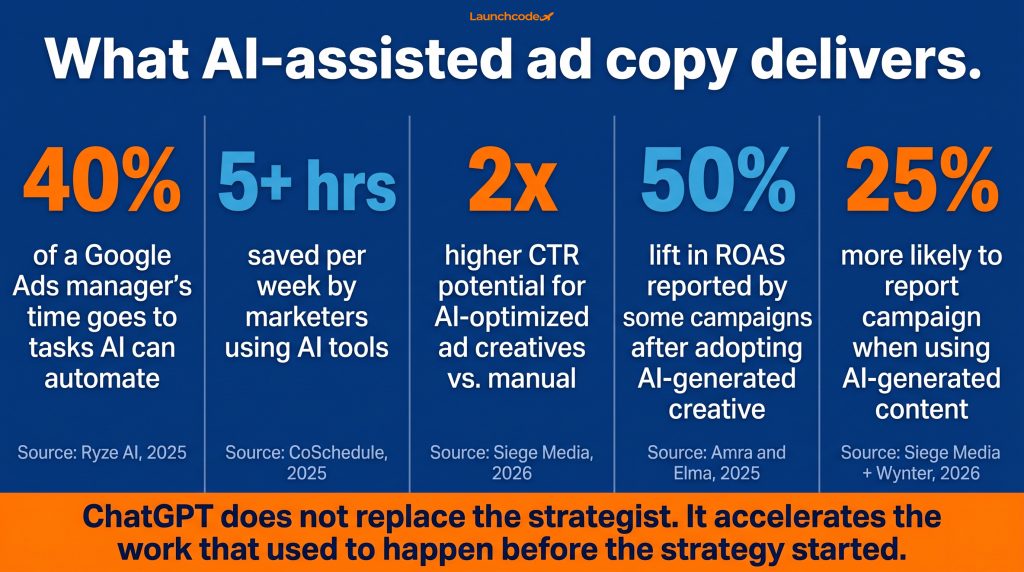
The average Google Ads manager spends 40% of their time on tasks AI can automate, and most of that time goes toward copywriting and variation work. This guide walks through a 4-step workflow for using ChatGPT to write responsive search ad copy that holds up under real campaign conditions, with prompts you can copy and adapt today.
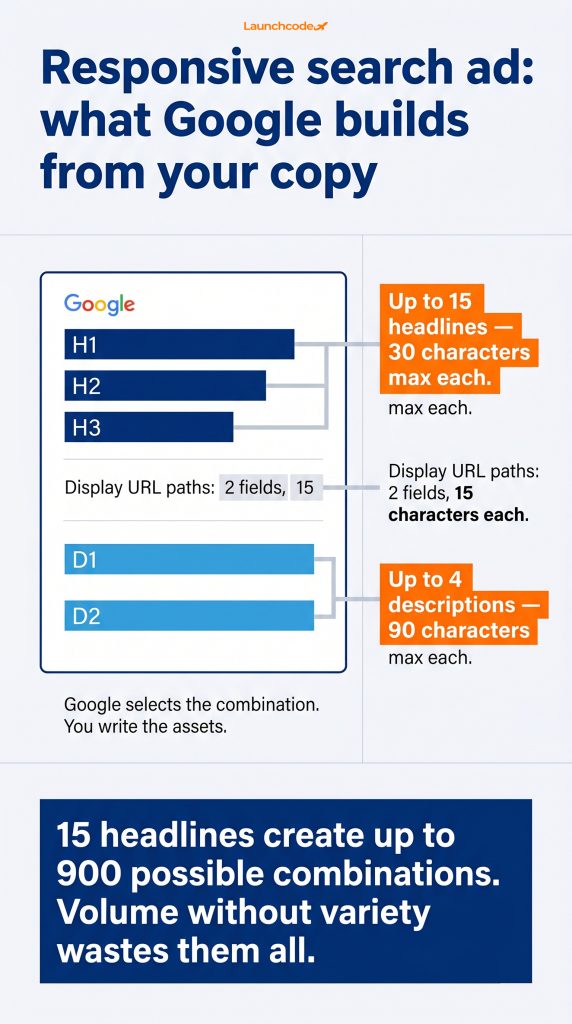
Responsive search ads replaced expanded text ads in June 2022. Since then, Google selects which headlines and descriptions appear together, not the advertiser. Every asset must work on its own and pair well with any other asset in the ad. One RSA requires up to 15 headlines and 4 descriptions, each written to a strict character limit. That writing task adds up fast.
Before RSAs, writing three to five ad variations was enough. Now Google’s machine learning tests combinations automatically. That works well when inputs are strong and breaks down when they are not. A poorly varied set of headlines restricts what the algorithm can test and lowers Ad Strength, Google’s indicator of how well an ad is set up for performance.
| Asset type | Character limit | Max number of assets |
|---|---|---|
| Headline | 30 characters | 15 |
| Description | 90 characters | 4 |
| Display URL path | 15 characters each | 2 paths |
Google recommends using all 15 headline slots. Each headline must stand alone because Google may display any combination of three headlines alongside any two descriptions. Fifteen inputs create up to 900 possible headline combinations. Volume without variety gives the algorithm nothing useful to learn from.
Writing 15 distinct, non-repetitive headlines in 30 characters each is hard. Teams run out of angles after headline 8 and start repeating the same phrases with minor word swaps. The result is low Ad Strength, limited testing signal, and copy that sounds like it was drafted by committee.
ChatGPT solves this specific problem well. As the team at Position2 noted after a hands-on experiment: the challenge is to present the same information “in enough different ways to populate the maximum number of allowable ad copy variants for Responsive Search Ads. This is what ChatGPT does really well.”
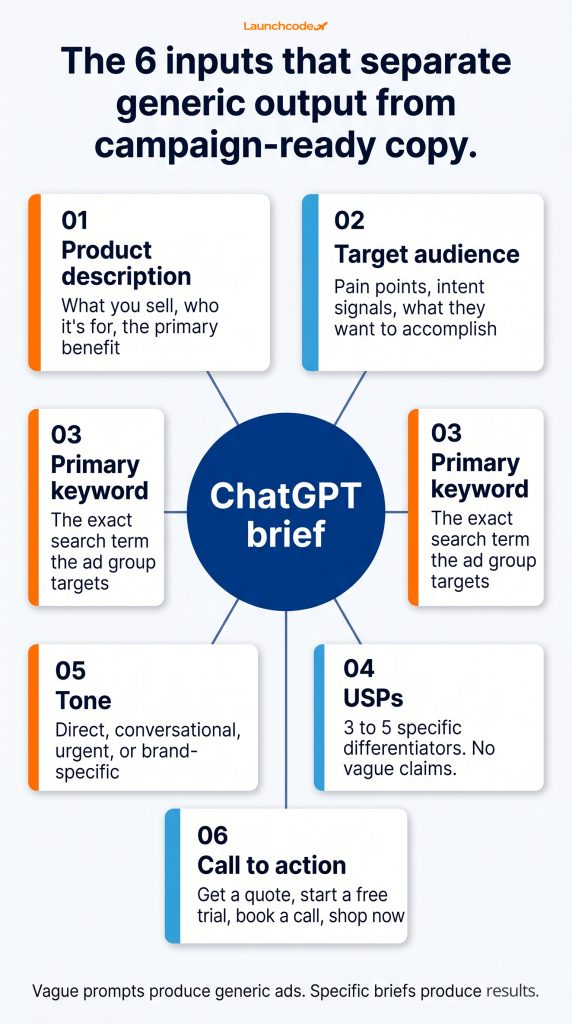
The quality of ChatGPT’s output depends entirely on the quality of the input. A vague prompt produces generic ads. A structured brief produces campaign-ready copy. Before writing any prompt, gather the six inputs below and feed them to ChatGPT at the start of every session. This is the step most guides skip, and it is the one that changes everything.
Google Ads consultant Zdravko Dimchov puts it plainly: “Bad prompts equal generic ads. Good prompts equal campaign-ready outputs.” Most teams skip the brief and jump straight to asking ChatGPT for headlines. That is why the output sounds like every other ad on the page.
“Most people treat ChatGPT like a search engine. They ask a vague question and expect a useful answer. Ad copy prompts work exactly the same way as any other AI workflow. The better your inputs, the less time you spend fixing outputs.”
Derick Do, Co-Founder & Chief Product Officer, Launchcodex
Product: Project management software for remote engineering teams. Tracks tasks, sprints, and blockers in one workspace. Integrates with GitHub and Slack.
Audience: Engineering managers at companies with 20 to 200 employees. Frustrated with scattered task tracking across Jira, Slack, and spreadsheets. Want one place developers actually use.
Primary keyword: project management software for engineering teams
USPs: GitHub integration in two clicks, built for developers not project managers, used by 4,000 teams, 14-day free trial with no credit card required.
Tone: Direct and confident, slightly technical.
CTA: Start free trial.
Feed that brief to ChatGPT before asking it to write anything. It gives the model the same context a human copywriter would need before sitting down to draft.
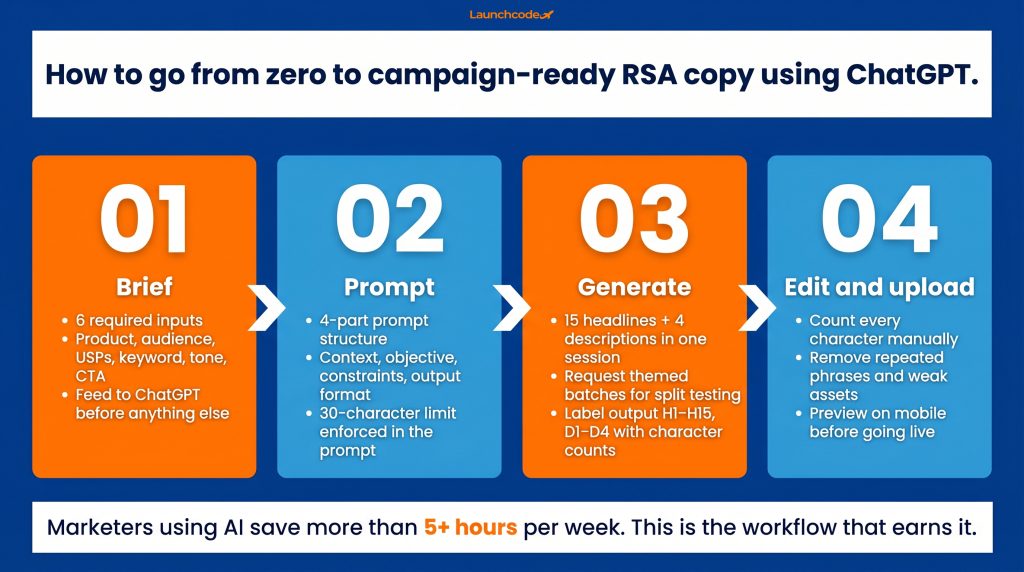
Effective Google Ads prompts follow four components: context, objective, constraints, and output format. Missing any one of these produces output that needs heavy editing or cannot be used at all. The constraints section, where you specify character limits and asset counts, is the most commonly skipped and the most critical.
ChatGPT does not know Google Ads rules unless you tell it. Left without constraints, it writes headlines that run 45 to 50 characters long and descriptions that spill past 90. Those outputs cannot go live without complete rewrites.
Context. Tell ChatGPT who it is. Role prompting anchors the output style and expertise level.
“Act as a senior Google Ads copywriter with 10 years of experience writing high-converting responsive search ads.”
Objective. Tell it exactly what you want. Be specific about the campaign goal.
“Write responsive search ad copy for [product] targeting [keyword].”
Constraints. State every limit explicitly and ask ChatGPT to verify compliance before including each asset.
“Write 15 headlines. Each headline must be 30 characters or fewer, including spaces. Count the characters before including each headline. Rewrite any that exceed 30 characters. Write 4 descriptions. Each must be 90 characters or fewer.”
Output format. Tell it how to return the output so you can use it without reformatting.
“Format the output as a numbered list. Label headlines H1 through H15 and descriptions D1 through D4. Show character count in parentheses next to each asset.”
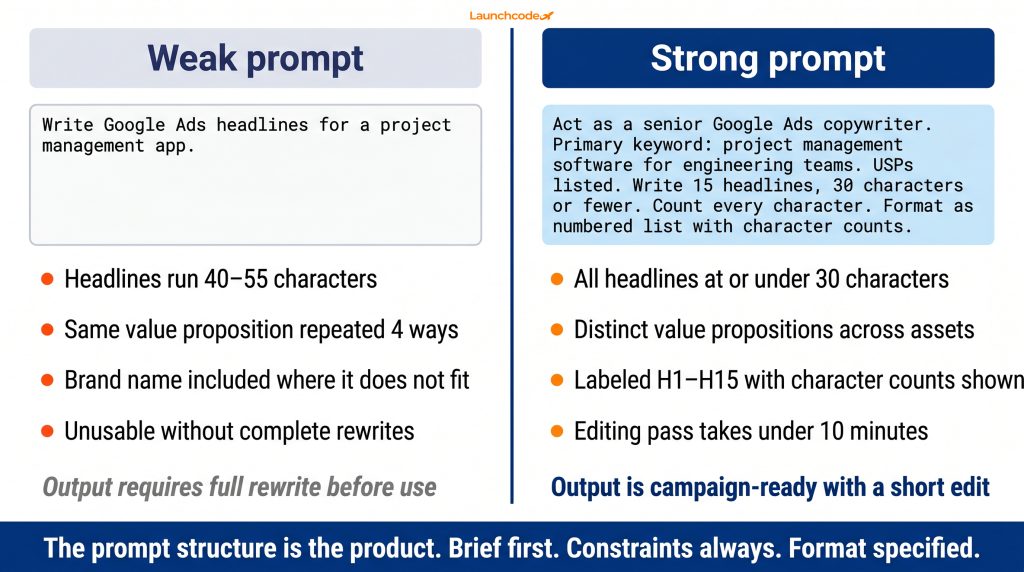
Weak prompt:
“Write Google Ads headlines for a project management app.”
ChatGPT returns headlines that may run 40 to 55 characters, repeat the same value proposition four ways, and include the brand name where it does not fit.
Strong prompt:
“Act as a senior Google Ads copywriter. I am writing responsive search ads for a project management app for remote engineering teams. Primary keyword: project management software for engineering teams. USPs: GitHub integration, built for developers, 4,000 teams use it, 14-day free trial.
Write 15 headlines. Each must be 30 characters or fewer including spaces. Count every character before listing each one. Write 4 descriptions, each 90 characters or fewer. Tone: direct and confident. CTA: start free trial. Format as a numbered list with character count in parentheses.”
The strong prompt produces usable, on-spec output. It still needs an editing pass, but the gap between raw output and uploadable copy is measured in minutes, not hours.
These four prompts cover the most common RSA copy tasks. Each includes the constraint language needed to enforce character limits inside ChatGPT. Copy each one, fill in the brackets, and run it with your brief loaded at the start of the session. Do not skip the brief step.
Use this when starting a new ad group from scratch.
Act as a competitive Google Ads copywriter.

Here are competitor ads running for [keyword]:
[paste competitor headlines and descriptions from Google search results]

My brief:
- Product/service: [describe]
- USPs: [list]
- CTA: [action]

Analyze these competitor ads. Identify:
1. Messaging they all share (what to avoid repeating)
2. Angles no competitor is using (opportunities)

Write 10 headlines and 3 descriptions for my ad that are clearly differentiated.
Every headline must be 30 characters or fewer. Every description must be 90 characters
or fewer. Show character counts.Use this when you have ads running and want to lift performance without starting from scratch.
Act as a competitive Google Ads copywriter.

Here are competitor ads running for [keyword]:
[paste competitor headlines and descriptions from Google search results]

My brief:
- Product/service: [describe]
- USPs: [list]
- CTA: [action]

Analyze these competitor ads. Identify:
1. Messaging they all share (what to avoid repeating)
2. Angles no competitor is using (opportunities)

Write 10 headlines and 3 descriptions for my ad that are clearly differentiated.
Every headline must be 30 characters or fewer. Every description must be 90 characters
or fewer. Show character counts.Use this when you want two or three complete RSAs with distinct messaging angles to test against each other.
Act as a competitive Google Ads copywriter.

Here are competitor ads running for [keyword]:
[paste competitor headlines and descriptions from Google search results]

My brief:
- Product/service: [describe]
- USPs: [list]
- CTA: [action]

Analyze these competitor ads. Identify:
1. Messaging they all share (what to avoid repeating)
2. Angles no competitor is using (opportunities)

Write 10 headlines and 3 descriptions for my ad that are clearly differentiated.
Every headline must be 30 characters or fewer. Every description must be 90 characters
or fewer. Show character counts.Use this when you want copy that stands apart from what competitors are running on the same keyword.
Act as a competitive Google Ads copywriter.
Here are competitor ads running for [keyword]:
[paste competitor headlines and descriptions from Google search results]
My brief:
- Product/service: [describe]
- USPs: [list]
- CTA: [action]
Analyze these competitor ads. Identify:
1. Messaging they all share (what to avoid repeating)
2. Angles no competitor is using (opportunities)
Write 10 headlines and 3 descriptions for my ad that are clearly differentiated.
Every headline must be 30 characters or fewer. Every description must be 90 characters
or fewer. Show character counts.RSA split testing works best when separate ads in the same ad group carry distinct messaging themes, not random headline swaps. When two ads argue different cases for the same product, the results tell you which value proposition drives clicks and conversions. ChatGPT generates multiple themed batches quickly once the brief is set.
Most teams treat RSA variation as a creative exercise. The goal is a structured test. When two ads in the same ad group share the same underlying message with slightly different words, there is nothing meaningful to learn from the results. Real theme contrasts produce real learning.
“We run this workflow on client campaigns regularly. The time win is real, but the bigger shift is copy quality. Themed RSAs give us something to actually learn from during testing, not just more volume for the algorithm.”
Tanner Medina, Co-Founder & Chief Growth Officer, Launchcodex
The most common error is building ads that are thematically identical despite different wording. If one ad opens with “Grow your business faster” and another opens with “Scale your team with ease,” those are not distinct themes. Both are vague benefit statements. A real theme contrast looks like this: “14-day free trial, no card” (proof of low risk) versus “4,000 engineering teams trust it” (social proof). One argument is about risk reduction. The other is about crowd validation. Those are testable differences.
ChatGPT output is a starting point, not a finished product. Even with a well-structured prompt, some headlines will need character corrections, some will be too generic, and some will clash with brand voice. A short editing pass before upload is faster than starting from scratch and is required for any live campaign.
The team at Position2 ran a hands-on experiment with ChatGPT-generated Google Ads copy and found they could bring raw output “up to an acceptable standard in less than 10 minutes.” That is the realistic benchmark. ChatGPT accelerates the draft. The strategist finishes it.
Run through these checks before uploading any ChatGPT-generated RSA copy.
ChatGPT does not connect to your Google Ads account by default. It cannot see your campaign metrics, search term reports, or historical ad performance. Every prompt in this article works with information you supply. If you want ChatGPT to analyze actual performance data, export from Google Ads and paste the data directly into the prompt before asking for recommendations.
Ad Strength and Quality Score are not vanity metrics. Both influence how often your ads show and what you pay per click. Copy decisions made during the writing phase directly affect both scores. Higher Ad Strength means more combinations tested, better auction efficiency, and lower cost per result over time.
Ad Strength rates RSAs on a scale from Incomplete to Excellent. Google calculates it based on how many assets you provide, how unique they are, and how well they reflect the ad’s keywords and landing page. A set of 15 varied, keyword-aligned, benefit-focused headlines rates higher than 15 variations of the same sentence.
Quality Score is calculated per keyword and reflects expected CTR, ad relevance, and landing page experience. Copy that closely matches what the searcher wants and delivers on the landing page lifts the relevance component. A higher Quality Score lowers CPC and improves ad rank without requiring higher bids.
AI-optimized creatives have shown the potential to deliver up to two times higher CTR compared to manually designed versions, and some campaigns have reported up to a 50% lift in return on ad spend after adopting AI-generated creative. Those outcomes depend on brief quality, prompt structure, and the editing pass that follows generation.
ChatGPT is a real time saver for Google Ads copy when used with a proper brief, structured prompts, and a human editing pass before anything goes live. The 4-step process in this article, brief, prompt, generate, and edit, removes most of the friction from RSA copy production without removing the strategic thinking that makes ads convert.
Marketers using AI report saving more than 5 hours per week, and those using AI-generated content are 25% more likely to report campaign success. ChatGPT does not replace the strategist who knows the product, the audience, and what the data is saying. It accelerates the parts of the job that used to drain time before the real work started.
At Launchcodex, the paid media workflow our team follows is built on the brief-first principle. The better the input, the faster a campaign reaches its first meaningful test. If you want a team that already runs this workflow at scale, our performance media practice is a good place to start.
No. ChatGPT frequently exceeds the 30-character headline limit unless you state the limit explicitly in the prompt and ask it to count characters before including each asset. The prompts in this article include that constraint language. Always verify character counts manually before uploading to your account.
Yes. Prompt 2 in this article covers that workflow. Paste your existing headlines and descriptions, provide the brief context, and ask ChatGPT to identify weak assets and rewrite them. Including current performance data such as CTR or Ad Strength rating gives the model more to work with.
No, as long as the content itself meets Google’s advertising policies. Google does not penalize ads based on how they were written. The standard rules still apply: no false claims, no misleading offers, no unsupported superlatives. Review all AI-generated copy against Google’s ad policies before uploading.
Two to three themes per ad group is the practical range. One theme gives Google nothing to compare. More than three makes it harder to interpret results clearly. Create one RSA per theme, run them simultaneously, and wait at least four weeks before reviewing which theme is winning on CTR and conversion rate.
GPT-4 or later produces more reliable output for constrained tasks like RSA copy writing. It follows multi-step instructions more consistently than earlier versions and is less likely to exceed character limits. GPT-3.5 can work for basic copy generation but requires more editing passes to get on-spec output.


Real stories from the people we’ve partnered with to modernize and grow their marketing.