Search is not just blue links anymore. Buyers start in AI overviews and answer engines that assemble results from entities and trusted sources. If you want durable visibility in 2026, build topical authority the way models understand it. This playbook shows exactly how to do that, step by step, with outcomes tied to traffic, pipeline, and revenue.
What topical authority means now
Topical authority is your demonstrated expertise across a subject, proven by depth, consistency, and citation. In 2026 it is shaped by three layers.
- Entities. Clear definitions for who you are, what you sell, who you serve, and the problems you solve.
- Sources. Content that is citable, structured, and linked from reputable places.
- Signals. Internal linking, authorship, schema, and engagement that reinforce meaning.
Get those three working together and you win twice. Traditional rankings improve and AI systems are more likely to reference your material in synthesized answers.
Ready to grow your organic traffic?
Get a free SEO audit from the Launchcodex team.
Book a Free Audit
The entity-first mindset
Entities are the building blocks of modern search. Treat them like products in a catalog.
- Core entities. Organization, products, features, solution themes, industries, personas, compliance frameworks, and key problems.
- Attributes. Names, aliases, definitions, owners, canonical URLs, supporting sources, related entities.
- Relationships. “Product A solves Problem B,” “Solution C applies to Industry D,” “Author E is an expert in Topic F.”
Document this once and you can generate consistent page titles, structured data, internal links, and content briefs without guesswork.
The 90 day entity-first playbook
This is a practical, four sprint plan. Expect to see early gains by day 45, with compounding results by day 90.
Days 1 to 14, map entities and baselines
Outcomes we want: a clean entity inventory, clear measurement, and a prioritized topic map.
- Inventory your entities. Build a sheet with columns for entity, type, definition, canonical URL, related entities, supporting sources, and status.
- Create a topical map. Cluster your existing queries and pages into themes that match your entities. Include gaps, duplicate intent, and decay candidates.
- Baseline metrics. Capture impressions, qualified sessions, rankings distribution, and conversion rate. Add GEO metrics like AI overview appearances and citation share for priority clusters.
- Decide the single source of truth. One hub page per core entity. No fragmented or competing hubs.
Days 15 to 30, fix information architecture and internal links
Outcomes we want: fewer clicks to reach key answers, stronger semantic connections, and paved paths to conversion.
- Design hub and spoke clusters. Each hub earns links, defines the entity, and explains relationships. Spokes handle subtopics, FAQs, comparisons, and how to content.
- Tighten navigation. Group sections by how buyers think, not how teams are organized. Use breadcrumb trails that mirror your clusters.
- Cross link with intent. Add “see also” blocks between sibling pages. Link up to the hub on every spoke. Place product or demo CTAs only where intent is high.
- Reduce click depth. Priority clusters should be reachable in two clicks from the homepage.
Days 31 to 60, ship citable content systems
Outcomes we want: reference grade assets that models and humans trust.
- Publish canonical guides. One comprehensive “what and why” guide per core entity with definitions, diagrams, and citations.
- Add practical formats. How to articles, checklists, calculators, and implementation templates. These formats earn bookmarks and citations.
- Create a knowledge base. Short, unambiguous articles that answer specific questions. Keep them free of fluff and heavy on definitions, examples, and schema.
- Cover comparisons and alternatives. Be objective. State where you are strong, link to sources, and include decision criteria.
Days 61 to 90, strengthen signals that models read
Outcomes we want: clean schema, credible authorship, and visible provenance.
- Schema coverage. Add Organization, Product or Service, WebPage, Article, FAQ, BreadcrumbList, and Person for authors. Keep it valid and consistent with your entity inventory.
- Authorship that counts. Create real author pages with credentials, publications, and links to professional profiles. Add a brief “how we ensure accuracy” note.
- Provenance and sources. Cite standards bodies, regulators, academic work, and customer proof where appropriate. Use footnotes or references sections to keep it clear.
- Governance. Implement an update schedule for every pillar and spoke. Track last reviewed, reviewer, and what changed.
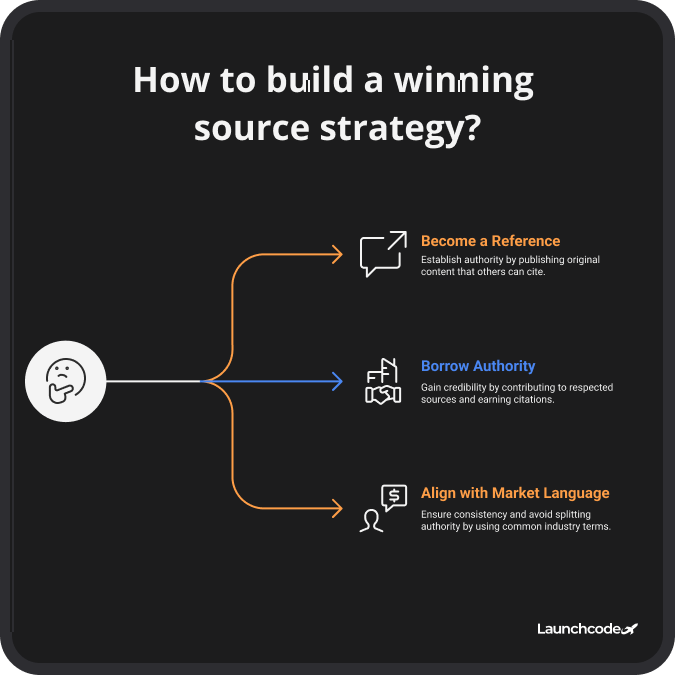
How to build a winning source strategy
Topical authority grows when you are both a source and a contributor to other sources.
- Become a reference. Publish definitions, terminology glossaries, process diagrams, and original datasets. Keep methods transparent so others can cite you.
- Borrow authority. Contribute bylined pieces to relevant associations, standards groups, and respected publishers. Earn citations that reference your hubs, not your homepage.
- Align with the market’s language. Adopt category and compliance terms your buyers already use. Update aliases in your entity sheet so you do not split authority across variations.
Content that models can cite
Models do not cite marketing copy. They cite clear, structured answers to specific questions.
- Answer explicit questions. Include short answers at the top, then expand with detail below.
- Use consistent labeling. Repeat your entity names in headings, figure captions, and alt text.
- Add tables and checklists. Structured formats are easier to extract and reuse.
- Show your work. Link to sources for claims, numbers, and definitions. Where possible, publish your raw data and methodology.
Internal linking that signals authority
Internal links are not just navigation. They are meaning.
- Link with descriptive anchors. Use the exact entity name or a clear relation, not “learn more.”
- Add related reading blocks. Surface siblings and prerequisites.
- Use breadcrumbs. They help models and users understand hierarchy.
- Protect your hubs. Do not dilute with off-topic links. Keep them focused on entity scope and relationships.
Structured data that reinforces entities
Use schema to say the quiet part out loud.
- Organization and Person. Connect authors to your organization with sameAs links to credible profiles.
- Product or Service. Describe what you sell with attributes that match your on-page content.
- Article and FAQ. Mark up explanatory content and question sets.
- BreadcrumbList and WebSite. Support hierarchy and sitelinks.
- Keep it consistent. The entity name in schema should match the page title and the H1. The canonical URL in schema should match your canonical tag.
Measurement that ties to outcomes
Authority is not a vibe. Measure it like a program.
- Visibility. Impressions, rankings distribution, and AI overview appearances by cluster.
- Citations. Share of answers that reference your pages. Mentions of your brand or authors next to target entities.
- Engagement. Dwell time on hubs, return visits to canonical guides, and scroll depth on technical sections.
- Pipeline. Assisted sessions, demo requests, and opportunity creation tied to entity clusters.
- Quality. Editorial error rate, source completeness, and percentage of pages with valid schema.
Create a simple dashboard that rolls up by cluster. Report progress every two weeks. Kill tactics that add noise without moving these numbers.
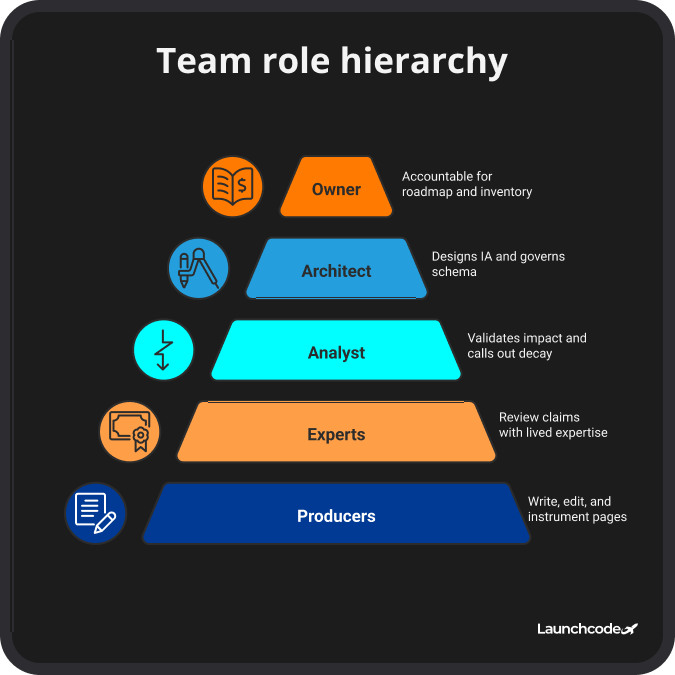
Realistic team setup
You do not need a huge team, you need clear roles.
- Owner. Accountable for the roadmap and the entity inventory.
- Architect. Designs IA, governs schema, and maintains the cross linking rules.
- Experts. Authors with credentials who bring lived expertise and review claims.
- Producers. Write, edit, and instrument pages.
- Analyst. Runs the dashboard, validates impact, and calls out decay.
Keep a lightweight cadence. One pillar or major update per week, two to four supporting pieces, and a weekly review of measurement and next steps.
Templates you can copy
Use these fields in your sheets and briefs. They reduce ambiguity and make your content citable.
Entity sheet fields: entity, type, definition, aliases, canonical URL, related entities, supporting sources, owning author, schema type, last reviewed.
Brief fields: target entity, search intent, primary question, secondary questions, claims and sources, outline headings, internal links in and out, schema requirements, measurement notes, review checklist.
Common pitfalls to avoid
Most failures start with a narrow plan. If your strategy begins and ends with keywords, you end up with thin clusters that read like variations of the same idea. Models look for entities and relationships, so a page that is not anchored to a clear concept, definition, or source will struggle to earn trust. Depth comes from mapping the subject, not from repeating terms.
Evidence is the next weak link. Claims without citations, especially numbers, invite doubt. Treat every statistic like a quote, identify where it came from, and show your method when it is your own data. The same standard applies to authorship. A credible byline includes real credentials, a profile that matches the topic, and a traceable history of work. Placeholder bios and ghostwritten expertise erode authority fast.
Architecture issues compound the problem. One pillar cannot carry a topic alone, it needs focused spokes that answer specific questions and link back with intent. Internal links should reflect real relationships between entities, not be sprinkled for convenience. When links mirror meaning, models understand context and users find the next right step.
Authority decays if you do not maintain it. Even the best guides go stale as standards, products, and language evolve. Set expectations for review, capture what changed and why, and retire pieces that no longer serve the cluster. A topic that is not curated loses visibility and, eventually, pipeline.
A simple checklist to keep you honest
- Do we have a single, maintained entity inventory
- Does every core entity have a hub with clear relationships and links
- Are our canonical guides citable and supported by methods and sources
- Do author pages prove expertise and link to real credentials
- Is schema valid, complete, and consistent with the page
- Are we measuring AI overview presence and citation share by cluster
- Do we update pillars and top spokes on a set cadence
Turn entities, sources, and signals into outcomes
Topical authority is not a trick. It is operational clarity. When entities, sources, and signals work together, your brand becomes the reference for your market. Rankings rise, AI answers cite you, and buyers reach you earlier with more intent. Start with the entity inventory, ship one pillar and a handful of spokes each week, and keep measurement visible. The compounding effect will surprise you.
Entity-first SEO frequently asked questions
What is an entity, and how is it different from a keyword?
An entity is a clearly defined thing, such as your company, a product, or a compliance framework. A keyword is a string users type. Entities persist across queries and formats, which is why models use them to assemble answers. Keywords help you target demand. Entities help you earn trust.
How many pillars and spokes do we need to establish topical authority?
Plan for one hub pillar per core entity and four to eight spokes that answer specific questions, comparisons, and how to tasks. If a topic drives revenue, expand to 10 or more spokes and add reference assets like checklists, glossaries, and calculators.
How long does it take to see results from an entity-first program?
Most teams see early movement in 45 to 60 days, then stronger gains by day 90 as hubs, spokes, and internal links work together. Timelines depend on technical health, publishing velocity, and the strength of your source citations.
How should we measure topical authority?
Track visibility and trust at the cluster level. Use impressions, rankings distribution, and qualified sessions alongside AI overview appearances and citation share. Tie results to pipeline with assisted sessions, demo requests, and opportunity creation from each entity cluster.
Which schema types matter most?
Start with Organization, WebSite, WebPage, BreadcrumbList, and Person for authors. Add Service or Product for what you sell, Article for long form guides, and FAQ where you answer discrete questions. Keep names, URLs, and definitions consistent with your entity inventory.
How do we choose authors and prove expertise?
Assign topics to people with real credentials and a public track record. Give each author a profile page with bio, specialties, publications, and links to professional profiles. Note the review process on articles and include sources for all material claims.
Does programmatic SEO help or hurt topical authority?
It helps when it supports a defined entity, uses tight templates, and links back to a hub with clear context. It hurts when it floods the site with thin variations that compete with your pillars. Quality controls and internal linking rules make the difference.
How often should we update pillars and spokes?
Review pillars quarterly and high traffic spokes every 60 to 90 days. Update definitions, standards, screenshots, and citations. Track last reviewed, owner, and change notes so you can prove freshness.
What internal linking rules should we follow?
Every spoke links up to its hub and to two or three closely related siblings. Use descriptive anchors that match entity names. Keep navigational breadcrumbs in place so hierarchy is obvious to users and machines.
How does GEO differ from traditional SEO in practice?
Traditional SEO focuses on ranking pages for queries. GEO focuses on making your brand, authors, and sources easy for models to cite. In practice you still publish great pages, but you also invest in entities, schema, provenance, and measurements that reflect AI surfaces.