




How tattoo artists get found on Google and AI search
Learn how tattoo artists rank in Google's local map pack and get recommended by AI tools like ChatGPT and Perplexity in 2026...


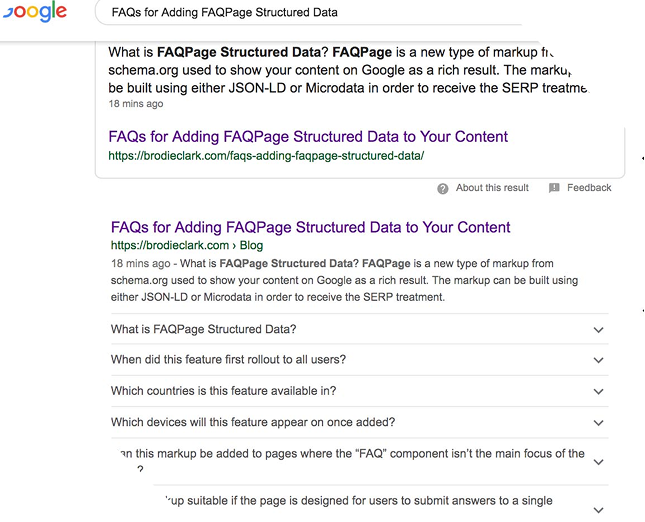


On May 7, 2026, Google officially pulled FAQ rich results from search. The expandable question dropdowns that once appeared beneath organic listings are gone. If your team has FAQ schema deployed across product pages, service pages, or blog content, you have probably already noticed the change or will soon.
This article covers what changed, what did not, and what your team should do between now and August 2026 when the final API support is removed. It also covers the bigger strategic opportunity that most coverage of this announcement has missed entirely.
Google removed a display feature, not a schema type. FAQ rich results were the expandable dropdown that appeared beneath certain organic listings. FAQPage structured data, the JSON-LD markup that powered them, remains a valid and recognized schema type. Google explicitly stated it will continue using FAQ structured data to better understand pages, even though the rich result feature is gone. That distinction changes how your team should respond.
Ready to grow your organic traffic?
Get a free SEO audit from the Launchcodex team.
Most of the early coverage treated structured data and rich results as the same thing. They are not.
Rich results are a visual SERP treatment. Schema markup is a machine-readable communication layer between your content and search engines. When Google removes a rich result type, it removes the display mechanism, not the underlying signal.
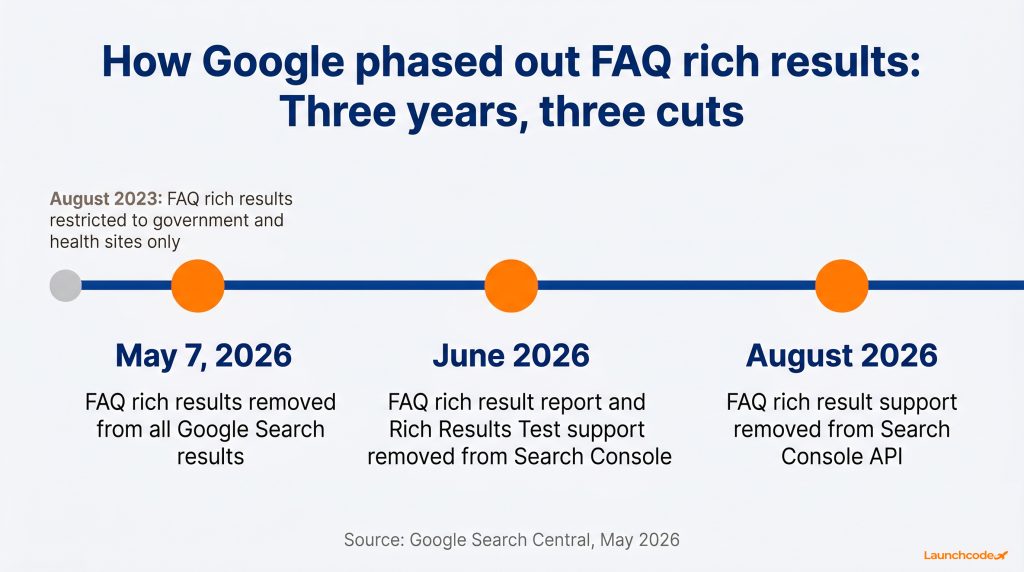
Barry Schwartz, contributing editor at Search Engine Land, broke the story on May 8, 2026, citing the Google Search Central documentation directly. The notice states that FAQ rich results are no longer appearing in Google Search, that the rich result report and Rich Results Test support will be removed in June 2026, and that Search Console API support will follow in August 2026.
Inside the same documentation update, Google included one sentence that has been underreported: the company will continue using FAQ structured data to better understand pages. That is not a throwaway note. It confirms that the markup still informs how Google reads and classifies content, even when it produces no visible SERP enhancement.
Schema markup tells Google what a page is about in machine-readable form. Rich results are a display feature that uses some of that structured data to render visual SERP elements. Those are two separate jobs, and only one of them ended on May 7.
The May 2026 announcement is not a sudden reversal. It completes a three-year phase-out. In August 2023, John Mueller of Google announced that FAQ rich results would only show for well-known, authoritative government and health websites. For the vast majority of the web, FAQ rich results have already been absent for nearly three years. The May 2026 update removes them for the small group of sites that still had them.
Google's March 2026 core update accelerated the process. Across tracked sites, FAQ rich result impressions fell by roughly half compared to the post-2023 baseline. Sites that had retained residual FAQ rich snippet visibility largely lost it before the official deprecation landed.
The pattern is not unique to FAQ markup. HowTo rich results followed the same path. Google restricted them in late 2023, then deprecated them entirely. Both changes share a common cause: widespread schema abuse. When teams add FAQ sections to pages specifically to capture the SERP dropdown, rather than to genuinely answer reader questions, the format produces more noise than signal. Google's response has been to remove the display feature rather than police individual implementations.
The lesson is not to stop using structured data. It is to stop treating display features as the primary reason to implement it. Schema types that produce genuine content signals for Google and AI systems survive these changes. Schema added purely to grab SERP real estate does not.
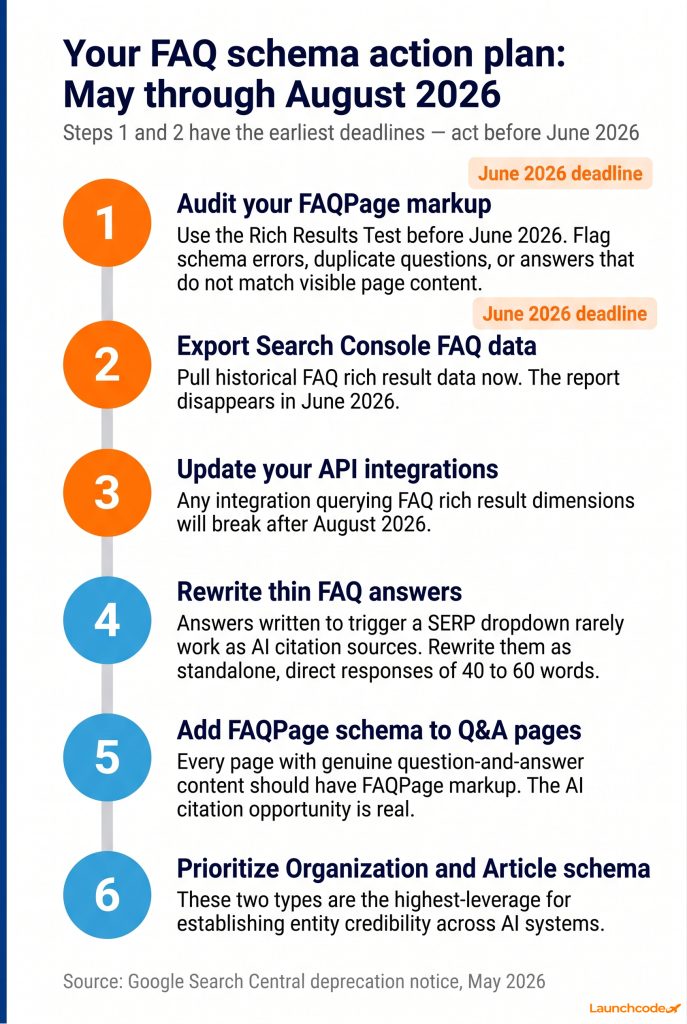
SEO teams need to act on two specific dates. The FAQ rich result report and Rich Results Test support disappear in June 2026. The Search Console API support for FAQ rich results is removed in August 2026. Any dashboard, automated report, or API integration that pulls FAQ rich result data will break without intervention. Export historical reports now, and update those integrations before August.
Here is the full removal timeline:
| Date | What gets removed |
|---|---|
| May 7, 2026 | FAQ rich results stop appearing in Google Search |
| June 2026 | FAQ rich result report removed from Search Console UI. Rich Results Test stops supporting FAQ markup validation |
| August 2026 | FAQ rich result support removed from the Search Console API |
If your team tracks FAQ-specific metrics, replace them with performance-based proxies before June 2026:
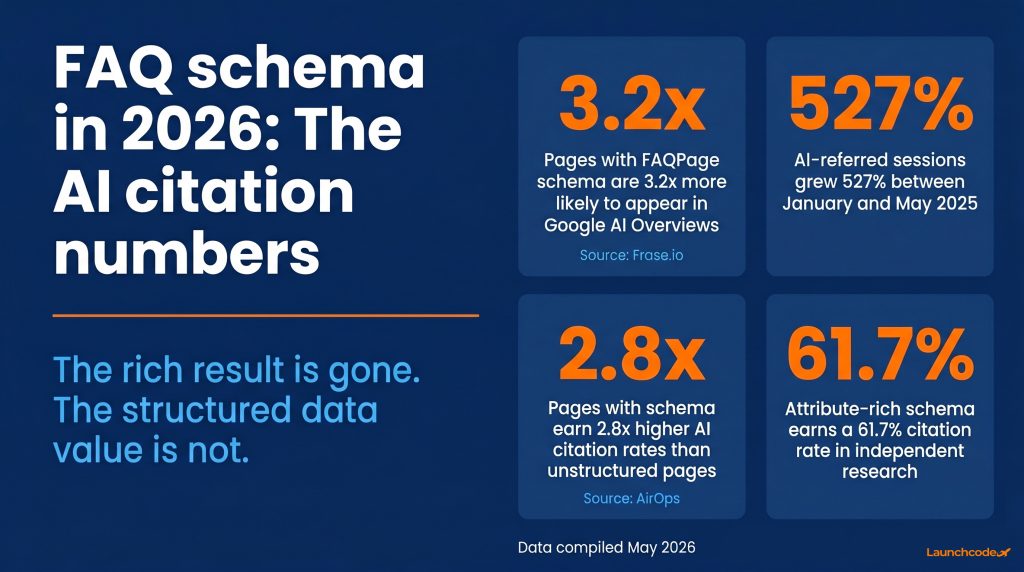
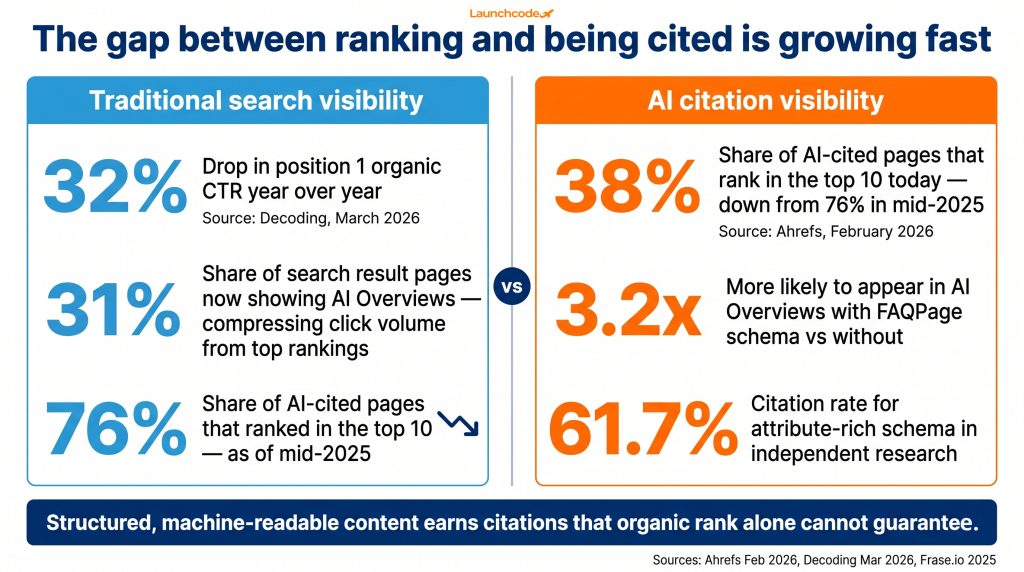
FAQ schema has shifted from a Google rich result trigger to an AI citation signal. Pages with FAQPage schema are 3.2 times more likely to appear in Google AI Overviews than pages without it. ChatGPT Search, Perplexity, and Gemini all parse FAQ structured data as a primary extraction source for Q&A answers. The markup that produced a dropdown in 2021 now helps AI systems find, trust, and cite your content in 2026.
AI-referred sessions jumped 527% between January and May 2025. That number reflects a real shift in how users discover and consume information. The first touchpoint is increasingly an AI-generated answer, not a list of blue links.
AI systems rely on machine-readable signals to decide which pages to cite. FAQPage markup provides exactly the format those systems prefer: explicit question, direct answer, identified source. Research from AirOps found that pages with clean structure paired with schema earn 2.8 times higher AI citation rates than poorly structured pages.
"AI systems are built to extract structured answers from structured data. FAQPage schema is almost a direct feed into how those systems build responses. The teams ignoring this will wonder why competitors keep showing up in AI answers while they don't."
Derick Do, Co-Founder & Chief Product Officer, Launchcodex
The format has not changed. What has changed is the outcome you optimize for. Write FAQ answers to be the source an AI cites, not to trigger a SERP dropdown.
Practical guidelines:
Attribute-rich schema earns a 61.7% citation rate in independent research, while minimal or generic schema underperforms pages with no schema at all. Quality of implementation is the key variable, not the volume of questions marked up.
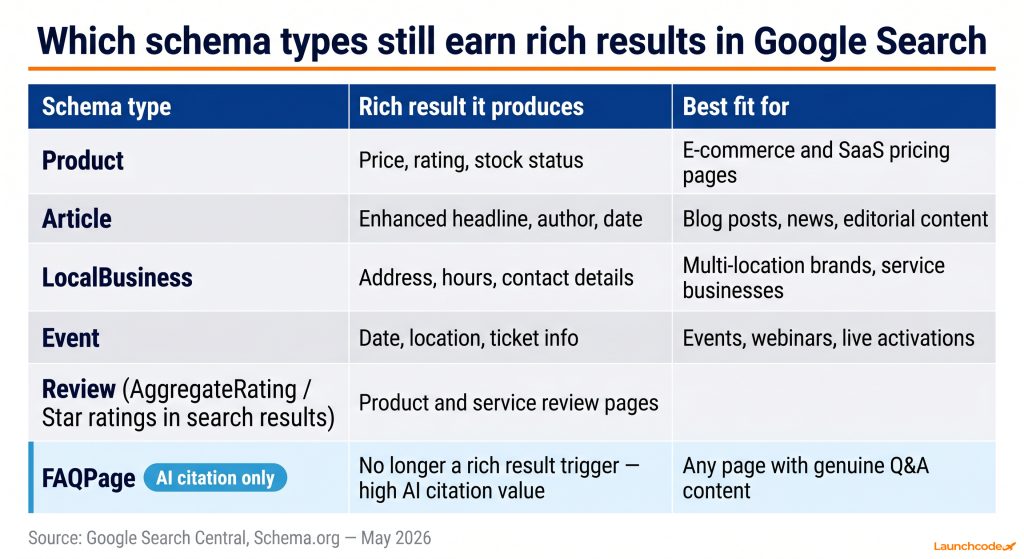
Not all structured data has followed the FAQ path. Several schema types continue to produce rich results in Google Search and should be prioritized as teams redirect their structured data investment. Product, Article, LocalBusiness, Event, and Review schema all remain active. Each serves a different business use case and each contributes independently to AI citation eligibility.
| Schema type | Rich result it produces | Best fit for |
|---|---|---|
| Product | Price, rating, stock status | E-commerce, SaaS pricing pages |
| Article | Enhanced headline, author, date | Blog posts, news, editorial content |
| LocalBusiness | Address, hours, contact details | Multi-location brands, service businesses |
| Event | Date, location, ticket info | Events, webinars, live activations |
| Review / AggregateRating | Star ratings in search results | Product and service review pages |
| FAQPage | No longer a rich result trigger, but high AI citation value | Any page with genuine Q&A content |
Beyond rich result eligibility, Organization and Person schema do something none of the types above can do alone: they establish your brand as a verified entity in Google's knowledge graph and in the entity recognition systems that AI platforms use.
Connecting your Organization schema to authoritative external profiles using the sameAs property links your content to a verifiable identity. That verification is increasingly how AI systems decide which source to trust and cite when generating an answer. The brands that invest in entity clarity now will hold a structural advantage in AI search as that channel grows.
For teams working in WordPress, Rank Math Pro handles JSON-LD output for most of these schema types natively. For larger site implementations, validating schema at the template level and running crawl audits with Screaming Frog ensures coverage stays consistent as content scales.
FAQ rich results improved CTR by presenting answer previews in the SERP. Removing them will reduce impressions for affected pages, but organic rankings are not affected. Google's deprecation of FAQ rich results is a display change, not a ranking change. Your page positions stay where they were. CTR may shift, but the direction and magnitude depend on how much of your visibility came from the rich result format specifically.
Google has confirmed this directly. Removing FAQ schema from your code will not improve or harm rankings. Leaving it in place carries no penalty. The ranking algorithm does not use rich results as an input.
The broader search environment is shifting in ways that do affect CTR. According to March 2026 research from Decoding, position 1 organic CTR has dropped 32% year over year, driven largely by AI Overviews now appearing on approximately 31% of search result pages. Traditional click volume from high rankings is compressing across the board. That context matters when you try to isolate the specific impact of FAQ rich result removal from the broader traffic picture.
Track these metrics for any page that previously carried FAQ rich result appearances:
Monitor for six to twelve weeks after May 7 before drawing conclusions. Traffic patterns stabilize once Google finishes re-indexing affected pages.
Three things require action before August 2026: update your Search Console reporting, validate your existing FAQ schema quality, and redirect your structured data investment toward AI citation. None of these require removing FAQ markup. All three have a clear deadline.
Work through this in order:
"Every client site we audit has FAQ schema deployed somewhere. Most of it was added to chase the dropdown. The work now is retooling that same markup to earn citations in AI answers. That is a more durable outcome than any SERP feature ever was."
Tanner Medina, Co-Founder & Chief Growth Officer, Launchcodex
At Launchcodex, our SEO and GEO work treats structured data as a foundational layer, not a SERP feature to chase. The teams that have invested in clean, complete schema implementations are already better positioned for AI citation than those who built FAQ markup purely to capture dropdown appearances.
The FAQ rich result is gone. The markup is not. The measurement framework needs to catch up with that reality.
For years, the value of FAQ schema was measured in rich result impressions, a metric visible in Search Console and easy to report. That metric is going away. What replaces it requires a different set of tools and a broader definition of search visibility.
Only 38% of pages cited in Google AI Overviews rank in the top 10 of traditional search results, according to an Ahrefs study of 863,000 keyword SERPs from February 2026. That figure is down from 76% in mid-2025. AI citation eligibility is increasingly disconnected from traditional ranking authority. Structured, machine-readable content earns citations that organic rank alone does not guarantee.
Measure structured data performance against these indicators going forward:
The SEO playbook that treated FAQ schema as a click multiplier is finished. The 2026 approach is to use FAQ markup as a machine-readable signal that positions your content as the authoritative source AI systems reach for first.
No. Google confirmed there is no need to proactively remove FAQPage structured data. The markup does not harm rankings or cause any technical penalty. AI systems including Google AI Overviews, Perplexity, and ChatGPT continue to parse FAQ schema as a primary citation signal. Removing it costs you AI visibility with no upside.
No. FAQ rich results were a display feature, not a ranking signal. Your organic positions are unaffected by this change. What may shift is CTR on pages that previously showed the expandable dropdown, since that visual prominence is now gone.
The FAQ rich result report and Rich Results Test support will be removed in June 2026. The Search Console API support for FAQ rich results is removed in August 2026. Export any historical FAQ rich result data before June if you need it for reporting.
Product, Article, LocalBusiness, Event, and Review/AggregateRating all continue to produce rich results in Google Search. Organization and Person schema are essential for entity recognition in AI systems. FAQPage markup remains worth adding for AI citation purposes, even without the Google rich result.
Yes. HowTo rich results followed the same path: restricted in 2023, deprecated shortly after. Google has consistently removed structured data display features that became targets for manipulation. Investing in schema for entity and AI citation value, rather than for SERP visual treatments, is the more durable strategy.




Learn how tattoo artists rank in Google's local map pack and get recommended by AI tools like ChatGPT and Perplexity in 2026...
Google's June 2026 spam update went live on June 24. See what it targets, how to confirm impact in Search Console, and a rea...
Build your first email nurture flow the right way. This guide covers trigger selection, sequence structure, segmentation, an...