


Link building guide: How to earn authority that moves rankings
Learn which link building tactics move rankings in 2026. Covers digital PR, HARO, linkable assets, anchor text strategy, and...





Financial services is one of the most competitive categories in digital advertising. The US financial services industry crossed $33 billion in digital ad spending in 2024, making it only the third industry to hit that milestone. Search ad spending in the sector grew over 12.4% that same year. Insurance ad spend is projected to grow 17% in 2025. Securities and wealth management is close behind at 14%.
That investment is colliding with a tightening set of rules. Platforms updated their financial advertising policies more aggressively in 2024 and 2025 than in any prior period. Regulators made clear that ad targeting algorithms can violate fair lending laws. And 19 US states had passed comprehensive data privacy laws as of February 2025, adding another compliance layer on top of federal requirements. The marketers who come out ahead are not the ones trying to work around the rules. They are the ones who build campaign systems designed for this environment from the start.
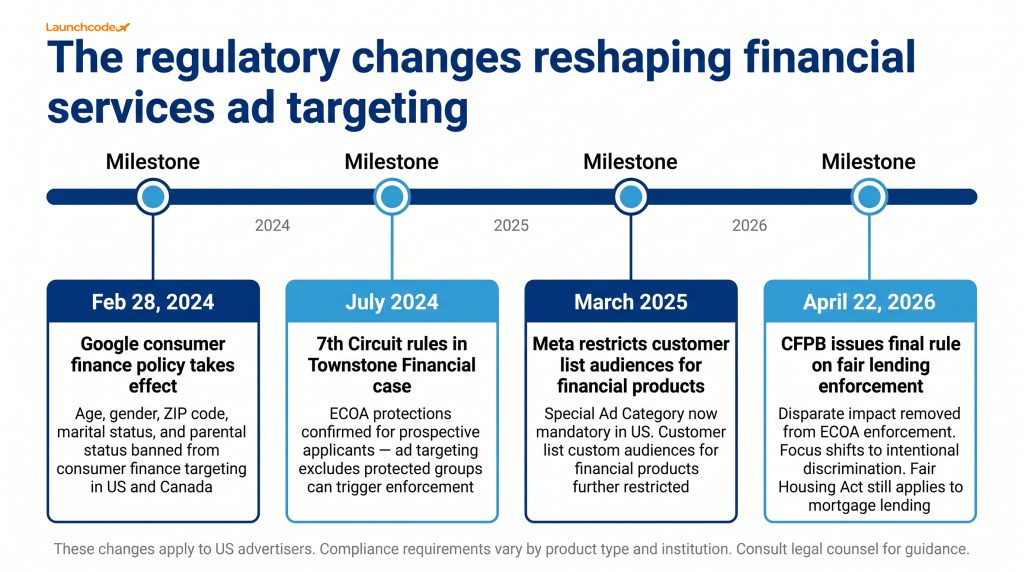
Effective February 28, 2024, Google banned financial services advertisers in the US and Canada from targeting consumer finance ads based on gender, age, parental status, marital status, or ZIP code. The policy, renamed "Consumer finance in personalized ads," covers credit cards, loans, banking accounts, debt management products, and certain financial planning services. Violations trigger a warning first, then account suspension.
Ready to grow your organic traffic?
Get a free SEO audit from the Launchcodex team.
This is a bigger operational shift than it sounds. A bank that previously used ZIP code targeting to restrict a product to a licensed service area now has to find a different geotargeting approach. Timothy Jensen, a senior search expert quoted by eMarketer at the time of the policy rollout, put it directly: "If a bank is only able to offer a particular product or rate in a specific geographic area, and they were previously using a ZIP code to do it, they will now need to switch to another form of geotargeting to cover the proper area."
Google also requires financial services advertisers to complete its Financial Services Verification process before running certain finance ads in markets including the US, UK, Australia, and Singapore. This is a separate requirement from policy compliance. Running finance ads without completing verification in required markets will get campaigns disapproved.
You cannot use age or gender as a targeting dimension for any consumer finance campaign. That includes audience exclusions. Removing someone from your audience because they are over 65 or under 30 triggers the same restriction as targeting them directly.
ZIP code targeting as a personalization signal is gone. You can still use geographic radius targeting to serve ads within a specific area. You cannot use ZIP codes to select or exclude audiences based on demographic proxies.
In-market audiences, keyword intent targeting, geographic radius, and remarketing to prior site visitors all remain available. These are based on behavior and intent, not protected class characteristics. Google's machine learning tools, including Smart Bidding and Demand Gen optimized targeting, are also still usable as long as your input signals do not include prohibited categories.
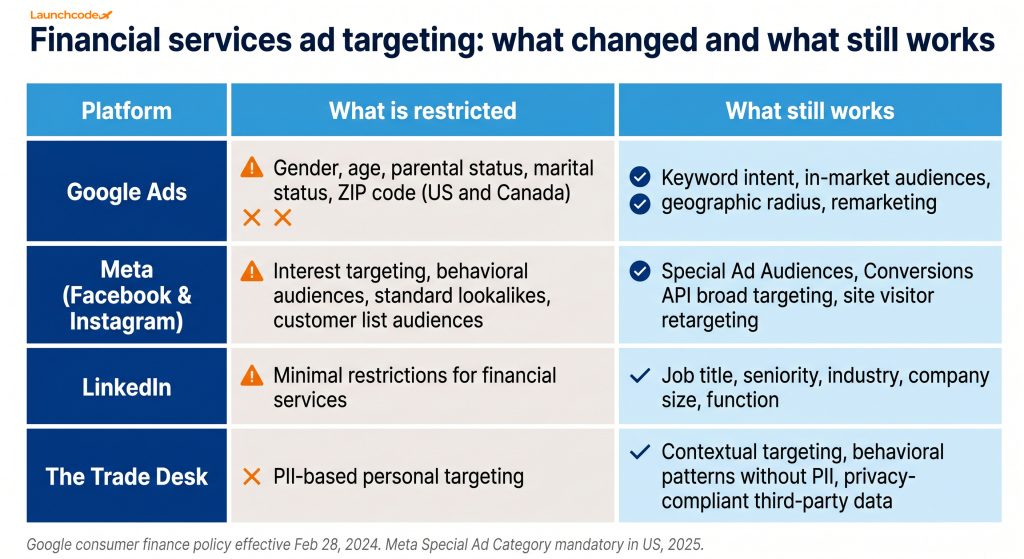
Meta's Special Ad Category for Financial Products and Services is now mandatory for US advertisers running credit, loan, insurance, and investment product campaigns. Declaring it removes interest targeting, behavioral targeting, most demographic layers, and standard lookalike audiences. Customer list custom audiences for financial products in the US were further restricted starting March 2025.
Here is what you lose when you declare the Special Ad Category:
Here is what you keep:
Meta's Conversions API is a server-side tool that sends conversion events directly from your server to Meta, bypassing browser limitations caused by iOS privacy changes. For financial advertisers, it is not optional. Without it, Meta's algorithm receives degraded signals and cannot optimize delivery effectively within the restricted targeting environment.
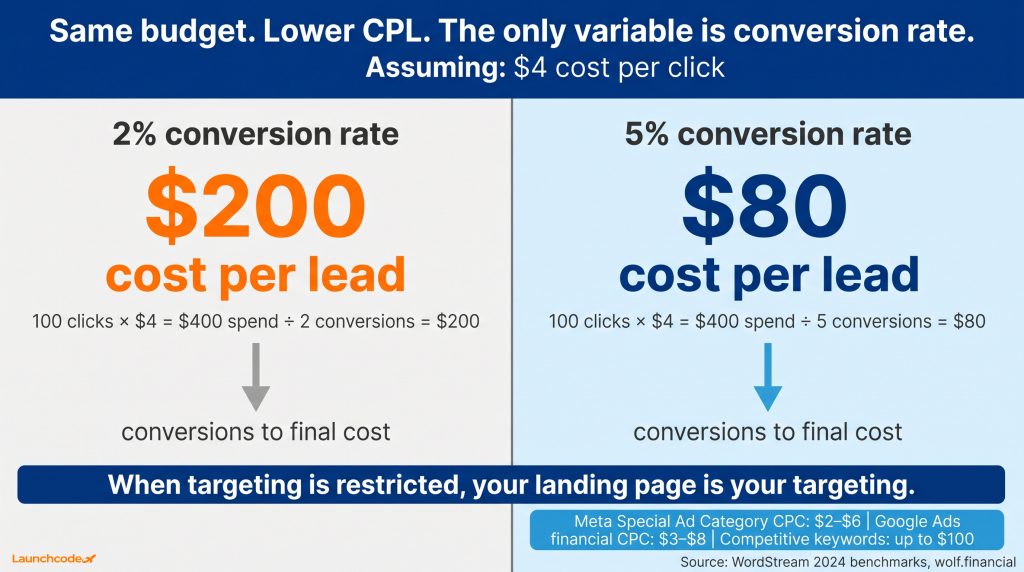
Financial services advertisers running Special Ad Category campaigns typically see CPC between $2 and $6, compared to $3 to $8 for Google Ads financial campaigns on average, according to WordStream's 2024 benchmarks cited by wolf.financial. Highly competitive Google keywords, such as those for home loans or financial advisors, can run $50 to nearly $100 per click.
ECOA, the Equal Credit Opportunity Act, does not just govern what your ad says. It governs who sees it. If your targeting algorithm excludes protected classes from seeing your credit or financial product ads, that can constitute illegal discouragement under Regulation B, regardless of whether the exclusion was intentional. A July 2024 federal court ruling confirmed that ECOA protections extend to prospective applicants, including people who were never shown your ad in the first place.
This is the part most financial marketers miss. The compliance conversation inside most organizations focuses on ad copy: Are disclosures present? Are claims accurate? Those questions matter. Regulators are also asking: Which audiences did you decide not to reach, and why?
In July 2024, the 7th Circuit Court of Appeals ruled in the Townstone Financial case that ECOA protections extend to prospective applicants, not just people who applied for credit. The CFPB had argued that Townstone's radio advertising discouraged African American applicants from applying for mortgages. The court upheld the CFPB's enforcement authority, ruling that lenders are liable for both outright discrimination and actions that discourage protected groups from applying.
Former CFPB Director Rohit Chopra stated the agency's position plainly: "The speed with which banks and lenders are turning lending and advertising decisions over to algorithms is concerning." The concern is not just about discriminatory intent. It is about discriminatory outcomes produced by algorithmic targeting, even when no one designed them that way.
Digital redlining is the practice, intentional or algorithmic, of excluding protected class consumers from seeing credit or financial product advertising. Regulators treat this as a fair lending violation under ECOA. The risk shows up in a few specific ways:
The CFPB issued a final rule on April 22, 2026 that removed disparate impact theory from ECOA enforcement and narrowed the discouragement standard under Regulation B. Under the new rule, enforcement focuses on intentional discrimination, not outcomes alone. This reduces some statistical-outcome risk for non-mortgage products. The Fair Housing Act still applies disparate impact standards to residential real estate lending, and state laws in many jurisdictions continue to recognize disparate impact as grounds for liability.
Have your ad targeting reviewed by a compliance officer or qualified attorney before launch, particularly for credit products. Document your audience decisions and keep records of what targeting signals you used and why.
Note: This article covers marketing strategy, not legal advice. Regulatory requirements vary by product type, institution, and jurisdiction. Consult legal counsel for compliance guidance specific to your situation.
Financial services advertisers still have effective targeting tools on every major platform. The key is knowing which options remain available after restrictions apply, and building campaigns designed for those constraints.
| Platform | What is restricted | What still works | Key requirement |
|---|---|---|---|
| Google Ads | Gender, age, parental status, marital status, ZIP code for consumer finance ads in US/Canada | Keyword intent, in-market audiences, geographic radius, remarketing | Financial Services Verification |
| Meta (Facebook/Instagram) | Standard interest targeting, behavioral audiences, standard lookalikes, customer list audiences (as of March 2025) | Special Ad Audiences, broad targeting with Conversions API signals, site visitor retargeting | Special Ad Category mandatory |
| Minimal restrictions for financial services | Job title, seniority, industry, company size, function | Standard advertiser verification | |
| The Trade Desk | PII-based personal targeting | Contextual targeting, behavioral patterns without PII, privacy-compliant third-party data segments | DSP setup and partner data agreements |
LinkedIn is largely unaffected by the platform-level restrictions that govern Google and Meta. Job title, company size, industry, seniority, and function are not protected class attributes. For B2B financial products, including business banking, commercial lending, corporate insurance, RIA services, or fintech platforms, LinkedIn often delivers the cleanest qualified audience of any major ad platform.
The average LinkedIn CPC is higher, but lead quality in financial services B2B is frequently strong enough to justify the cost. If your financial product maps to a specific role, such as CFO, controller, HR director, or small business owner, LinkedIn targeting can deliver precision that Meta's Special Ad Audience model cannot match.
Contextual targeting places ads based on the content of the page a user is actively viewing, not based on who the user is. It requires no personal data and is fully compliant with both platform policies and privacy regulations.
In financial services, contextual targeting lets you reach users reading about retirement planning, mortgage rates, business loans, or investment strategies. The match between content and ad intent improves engagement and reduces wasted impressions. According to Experian's 2026 analysis of contextual targeting, ads placed in contextually aligned environments show higher conversion rates than generic placements, and campaigns can launch quickly with measurable results. Financial advertisers running contextual campaigns via programmatic DSPs like The Trade Desk can reach high-intent environments at meaningful scale without relying on personal identifiers.
First-party data, collected directly from your own customers and prospects through your website, CRM, email, and app, is the only targeting asset that remains fully available under current platform restrictions and grows more valuable as third-party data erodes. Brands that use first-party data effectively achieve up to 2.9x revenue uplift and 1.5x cost savings, according to Google.
This is a performance advantage, not just a compliance answer. First-party audiences convert 2 to 6 times higher than generic or third-party audiences, according to industry benchmarks. When you build targeting from your actual customer data, you reach people who already have a relationship with your brand or have shown intent through their behavior.
For financial services, first-party data includes:
"The financial marketers who come to us already struggling are almost always missing a first-party data system. They have ad spend but no clean audience foundation. Building that foundation is always the first fix, not the creative."
Brittany Charles, SVP, Client Services, Launchcodex
On Meta, CRM-based custom audiences remain available for financial campaigns with the March 2025 restrictions in mind. Review Meta's current policies on customer list use for financial products before uploading. Build Special Ad Audiences from your pixel data rather than interest-based lookalikes.
On Google, Customer Match lets you upload first-party CRM data to reach existing customers and build similar audiences based on your actual customer profiles. This is allowed under Google's consumer finance policy because it is based on your own data, not demographic proxies.
Use Conversions API on Meta and server-side tagging in Google Tag Manager to maintain clean conversion signal as browser-based tracking continues to degrade. Signal quality directly determines how well the platform's algorithm optimizes within restricted targeting parameters.
The brands with the strongest first-party data in financial services built it through consistent collection across owned channels over time. Here is the process:
Financial media networks, including ad platforms being built by banks like Chase and payment companies like PayPal, are an emerging channel worth watching. US financial media network ad spend is projected to reach $1.22 billion in 2026, nearly doubling from $640 million in 2025. These networks give advertisers access to first-party financial transaction data in a compliant, walled-garden environment.
When you cannot pre-qualify your audience through demographic or behavioral targeting, your landing page takes over that job. Landing page conversion rate is the single highest-leverage performance variable in a restricted targeting environment. A 2% conversion rate at a $4 CPC produces a $200 cost per lead. A 5% rate at the same CPC drops it to $80.
This math comes directly from wolf.financial's 2024 analysis of Meta Special Ad Category campaign economics. It holds across platforms. When CPCs are fixed and targeting is broad, improving conversion rate is the only variable that moves cost per lead meaningfully.
Most financial services landing pages are built for legal compliance, not conversion. They include required disclosures, which is correct. They also tend to bury the value proposition, use vague calls to action, and ask for too much information before delivering any value in return.
It states exactly what the visitor gets and what it costs them in time or information within the first three seconds of loading.
It qualifies the visitor through content, not form fields. Headlines, product descriptions, and FAQ sections do the filtering that demographic targeting used to do. A mortgage landing page that clearly states the minimum credit score and loan size it serves will repel unqualified traffic without a single form field.
It includes trust signals that are specific. Named regulatory registrations, exact years in operation, and audited performance data outperform generic "trusted by thousands" claims. The average financial services search ad conversion rate is 5.10%, but display ads average 1.19%. Part of that gap comes from intent. The rest comes from mobile performance and page quality.
It makes the next step frictionless. For high-commitment products like mortgages or wealth management, the conversion event is often a phone call or a booked appointment. Design the page around that outcome, not a generic form submission.
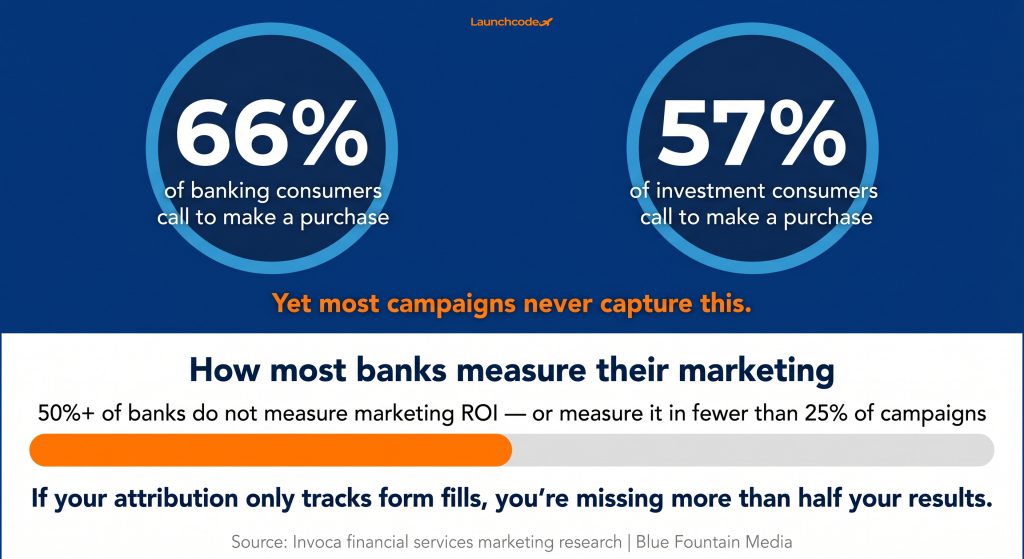
More than 50% of banks do not measure marketing ROI at all, or measure it in fewer than 25% of their campaigns. That gap compounds over time. In financial services, 66% of banking consumers and 57% of investment consumers call to make a purchase, which means digital-only attribution models systematically undercount campaign performance.
These figures come from Invoca's financial services marketing research. If your attribution model only captures form fills, you are missing more than half of the conversions your campaigns are actually driving.
"Clean conversion signal is everything in a restricted targeting environment. When platforms cannot use demographics, they lean harder on behavioral signals. If those signals are degraded or incomplete, the algorithm cannot learn. It just burns budget."
Derick Do, Co-Founder & CPO, Launchcodex
The SEC's Division of Examinations stated in its December 2025 Risk Alert that marketing compliance is an examination priority, and advisers should reassess the policies, procedures, and oversight frameworks that support all marketing activities. That applies directly to measurement and record keeping. Store targeting configurations, audience definitions, and creative versions for each campaign. If your account is ever examined, you need to produce those records quickly.
At Launchcodex, when we audit paid media programs for clients in regulated industries, the first thing we examine is the data infrastructure. Audience quality, conversion signal integrity, and attribution accuracy determine whether a campaign can learn and improve within restricted targeting parameters. Campaigns without clean signals do not optimize. They spend.
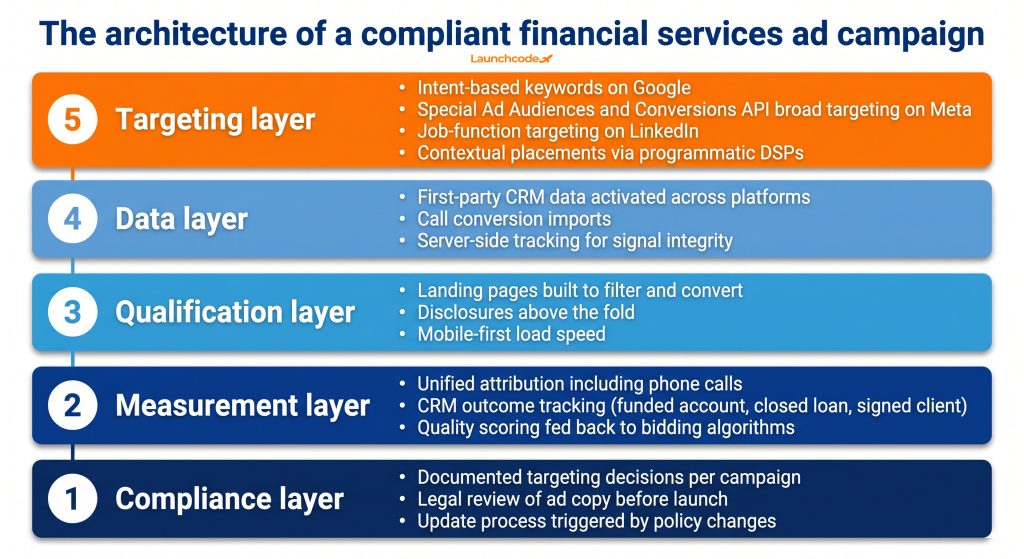
The brands that perform best in financial services advertising today are not the ones with the biggest budgets. They are the ones with the cleanest first-party data, the strongest landing pages, and measurement systems that connect ad spend to actual revenue outcomes.
Here is the campaign architecture that works in this environment.
This is a sustainable campaign architecture built for the environment that actually exists. The rules around financial services ad targeting are not reverting. Google's consumer finance policy is active and enforced. Meta's mandatory Special Ad Category is expanding. ECOA's reach into advertising is confirmed by federal courts. State privacy laws continue to multiply.
The brands that treat compliance as a design requirement, rather than a constraint, are the ones that scale without disruption.
If you want to explore how a performance media program built for a regulated environment would work for your brand, our performance media services page walks through how we approach campaign architecture, compliance, and optimization for complex industries.
No. As of February 28, 2024, Google's consumer finance in personalized ads policy prohibits targeting based on age, gender, parental status, marital status, or ZIP code for credit, banking, and financial planning ads in the US and Canada. Geographic radius targeting is still available as an alternative to ZIP code targeting.
In the US, yes for most financial products. Credit cards, loans, insurance, and investment products require the Special Ad Category declaration. Educational content about financial topics may not always require it, but Meta's automated review system flags financial content broadly. Declare the category proactively to avoid retroactive enforcement and account restrictions.
Digital redlining is the practice of excluding protected class consumers from seeing financial product advertising through targeting, either intentionally or through algorithmic patterns. The CFPB and DOJ treat this as a fair lending violation under ECOA. The 7th Circuit's July 2024 ruling in Townstone Financial confirmed that ECOA protections extend to prospective applicants, including people who were never shown an ad because of how targeting excluded them.
A Special Ad Audience is Meta's restricted version of a lookalike audience for Special Ad Category campaigns. It uses broader signals than a standard lookalike and excludes demographic proxies that could represent protected classes. It is less precise than a standard lookalike but remains an effective prospecting tool when paired with strong Conversions API signal and optimized landing pages.
FINRA governs broker-dealer communications and requires review of many marketing materials. SEC marketing rules for investment advisers focus heavily on disclosures, testimonials, and performance claims. Neither body prescribes targeting methodology directly, but the content of ads, the claims made, and the process for reviewing and approving materials all fall under their oversight. The SEC's December 2025 Risk Alert on adviser marketing compliance specifically flagged the need for documented policies, procedures, and oversight frameworks across all marketing activities.
Yes. Invoca's research shows that 66% of banking consumers and 57% of investment consumers call to make a purchase. If your attribution model only tracks form fills, you are likely undercounting your campaign's actual contribution to revenue by more than half. Call tracking that imports phone conversions into Google Ads and Meta allows the platforms' bidding algorithms to optimize toward real purchase intent.



Learn which link building tactics move rankings in 2026. Covers digital PR, HARO, linkable assets, anchor text strategy, and...
Google removed Business Profile messaging in 2024. In 2026, it returns as an AI chatbot that answers customers and hands off...
Most healthcare marketers track activity, not outcomes. Learn the five most common ROI measurement failures in healthcare ma...