


What is performance creative and how it transforms your digital marketing results
Performance creative is the data-driven approach to building ads that convert. Learn what it is, which metrics matter, and h...





Marketing budgets are growing, but results are not keeping pace. The Shutterstock 2025 Creative Impact Report found that between 2023 and 2024, marketing spend surged 33% while its impact on purchase intent rose only 17%. That 12% impact gap is not a targeting problem or a channel problem. It is a creative problem.
Performance creative is the discipline that closes that gap. It combines creative development with data analysis and structured testing so that every ad is built to perform, not just to look good. This article explains what performance creative is, how it differs from traditional advertising, which metrics actually measure it, and how to build a system that turns your creative into a repeatable revenue driver.
Performance creative is a data-informed advertising practice where every asset, from a video hook to a headline, is built to drive a measurable business outcome and improved through continuous testing. The goal is not subjective quality. The goal is quantifiable results: lower cost per acquisition, higher return on ad spend, and more conversions per dollar spent.
Ready to grow your organic traffic?
Get a free SEO audit from the Launchcodex team.
It is not a new term for direct response advertising, though direct response principles inform it. Performance creative brings together creative strategy, audience research, platform data, and a testing framework into a single repeatable workflow. A creative team operating in this model does not produce ads and wait for feedback. They build hypotheses, test variables, measure outcomes, and brief the next round of production based on what the data shows.
Directive Consulting puts it clearly: performance creative "prioritizes measurable business outcomes over subjective design preferences. It's not about what looks good in a brainstorm; it's about what performs in the market."
At a practical level, performance creative encompasses five components:
Without all five components working together, what brands call "performance creative" is often just production with a dashboard attached.
"The brief is the creative. If you cannot state what you are testing and why in one sentence, you are not ready to produce anything." Georgia Callahan, Executive Creative Director
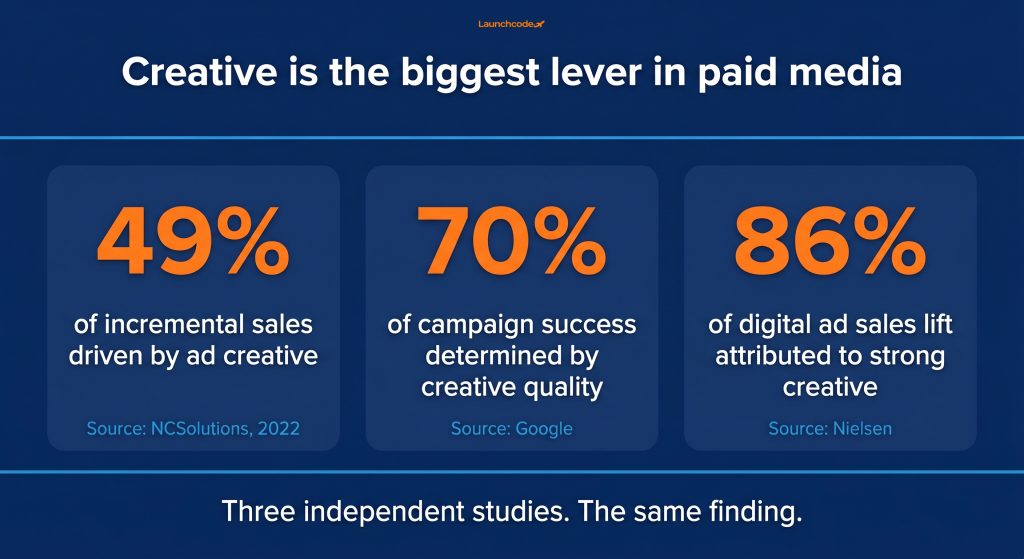
Creative is the single biggest controllable factor in paid media performance. NCSolutions analyzed nearly 450 campaigns and found that advertising creative drives 49% of incremental sales, ahead of targeting, reach, and recency combined. Google reports that 70% of a campaign's success is determined by creative quality. On digital channels specifically, Nielsen research shows strong creative is responsible for 86% of sales lift.
Most brands underestimate these numbers because they spend more time optimizing bids and audiences than creative. A 2025 survey found that 76% of marketing leaders spend more time reviewing dashboards than working on creative strategy. That imbalance is costing them.
Meta's Andromeda algorithm update, rolled out globally by October 2025, fundamentally changed how ads are delivered on Facebook and Instagram. The old system rewarded precise audience targeting. The new system evaluates granular creative signals, including hook effectiveness, narrative structure, color use, and social proof placement, then matches each ad to the user most likely to respond.
The result: creative diversity is now the primary delivery lever on Meta, not audience segmentation. Advertisers who enabled Meta Advantage+ Creative features saw a 22% increase in ROAS following the update, according to Meta Engineering data. Brands still relying on a handful of similar ads and tightly defined audiences are working against the algorithm.
Among companies with revenue growth of 10% or more, 76% had strong creative scores. Following Meta creative best practices has been shown to drive between 1.2 and 7.4 times increases in short-term sales, according to joint research from Meta and Nepa. The brands that treat creative as a strategic function rather than a production task are the ones outpacing their competitors on ROAS and cost per acquisition.
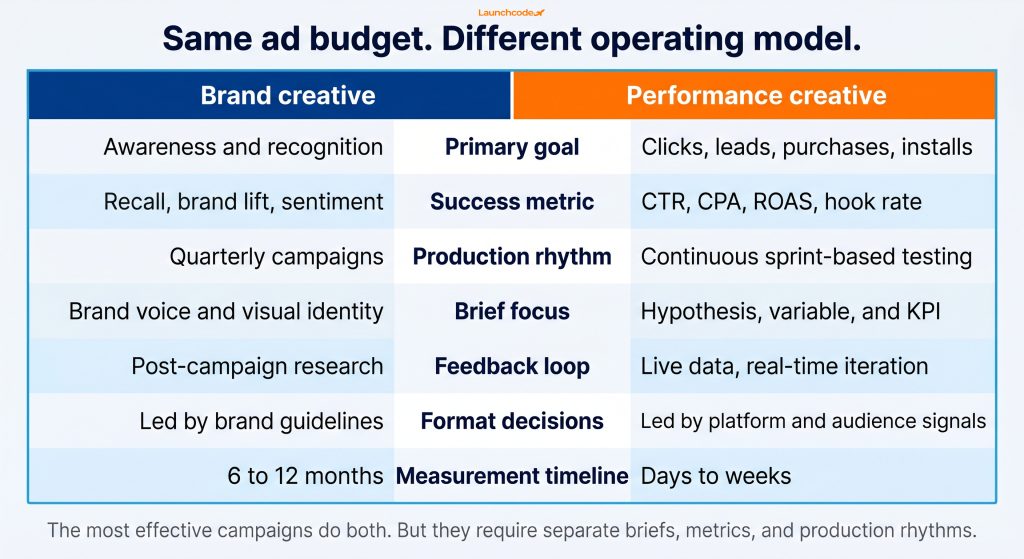
Traditional brand creative is built to communicate identity and build recognition over time. Performance creative is built to generate a specific measurable action right now. Both matter, but they require different briefs, different metrics, and different production rhythms. Mixing them up leads to ads that are neither distinctive nor effective.
| Dimension | Brand creative | Performance creative |
|---|---|---|
| Primary goal | Awareness and brand recognition | Clicks, leads, purchases, installs |
| Success metric | Recall, brand lift, sentiment | CTR, CPA, ROAS, hook rate |
| Production rhythm | Quarterly campaigns | Continuous sprint-based testing |
| Creative brief focus | Brand voice and visual identity | Hypothesis, variable, and KPI |
| Feedback loop | Post-campaign research | Live data, real-time iteration |
| Format decisions | Led by brand guidelines | Led by platform and audience signals |
| Measurement timeline | 6 to 12 months | Days to weeks |
The most effective campaigns build brand equity and drive conversion at the same time. But those outcomes require separate creative thinking. An ad designed to make someone feel something and an ad designed to make someone click something are built differently, briefed differently, and measured by different standards.
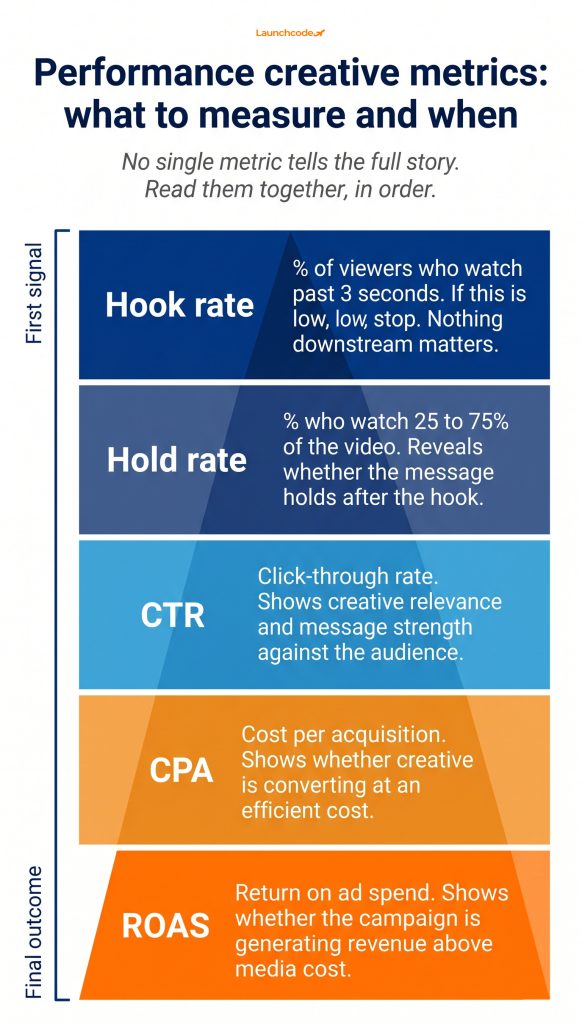
Most teams track CTR and stop there. That is not enough. Performance creative requires a hierarchy of metrics that reveal where creative is winning or failing, from the first second of attention to the final conversion. The key metrics are hook rate, hold rate, CTR, cost per acquisition, and return on ad spend.
"Hook rate is the first filter we look at. If we lose people in three seconds, no amount of media optimization fixes that. The creative has to earn its place in the feed before anything else matters." Olivia Tran, AVP, Media Services
Hook rate measures the percentage of viewers who continue watching a video past the first three seconds. If your hook rate is low, the ad is not earning attention before the scroll. No optimization downstream fixes a creative that loses people in the opening moment.
Hold rate measures the percentage of viewers who watch between 25 and 75 percent of the video. A strong hook rate combined with a weak hold rate means the opening works but the message falls apart. A weak hook rate with a strong hold rate among those who stayed suggests a niche appeal that may work for retargeting but will not scale.
Click-through rate shows creative relevance and message strength relative to the audience. Cost per acquisition shows whether the creative is converting at an efficient cost. Return on ad spend shows whether the campaign is generating revenue above the media cost.
No single metric tells the full story. A creative that drives high CTR but poor CPA often means the ad attracts clicks but the landing page or offer fails to close. A creative with low CTR but high ROAS may perform well for a high-intent, narrow audience. Reading these metrics together is what separates teams that optimize blindly from teams that learn.
None of these metrics are useful if the team cannot connect results to the specific creative element being tested. A standardized naming convention solves this. Each asset name should include the concept, hook type, format, aspect ratio, and variant label. With that structure in place, a team can filter by hook type and see in minutes which opening performs best across all active ads.
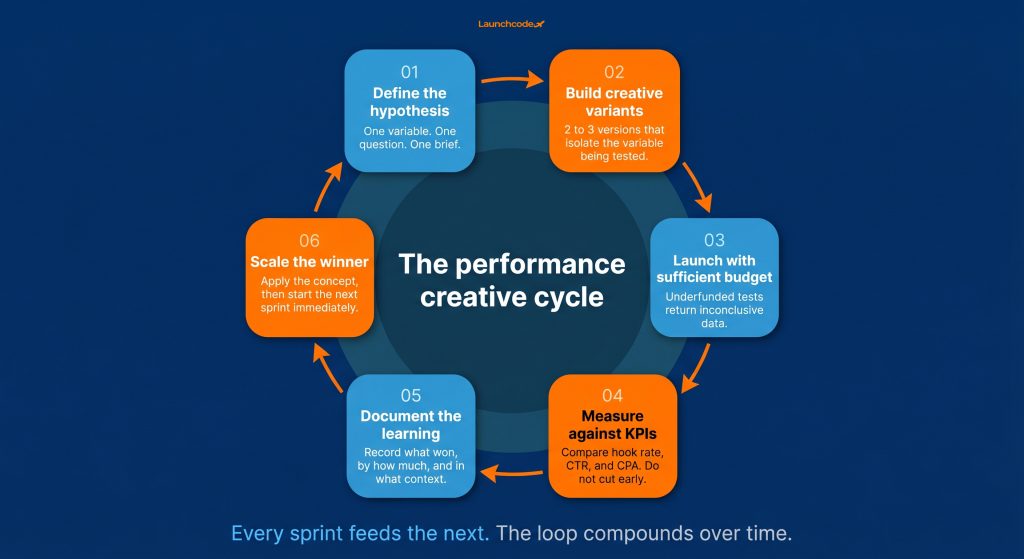
A performance creative system is a repeatable workflow that moves from brief to production to testing to analysis and back to brief. Without this loop, teams produce creative based on taste, not evidence. The cycle compounds over time: better briefs lead to better tests, better tests lead to better data, and better data leads to better creative.
Dara Denney, Senior Director of Performance Creative and one of the most cited practitioners in the field, frames the core principle well: "Creative is the most important lever on paid social. It's a marriage between content and data: knowing what makes your audience tick at scale."
Creative velocity is the rate at which new assets are launched and tested. Higher velocity gives the algorithm more signal to work with and reduces the risk of creative fatigue. Creative fatigue happens when an audience has seen the same ad enough times that engagement drops and cost per result climbs.
Teams that test two or three new concepts per week build a library of performance data far faster than teams that produce one polished campaign per quarter. The advantage is not just faster learning. High-velocity teams have more winners to scale at any given time.
Using the same creative across the full funnel is one of the most common and expensive mistakes in paid media. A first-time visitor who has never heard of your brand needs a completely different message than someone who visited your pricing page last week. Each funnel stage requires a different creative objective, a different format, and different success metrics.
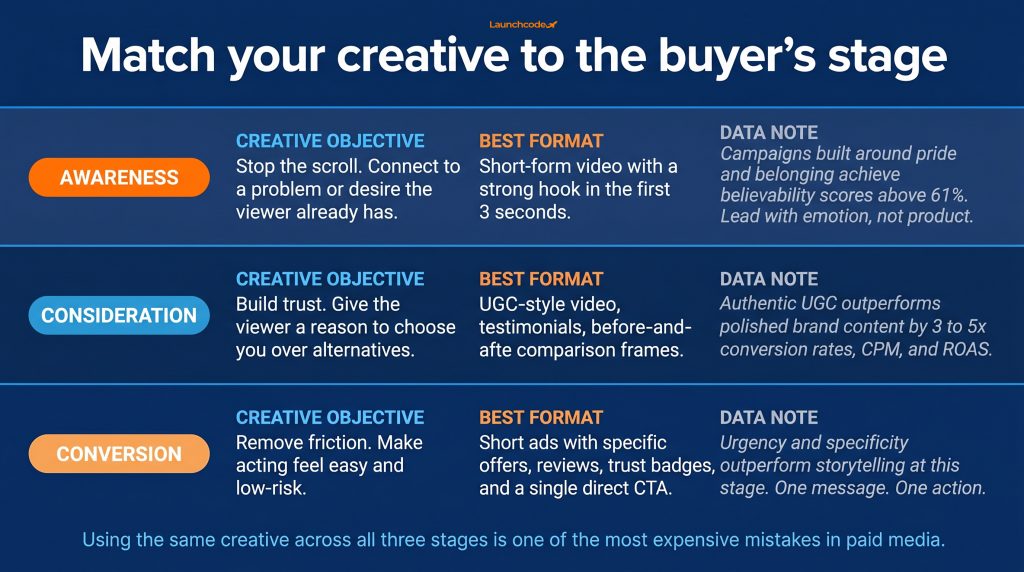
At the top of the funnel, the creative job is to stop the scroll and connect the brand to a problem or desire the viewer already has. Short-form video with a strong hook in the first three seconds performs best here. Emotional resonance matters at this stage. The Shutterstock 2025 Creative Impact Report found that campaigns built around pride and belonging achieve believability scores above 61%.
Do not lead with your product at awareness. Lead with the audience's pain or aspiration. The product is the resolution, not the opening.
Mid-funnel creative bridges interest and intent. The viewer knows the problem. Now they need a reason to trust your solution over alternatives. Case study formats, testimonials, comparison frames, and before-and-after content all perform well here. The hook should acknowledge a specific objection or question. The body of the ad should answer it.
UGC-style content works particularly well at this stage. An analysis of more than 400 DTC brands found that authentic UGC ads outperformed polished professional content by 3 to 5 times across conversion rates, CPM, and ROAS. The reason is not that production quality is irrelevant. It is that authenticity signals trust, and trust converts.
Bottom-of-funnel creative speaks to people who are close to a decision. The message should be specific, the offer should be clear, and the call to action should remove any reason to delay. Proof elements like reviews, trust badges, guarantees, or specific results reduce the perceived risk of acting. Keep these ads short. Urgency and specificity do more work at this stage than story.
AI does not replace creative strategy. It compresses the time between idea and result. Generative AI tools produce hundreds of headline and copy variations in minutes. Dynamic creative optimization (DCO) assembles and delivers the best-performing combinations in real time. The teams that use these tools well produce and test more concepts, which means they find winners faster and scale them with less wasted spend.
Companies actively using AI in their marketing programs see 20 to 30% higher ROI, with gains coming from both faster creative generation and smarter targeting, according to multiple studies summarized by Amra and Elma in their AI ad creative performance analysis.
The caveat worth noting: AI multiplies whatever creative strategy it is given. A weak brief fed into an AI variation tool produces more weak variants faster. The strategic brief, the hypothesis, and the judgment about what the audience actually needs still require human thinking.
Most creative performance problems are workflow problems, not talent problems. The creative is often capable. The system around it is broken: no brief, no hypothesis, no testing plan, and no feedback loop connecting results back to the production team. Without those inputs, creative teams are guessing.
As one creative strategist at a DTC brand noted in an interview with Focal: "Without the connection between creative and performance data you can't learn properly. You brief the next sprint from gut feel, and the cycle repeats."
Performance creative is an operating model, not a campaign decision. The teams that build it well treat every asset as an experiment and every sprint as a source of evidence. Over time, the data accumulates. You know which hook types work for which audiences. You know which formats hold attention in each placement. You know which offers close at the lowest cost.
MMA Global's 2025 State of Performance Marketing report frames the direction clearly: "The next era of performance will not be defined by speed alone but by strategic orchestration, creative scalability, and measurable contribution to business outcomes."
That shift is immediate and practical. Rising CPMs, more competitive ad platforms, and privacy-driven targeting constraints all reduce the leverage that media buying alone can provide. Creative is one of the few remaining variables a brand controls completely.
At Launchcodex, our creative strategy work ties every asset to a defined business outcome from the first brief through final reporting. If your paid media is spending consistently without producing predictable results, the creative system is usually where to start.
The path forward is clear: define what you are testing, build the variants, measure what matters, document what you learn, and brief the next sprint smarter. That loop, run consistently, is what turns creative from a budget line item into a compounding revenue asset.
Performance creative is the practice of building ad creative to drive measurable outcomes like sales, leads, or app installs, and then testing and improving those ads based on real data. It treats creative as a business tool, not just a design output.
Traditional advertising focuses on brand awareness and aesthetic quality. Performance creative is built around a specific measurable goal, tested against defined KPIs, and refined continuously based on what the data shows. The brief, the metrics, and the production rhythm are all different.
Track hook rate (viewers who watch past three seconds), hold rate (viewers who watch 25 to 75% of a video), CTR (clicks divided by impressions), CPA (cost per conversion), and ROAS (revenue per dollar of ad spend). Use these together, not in isolation.
Yes. The principles are the same: build to a measurable outcome, test variables, measure and iterate. The formats and metrics shift. B2B campaigns often prioritize pipeline metrics like cost per qualified lead or cost per opportunity rather than direct purchase conversions.
Watch for rising CPMs, falling CTR, or increasing CPA. These are signs of creative fatigue. High-performing teams test new concepts continuously rather than waiting for performance to drop before refreshing.
AI accelerates the process at several points: generating copy and headline variations, analyzing which creative elements correlate with performance, and powering dynamic creative optimization that assembles and delivers the best ad for each individual user in real time. It does not replace creative strategy. It makes strategy faster to execute and test.




Performance creative is the data-driven approach to building ads that convert. Learn what it is, which metrics matter, and h...
Find out exactly where Google Display Network ads appear, which campaign types auto-enroll in GDN, how to audit your placeme...
Learn a 4-step workflow for using ChatGPT to write responsive search ad copy that meets Google Ads character limits, support...