





What is SEO? (Search Everywhere Optimization) a complete guide
SEO now means Search Everywhere Optimization. Learn why Google rankings no longer guarantee traffic, what GEO and AEO mean, ...





Most AI users run into the same problem. They write a detailed prompt, get a mediocre output, then write an even longer prompt trying to fix it. The problem is not the model. The problem is the approach. Asking one prompt to handle research, analysis, formatting, and tone at the same time forces the model to compress or drop something. The final output reflects that compromise.
This article explains how to move from single-shot prompting to structured prompt chains that produce reliable, high-quality outputs for complex tasks. You will learn the difference between chain-of-thought and prompt chaining, how to design handoffs between steps, which chain patterns fit which tasks, and how to catch errors before they compound through your workflow.
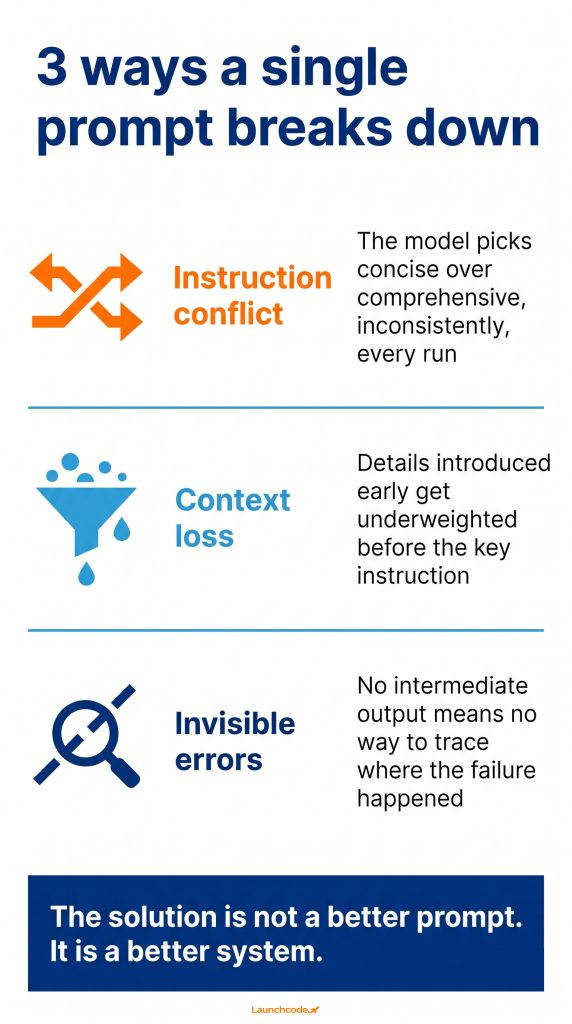
Single prompts fail at complex tasks because they ask a language model to hold too many instructions, contexts, and constraints at once. The model trades depth in one area for breadth across all of them. Output quality drops, consistency suffers, and debugging becomes nearly impossible because there is no visible step where the failure happened.
Ready to grow your organic traffic?
Get a free SEO audit from the Launchcodex team.
Language models work by predicting the most likely next token given everything in their context window. When a prompt includes a research brief, a style guide, a target audience definition, a word count, and a formatting requirement all at once, the model has to balance all of them simultaneously. Something gets compressed or ignored.
The data supports this. ZenML's analysis of 1,200 production LLM deployments found that 2024 and 2025 marked a clear dividing line between teams shipping reliable AI systems and teams still wrestling with inconsistent results. The teams winning were not using better prompts in isolation. They were building better architectures around their prompts.
Systematic surveys have now cataloged 58 distinct LLM prompting techniques, which signals how far the field has moved from guesswork toward engineered methodology. The gap between casual AI use and production-grade output is a structural gap, not a vocabulary gap.
When one prompt tries to do too much, three failure modes appear:
The solution is not a better prompt. It is a better system.
Prompt chaining and chain-of-thought prompting are not the same technique. Chain-of-thought is a single-prompt method that tells a model to reason step by step before answering. Prompt chaining connects separate LLM calls in a sequence, where the output of one prompt becomes the input for the next. Conflating these two leads to design mistakes and wasted debugging time.
Chain-of-thought (CoT) works inside a single prompt. You add an instruction like "think step by step" or provide worked examples that show reasoning before answers. The model reasons internally and produces one final output.
Prompt chaining works across multiple calls. Step one might extract key entities from a document. Step two scores each entity by relevance. Step three drafts a summary using only the top-scored entities. Each step runs as a separate LLM call, and the output becomes the input for what follows.
CoT is useful for self-contained reasoning tasks: multi-step math, logic problems, and structured analysis with a clear answer. But Wharton's Generative AI Labs published a technical report in June 2025 showing that explicit CoT instructions add 20 to 80% latency for modern reasoning models while delivering accuracy gains of only 2.9 to 3.1%. On Gemini Flash 2.5, adding CoT instructions made outputs worse by 3.3%.
The Wharton researchers, led by Lennart Meincke and Ethan Mollick, concluded that many current models already perform a form of internal CoT without being told to. Explicitly asking them to reason out loud can introduce noise, especially on tasks where pattern recognition matters more than deliberate step-by-step reasoning.
Prompt chaining is the right tool when:
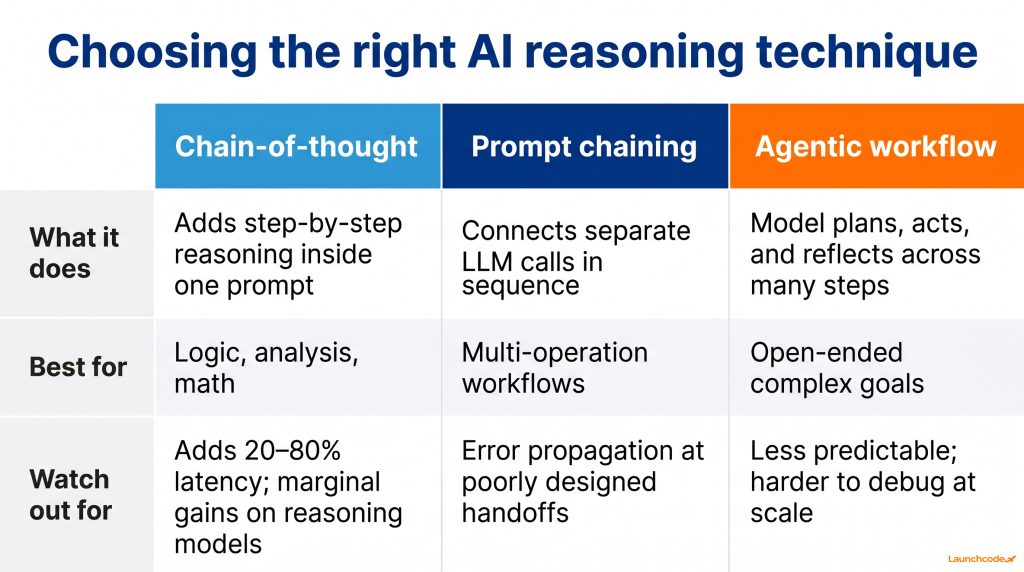
| Technique | What it does | Best for | Watch out for |
|---|---|---|---|
| Chain-of-thought | Adds step-by-step reasoning inside one prompt | Logic, analysis, math | Adds latency; marginal gains on reasoning models |
| Prompt chaining | Connects separate LLM calls in sequence | Multi-operation workflows | Error propagation at poorly designed handoffs |
| Agentic workflow | Model plans, acts, and reflects across many steps | Open-ended complex goals | Less predictable; harder to debug at scale |
Use prompt chaining when a task involves multiple distinct operations that each need full model attention. Skip chaining when the task is simple enough that one focused prompt returns consistent, high-quality results. Adding chain complexity to simple tasks increases cost and latency without improving output.
A useful test: ask whether you are doing multiple things or doing one thing multiple ways. Writing a subject line for an email is one thing. Researching a topic, structuring an argument, writing a draft, and editing for tone are four different things. The second set belongs in a chain.
Ask these questions before building a chain:
If you answer yes to three or more, build a chain. If you answer yes to one or two, refine your single prompt first.
Practical research from AirOps on chain design shows that most effective chains contain three to five steps. Below three steps, the overhead rarely justifies the added complexity. Above seven steps, compounding error risk increases faster than output quality improves.
A prompt chain is only as strong as its handoffs. The most common failure point is not a weak prompt inside a step. It is a poorly designed output format that the next step cannot reliably consume. Every step in a chain must produce output in a shape the following step can use without ambiguity or loss of context.
Each step has a defined input, a single task, and a defined output format. If the output is unstructured prose when the next step expects a list, the chain breaks or produces degraded results.
Follow this process when building a new chain:
"The handoff is where most teams lose time. If step two can't cleanly read step one's output, you're not debugging the prompt, you're debugging the format. Getting that right before you build saves hours later." Valerie West, Head of AI & Automation
Andrej Karpathy described the core discipline behind this as context engineering, which he defined in June 2025 as "the delicate art and science of filling the context window with just the right information for the next step." In every serious production application, the quality of what the model sees at each step determines the quality of what it produces.
Use these formats to reduce ambiguity between steps:
Different task types map to different chain structures. A linear chain works for sequential processes like research-to-draft workflows. A branching chain handles conditional logic where the next step depends on what a prior step returned. A parallel chain runs multiple steps simultaneously and then combines results. Knowing which pattern fits your task saves build time and reduces failure.
Linear chains are the most common pattern. Each step runs after the previous one completes and output flows in one direction.
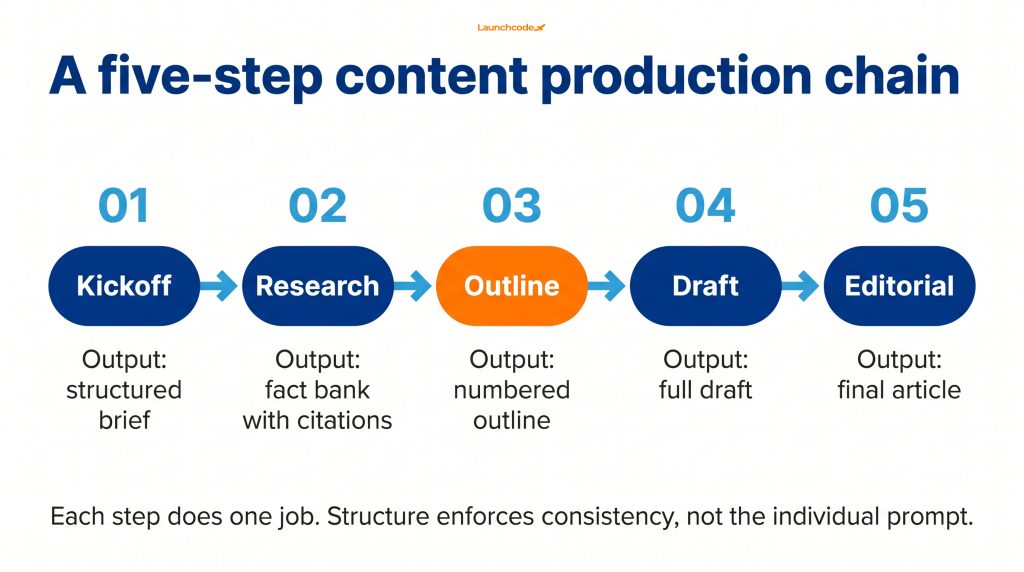
A content pipeline for a marketing team might look like this:
Each step uses the prior step's output as its primary input. The final draft is far more structured and consistent than anything produced by a single "write me a blog post about X" prompt.
Branching chains route the workflow differently depending on what a prior step returns. A customer support chain might classify an incoming query in step one, then route it to a specialized prompt for billing questions, technical issues, or general account questions based on that classification. This pattern is common in operations and customer-facing systems where the same workflow needs to handle fundamentally different input types.
Parallel chains run multiple prompts simultaneously and then pass all outputs into a single synthesis step. A competitive analysis workflow might research three competitors in parallel, then combine all findings into a structured comparison in a final step. This pattern reduces total processing time and fits research, reporting, and decision-support workflows well.
Errors introduced in early chain steps get amplified in later steps. If step two receives bad output from step one and produces a response based on it, step three receives a compounded error. By step five, the original mistake can be unrecognizable but still driving a wrong final output. The solution is to build validation into the chain, not only at the end.
This is the most underestimated design problem in prompt chain engineering. A single prompt that fails produces one bad output. A chain step that fails quietly can corrupt everything downstream.
Add a validation step after any step where output quality is difficult to predict. A validation step passes the prior output to the model with a targeted instruction, such as "Check this output against the following criteria and flag any issues before proceeding." This adds a small amount of latency but prevents bad output from propagating through the rest of the chain.
Structured output formats also act as passive guardrails. If a step is required to return a JSON object with specific keys and it cannot produce that format, the chain fails visibly rather than silently degrading. Tools like LangChain and PromptHub support automated logging at each step, which makes it possible to inspect chain behavior across many runs and identify which step fails most often.
Context engineering is the discipline of deciding exactly what information each step in a chain should see. It covers what prior outputs to include, what to exclude, how much history to carry forward, what external data to retrieve, and how to format everything so the model can use it without confusion. Teams that apply context engineering ship more reliable AI systems than teams focused only on individual prompt quality.
Shopify CEO Tobi Lutke described the core principle this way: "It describes the core skill better: the art of providing all the context for the task to be plausibly solvable by the LLM." Karpathy reinforced this framing, noting that in every industrial-strength application, context engineering is not a single prompt but a dynamic assembly of information built at runtime for each specific step.
More context is not always better. Passing the full output of every prior step into every subsequent step bloats the context window, increases token cost, and can cause the model to weight irrelevant earlier information too heavily.
Include at each step:
Exclude at each step:
"When we build automation systems for clients, the first question is never which model to use. It's what does each step actually need to see. That's what determines whether the system produces the same quality on run fifty as it did on run one." Derick Do, Co-Founder & Chief Product Officer
The ZenML analysis of 1,200 production deployments identified context engineering as the clearest operational differentiator between teams with reliable systems and teams still troubleshooting inconsistent outputs. It is not a conceptual reframe of prompting. It is the practical skill that separates experimental AI from production AI.
Prompt chaining is not a developer-only technique. Marketing teams, operations leads, and content strategists use it to automate research, drafting, analysis, and reporting workflows. The key is matching the chain structure to the actual sequence of work a skilled human expert would follow on the same task.
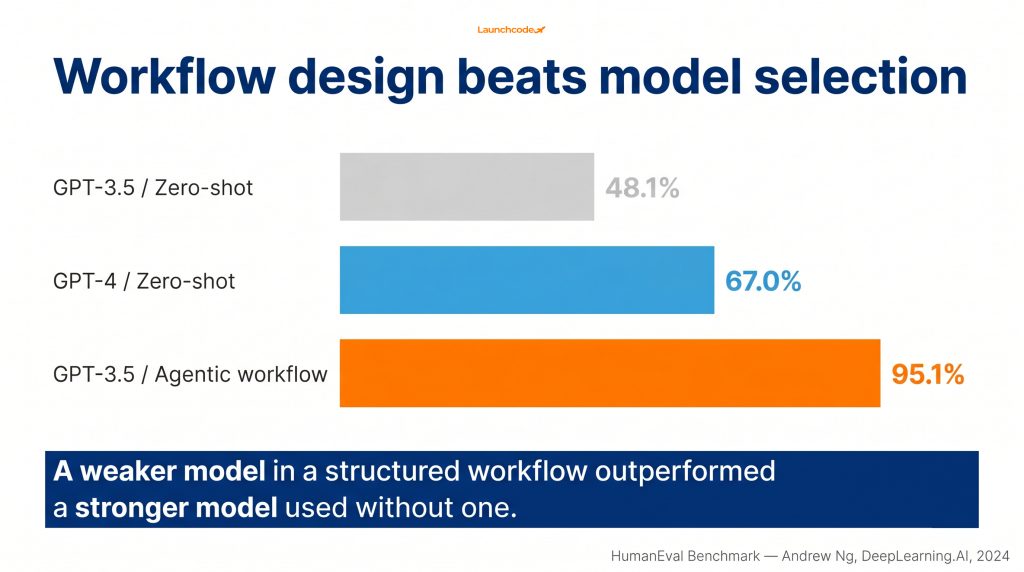
Andrew Ng demonstrated this principle with a concrete benchmark. Using the HumanEval coding benchmark, GPT-3.5 in zero-shot mode solved 48.1% of tasks correctly. GPT-4 in zero-shot mode solved 67%. GPT-3.5 wrapped in an iterative agentic workflow solved 95.1%, surpassing GPT-4 used without a structured workflow. Ng's conclusion was direct: "The improvement from GPT-3.5 to GPT-4 is dwarfed by incorporating an iterative agent workflow."
The implication for business teams is clear. You do not need to chase the latest model. You need to build a better workflow around the model you have.
At Launchcodex, the content production workflow runs as a structured chain rather than a single "write this article" prompt. Here is how the steps connect:
Each step does one job. Each output is structured so the next step can consume it cleanly. The chain produces consistent output across articles because the structure enforces consistency, not the individual prompt.
AI-powered content workflows built on structured chaining consistently produce 30 to 45% productivity gains for content teams, while software development workflows built on similar patterns produce gains of 20 to 35%.
Several tools are purpose-built for prompt chain design, from no-code platforms for marketing teams to developer frameworks for production systems. The right choice depends on how technically complex the chain is and how tightly it needs to integrate with other systems.
For teams building more sophisticated systems, the AI automation services at Launchcodex cover full chain design, validation layer setup, and integration with existing marketing and operations infrastructure using platforms including n8n and custom API-connected workflows.
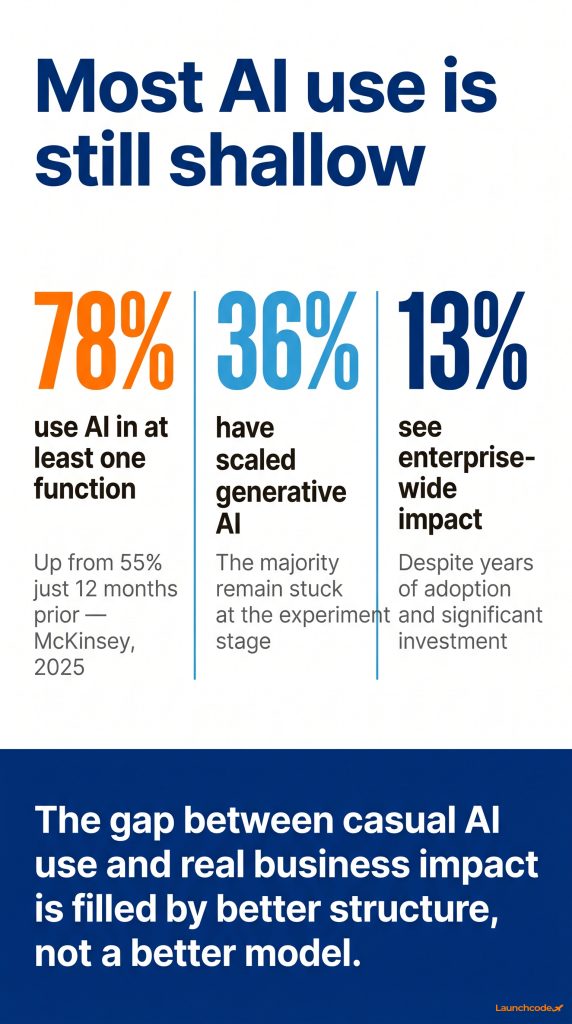
Most organizations are still stuck at the experiment stage. McKinsey data shows that 78% of organizations now use AI in at least one business function, up from 55% just twelve months prior. Yet only 36% of enterprises have scaled generative AI and just 13% see enterprise-wide impact. The gap between casual use and real business impact is not filled by a better model. It is filled by better structure.
Prompt chaining is that structure. It turns a one-off AI interaction into a repeatable, inspectable, improvable system. Teams that treat their chains as living assets, testing them against new inputs, improving handoffs as they find failure points, and adding validation where errors appear, consistently outperform teams that iterate on individual prompts without architectural thinking.
Start with one workflow you run repeatedly and know well. Map the steps a skilled human expert would follow. Assign one step to each prompt. Define the output format for each step before writing a single instruction. Test each step before connecting it to the next.
The upgrade from AI tool to AI system starts with the next chain you build.
Prompt chaining connects multiple LLM calls in a sequence. The output of one prompt becomes the input for the next. Each step handles one specific task, and together the steps complete a complex workflow that a single prompt handles poorly.
Chain-of-thought prompting happens inside a single prompt. It asks the model to reason step by step before giving a final answer. Prompt chaining happens across multiple separate LLM calls. The two techniques serve different purposes and can be combined when a task requires both structured reasoning and multi-step processing.
Most effective chains run three to five steps. Below three steps, the overhead of a chain rarely justifies the added complexity. Above seven steps, the risk of compounding errors grows faster than the improvement in output quality.
The most common failure point is a poorly designed handoff between steps. When one step produces output in a format the next step cannot reliably consume, the chain degrades silently. Other common failure modes include error propagation from an early mistake carrying through all downstream steps, and context bloat from passing too much prior output into later steps.
No. No-code tools like AirOps and n8n let marketing and operations teams build and run prompt chains without writing code. More complex chains that integrate external APIs or databases typically require developer support.
It depends on the model and the task. Wharton's Generative AI Labs found in June 2025 that explicit chain-of-thought instructions add 20 to 80% latency for modern reasoning models while delivering marginal accuracy gains. Many current models already reason internally without being told to. For reasoning-capable models, structured prompt chaining often delivers better results than asking the model to think out loud inside a single prompt.
Context engineering is the practice of deciding exactly what information each step in a chain should see. It covers what prior outputs to include, what to exclude, what to retrieve from external sources, and how to format everything so the model can use it effectively. It is the architectural layer that makes prompt chains reliable at scale.


SEO now means Search Everywhere Optimization. Learn why Google rankings no longer guarantee traffic, what GEO and AEO mean, ...
Learn how prompt chaining outperforms single-shot AI prompts for complex work. Covers chain design, handoff structure, error...
WordPress 7.0 launched May 20, 2026. This guide covers what actually shipped, including the WP AI Client, DataViews admin re...