

How to automate your email marketing with AI
Learn how to automate your email marketing with AI. This practical guide covers segmentation, behavioral flows, send time op...




Email delivers the highest return of any marketing channel, returning $36 to $40 for every dollar spent in 2025, according to Bloomreach. The problem is not the channel. It is the time required to run it well. Segmenting lists, writing copy for multiple audiences, choosing send times, and analyzing results manually keeps most teams stuck in a cycle of batch-and-blast campaigns that leave real revenue on the table.
This article walks through how to automate your email marketing with AI: what tasks AI can take over, which tools handle them, how to set up the right flows in the right order, and how to measure what the system is actually worth.
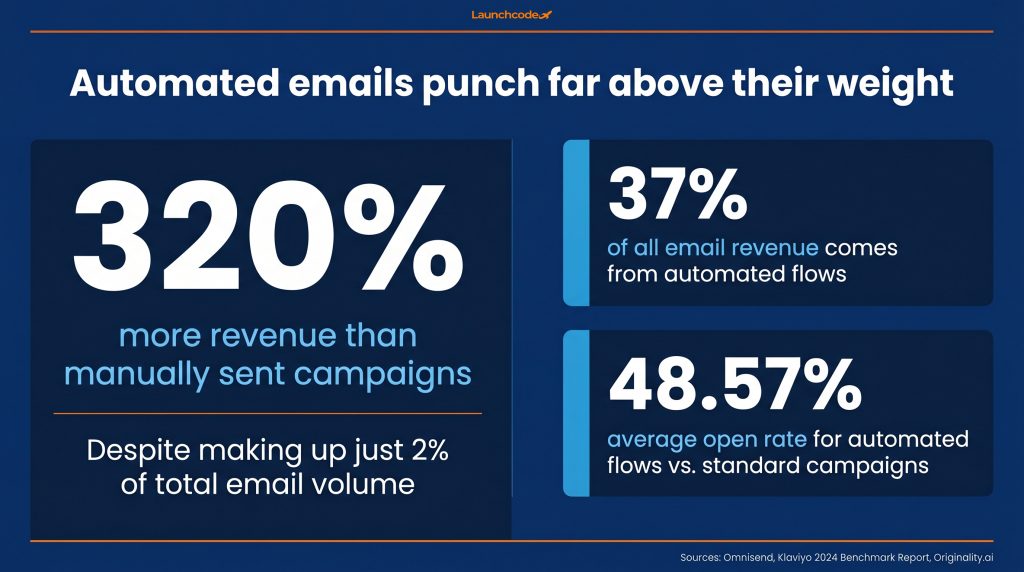
Automated emails generate 320% more revenue than manually sent campaigns, even though they represent only 2% of total email volume. That gap exists because automation fires at the right moment for each subscriber rather than at a time that is convenient for the marketing team. AI makes that timing, targeting, and personalization scalable at every list size.
Ready to grow your organic traffic?
Get a free SEO audit from the Launchcodex team.
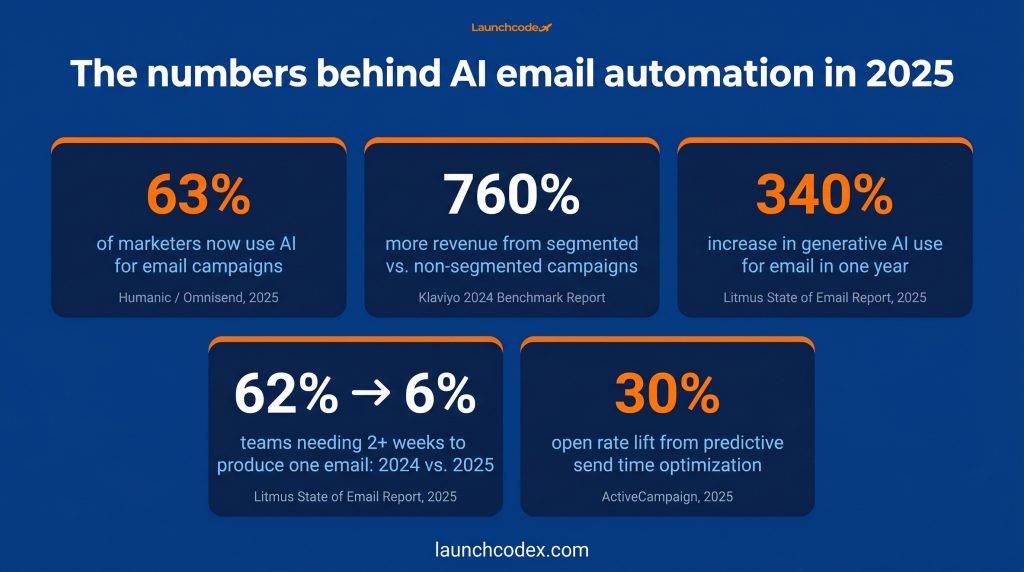
The Litmus State of Email Report 2025 found that 62% of teams needed two or more weeks to produce a single email in 2024. By 2025, only 6% did. That shift came almost entirely from AI and automation adoption.
Devin Reed, founder of content strategy firm The Reeder, describes email as the most obvious marketing investment because of its cost-to-impact ratio and the simple fact that every customer already has an inbox. The question is not whether to use email. It is whether you are using it efficiently.
A marketing manager spending twelve hours building a campaign can only produce so many per month. That same time spent building one well-structured automation can run indefinitely, improve with data over time, and touch thousands of subscribers without additional effort per send.
Automated flows now drive 37% of all email-generated revenue despite being a small fraction of total sends. Brands that rely entirely on broadcast campaigns leave the majority of their email revenue potential untapped. 95% of marketers who use AI or automation also report that their overall strategy became more effective, according to research from Ascend2.
AI takes over the repetitive, data-intensive parts of email marketing: segmenting contacts, selecting send times, generating and testing copy, scoring leads, and triggering messages based on subscriber behavior. It does not replace strategy or brand voice. It handles the execution that would otherwise require a team of analysts and copywriters working in parallel.
Here is where AI adds measurable value across a standard email program:
Thamima Christensen, Head of Product for Oracle Eloqua at Oracle, points out that most brands already collect the data they need for AI to be useful. The gap is activation. Many teams hold behavioral data that never connects to their email platform, which means AI has no signal to learn from.
Human judgment still drives strategy: which audiences to prioritize, what offers to make, how the brand should sound, and when to pause or pivot a sequence. AI executes within the parameters you set. Teams that see the best results treat AI as a capable operator, not an autonomous decision-maker.
Before selecting an AI email platform, audit your data layer. AI learns from subscriber behavior, purchase history, and engagement signals. If that data is siloed, incomplete, or disconnected from your email system, no platform will produce useful outputs. Data readiness is the prerequisite that determines whether your implementation delivers results or adds complexity without lift.
Most failed AI email implementations share one root cause: the team chose the platform before fixing the data. A tool with AI segmentation cannot build useful audiences from a list with no behavioral tags, no CRM connection, and no purchase data flowing in.
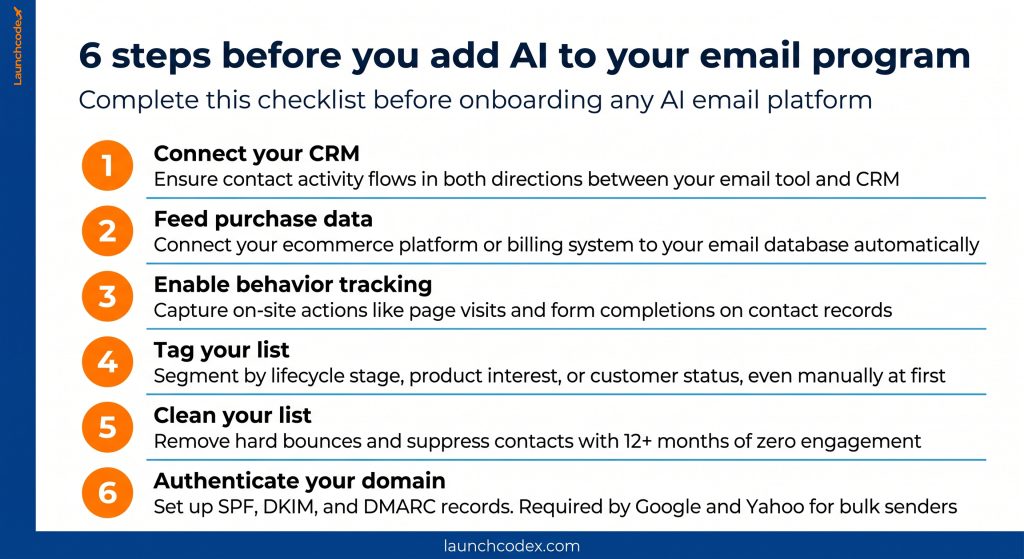
Work through these steps before onboarding any AI email platform:
"The teams we set up fastest already have clean CRM data flowing into their email platform before we touch anything else. When that data layer is solid, AI automation starts producing results in weeks, not months." Derick Do, Co-Founder and Chief Product Officer, Launchcodex
Connecting a CRM, a commerce platform, a website behavior layer, and an email system into a working data infrastructure takes technical configuration that many marketing teams are not resourced to handle. If your team does not have that capacity internally, working with a data infrastructure specialist reduces setup time significantly and prevents the mapping errors that corrupt contact records.
Build the flows that generate revenue before your subscriber is ready to hear from you consistently. Welcome sequences, abandoned cart flows, re-engagement campaigns, and post-purchase sequences are the highest-converting automations in most programs. Get these four running before adding complexity.
According to Klaviyo's 2024 Benchmark Report, automated flows achieve a 48.57% average open rate and a 4.67% average CTR, far above standard broadcast campaign performance. Behavioral triggers produce those results because they respond to what a contact is doing, not to a date on a marketing calendar.
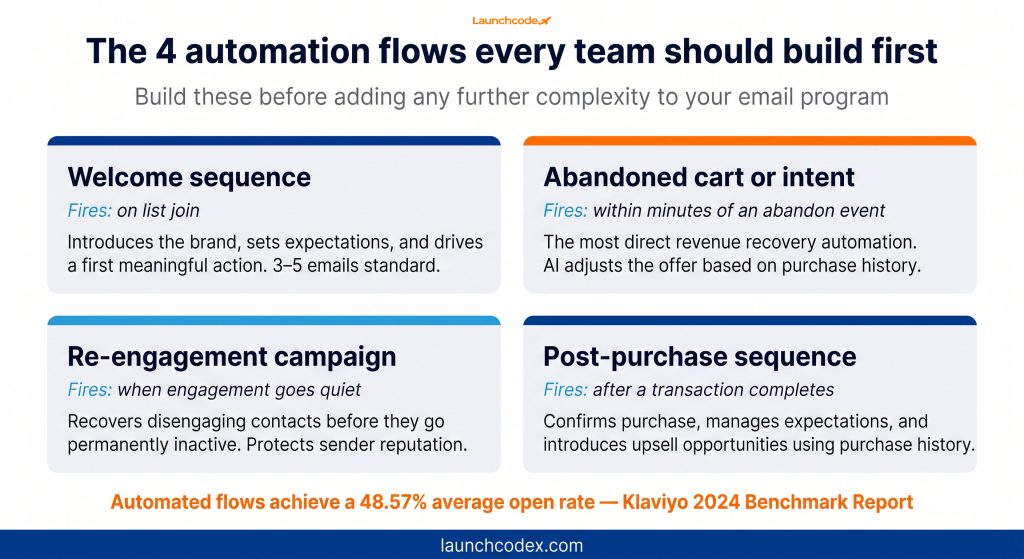
Fires the moment someone joins your list. This is your highest-engagement window. A solid welcome sequence introduces the brand, sets expectations, and moves the subscriber toward a first meaningful action, such as a purchase, a trial signup, or a content download. A three to five email sequence is standard. AI personalizes the content based on the signup source and any initial behavioral signals the contact generates in the first 24 to 48 hours.
Fires when a contact visits a high-value page or adds items to a cart without completing the action. This is the most direct revenue recovery automation available. Most platforms can trigger this flow within minutes of the abandon event. AI adjusts the message and any discount offer based on the contact's purchase history and price sensitivity signals.
Fires when an active subscriber goes quiet. AI identifies disengaging contacts before they fully drop off by watching engagement trends across opens, clicks, and site visits. The sequence attempts to recover attention before the contact becomes permanently inactive, which also protects your sender reputation from a growing unengaged segment.
Fires after a transaction completes. It confirms the purchase, manages expectations, and introduces relevant upsell or cross-sell opportunities based on what the customer just bought. AI personalizes product recommendations using purchase history and browsing behavior, moving the interaction from a transactional receipt into a revenue continuation.
Stefan Milicevic, Strategy Director at Underground Ecom, describes how AI identifies patterns in retention cycles and recommends the right triggers, delays, and messaging angles, making it possible to maintain a personal feeling at scale across thousands of individual customer journeys.
AI segmentation groups subscribers by what they do, not just who they are. It uses behavioral signals, purchase history, and engagement patterns to build dynamic audiences that update in real time. Segmented campaigns generate 760% more revenue than non-segmented campaigns, and AI makes that level of segmentation achievable without a dedicated analyst on your team.
Traditional segmentation draws on static fields: location, company size, industry, or signup date. These are useful as a starting point but shallow as a targeting layer. They miss the signals that actually predict purchase intent, such as which pricing page a contact visited, how frequently they opened your emails this month, or whether their engagement trend is rising or falling.
AI segmentation tools ingest behavioral data and surface patterns across your contact database. A platform like ActiveCampaign's Active Intelligence might identify a group of contacts who opened your last three emails but never clicked through. That is a clear signal: the content is resonating but the calls to action are not landing. That segment has a specific problem with a specific fix.
The same system might surface contacts who have visited your pricing page multiple times without starting a trial. Those contacts need a different conversation than someone who has never seen your pricing. AI creates and maintains that distinction automatically and updates it as behavior changes.
Omnisend's 2025 research found that AI-driven personalization lifts revenue by up to 41% and click-through rates by over 13%. Those results come from relevance: the right contact gets the right message at the right stage, rather than everyone receiving the same email at the same time.
Three mistakes teams make when setting up AI segmentation:
Generative AI drafts and tests email copy faster than any manual process. Send time optimization uses individual engagement history to deliver each email during the window when that specific contact is most likely to open it. Together, these features reduce production time while improving performance at every stage of the funnel.
The Litmus 2025 report found a 340% increase in marketers using generative AI for email copy, personalization, and A/B testing in a single year. Writing ten subject line variations for ten audience segments manually takes hours. Generative AI produces those variations in minutes, and automated testing identifies the winner without manual monitoring.
Most major platforms now include generative AI for subject lines and email body copy. The output is a starting point, not a finished product. Your team's job shifts from writing from scratch to reviewing for brand voice and accuracy.
How to run AI-generated copy effectively:
Rafael Viana, a senior email marketing manager cited in the Litmus 2025 report, frames the goal well: AI is not a way to create more campaigns. It is a way to make each campaign more personalized and detailed, which is a more productive goal entirely.
Most teams pick a send time that worked once and keep using it. Send time optimization (STO) replaces that fixed choice with individual-level data. AI analyzes each contact's historical open and click patterns and schedules delivery for the window when that person is most likely to engage.
ActiveCampaign reports that predictive send time optimization can lift open rates by as much as 30%. The model improves over time: the more data it collects from each subscriber, the sharper the timing prediction becomes.
Predictive analytics uses historical engagement data, purchase patterns, and behavioral signals to rank contacts by their likelihood to convert, churn, or respond to a specific offer. Teams that use predictive lead scoring stop sending the same message to their entire list and start concentrating their best offers on the contacts most likely to generate revenue.
Without predictive analytics, most teams treat their list as a flat audience. Every contact gets the same campaign, and results reflect that averaging effect. AI-driven lead scoring creates a ranked view so your highest-value contacts receive the right message at the right time, and your least engaged contacts do not drain your sender reputation.
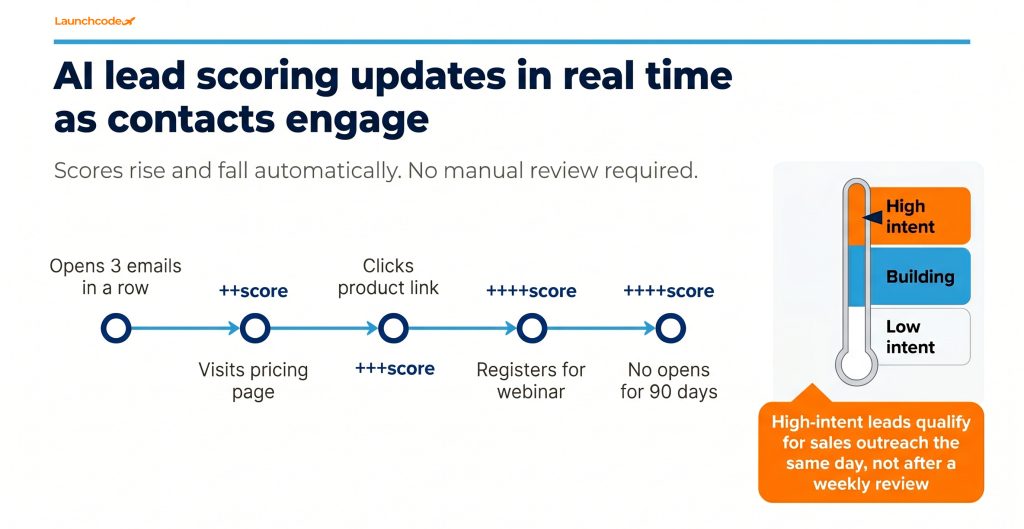
AI lead scoring assigns numeric values to behavioral signals and updates them continuously. A contact who visits your pricing page gets a score increase. One who opens five emails in a row and clicks through to your product pages scores higher still. A contact who has gone 90 days without opening anything sees their score decrease.
These scores update in real time. A lead who registers for a webinar this morning might qualify for a sales follow-up by this afternoon, rather than sitting in a queue until a weekly manual review. ActiveCampaign's Active Intelligence applies this logic continuously across the contact database, surfacing high-intent segments as they emerge.
Sending targeted offers to high-scoring contacts rather than your full list also reduces spam complaints, protects your sender reputation, and concentrates revenue-generating messages where they are most likely to convert.
The right AI email platform depends on your audience type, your existing tech stack, and the automation complexity you need to run. Ecommerce brands have different requirements than B2B SaaS teams. Before evaluating tools, define which automation use cases matter most and verify that each platform integrates cleanly with your CRM and data sources.
| Platform | Best fit | Core AI strength | Watch out for |
|---|---|---|---|
| Launch Portal | SMBs and growth brands that want CRM, email, SMS, and pipeline management in one system | Unified automation across email, SMS, and sales pipeline with no third-party integrations required | Available through Launchcodex engagements, not as a standalone self-serve product |
| Klaviyo | Ecommerce brands | Behavioral segmentation and revenue attribution | Limited outside ecommerce context |
| ActiveCampaign | B2B, SaaS, multi-channel teams | AI-native segmentation, lead scoring, full-stack CRM | Can feel complex for small teams new to automation |
| Mailchimp | SMBs and content businesses | Ease of use, generative content, send time optimization | Basic automation logic at lower pricing tiers |
| HubSpot | B2B teams needing sales alignment | CRM integration, AI copy tools, lifecycle automation | Cost scales quickly as contact volume grows |
| Brevo | Budget-conscious teams | Multi-channel automation and send time AI | Fewer advanced AI features than category leaders |
A comparison table shows capabilities. These questions reveal actual fit:
Most teams benefit from starting with one platform and building their core flows before adding point solutions. A standalone tool like Seventh Sense, which plugs into HubSpot or Marketo to add send time optimization, is worth considering only after your foundational automation is already running.
AI makes it faster to produce and send more email. That speed introduces a deliverability risk most teams underestimate. Higher send volumes and AI-generated content increase the chance of inbox providers flagging your messages. Protecting your sender reputation requires active monitoring, proper technical setup, and list discipline that scales alongside your automation.
Validity's 2025 Email Deliverability Benchmark Report found that global send volumes are at an all-time high, and inbox providers have responded with stricter filtering. Google and Yahoo require authenticated sending via SPF, DKIM, and DMARC for anyone sending above a volume threshold. Missing that authentication moves your emails to spam regardless of content quality.
GDPR and CCPA apply to how you collect, store, and use subscriber data. Contacts must opt in clearly, data must be used only for stated purposes, and unsubscribe requests must be honored promptly. CAN-SPAM sets the same floor for US-based senders.
Measure automation ROI by tracking revenue generated per flow, not just open rates and click rates. Connect your email platform's event data to your CRM or revenue system so you can draw a direct line from an automated email to a closed sale or a recovered cart. If you cannot attribute a dollar to a sequence, you are measuring activity rather than results.
"Clients often come to us focused on open rates. We redirect that conversation to revenue per flow. That one shift changes how they build and optimize everything downstream." Brittany Charles, SVP, Client Services, Launchcodex
Klaviyo's 2024 benchmark data shows automated flows averaging 48.57% open rates and 4.67% CTR across industries. Your own flows should approach or exceed those numbers within two to three optimization cycles. If they do not, the problem is usually in the segmentation logic or the email-level copy, not the platform itself.
Ascend2 research via Email Vendor Selection found that 95% of marketers who use AI and automation report their strategy became more effective. That result comes from measurement discipline, not just tool adoption.
Automating your email marketing with AI does not require a full-stack overhaul before you see results. It requires a clean data foundation, one well-built flow, and the discipline to measure whether it is working before you add the next layer.
Teams that try to automate everything at once build fragile systems that are difficult to troubleshoot and harder to improve. The teams that produce durable results start with a single high-value flow, connect it to revenue data, refine it over a few cycles, then move to the next.
The tools are no longer a barrier. 63% of marketers now use AI for email, according to 2025 data from Humanic. The competitive advantage no longer comes from having access to AI. It comes from how systematically you build and improve the automation that runs beneath your campaigns.
If your team is working through platform selection, data integration, or flow architecture and needs a specialist to build and manage the system, Launchcodex designs and deploys AI-powered email programs as part of its full-service growth engagements. The goal is always the same: an email program that generates revenue whether or not someone on your team is actively working on it.
AI email marketing automation uses machine learning to segment your list, trigger behavior-based email sequences, personalize content, optimize send times, and score leads without manual input. It replaces static, rule-based workflows with adaptive systems that improve as they collect more subscriber data.
Basic flows like a welcome sequence or abandoned cart email can be live within a few days on most platforms. Systems that involve CRM integration, behavioral data pipelines, and multi-step nurture flows typically take two to six weeks depending on your tech stack and data readiness.
It can, if you scale volume without maintaining list hygiene and sender authentication. AI makes it easier to produce more emails, which increases the risk of spam complaints if content quality drops or your list includes disengaged contacts. The protection is regular list cleaning, SPF and DKIM authentication, and active monitoring of your spam rate in Google Postmaster Tools.
Send time optimization analyzes each subscriber's historical engagement patterns and schedules email delivery during their individual high-engagement window. ActiveCampaign reports open rate lifts of up to 30% from predictive send time optimization, and the model improves with each additional data point it collects.
Match the platform to your audience type and existing tech stack. Klaviyo is strongest for ecommerce. ActiveCampaign fits B2B and SaaS teams. Mailchimp works well for SMBs and content businesses. HubSpot suits teams that need tight CRM and sales alignment. Evaluate integration capability and which AI features are available on your budget tier before committing.
You need behavioral data from your website and product, purchase or CRM data flowing into your email platform, and a reasonably clean, tagged contact list. Without those inputs, AI segmentation and personalization have no meaningful signal to work from.




Learn how to automate your email marketing with AI. This practical guide covers segmentation, behavioral flows, send time op...
AI marketing automation uses machine learning to personalize, optimize, and execute campaigns automatically. Learn how it wo...
Claude skills are reusable instruction packages that teach Claude repeatable workflows. Learn what they are, what comes pre-...