




How ChatGPT actually picks sources (and other LLMs)
See how ChatGPT, Perplexity, Gemini, and Claude choose which pages to cite, backed by data from Pew, Ahrefs, and Princeton, ...




Google confirmed the May 2026 core update on May 21 via its Search Status Dashboard. The official message was brief: the rollout may take up to two weeks to complete and is designed to better surface relevant, satisfying content for searchers from all types of sites. If your rankings are moving right now, this is why.
This article covers what the update is, why the timing makes it more complex than prior updates, how to measure impact accurately using Google Search Console, and what steps to take during the rollout versus after it ends. Every recommendation here is grounded in Google's official guidance and verified research from the past 90 days.
The May 2026 core update is a broad, system-wide ranking change. It is not a penalty. It is not a spam action. It is Google recalibrating how its core ranking systems evaluate content quality across the entire index. The rollout started May 21, 2026, and could take up to two weeks to complete. Based on the March 2026 update, which finished in 12 days, a completion date around June 2 to June 4 is a reasonable working estimate.
Ready to grow your organic traffic?
Get a free SEO audit from the Launchcodex team.
Core updates work differently from targeted updates. A spam update removes bad actors. A core update re-weights quality signals across every site type, every niche, and every content category simultaneously. Sites that gain visibility did not necessarily improve. Sites that lose did not necessarily make a mistake. Google is adjusting what it values and how heavily it weighs it.
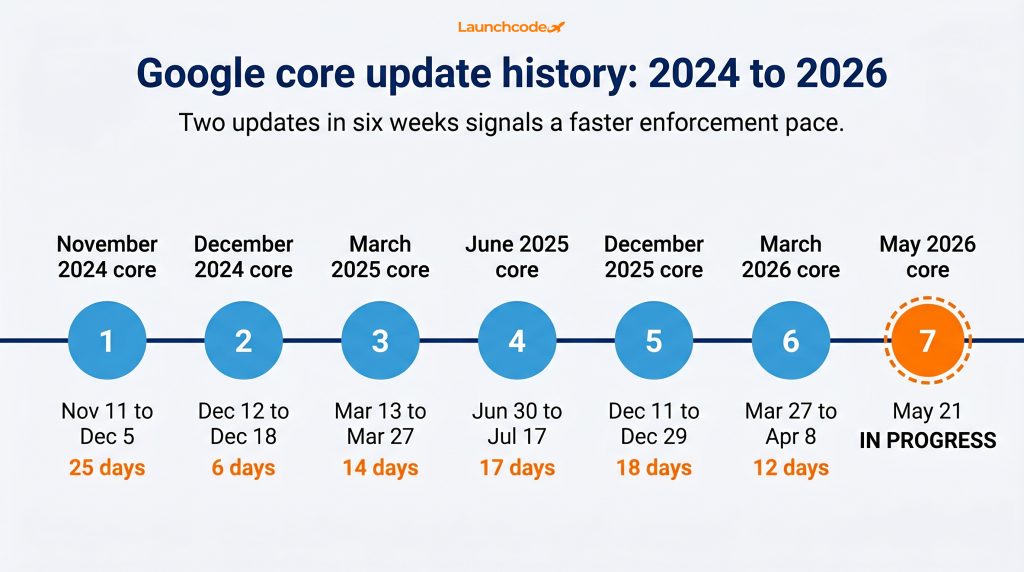
The May 2026 update is the second broad core update of 2026. The March 2026 core update ran from March 27 to April 8, a 12-day rollout that finished faster than the December 2025 update, which took 18 days. The table below puts the full recent timeline in context.
| Update | Start date | End date | Duration |
|---|---|---|---|
| November 2024 core | Nov 11, 2024 | Dec 5, 2024 | 25 days |
| December 2024 core | Dec 12, 2024 | Dec 18, 2024 | 6 days |
| March 2025 core | Mar 13, 2025 | Mar 27, 2025 | 14 days |
| June 2025 core | Jun 30, 2025 | Jul 17, 2025 | 17 days |
| December 2025 core | Dec 11, 2025 | Dec 29, 2025 | 18 days |
| March 2026 core | Mar 27, 2026 | Apr 8, 2026 | 12 days |
| May 2026 core | May 21, 2026 | TBC | In progress |
Google described May 2026 as a "regular update designed to better surface relevant, satisfying content for searchers from all types of sites." That phrase matters. It signals this update applies across all niches and site sizes, not only YMYL categories like health or finance. Small publishers, enterprise brands, and multi-location businesses are all in scope.
Google has released an average of seven named ranking updates per year since 2021, according to DemandSphere's algorithm update tracker. In 2026, the pace is faster. Two core updates arrived within six weeks of each other, alongside a spam update and a Discover-only update earlier in the year.
The May 2026 core update launched the same week Google deployed Gemini 3.5 Flash as the default model in AI Mode globally, confirmed AI Mode passed one billion monthly users at Google I/O 2026, and introduced a redesigned search box. Ranking signals and click behavior are shifting simultaneously from two different causes. That makes clean diagnosis harder than in any prior update cycle.
In previous cycles, site owners could compare pre-update and post-update Search Console data and draw a reasonably clear line. May 2026 complicates that. A site might hold its rankings through the core update and still see click declines because AI Mode and AI Overviews are absorbing more of the traffic on those queries.
Elizabeth Reid, VP of Search at Google, stated at I/O 2026 that AI Mode has surpassed one billion monthly users, with queries more than doubling every quarter since its launch one year ago. That scale changes the traffic baseline independent of any ranking changes.
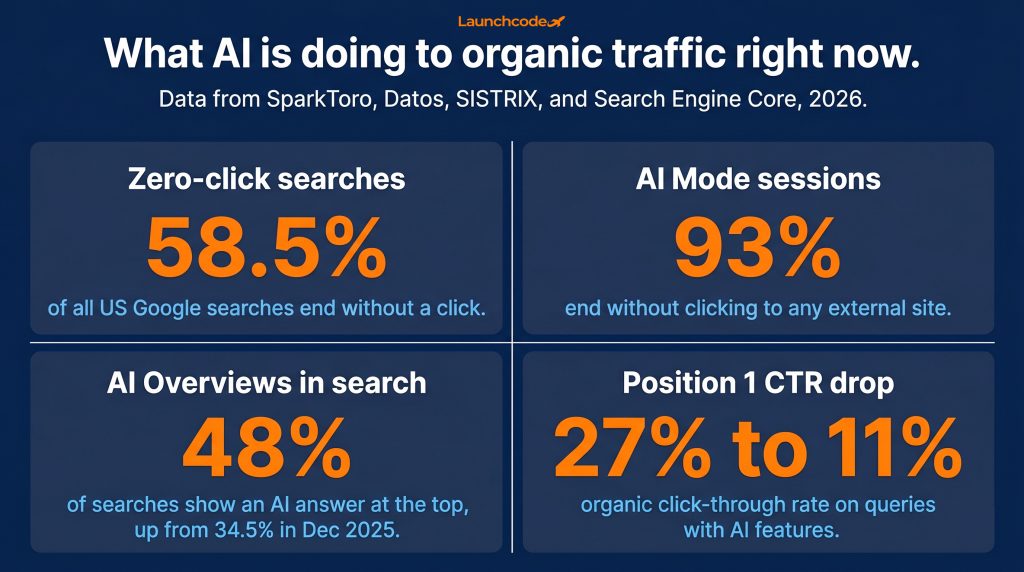
AI Overviews are not new, but their reach is expanding fast. During the March 2026 core update rollout, Raptive tracked AI Overviews coverage rising from under 20 percent to between 26 and 31 percent of tracked food-category impressions. Non-food results moved from 24 to 32 percent across the same period. By March 2026, 48 percent of all Google searches displayed an AI answer at the top of the page, up from 34.5 percent in December 2025, according to SEO.com data.
On May 6, 2026, Google announced five updates to AI Overviews and AI Mode, including inline links next to bullet points, hover previews, and article suggestions at the end of AI answers. These changes were framed as improving web discovery. They are also Google's clearest acknowledgment yet that click pressure from AI features is real and documented.
A site that ranks on page one can see traffic fall if AI Overviews answer the query before anyone clicks through.
Zero-click searches now account for 58.5 percent of all US Google searches, according to research from SparkToro and Datos. In AI Mode specifically, 93 percent of sessions end without a single click to an external site. That figure is significantly higher than AI Overviews alone, where roughly 43 percent of sessions end in zero clicks.
"When a client calls about a traffic drop, the first thing we pull is the impressions versus clicks split in Search Console. That one chart tells you whether the issue is rankings or AI Overviews. They look similar on the surface and need completely different responses." Derick Do, Co-Founder and Chief Product Officer
If your Google Search Console data shows impressions holding steady while clicks fall, that is almost certainly an AI feature signal, not a core update ranking signal. The two need to be diagnosed separately before you can act on either.
Google's 2026 core updates consistently favor specific, first-hand content tied to credible sources. The pattern from March 2026, which SE Ranking found was more volatile than December 2025 at every ranking tier, shows Google moving toward direct, authoritative sources and away from aggregators. Expect May 2026 to continue that direction.
According to Amsive's post-March winner and loser analysis, Google is now willing to demote even established publishers in favor of the underlying authoritative sources those publishers cite. Brand reputation no longer acts as a floor in ranking evaluations.
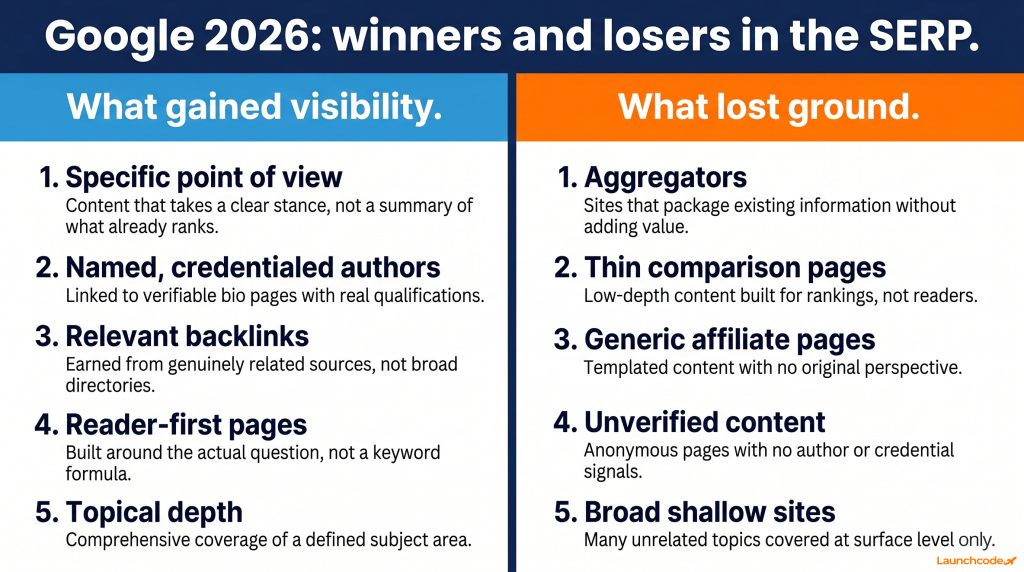
The sites that held or gained during March 2026 shared clear characteristics across multiple independent analyses:
Government sources, nonprofit primary sources, professional associations, and transactional brands with direct relationships to their subject matter consistently won. Consumer-facing publishers that aggregated information from those primary sources tended to lose.
"Every client that held its rankings through the 2025 and 2026 update cycle had built content around what their customers actually ask, not what a keyword tool said to target. That pattern is consistent." Tanner Medina, Co-Founder and Chief Growth Officer
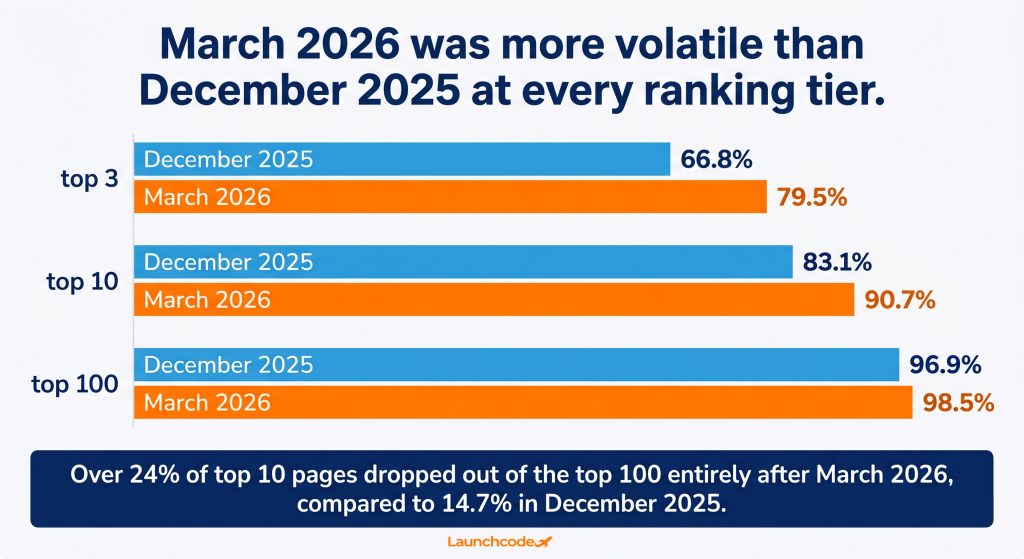
SE Ranking's analysis showed that 79.5 percent of top-three URLs changed rankings during March 2026, compared to 66.8 percent in December 2025. Over 24 percent of pages that ranked in the top 10 dropped out of the top 100 entirely. The December 2025 equivalent figure was 14.7 percent.
The hardest-hit categories were aggregators, thin comparison pages, generic affiliate content, and pages that repackaged information from stronger sources without adding original value. YouTube appeared as one of the most notable visibility losers in multiple analyses, suggesting Google is becoming more selective about when a video platform deserves top placement over a direct, text-based source for a given query.
EEAT, Google's framework covering experience, expertise, authoritativeness, and trustworthiness, was initially applied most strictly to health and finance content. After the December 2025 core update, that changed. EEAT signals now apply broadly across topic categories. A marketing blog, a business directory, and a software review site face the same standard.
Roger Montti of Search Engine Journal noted that the pattern of a spam update immediately preceding a core update, which occurred in both March 2026 and the broader 2026 cluster, is deliberate. Spam fighting is part of the broader quality reassessment, clearing low-quality signals before the core recalibration runs.
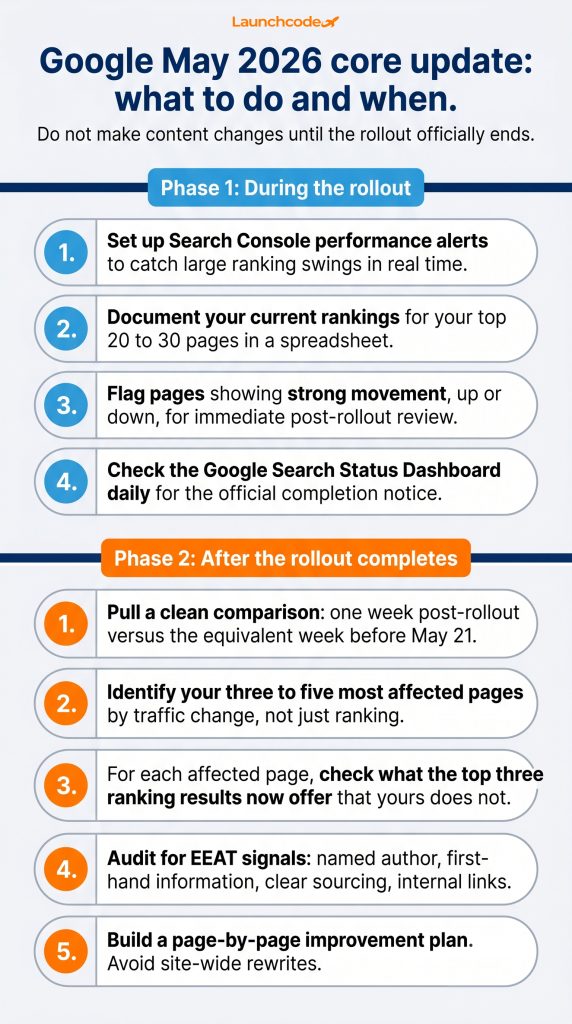
Google recommends waiting at least one full week after a core update completes before analyzing your data in Search Console. During an active rollout, rankings fluctuate as Google tests different result sets across its infrastructure. Data pulled mid-rollout will produce false conclusions. Wait for the official completion notice, then compare a clean post-update window against a clean pre-update window.
Google Search Central's core update documentation specifies the comparison approach directly: confirm the rollout has finished, note the start and end dates, and compare a week of post-update data against the equivalent window before the update began.
A single page moving down two positions during an active rollout is not a signal worth acting on. A 20 to 30 percent traffic drop across a content cluster that holds after the rollout stabilizes is.
If your ranking held through this update but your traffic still dropped, AI Overviews are the most likely cause. A site can rank in position one and lose a substantial share of clicks if AI Overviews answer the query directly above the organic results. Rankings and traffic are now two separate performance metrics that need to be tracked and responded to separately.
The traffic impact is documented and significant. Position one organic click-through rates on queries where AI features appear have dropped from around 27 percent to as low as 11 percent, based on SISTRIX data from March 2026, as referenced in the Launchcodex analysis of the Google I/O 2026 AI search update. Across many informational categories, studies have documented CTR drops of 38 to 58 percent on queries where AI Overviews appear.
Open Google Search Console and look at your top queries by impression volume. Run manual searches for those queries in an incognito window. Note whether AI Overviews appear and whether your page is cited inside the AI answer.
If you are cited in an AI Overview, you have a chance of recovering some of the clicks that AI absorbs, because readers can click through from the citation. If you are not cited, your page is effectively invisible at the top of the results even when you rank in position one.
Pages cited consistently in AI Overviews and AI Mode tend to share a few clear traits:
Ranking well supports citation probability. Being the most direct, clearly structured answer to a specific question increases it further.
During an active rollout, observe rather than act. Rankings will shift before settling. Making content changes now creates noise that makes post-rollout analysis unreliable. The right moves during an active rollout are documentation, monitoring, and preparation.
Google's position on recovery is consistent: there are no specific technical actions that reverse core update impact. The system evaluates sustained quality improvement over time. Google has also confirmed that smaller, unannounced core updates run continuously between major named events, which means improvements made now can be recognized before the next named update, not only during it.
Every core update in 2026 has reinforced the same direction: Google rewards content with genuine depth, credible authorship, and original value. Sites that treat each update as an isolated event to react to will always be playing catch-up. The sites gaining ground consistently are the ones building topical authority and content quality between updates.
Google's message has not changed across the March or May 2026 updates. The Search Liaison's standing guidance, carried through the May 2026 announcement, remains: "There's nothing new or special that creators need to do for this update as long as they've been making satisfying content meant for people."
For sites hit in March 2026 that have not recovered, the May 2026 update can either accelerate recovery or extend losses depending on what has changed since April 8. Recovery from a core update typically takes three to six months of sustained improvement. Partial recovery through continuous smaller updates can appear sooner.
These five areas consistently separate sites that recover from those that stall:
Two core updates in six weeks, following a spam update, a Discover update, and a major AI infrastructure deployment, reflects a deliberate direction. Google is enforcing quality standards more aggressively because AI search features, from AI Overviews to AI Mode, depend on citing credible sources. The underlying index quality directly determines what those AI systems surface.
Content quality is now tied to AI citation visibility, not only traditional search rankings. The two are connected at the infrastructure level. Sites that build for quality build for both.
The Launchcodex team monitors every named update and tracks client performance through active rollouts. If you want a direct assessment of how your site is positioned ahead of the next core update, our SEO and GEO services are built around exactly this kind of ongoing quality signal management.
It is Google's second broad core update of 2026, launched May 21 via the Search Status Dashboard. It re-evaluates quality signals across all site types globally and can take up to two weeks to fully roll out.
Google estimates up to two weeks. The March 2026 update finished in 12 days and the December 2025 update took 18 days. Check the Google Search Status Dashboard for the official completion notice before drawing any conclusions from your data.
No. Wait until the rollout ends before making significant content changes. Mid-rollout data is unreliable and changes made during an active rollout create noise that makes post-update analysis difficult.
This pattern almost always indicates AI Overviews or AI Mode absorbing clicks rather than a ranking drop. Check whether AI Overviews appear on your top queries and whether your pages are cited inside those answers.
Content with genuine first-hand experience, clear author expertise, topical depth, and original value that does not exist elsewhere. Google's consistent message is to write for people, not for search engines. Sites that repackage existing information without adding something new are consistently the biggest losers.
Possibly. The May 2026 update evaluates the same quality signals. If you meaningfully improved your content since April 8, some of those changes may be recognized. Full recovery typically requires sustained improvement over three to six months, often confirmed during the next named core update cycle.
No. Google's position is that AI content is not the problem. Unedited, generic, or mass-produced AI content that adds no original value is. Quality and original value are the measures, not the tool used to produce the content.




See how ChatGPT, Perplexity, Gemini, and Claude choose which pages to cite, backed by data from Pew, Ahrefs, and Princeton, ...
Google's new Search Console platform properties let you track how your TikTok, Instagram, X, and YouTube content performs in...
Learn the nine-step keyword research process used by growth-focused teams. Covers seed keywords, search intent, keyword diff...