
Share:

AI marketing & automation


If your Google Search Console data shows impressions rising while clicks and CTR fall, you are already seeing the effect. AI Overviews and AI Mode are absorbing the traffic that used to reach your pages. Google I/O 2026 did not start this shift. It accelerated it, significantly.
This article covers exactly what Google announced on May 19, 2026, what the data shows about the real traffic impact, and which actions protect and grow your search visibility over the next 12 months. Every claim here is grounded in primary sources and recent research. Vague forecasts are not useful. Specific, actionable analysis is.
Four announcements from I/O 2026 directly change how businesses are discovered online. Gemini 3.5 Flash is now the default AI model in AI Mode globally. The search box was redesigned for the first time in 25 years, now accepting text, images, files, videos, and Chrome tabs. Information agents that run 24/7 went live. And Personal Intelligence expanded to nearly 200 countries and 98 languages, free of charge.
Google described the new search box as the biggest upgrade in over 25 years. It expands dynamically as users type, offers AI-powered suggestions that go beyond autocomplete, and accepts multimodal inputs including uploaded documents and active Chrome tabs.
This tells you something important about where query behavior is going. Users are submitting fuller context, not shorter keywords. A content strategy built around two-to-four word queries alone will miss an increasing share of the searches where your audience wants depth. Pages that answer specific, conversational questions with clear, direct language are better positioned for this input format.
Information agents are background programs that run inside Search continuously on a user’s behalf. A user describes what they are looking for, the agent scans blogs, news sites, social posts, and real-time data across finance, shopping, and sports, and delivers a synthesized update when a match appears.
This changes the discovery model in a direct way. Until now, a person opened Google and typed a query. With agents, that step is automated. Your content, pricing, and listings need to be machine-readable and accurate even when no human is actively searching. The consumer of your web presence may increasingly be an AI agent rather than a person.
Gemini 3.5 Flash now powers AI Mode for all users worldwide. It is optimized for speed, agentic task execution, and coding. The upgrade means AI Mode responses are faster, more capable of multi-step reasoning, and better at evaluating content quality, context, and entity relationships. A model this capable will be harder to satisfy with surface-level keyword optimization and more responsive to genuine depth and expertise.
Personal Intelligence connects AI Mode to a user’s Gmail, Google Photos, and soon Google Calendar. As of May 19, two users searching the same phrase in the same city can receive meaningfully different results based on their inbox history, saved images, and behavioral context. At 200 countries and 98 languages, this personalization layer now operates in virtually every market where Google Search is active.
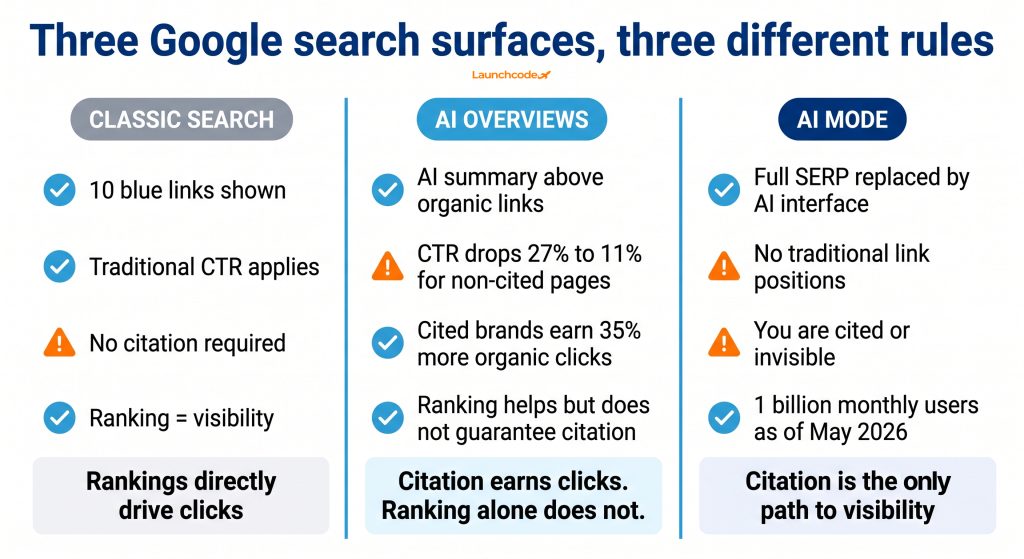
AI Mode and AI Overviews are not the same feature. AI Overviews appear above the traditional organic results and still show the standard blue links below them. AI Mode replaces the traditional SERP entirely with a conversational interface. In AI Overviews, you can still receive traffic from organic positions below the summary. In AI Mode, you are cited or you receive no visibility at all.
| Feature | How it appears | Traditional results shown | Traffic behavior |
|---|---|---|---|
| AI Overviews | Above organic results | Yes, below the overview | Reduced CTR for non-cited pages |
| AI Mode | Full replacement interface | No | Citation earns traffic; absence means none |
| Classic Search | Standard 10 blue links | Yes | Baseline click behavior |
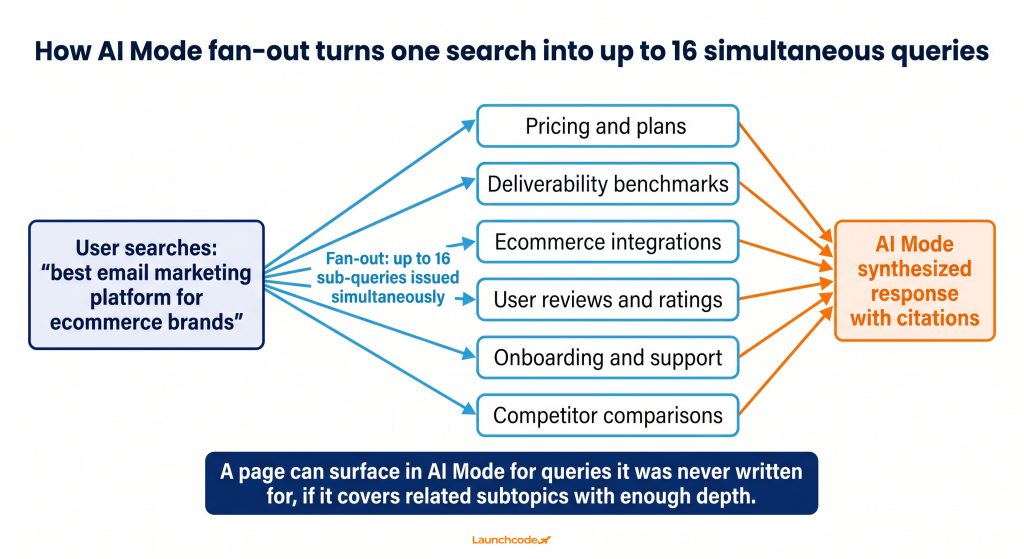
AI Mode uses a process called fan-out. For a single user query, it issues up to 16 simultaneous sub-queries to gather information from multiple angles before generating a response. A search for “best email marketing platform for ecommerce brands” might trigger separate lookups for pricing, deliverability data, integration support, and user reviews simultaneously.
A page can surface inside AI Mode responses for queries it was never directly written for, as long as the content covers related subtopics with enough depth. A narrow page targeting a single keyword is less likely to appear than a content cluster that covers a topic across multiple angles.
Think of AI Overviews as a filter applied to the existing SERP. Think of AI Mode as an entirely different surface with its own citation criteria. Your strategy needs to work on both. Ranking well supports visibility in AI Overviews. Being recognized as an authoritative, clearly structured source supports citation in both AI Overviews and AI Mode. Neither goal replaces the other.
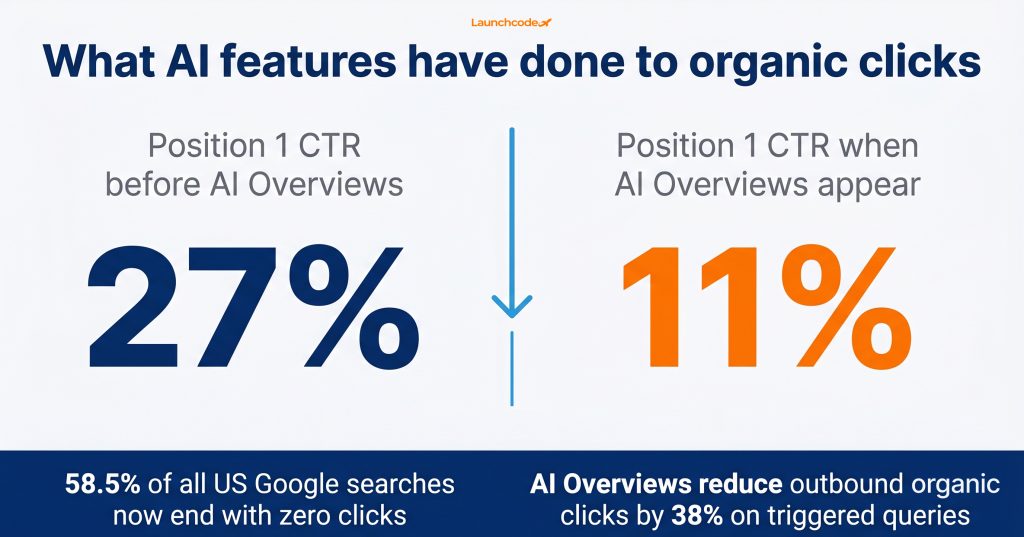
The traffic impact from AI features is real, measurable, and documented across multiple large-scale studies. Position one organic CTR on queries where AI features appear has dropped from 27% to as low as 11%, based on SISTRIX data from March 2026. Zero-click searches now account for 58.5% of all US Google searches, according to SparkToro and Datos. More than half of all search sessions end without a single outbound click.
These numbers require a reset in how performance is measured and reported. Teams that continue to benchmark against pre-AI traffic baselines will misread their results and misallocate budget.
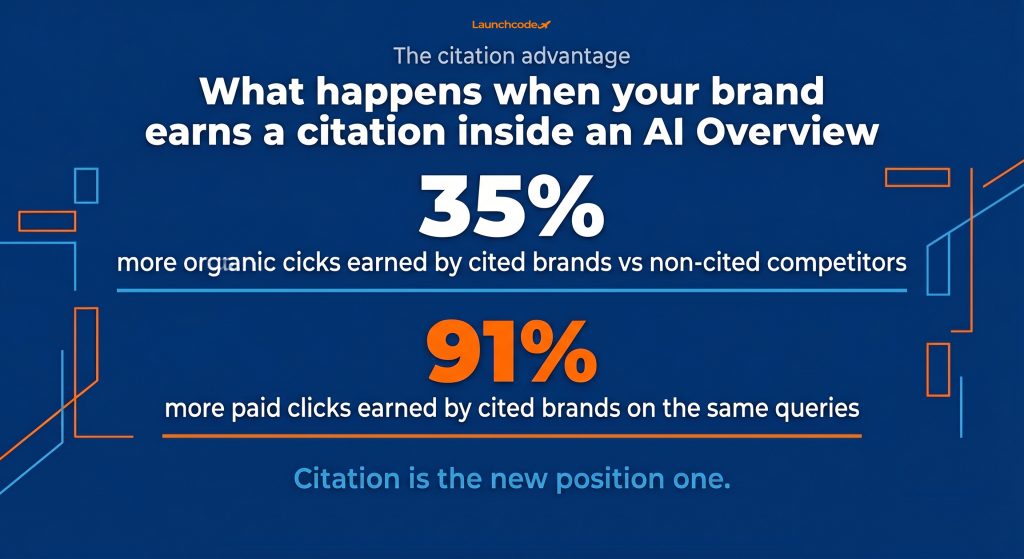
Data published in March 2026 by Digital Applied shows that brands cited inside AI Overviews earn 35% more organic clicks and 91% more paid clicks compared to non-cited competitors on the same queries. Being named inside the AI response is more commercially valuable than holding the top organic position below it.
That one data point changes the strategic priority. Citation is the new position one for queries where AI Overviews appear. A team optimizing purely for ranking position is solving the wrong problem on a significant share of target keywords.
“The teams adjusting fastest right now are not panicking about traffic declines. They are pulling the impression data, finding which queries trigger AI Overviews, and restructuring those pages to lead with a direct answer. That is where the citation opportunity sits.” Tanner Medina, Co-Founder and Chief Growth Officer, Launchcodex
In mid-2025, roughly 76% of AI Overview citations came from pages ranked in the top ten. By early 2026, research aggregated by QuickSEO from Profound, SE Ranking, and Ahrefs put that overlap at between 17% and 54% depending on the study. Google’s AI systems now pull from a much wider pool than the visible top ten. Reddit, niche authority sites, and structured data sources that may never appear in a standard top-ten result are increasingly cited.
Ranking optimization and citation optimization are now separate disciplines. Both need to be tracked and managed independently.
Most CTR studies are correlational. A randomized field study published by Search Engine Journal from January to February 2026 isolated the causal effect. Researchers randomly assigned users to see or hide AI Overviews during real searches. The result: AI Overviews reduced outbound organic clicks by 38% on triggered queries. Zero-click searches rose from 54% to 72% in those sessions. Removing the AI Overview nearly doubled outbound clicks.
Gartner projects that 25% of organic search traffic will shift to AI chatbots and voice assistants by the end of 2026. If your board review still uses 2023 traffic as its reference point, those benchmarks need to change before your next quarterly report.
Information agents do not wait for a user to type a query. They scan the web continuously on a user’s behalf and deliver synthesized updates when they find relevant matches. If you run a service business, an ecommerce store, or any operation that depends on people finding you through search, an AI agent may now be the first thing reading your site.
Google’s official AI search optimization guide, published May 15, 2026, notes that browser agents access websites by analyzing screenshots, inspecting the DOM structure, and interpreting the accessibility tree. The guide also references the Universal Commerce Protocol (UCP), an emerging open standard co-developed with Shopify and endorsed by more than 20 companies, as the framework that will allow agents to execute transactions directly on websites.
Preparing for agent access means:
“The biggest readiness gap we see is not content. It is data hygiene. Pricing that is six months out of date, booking flows that break on mobile, product pages that rely on JavaScript to render the key specs — agents will skip or misread all of it.” Derick Do, Co-Founder and Chief Product Officer, Launchcodex
Addy Osmani, Director of Engineering at Google Cloud AI, published a content framework in April 2026 making the case that token efficiency is a real optimization factor for agent-facing content. Pages that bury key answers inside long narrative sections are more likely to be skipped or summarized inaccurately by AI systems. Getting to the point fast is a technical requirement, not just good writing practice.
On May 15, 2026, Google published its first consolidated guide on optimizing for generative AI features in Search. John Mueller of Google’s Search Relations team announced it through the Google Search Central Blog. The central message is direct: there is no separate strategy for AI search. AEO and GEO are foundational SEO applied to an AI surface. The guide also names specific tactics that are wasting budget and carrying active downside risk.
Google’s guide identifies five areas that support visibility in AI responses:
Danny Sullivan, Google’s Search Liaison, stated in January 2026 that Google engineers had specifically advised against breaking content into small chunks designed for AI consumption. The May guide confirmed this. Google’s systems parse full pages and extract relevant passages.
The guide also cautions against chasing inauthentic brand mentions across forums, blogs, and social platforms. Core ranking systems evaluate quality, and spam filtering systems actively block manipulation. Seeding fake mentions carries real downside risk to your site’s trust signals and is not a sustainable tactic.
Personal Intelligence connects AI Mode to a user’s Gmail, Google Photos, and soon Google Calendar. As of May 19, 2026, this feature is live in nearly 200 countries and 98 languages, with no subscription required. Two users searching the same phrase in the same city now frequently receive different results, shaped by their personal context. Uniform search rankings no longer represent a uniform experience for your audience.
For local businesses, Personal Intelligence increases the value of consistent presence across multiple touchpoints. A brand that appears in a user’s review history, inbox, local directory listings, and Google Business Profile is more likely to be surfaced as a relevant match when that user’s agent processes a context-aware query. Accurate hours, current reviews, and consistent NAP data now feed into a personalization layer that amplifies their effect.
For B2B brands and content publishers, personalized responses increase the value of first-party audience relationships. Email subscribers, registered users, and returning visitors carry behavioral context that shapes how AI Mode presents results to them. A brand they have engaged with before is more likely to surface again. Cold keyword rankings alone do not build that relationship.
The 98-language rollout of Personal Intelligence makes personalized search a global SEO variable, not a US-specific concern. International teams running multilingual strategies need to account for the fact that AI responses in each market now reflect personal context alongside keyword relevance. Localized content quality, entity coverage, and factual accuracy carry more weight than broad keyword volume targeting.
The right response to Google I/O 2026 is a tiered action plan, not a complete rebuild. Some actions protect existing traffic and should happen within 30 days. Others build structural advantages that compound over 6 to 12 months. A smaller set of forward-looking investments in agent-readiness matter more from late 2026 onward. Knowing which tier each action belongs to is what separates a focused response from an expensive distraction.
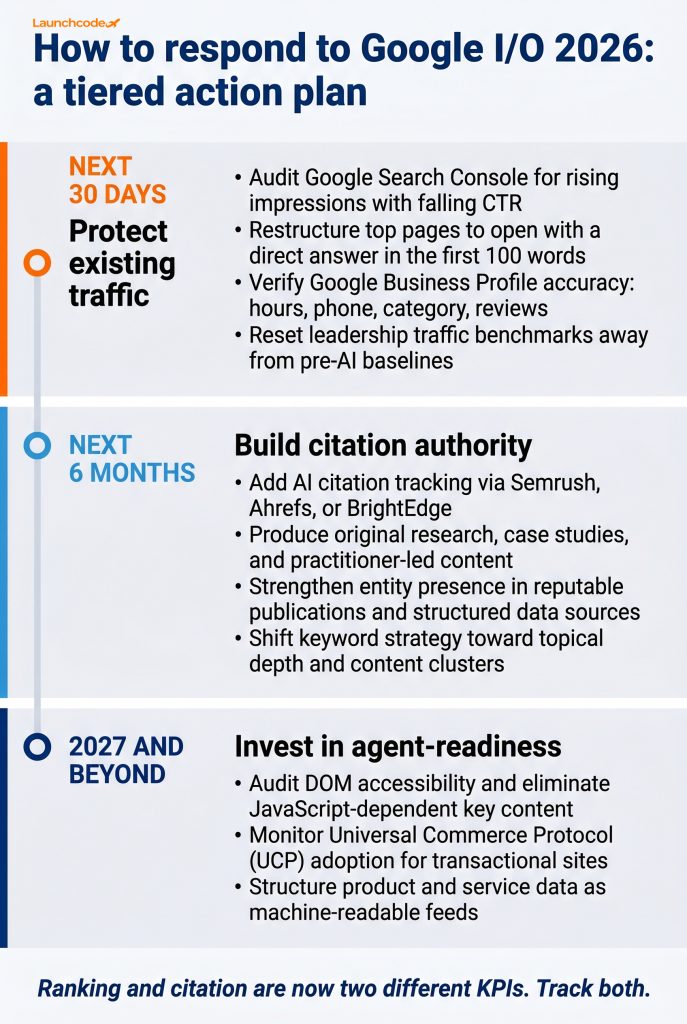
At Launchcodex, the search programs showing the most durable performance combine strong technical SEO fundamentals with a deliberate citation strategy and content that reflects direct, verifiable expertise. Ranking and citation are two different KPIs. Both need to be tracked and owned.
Google I/O 2026 did not announce the end of SEO. It confirmed the end of the version of SEO where ranking position alone determined commercial visibility. The shift has been building for 18 months. The I/O announcements formalize it.
The businesses that maintain and grow their search presence in this environment are doing three things. They keep their technical SEO foundations clean and current, because those foundations still determine eligibility for AI inclusion. They produce content that reflects genuine expertise, because that is what earns citation over generic coverage. And they structure their pages and data so AI agents can read and act on the information inside, because the agent is increasingly the reader their content needs to serve.
Traffic will not recover to pre-AI baselines on queries where AI Overviews dominate. That is a known outcome, not a problem to solve. The problem worth solving is building enough citation authority and brand presence that your business is the source Google’s AI names when a high-value query matches your offering.
If you want to understand where your current strategy stands against these new surfaces, our SEO and GEO audit process is built for exactly that starting point.
AI Overviews appear above traditional organic results and still show the standard list of blue links below them. AI Mode replaces the traditional results page entirely with a conversational interface powered by Gemini. In AI Mode, you are either cited or you receive no visibility. There are no traditional link positions below the response.
Yes. The redesigned search box accepts longer, more conversational inputs and is built to anticipate complex user intent. Keyword research should now prioritize topical coverage and question-based queries alongside short-tail terms. The fan-out technique in AI Mode means a page can surface for related queries it was not directly written for, as long as the content covers the topic with enough depth.
No. Google’s May 15, 2026 official guide states clearly that AEO and GEO are not separate disciplines. They are foundational SEO applied to an AI surface. The recommendation from Google is to maintain strong technical SEO, produce unique expert-led content, and follow existing best practices. No separate AI-specific optimization layer is required.
Information agents are background AI features within Google Search that run 24/7 on a user’s behalf. A user describes what they are looking for, and the agent continuously scans the web for matches and delivers synthesized updates. Your content, pricing, and listings need to be accurate and machine-readable at all times, not just when a human happens to search.
Personal Intelligence connects AI Mode to a user’s Gmail, Google Photos, and soon Google Calendar. As of May 19, 2026, it is available in nearly 200 countries. Local search results now reflect personal context alongside geographic relevance and keyword match. Businesses with consistent presence across multiple user touchpoints are better positioned to appear in personalized AI responses.
Track impressions alongside clicks rather than CTR alone. Rising impressions with flat or falling clicks often indicates AI Overview presence, not a content failure. Add AI citation tracking to your reporting stack using tools like Semrush, Ahrefs, or BrightEdge. Measure whether your brand appears as a cited source on high-value queries, and treat citation frequency as a primary visibility KPI alongside traditional position data.


Real stories from the people we’ve partnered with to modernize and grow their marketing.