
Share:

AI marketing & automation


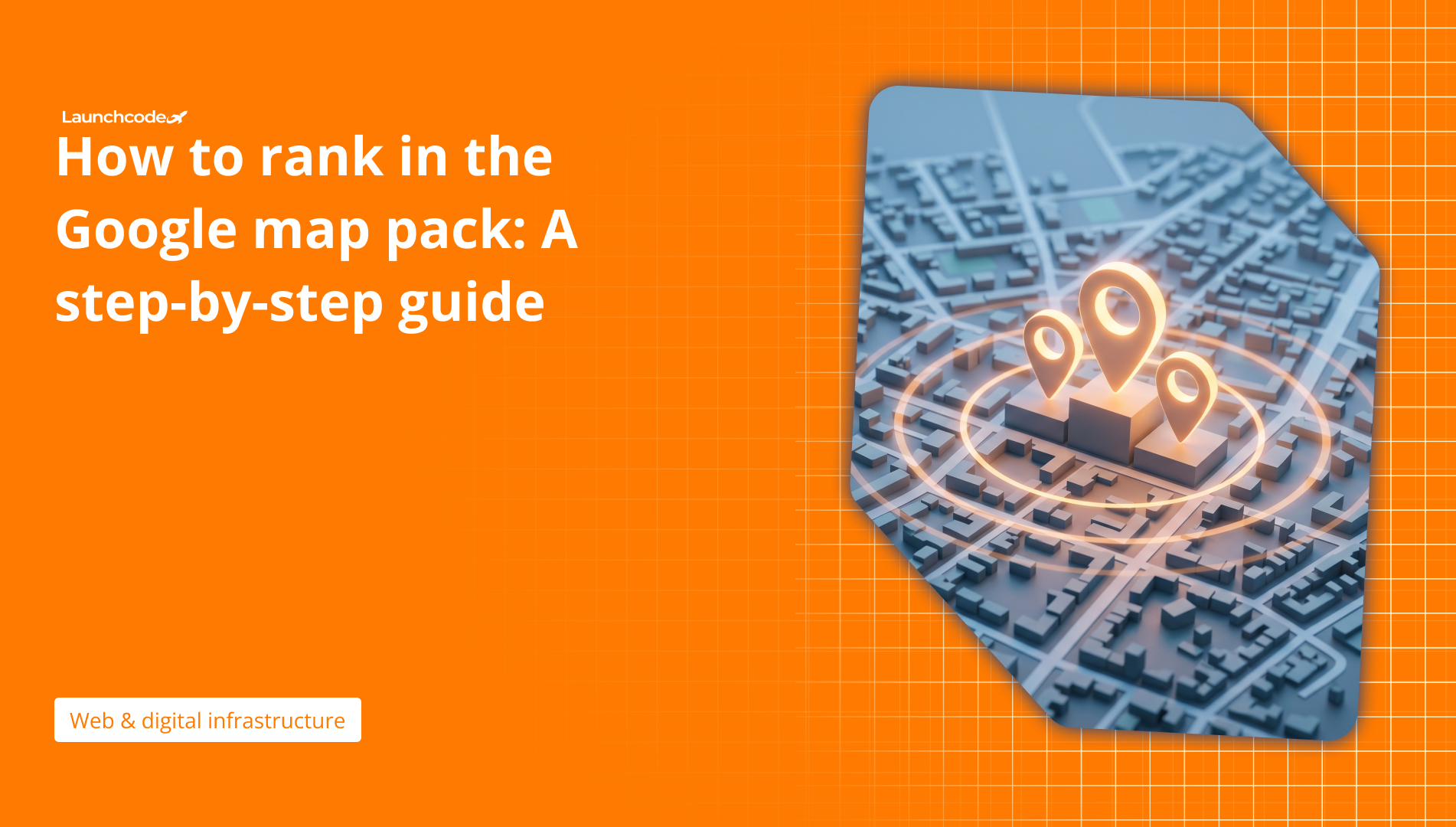
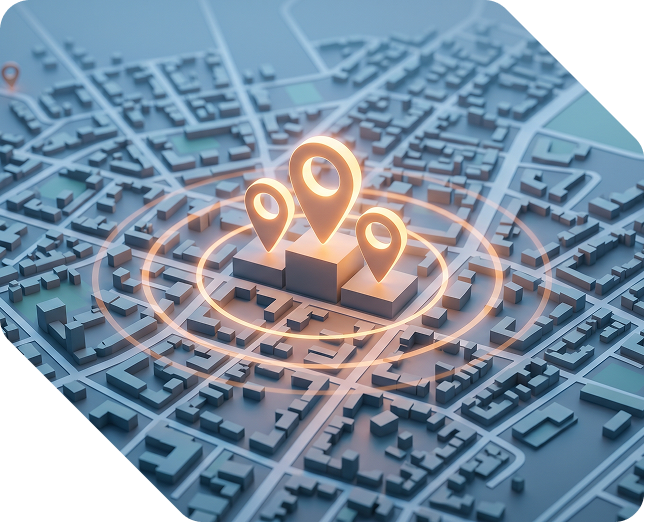
The Google map pack decides who gets the call. Businesses that hold one of the top three local positions earn 126 percent more traffic and 93 percent more actions like calls and direction requests than businesses ranked just below them, according to a SOCi study cited in Search Engine Land’s local pack guide. Roughly 42 percent of clicks on local search pages go to the map pack, based on Backlinko’s local search analysis. If you sit in position four, most searchers never see you.
This guide gives you the work in order. Each step maps to one of Google’s confirmed ranking pillars, includes the evidence behind it, and sets a realistic timeline. You will also learn which popular tactics waste your time, because the fastest path up is skipping work that does not move rankings.
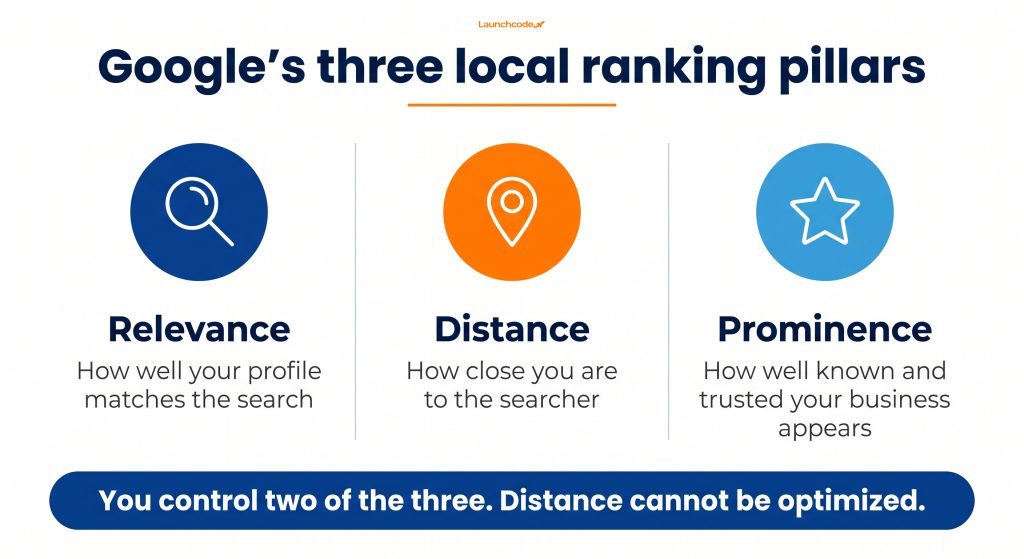
Google states that local results are based primarily on three factors: relevance, distance, and prominence. Relevance measures how well your profile matches the search. Distance measures how close you are to the searcher. Prominence measures how well-known and trusted your business appears online. Every tactic in this guide feeds one of these three pillars.
That framework comes straight from Google’s official local ranking guidance, which makes it the only first-party explanation of how the map pack works. Everything else the industry knows comes from testing and expert consensus.
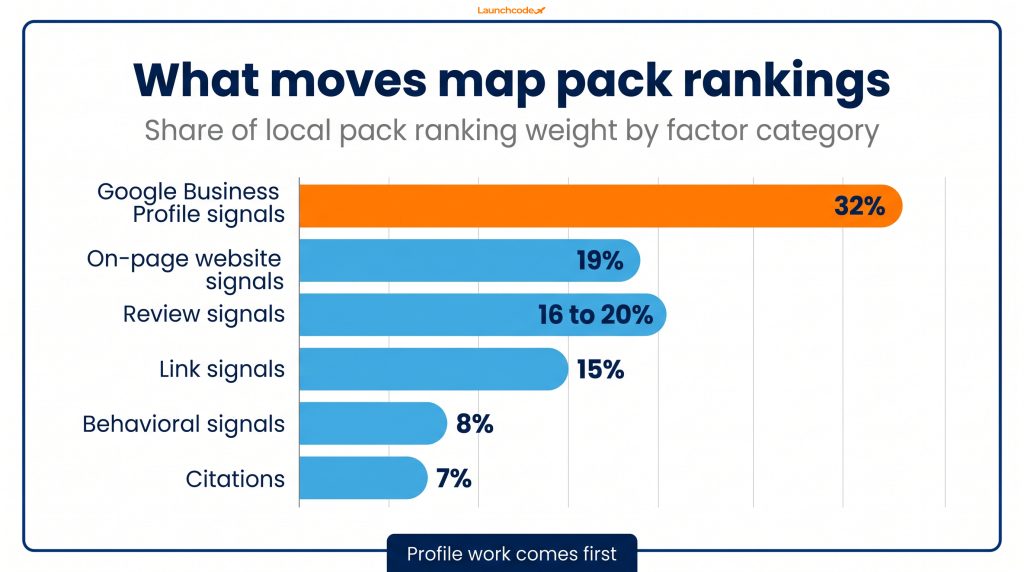
The most current expert consensus is the Whitespark Local Search Ranking Factors survey, published in November 2025. It gathered input from 47 local search experts across 187 individual factors and added AI search visibility as a formal category for the first time.
| Factor category | Share of map pack ranking weight |
|---|---|
| Google Business Profile signals | 32 percent |
| On-page website signals | 19 percent |
| Review signals | 16 to 20 percent |
| Link signals | 15 percent |
| Behavioral signals | 8 percent |
| Citations | 7 percent |
These weights come from expert survey consensus, not from Google disclosure. Treat them as a prioritization guide, not a formula.
Distance is the one pillar you cannot optimize. A mediocre competitor two blocks from the searcher will often outrank you from across town, and no profile edit changes that. The practical response is to win the remaining factors so your visibility radius stretches as far as possible from your location. Businesses that accept this early stop wasting months on tactics meant to trick a distance signal that cannot be tricked.
Start with the basics that gate everything else: claim and verify your Google Business Profile, select the most specific primary category available, confirm your name, address, and phone number match your website exactly, and set accurate hours. Profile changes typically take effect within two to four weeks, which makes this the fastest win in local SEO.
Profile signals are the largest ranking category at roughly 32 percent, which is why Whitespark founder Darren Shaw advises businesses to claim and optimize the profile first and worry about citations later. The foundations take an afternoon and remove the errors that quietly cap your visibility.
There is no way to request or pay for better local ranking. Anyone selling guaranteed map pack placement is selling risk.
Once foundations are set, build out every relevance field Google gives you. Controlled testing by Joy Hawkins and the Sterling Sky team found that filling out the services section of a Google Business Profile measurably impacts local rankings. Add every service you offer with a clear description, complete your attributes, write a specific business description, and upload current photos.
This step matters because most profiles stop at the basics. The services finding surprised even veteran practitioners. Darren Shaw’s reaction summed it up: “Everyone needs to go and make sure your services section in GBP is fully built out.”
The 2026 Whitespark survey flagged behavioral signals, meaning clicks, calls, photo views, and direction requests, as increasingly influential in map pack rankings. A complete profile earns more of those actions, and those actions feed back into rankings. This loop matters even more because SparkToro’s zero-click research found that 58.5 percent of US Google searches end without a click to any website. For many customers, your profile is the entire experience. It has to rank and convert in the same view.
Reviews are the ranking factor you can grow every single week. Build a system that asks every satisfied customer for a review within 24 hours of service, responds to every review within two business days, and sustains a steady pace instead of occasional bursts. Review-driven ranking movement typically shows in 60 to 90 days.
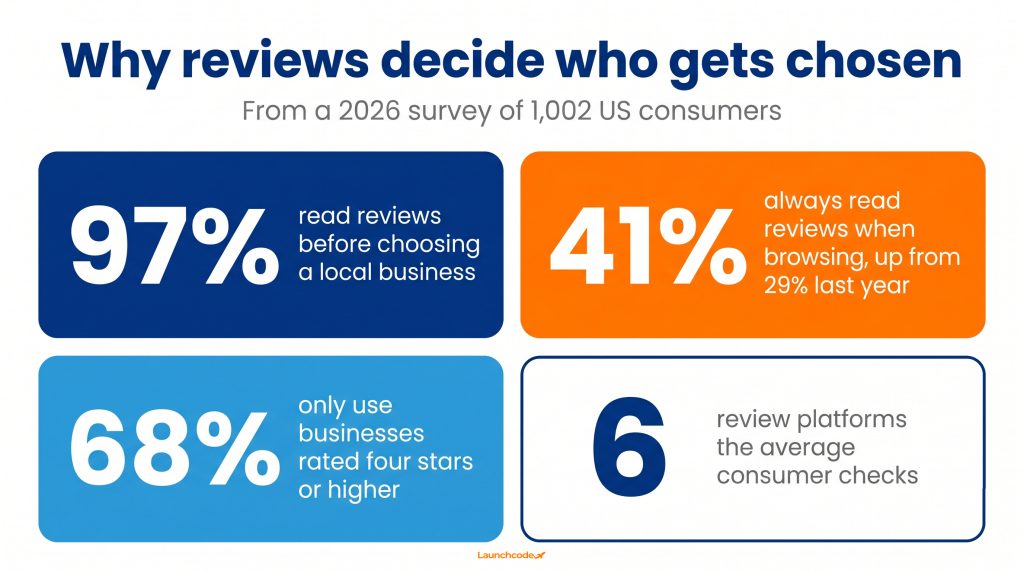
The consumer data makes the case bluntly. The BrightLocal Local Consumer Review Survey 2026, based on 1,002 US adults, found that 97 percent of consumers read reviews before choosing a local business, and 41 percent now always read reviews when browsing, up from 29 percent one year earlier. The survey also found that 68 percent of consumers only use businesses rated four stars or higher. Joy Hawkins, founder of Sterling Sky and a Google Business Profile Product Expert, puts it plainly: “Reviews are huge. They’re like table stakes.”
“The ask is where most businesses fail, not the service. When clients move the review request into a text sent the same day, we typically see review velocity triple within a month, and that steady cadence is what the algorithm rewards.” Tanner Medina, Co-Founder and Chief Growth Officer
Never buy reviews, post fake ones, or steer unhappy customers away from review forms. The FTC prohibits fake and incentivized reviews, and Google removes profiles that violate review policies. One clean review per week beats ten risky ones overnight.
Your website carries roughly 19 percent of map pack ranking weight through on-page signals, plus another 15 percent through links. Build a dedicated page for each core service, a location page for each office, and earn links from local organizations. Your profile tells Google what you do. Your website proves it.
A strong profile sitting on a thin website hits a ceiling. Google cross-references the two, and the website confirms your service coverage, builds topical depth, and gives searchers who do click somewhere worth landing.
Skip mass directory submissions. Earn a smaller number of real local links instead: the chamber of commerce, local news coverage, sponsorships of community events, and industry associations. These links feed prominence, the pillar that reflects how well known your business is, and they tend to send actual customers too.
Searching your own keyword from the office tells you almost nothing, because map pack results change block by block based on the searcher’s location. Geo-grid tracking tools check your ranking from dozens of points across your service area and plot the results as a heatmap. Set a baseline before you start optimizing, then rescan monthly.
Without geo-grid data, you cannot tell whether your work is expanding your visibility radius or whether you are celebrating a ranking that only exists at your own address.
Pair grid data with Google Business Profile performance insights, which report calls, direction requests, and website clicks. At Launchcodex, local SEO engagements report on those outcome metrics alongside grid movement, because a wider green heatmap only matters if the phone rings more. That pairing also exposes problems early, like a profile that ranks well but converts poorly because photos are outdated or hours are wrong.
“Run the baseline scan before you touch a single field. We use a 7×7 grid as the default, and on most single-location accounts the category and services fixes alone expand visibility by two to three pins within six weeks. Without the baseline, you end up crediting the wrong work.” Tanner Medina, Co-Founder and Chief Growth Officer
Map pack work now has a second payoff: AI assistants. BrightLocal’s 2026 survey found that 45 percent of consumers use AI tools like ChatGPT for local business recommendations, up from 6 percent a year earlier. The same survey shows Google review platform usage fell from 83 percent to 71 percent in that period. Local discovery is fragmenting, and the businesses with strong structured data, consistent listings, and deep review profiles are the ones AI systems recommend.
The bar is high. According to the SOCi Local Visibility Index data summarized in BrightLocal’s local SEO statistics roundup, visibility in ChatGPT local recommendations is roughly 30 times harder to achieve than ranking in Google local results, and less than half of the businesses that lead Google’s local results also appear in AI recommendations. Winning the map pack no longer guarantees winning the AI answer.
“Treat your business information like a dataset, not a listing. When the name, hours, services, and LocalBusiness schema match across Google, Apple Maps, Bing Places, and your own site, AI assistants stop guessing and start citing you. Mismatched data is the most common reason a business that ranks well in Maps never shows up in ChatGPT.” Derick Do, Co-Founder and Chief Product Officer
The 2026 Whitespark survey formalized this shift by adding AI search visibility as a ranking factor category. Generative engine optimization is becoming part of local SEO, not a separate discipline, and the fundamentals in steps one through four are also the foundation for it.
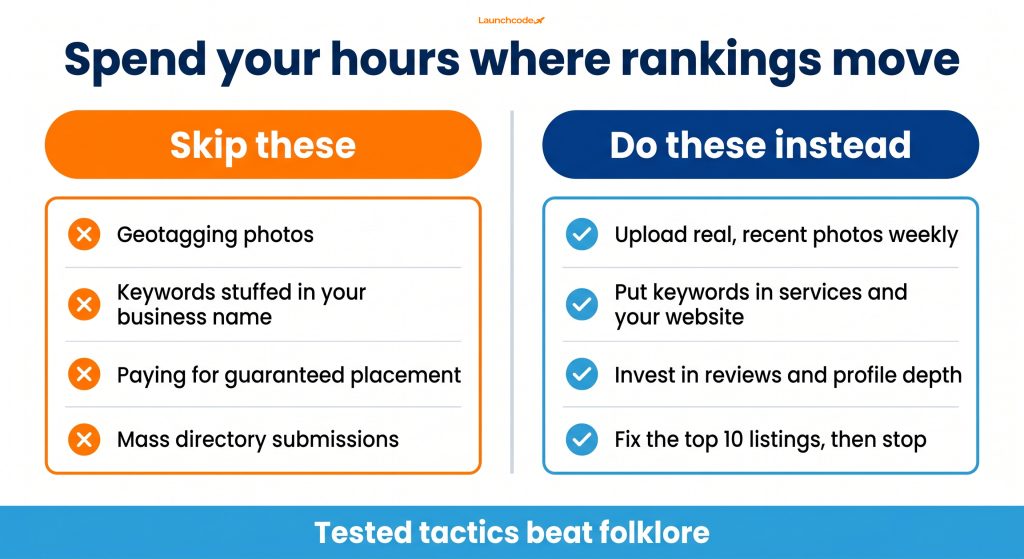
Three popular tactics have been tested and debunked: geotagging photos before upload, stuffing keywords into your business name, and paying anyone who promises guaranteed placement. Controlled tests by Sterling Sky and independent practitioners found no ranking impact from geotagged photos, keyword-stuffed names risk suspension, and Google confirms ranking cannot be bought.
Every hour spent on folklore is an hour not spent on the 32 percent of ranking weight sitting in your profile.
| Tactic | The evidence | Do this instead |
|---|---|---|
| Geotagging photos | Multiple controlled tests found no ranking impact | Upload real, recent photos weekly |
| Keywords in business name | Violates Google guidelines, risks suspension | Put keywords in services and your website |
| Buying placement | Google states local ranking cannot be paid for | Invest in reviews and profile depth |
| Mass directory citations | Citations carry 7 percent of ranking weight | Fix the top 10 listings, then stop |
Most of these tactics sound logical, which is why they persist. The local search community kills them with controlled testing, where one variable changes and rankings are measured before and after. When advice lacks a test or a named source behind it, treat it as a guess.
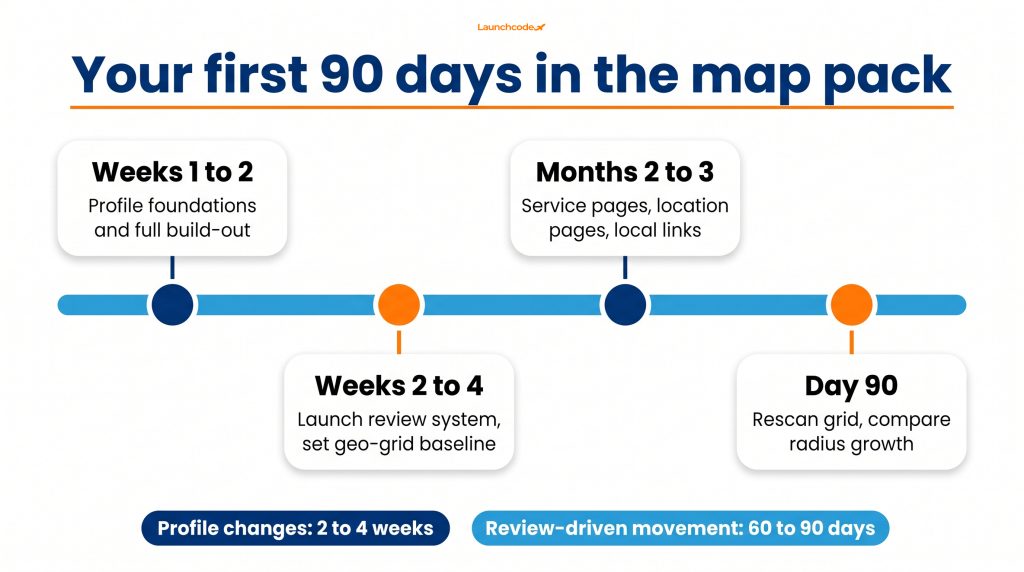
Run the steps in order and hold the schedule. Weeks one and two: foundations and full profile build-out. Weeks two through four: launch the review system and set your geo-grid baseline. Months two and three: ship service and location pages, earn your first local links, and rescan your grid monthly. Expect profile changes to register within two to four weeks and review-driven movement within 60 to 90 days.
Timelines vary with market competitiveness. A niche service in a small city moves faster than a pizza shop in Chicago. What stays constant is the order of operations: profile first, reviews always, website and links as reinforcement, measurement throughout, and AI visibility as the layer that compounds all of it.
If rankings stall after 90 days of clean execution, the gap is usually competitive depth, not effort. That is the point where a geo-grid competitor comparison shows exactly which signals the businesses above you hold, and where a structured local SEO program earns its keep.
Most businesses see profile-driven changes within two to four weeks and review-driven movement within 60 to 90 days. Competitive markets and new businesses can take six months or longer.
You can appear, but you compete with a handicap. On-page and link signals together carry roughly 34 percent of map pack ranking weight, and a website confirms the relevance claims your profile makes.
Testing shows posts have little direct ranking impact. They support conversions and engagement signals, so treat them as a conversion tool rather than a ranking lever.
Usually proximity. Distance is one of Google’s three core ranking factors and cannot be optimized. Win by building stronger relevance and prominence signals to expand your visibility radius.
It helps but does not guarantee anything. Less than half of businesses leading Google local results appear in AI recommendati


Real stories from the people we’ve partnered with to modernize and grow their marketing.