




The dental practice local SEO playbook: How to dominate 'dentist near me' searches
A step-by-step local SEO playbook for dental practices. Optimize your Google Business Profile, build reviews, and rank for d...




A patient with a cracked tooth opens Google, types "dentist near me," and calls one of the first three practices on the map. If your office is not in that block, you rarely get the call. The practice that ranks gets the appointment, and the work behind that ranking is learnable.
This playbook gives you a sequenced plan, not a pile of tips. You will learn how Google ranks local dental results, which moves matter most, and how to run them in order. Each phase ties to a real outcome: more calls, more booked appointments, and a lower cost to win each new patient.
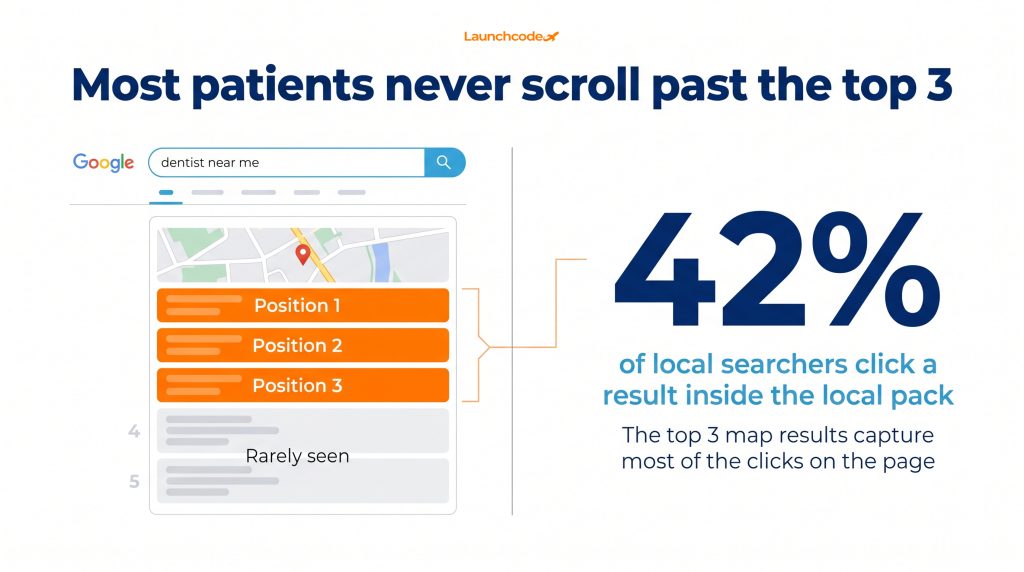
Top map pack visibility decides whether a high-intent patient reaches your front desk or a competitor's. About 42% of people who run a local search click a result inside the local pack, and the top three results capture most of the clicks on the page. For a dental office, missing those spots means missing the patients who are ready to book right now.
Ready to grow your organic traffic?
Get a free SEO audit from the Launchcodex team.
The patient pool is larger than most owners assume. The American Dental Association reports that only 45% of the U.S. population had a dental visit in the past 12 months, including 40% of working-age adults. Most adults are not regular patients, so the practice that gets found captures demand that is otherwise unclaimed.
A single new patient carries real value over time. Industry estimates put the cost to acquire a new dental patient between $150 and $300, while one new patient often returns several thousand dollars in lifetime treatment. Strong organic local visibility lowers your blended acquisition cost because those calls arrive without a per-click ad fee.
Referrals still matter, but search has taken the lead for new patients, especially younger ones. Health-related "near me" searches have grown sharply since 2020, and adults under 45 are far more likely to choose a provider based on online presence than on a personal recommendation. Your search footprint now does the work a referral used to do.
Google bases local results on three factors: relevance, distance, and prominence. Relevance is how well your profile matches the search. Distance is how close you are to the searcher. Prominence is how known and trusted you are. You can influence two of the three directly, and that is where the playbook focuses.
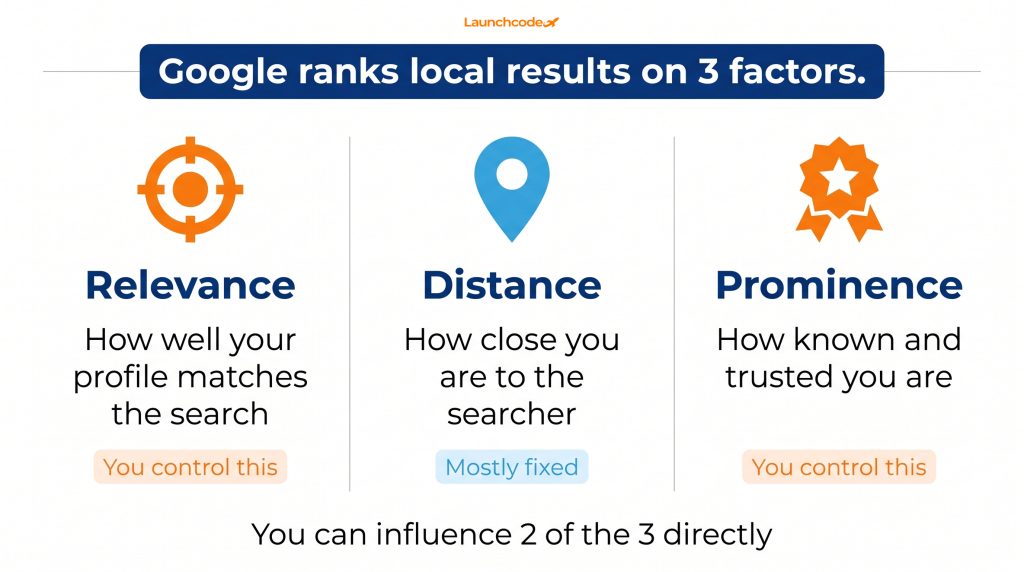
Google states this plainly in its own guidance. As the Google Business Profile help documentation puts it, "Local results are based primarily on relevance, distance, and prominence." Distance is mostly fixed by your address. Relevance and prominence are yours to build.
Use this map to decide where your effort goes.
| Ranking pillar | What it means | What a practice can control |
|---|---|---|
| Relevance | How well your profile and site match the search | Primary category, services listed, on-page content, schema |
| Distance | How close you are to the searcher | Accurate address and map pin, additional verified locations |
| Prominence | How known and trusted you are | Reviews, citations, links, brand mentions, engagement |
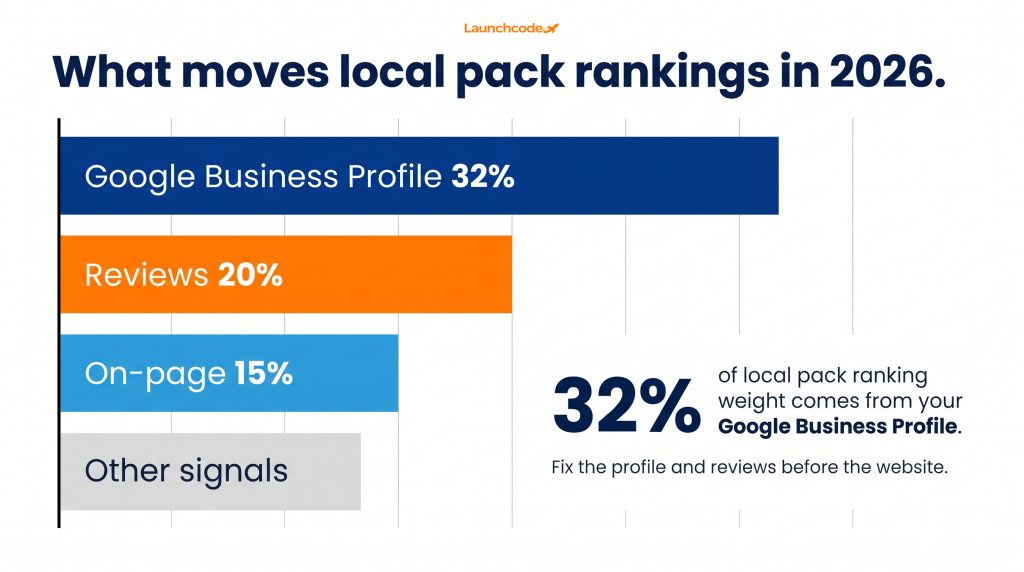
Many practices spend on website redesigns while their Google Business Profile sits half finished. That order is backward. Survey data compiled by BrightLocal from the Whitespark Local Search Ranking Factors study shows Google Business Profile accounts for roughly 32% of local pack ranking weight, with reviews at 20% and on-page factors at 15%. Fix the profile and reviews before you touch the site.
Your Google Business Profile is the single biggest lever for map pack rankings, so optimize it before anything else. The primary category is the top individual ranking factor, which means choosing "Dentist" or the correct subcategory like "Cosmetic dentist" directly shapes which searches you appear in. Complete every field, because completeness feeds both rankings and patient trust.
A profile is not a one-time setup. Practices that keep posting photos, updating hours, and responding to reviews send the engagement signals Google now rewards.
Work through these in order.
One single location practice that struggled to appear for "dentist near me" had picked a vague primary category and left half its services blank. After switching to the correct primary category, filling in services, and adding photos, the profile started surfacing for service-specific searches within weeks. The fix cost nothing but attention.
"When we audit a new dental client, the primary category is set wrong about half the time. Correcting it and filling in every service often moves the profile into the map pack before we touch the website." Tanner Medina, Co-Founder and Chief Growth Officer
Reviews are your second strongest ranking signal and your leading trust signal with patients. A steady stream of recent, genuine reviews beats a large pile of old ones. Build a simple front desk habit that asks happy patients for a Google review on the day of their visit, because recency and consistency carry the most weight.
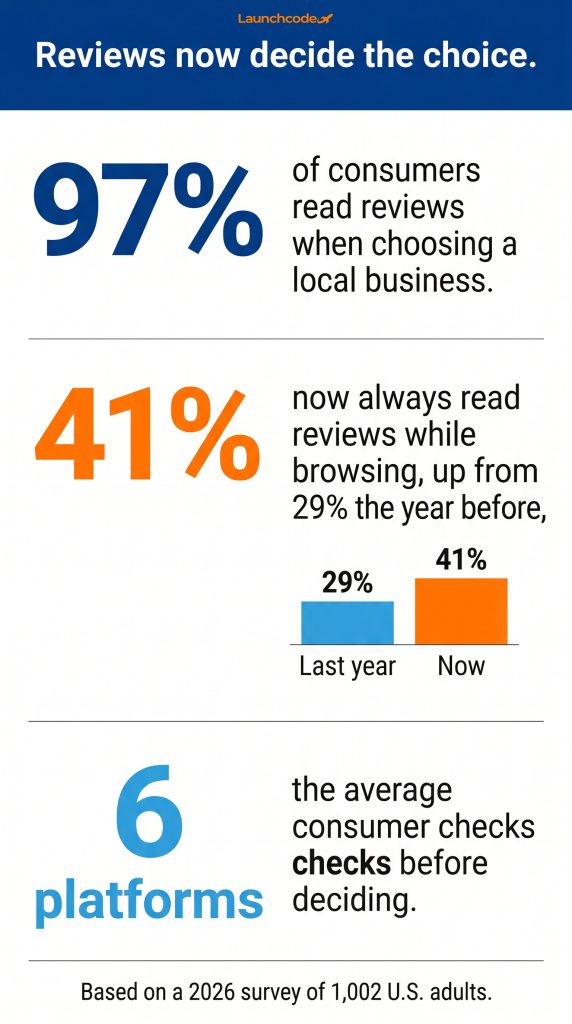
Patients now treat reviews as the deciding factor. The BrightLocal Local Consumer Review Survey 2026, based on 1,002 U.S. adults, found that 97% of consumers read reviews when choosing a local business, and 41% now always read them while browsing, up from 29% the year before. Rosie Murphy, the report's author, sums it up directly: "Reviews are stable, sticky, and more important than ever."
Make the ask part of checkout, not a campaign.
"The practices that win on reviews build the ask into checkout. One QR code at the desk and a same day follow up text will outperform any quarterly review push, because Google weights recent reviews so heavily." Brittany Charles, SVP, Client Services
Dedicated pages for each service and each location carry most of the weight in local organic rankings. A patient searching "Invisalign [city]" should land on a page about Invisalign at your office, not a buried line on a general services page. One clear page per service, written in plain language, helps both Google and AI systems understand exactly what you offer.
This is also where you support relevance for searches the map pack alone cannot win. The same data set that ranks profile and reviews highly places dedicated service pages and internal linking at the top of local organic factors.
For each core service, build a page with:
A practice with separate, well-built pages for implants, Invisalign, and emergency care gives Google three distinct chances to match a search, instead of one general page trying to do all three jobs.
Add LocalBusiness and Dentist schema so search engines parse your address, hours, and services cleanly. If structured content and page architecture sit outside your team's comfort zone, this is the layer where a web development partner earns its keep, because clean structure compounds across every page.
Google treats dental content as Your Money or Your Life, which means it applies its strictest quality standards. Health pages need to show real expertise. A named dentist as the author, a clinical reviewer, and clear credentials beat anonymous marketing copy every time. This is not optional polish. It directly affects whether health pages rank.
The standard comes straight from Google's rater guidance. The Search Quality Evaluator Guidelines state that high-quality medical advice "should be written or produced by people or organizations with appropriate medical expertise or accreditation" and should be "edited, reviewed, and updated on a regular basis."
Keep patient privacy front of mind when you add forms, chat tools, or tracking. Treat any handling of patient information carefully and confirm your setup with your own compliance advisor, since rules vary and this article is not legal advice.
Consistent listings across the web raise your map pack odds and now feed AI tools that recommend providers. Businesses with consistent name, address, and phone data across major sources are 40% more likely to appear in the local pack. The same listings and reviews increasingly shape whether AI systems mention your practice at all.
Patient discovery is spreading beyond Google. The BrightLocal review survey found the average consumer now uses around six review platforms, that Google's share of review reading fell from 83% to 71% in a year, and that use of AI tools like ChatGPT for recommendations rose from 6% to 45%. Your information has to be correct everywhere those tools look.
The 2026 ranking factors work, summarized by BrightLocal, scored AI search visibility for the first time. Top factors include appearing on expert-curated "best of" lists and having a dedicated page for each service. As industry analysts noted in Street Fight's coverage of the Whitespark report, local visibility "is no longer just about keywords, it is about authentic engagement and brand trust." The signals that build prominence in Google also build it in AI answers.
Track the metrics that prove patient growth, not rankings alone. Connect map pack position to phone calls, form submissions, and booked appointments. A jump in rankings only matters if it produces calls, and a call only matters if the front desk books it. Measure the full path from search to scheduled visit.
Rankings move around by neighborhood and device, so a single position check tells you little. Watch the trend and the conversions behind it.
Review these monthly. Pair Search Console query data with call tracking so you can say which searches produced which calls.
"Rankings only matter if calls turn into booked chairs. We pair Search Console with call tracking so a client sees which searches produced appointments, not just impressions." Tanner Medina, Co-Founder and Chief Growth Officer
This reporting layer is where Launchcodex ties ranking work to revenue for service businesses, so the practice sees booked appointments instead of a position chart.
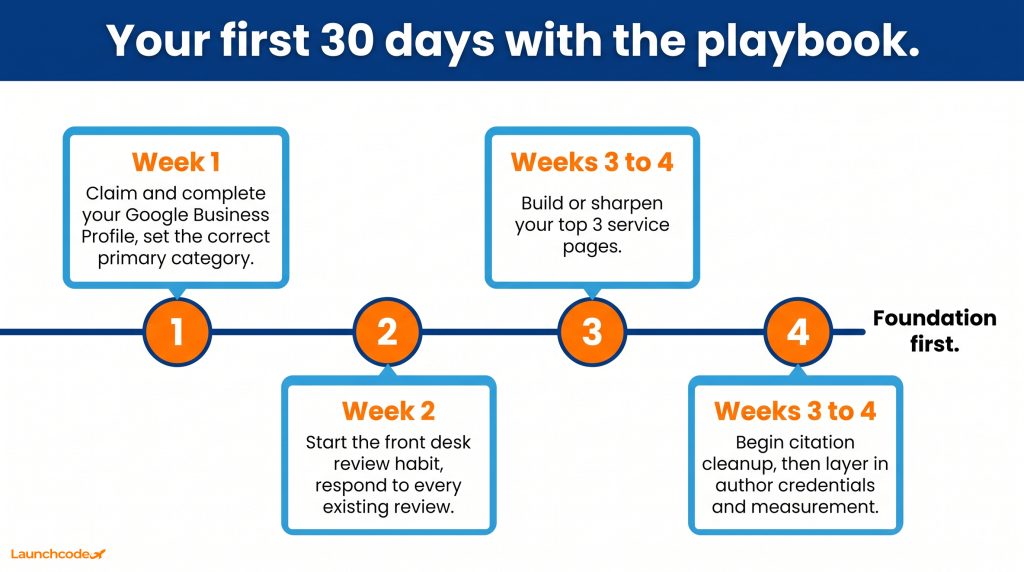
Run this playbook in order and the early wins come fast. In the first week, claim and complete your Google Business Profile and set the correct primary category. In the second week, start the front desk review habit and respond to every existing review. In the third and fourth weeks, build or sharpen your top three service pages and begin the citation cleanup. Layer in author credentials and measurement as you go.
The practices that dominate "dentist near me" are rarely the ones with the biggest budgets. They are the ones who fixed the foundation first, kept reviews flowing, and matched their pages to what patients actually search. Start with phase one this week, and let each phase build on the last.
There is no fixed number. Recency and steady growth matter more than a single total, so aim for a consistent flow of new, genuine reviews each month rather than one large push.
Distance is the hardest factor to influence because it depends on the searcher's location. Strong relevance and prominence can widen your reach somewhat, but a single office will always rank best closest to its address.
Yes, for your core services. A dedicated page for implants, Invisalign, or emergency care gives Google and AI tools a clear match for specific searches, which a single combined page cannot do as well.
Profile and review fixes can show movement within weeks. Service page and citation work usually compound over a few months, so treat this as a steady program rather than a one time project.
Dental content affects health, so Google classifies it as Your Money or Your Life and applies higher quality standards. Named clinician authors, clinical review, and current information all help these pages meet that bar.




A step-by-step local SEO playbook for dental practices. Optimize your Google Business Profile, build reviews, and rank for d...
A data-backed e-commerce marketing guide to acquire, convert, and retain customers as one profit loop. Benchmarks, checkout ...
Build a SaaS marketing strategy as a connected growth engine. Learn the four stages, AI search visibility, the right GTM mot...