

Share:

AI marketing & automation


Most SaaS marketing fails for one reason. Teams run content, ads, email, and social as separate efforts that never connect. Spend climbs, leads trickle in, and no one can name the part of the funnel that moves recurring revenue. You get motion without progress.
This guide fixes that. You will learn how to build a SaaS growth engine with four connected stages, how to earn visibility where AI now forms the buyer shortlist, how to pick a go-to-market motion that fits your product, and which metrics keep the system honest. Every claim ties to current data and to revenue you can measure.
A SaaS growth engine is a connected system that moves a buyer through four stages, acquire, activate, retain, and expand, with each stage tied to one metric and one motion. A tactic list does not compound. An engine does. Content feeds activation, activation feeds retention, and retention feeds expansion, so each dollar works across the full lifecycle instead of a single campaign.
The stakes are real. In Kyle Poyar’s analysis of ChartMogul data covering 6,525 software companies, only 3.5 percent of SaaS startups reach 20 million in ARR within ten years of monetizing. The companies that scale rarely speed up acquisition. They grow expansion share, average revenue per account, and retention. They fix the whole engine, not the front of it.
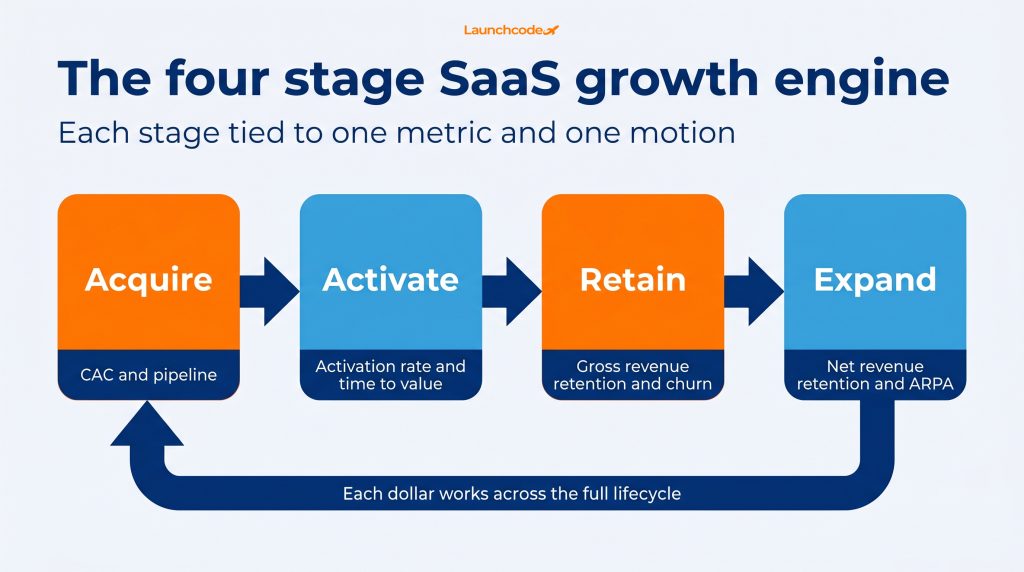
Each stage answers a different question and reports a different number. Map them once and your team stops arguing about random tactics.
| Stage | Core question | Primary metric | Lead motion |
|---|---|---|---|
| Acquire | How do buyers find and choose us | CAC, pipeline, AI visibility | Content, SEO, GEO, paid |
| Activate | Do new users reach value fast | Activation rate, time to value | Onboarding, product, lifecycle email |
| Retain | Do customers stay and stay healthy | Gross revenue retention, churn | Customer marketing, education |
| Expand | Do accounts grow over time | Net revenue retention, ARPA | Upsell, usage based pricing, advocacy |
Teams skip positioning and jump to channels. That backfires. Positioning expert April Dunford, in a SaaSiest keynote recap, defined positioning as how your product becomes the best in the world at delivering a value your customers care about. Get it right and every channel works harder. Skip it and you pay to promote a message that does not land.
Efficient acquisition starts with a clear ideal customer profile and a value proposition tied to outcomes, then runs durable channels like content, SEO, and AI visibility ahead of paid spend. Chase a customer acquisition cost you can pay back fast, not raw lead volume. Aim for an LTV to CAC ratio of 3 to 1 or better.
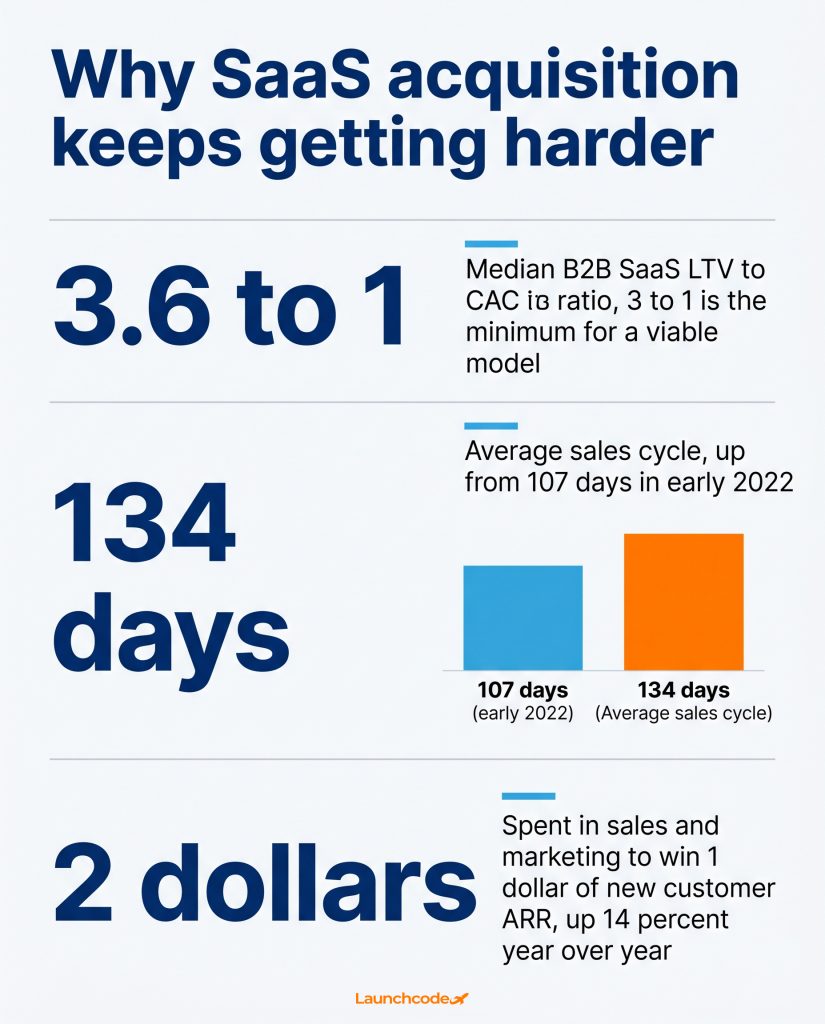
Acquisition has gotten harder and pricier. The median LTV to CAC ratio for B2B SaaS now sits near 3.6 to 1, with 3 to 1 as the floor for a viable model, per Benchmarkit. The same data shows companies now spend about 2 dollars in sales and marketing to win 1 dollar of new customer ARR, up 14 percent year over year. Benchmarkit also reports sales cycles stretching to roughly 134 days, up from about 107 in early 2022. Durable assets beat short bursts of spend.
Pick channels by intent, cost, and how fast they compound. This order works for most early to mid-stage teams.
Buyers at different sizes behave differently, so the mix should shift.
| Segment | Primary channels | Buying behavior |
|---|---|---|
| SMB | Search, content, self-serve trial | Fast, self-directed research |
| Mid market | Multi-channel, webinars, email nurture | Longer evaluation, several touchpoints |
| Enterprise | ABM, events, direct sales | Many stakeholders, relationship-driven |
Do not spread budget evenly. Concentrate on the channels your buyers already use to evaluate software, and treat content as the asset that feeds every stage downstream.
Activation is the moment a new user reaches first real value, and it predicts conversion better than top-of-funnel volume. Strong SaaS products activate 20 to 40 percent of trial users, and leaders clear 50 percent. Onboarding should guide a user to one clear win in days, not weeks, because most trials convert or stall in that first window.
Acquisition means nothing if users never reach value. A product-led growth benchmark roundup citing SlashExperts and UserPilot data found that top products keep activation above 50 percent, and 80 percent of those high performers use multimedia in onboarding. Activation is a design problem, not a volume problem.
Build onboarding around a single first value moment, then remove every step that delays it. Tools like Pendo, Appcues, and Customer.io handle the in-product guidance and triggered emails.
Most activation failures repeat the same mistakes. Watch for these.
The math makes the case. Spend 3,000 dollars to win a 100 dollar per month customer and that account must stay 30 months just to break even. Faster activation shortens that timeline and protects the whole engine.
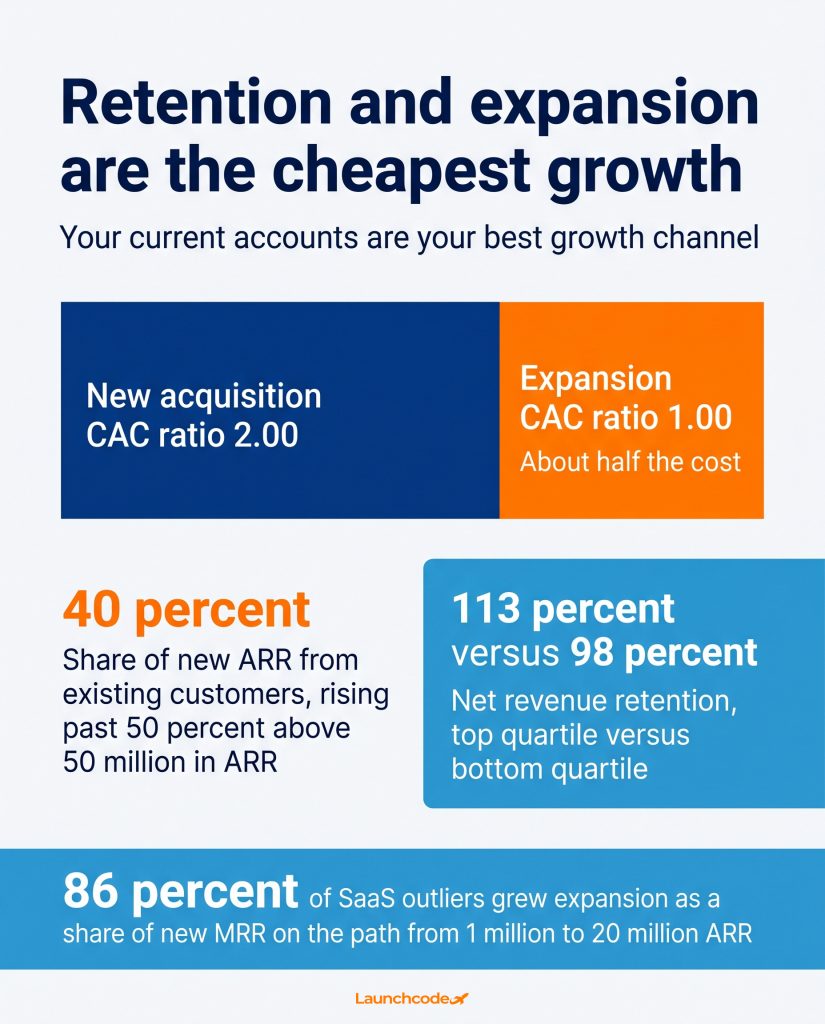
Retention is the cheapest growth lever you own, because keeping a customer costs far less than winning one. Top quartile B2B SaaS companies hold net revenue retention near 113 percent, while bottom performers sit at 98 percent. Marketing’s job does not end at the sale. Customer education, community, and lifecycle email all protect recurring revenue.
Retention separates leaders from the rest. McKinsey research on net revenue retention in B2B tech found that 113 percent versus 98 percent gap, and it compounds every year. A company that keeps and grows existing revenue needs far fewer new acquisitions to hit the same number.
Treat retention as a marketing-owned program, not only a customer success task. Product analytics from Amplitude or Mixpanel feed the health signals.
Churn rarely arrives without notice. These signals predict it.
“We watch core feature usage and ticket volume more closely than any acquisition metric. A health score that dips two weeks early gives the team time to save an account before renewal.” Brittany Charles, SVP, Client Services
Catch these early and you can step in. Miss them and you pay full price to replace revenue you already had.
Expansion revenue drives a large share of growth at roughly half the cost of new acquisition, which makes it the most efficient stage in the engine. Existing customers generate about 40 percent of new ARR, rising past 50 percent for companies above 50 million in ARR. Upsells, cross-sells, and usage-based pricing turn current accounts into your best growth channel.
Most teams underuse this stage. Benchmarkit data puts the expansion CAC ratio near 1.00, about half the cost of winning a new customer. Yet many companies keep pouring budget into the top of the funnel while ignoring the accounts they already serve. That is the cheapest growth left on the table.
HubSpot, Atlassian, and DocuSign built large businesses on this motion. Win a small foothold, prove value, then grow the account.
Expansion runs on data. Map these capabilities to the work.
The payoff lasts. Poyar’s data showed 86 percent of SaaS outliers improved expansion as a share of new MRR by more than 10 percent on the path from 1 million to 20 million in ARR.
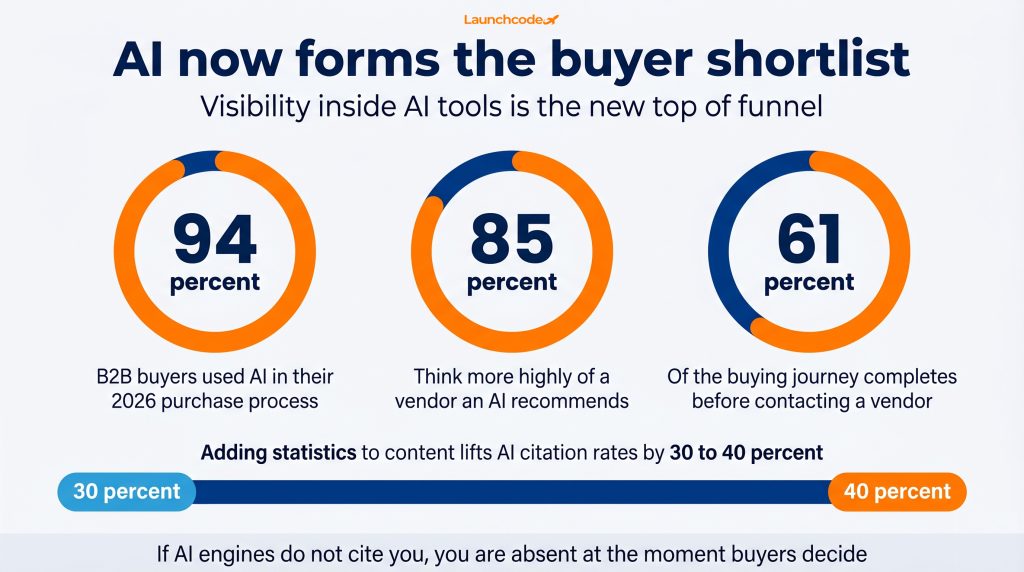
In 2026, AI tools form the buyer shortlist before any vendor conversation, so AI visibility is the new top of funnel. 94 percent of B2B buyers used AI in their purchase process this year, and twice as many named generative AI as their most meaningful research source than any other source. If AI engines do not cite you, you are absent at the moment buyers decide.
This is the shift most SaaS marketing guides still miss. They optimize for Google clicks while buyers move to answer engines. Forrester’s 2026 buyer survey of nearly 18,000 buyers, summarized in this research analysis, confirmed the 94 percent figure and found that adding statistics to content lifts AI citation rates by 30 to 40 percent. Domain authority matters too, since a large share of top-cited pages come from high authority sites.
Buyers now do most of the work alone. A multi-source analysis citing Forrester data found that 61 percent of the B2B buying journey completes before the buyer contacts a vendor. By the time a sales call happens, the shortlist is set. Tim Sanders of G2 framed it in Demand Gen Report coverage, saying buyers have moved from reference to inference and trust AI to return the shortlist in a single prompt. That report also found half of software buyers now start research with AI chatbots, and 85 percent think more highly of a vendor when an AI recommends it.
Generative engine optimization, or GEO, is how you become citable. The work is concrete.
“The AI visibility gap is the most expensive blind spot we find in a SaaS audit. After we added cited statistics and clean answer structure to a client’s top ten pages, those pages started showing up in ChatGPT and Perplexity answers inside a quarter.” Tanner Medina, Co-Founder & Chief Growth Officer
Launchcodex runs GEO and traditional SEO as one program, because the same structured, data-backed content earns both human clicks and AI citations. Our guide to generative engine optimization shows how the two connect.
Most competitive SaaS companies in 2026 run a hybrid motion, using product-led growth to land efficiently and a sales team to expand strategically. Pure models are the exception now. Hybrid companies hit their net revenue retention targets more often, 67 percent versus 58 percent for pure PLG, because they match how both small and large accounts buy.
The old PLG versus sales led debate is mostly settled. Userpilot’s analysis of OpenView benchmark data shows hybrid beating pure PLG on retention targets. The deciding factor is not the label. It is whether your product delivers value fast enough for self-serve adoption to stick.
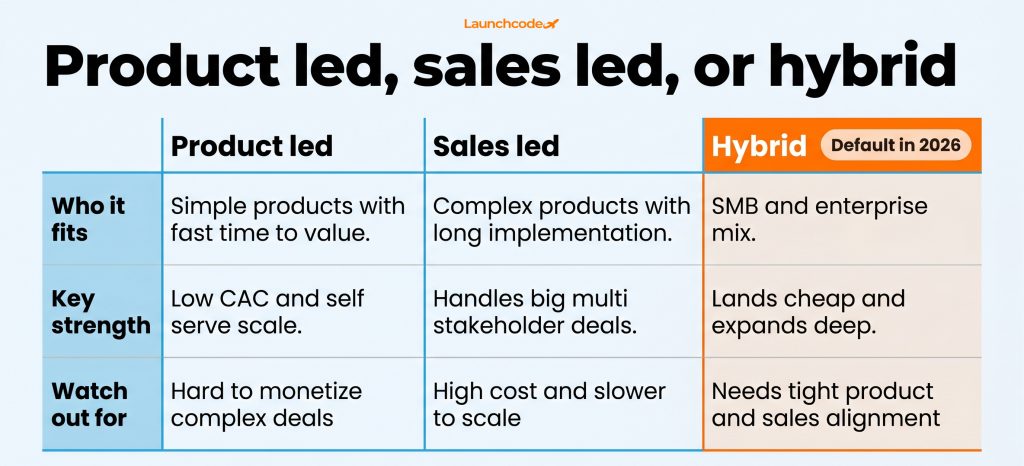
Use this table to find your starting point.
| Motion | Who it fits | Key strength | Watch out for |
|---|---|---|---|
| Product led | Simple products with fast time to value | Low CAC, self-serve scale | Hard to monetize complex or enterprise deals |
| Sales led | Complex products, long implementation | Handles big, multi-stakeholder deals | High cost, slower to scale |
| Hybrid | SMB and enterprise mix | Lands cheap, expands deep | Needs tight product and sales alignment |
Where self-serve fits, the numbers are strong. A GTM benchmark roundup found product-qualified leads convert at about 25 percent versus 9 percent without them, and PLG companies post a Rule of 40 near 34 versus 20 for sales-led peers. The same data shows PLG adoption reaching 91 percent among companies above 50 million in ARR, inside a global SaaS market valued near 390 billion dollars. Self-serve is no longer optional at scale, but it works best when paired with sales for the accounts that need a human.
A SaaS marketing engine reports on four metric categories that mirror its four stages, acquisition, activation, retention, and revenue. Track leading indicators, not vanity metrics, so you can act before results reach revenue. The non-negotiables are CAC, activation rate, net revenue retention, and the LTV to CAC ratio, which should hold at 3 to 1 or better.
Measurement is where most engines break. Teams track traffic and leads while ignoring whether those leads activate, stay, or expand. The fix is a full funnel dashboard, built in tools like GA4 and Looker Studio, that connects activity to recurring revenue.
Organize metrics by lifecycle stage so every team sees the number it owns.
| Category | Key metrics | Healthy target |
|---|---|---|
| Acquisition | CAC, pipeline, conversion rate | LTV to CAC at or above 3 to 1 |
| Activation | Activation rate, time to value | 20 to 40 percent activation or higher |
| Retention | Churn, gross revenue retention | Low churn, GRR protected |
| Revenue | MRR, ARR, net revenue retention | NRR above 100 percent |
Avoid the traps that make a dashboard lie.
Leading indicators give you time to act. Traffic forecasts lead volume, activation predicts conversion, and health scores anticipate churn. Watch the early signals and you steer the engine instead of reacting to it.
Start by mapping your four stages, then fix the weakest one first. Most teams overinvest in acquisition and underinvest in activation, retention, and expansion, where growth is cheaper and compounds faster. Add AI visibility as your new top of funnel, run a hybrid motion if you serve both small and large accounts, and measure each stage with one clear number.
The companies that scale do not chase every tactic. They build a system, measure it honestly, and improve the stage that holds them back. Acquisition will keep getting more expensive, so the edge goes to teams that activate fast, retain hard, and grow the accounts they already won.
“We start every engagement by scoring all four stages and putting the next quarter’s effort on the one with the worst number. Teams that win do not add tactics, they fix the weakest stage first.” Brittany Charles, SVP, Client Services
Here is a simple first move. Audit each stage against the metrics in this guide, find the one with the worst number, and focus next quarter there. If buyers cannot find you inside AI tools, start with GEO and content that earns citations. If trials stall, fix activation. The engine only runs as fast as its slowest stage. For a deeper build-out, our SaaS SEO and content services and case studies show how these stages connect in practice.
A note on the data. Benchmarks vary by stage, ACV, and segment, so treat the figures here as reference points, not guarantees. Sources are cited inline and reflect data published between 2024 and 2026.
Aim for 3 to 1 or higher. The current median for B2B SaaS sits near 3.6 to 1. A ratio below 2 to 1 signals a problem with unit economics, while 4 to 1 or more is strong and leaves room to reinvest in growth.
Plan for 12 to 18 months of coordinated effort. Paid channels and email can generate leads within weeks, but content, SEO, and GEO usually show results after six to twelve months. The engine compounds once activation, retention, and expansion start reinforcing acquisition.
Most companies should run a hybrid motion. Use product-led growth to land small accounts through self-serve, then add sales to expand into larger, multi-stakeholder deals. The right balance depends on product complexity, deal size, and how fast users reach value.
Buyers build their shortlist inside AI tools before contacting any vendor. 94 percent of B2B buyers used AI in their 2026 research, and many start there before opening Google. If AI engines do not cite your brand, you are absent at the moment of decision.
Expansion within existing accounts. It costs about half as much as new acquisition and drives roughly 40 percent of new ARR for many companies. Focus on activation, retention, and usage-based expansion


Real stories from the people we’ve partnered with to modernize and grow their marketing.