




How to optimize for each LLM: A GEO guide to ChatGPT, Perplexity, and Gemini
Generative engine optimization (GEO), sometimes called AI SEO, works differently on each engine. Here's how retrieval works ...





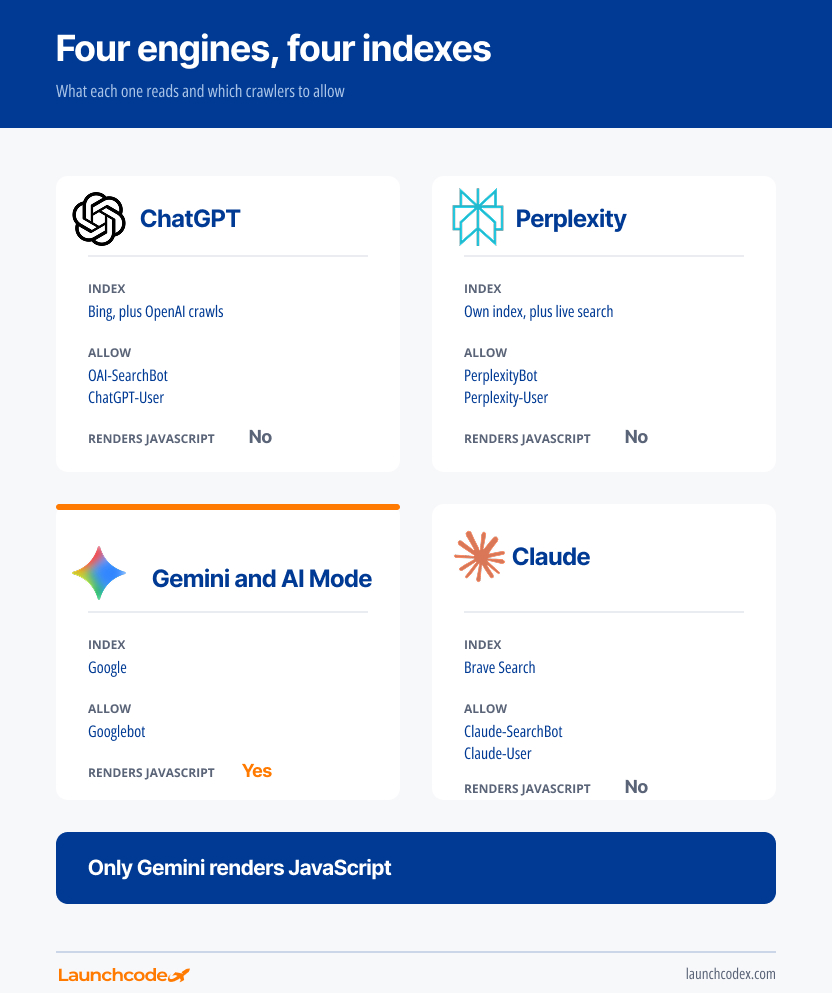
Most teams treat AI search as one channel. It is four. ChatGPT Search retrieves through Bing's index, Perplexity queries a proprietary index alongside live search, Gemini and Google AI Mode run on Google's index, and Claude sends its queries to Brave. Four different views of the web, which is why a page cited daily in one engine can be absent from another.
This guide covers what each engine does when it retrieves, which crawlers to allow, and the specific change that moves visibility on each surface. It also covers the shared technical work that helps everywhere, and the two popular tactics you can stop paying for. Every claim is sourced, and retrieval behavior was checked in July 2026.
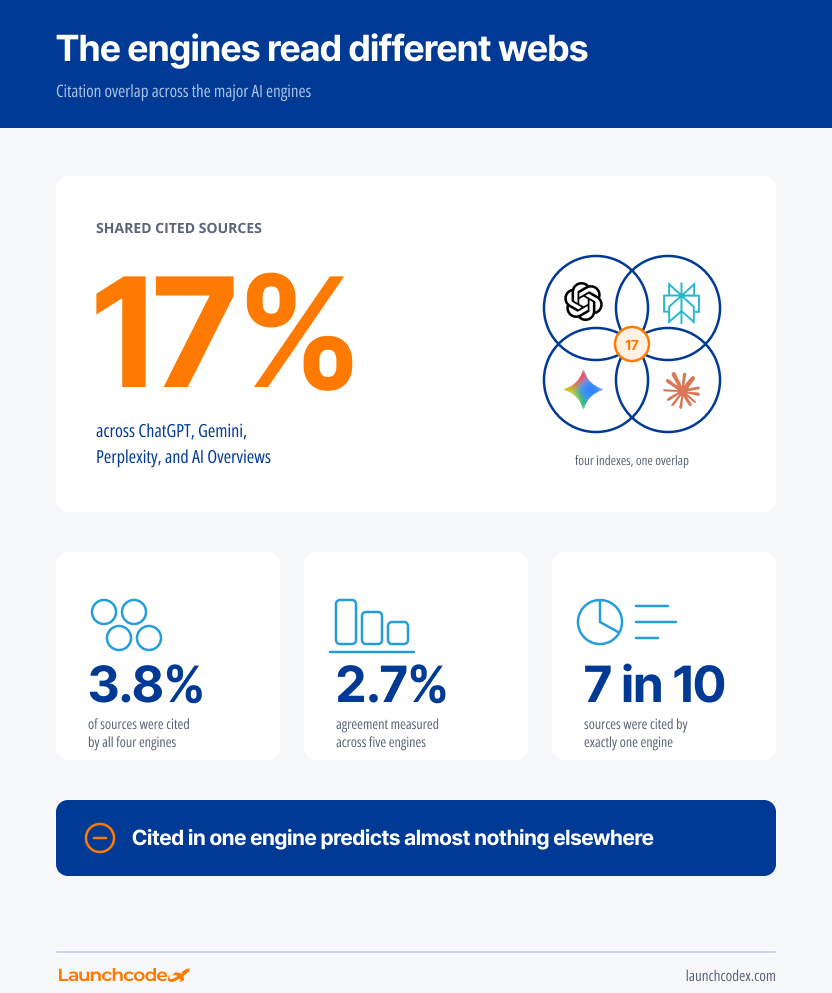
The engines read different indexes, so they surface different pages. A study of 161,286 prompts found ChatGPT, Gemini, Perplexity, and Google AI Overviews shared only about 17% of their cited sources for the same prompt, with just 3.8% cited by all four. No engine pair cleared 25% overlap. Being cited in one predicts almost nothing about the others.
Ready to grow your organic traffic?
Get a free SEO audit from the Launchcodex team.
That finding is not a single-study quirk. A separate analysis of 127,198 citations across five engines found the engines agreed on only 2.7% of sources, and seven in ten sources were cited by exactly one engine. Two methodologies, one conclusion.
The 161,286-prompt overlap study puts the closest pair, Perplexity and Google AI Overviews, at 0.237. Even there, more than three quarters of cited domains belong to one engine alone. Benchmarking your AI visibility against a single engine gives you a number that does not generalize.
"We audited a client who looked healthy in ChatGPT and assumed the rest would follow. They appeared in zero Perplexity answers across 40 category prompts. Same content, different index." Tanner Medina, Co-Founder and Chief Growth Officer
| Engine | Index it reads | Crawlers to allow | Renders JavaScript | Highest-leverage move |
|---|---|---|---|---|
| ChatGPT | Bing, plus OpenAI crawls | OAI-SearchBot, ChatGPT-User | No | Get indexed in Bing Webmaster Tools |
| Perplexity | Proprietary index, plus live search | PerplexityBot, Perplexity-User | No | Front-load the answer in the first two sentences |
| Gemini and AI Mode | Googlebot | Yes | Cover the full sub-question set on one deep page | |
| Claude | Brave Search | Claude-SearchBot, Claude-User | No | Check that your pages rank on search.brave.com |
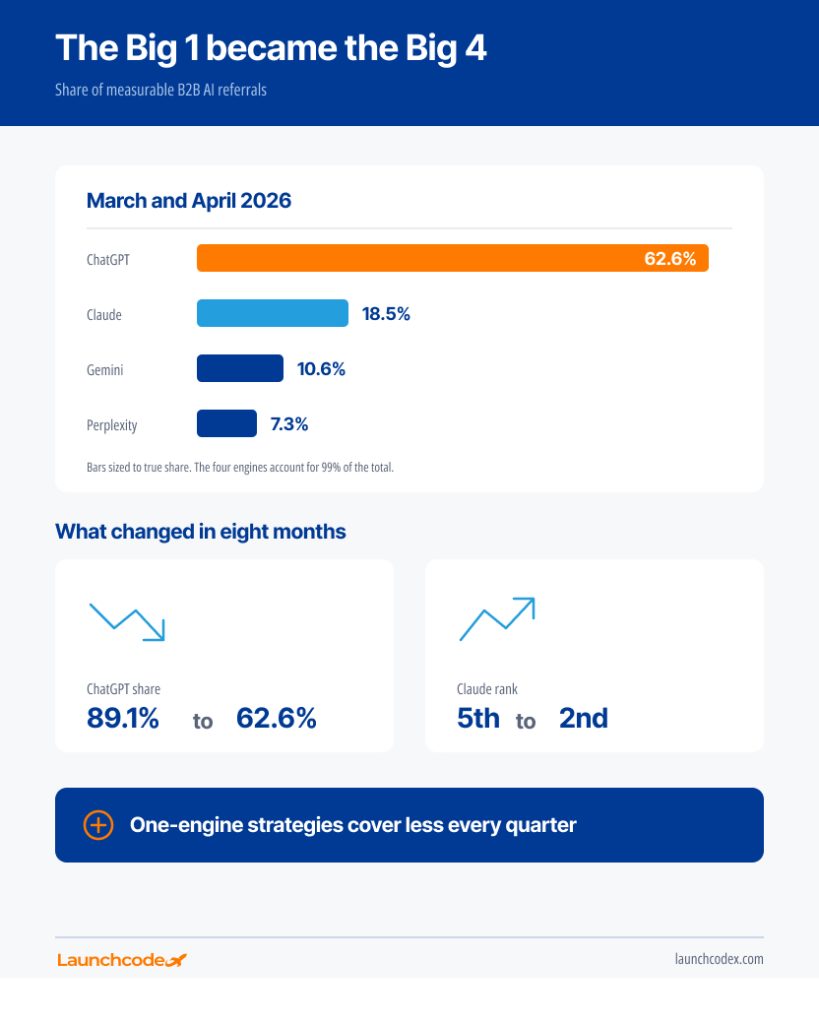
Engine share keeps moving. Goodie's AI search traffic report tracked ChatGPT's share of measurable B2B AI referrals falling from 89.1% in mid 2025 to 62.6% by March and April 2026, with Claude at 18.5%, Gemini at 10.6%, and Perplexity at 7.3%. A single-engine strategy covers less of the market every quarter.
ChatGPT Search retrieves from Bing's index, supplemented by OpenAI's own crawls. If your site is not in Bing, ChatGPT cannot cite it, regardless of your Google rankings. One study found roughly 73% overlap between ChatGPT results and Bing results. Verifying your site in Bing Webmaster Tools takes about ten minutes and gates everything downstream.
Bing indexing is the prerequisite, not the strategy. Getting into the retrieval pool and getting cited are two separate problems, and most teams only solve the first.
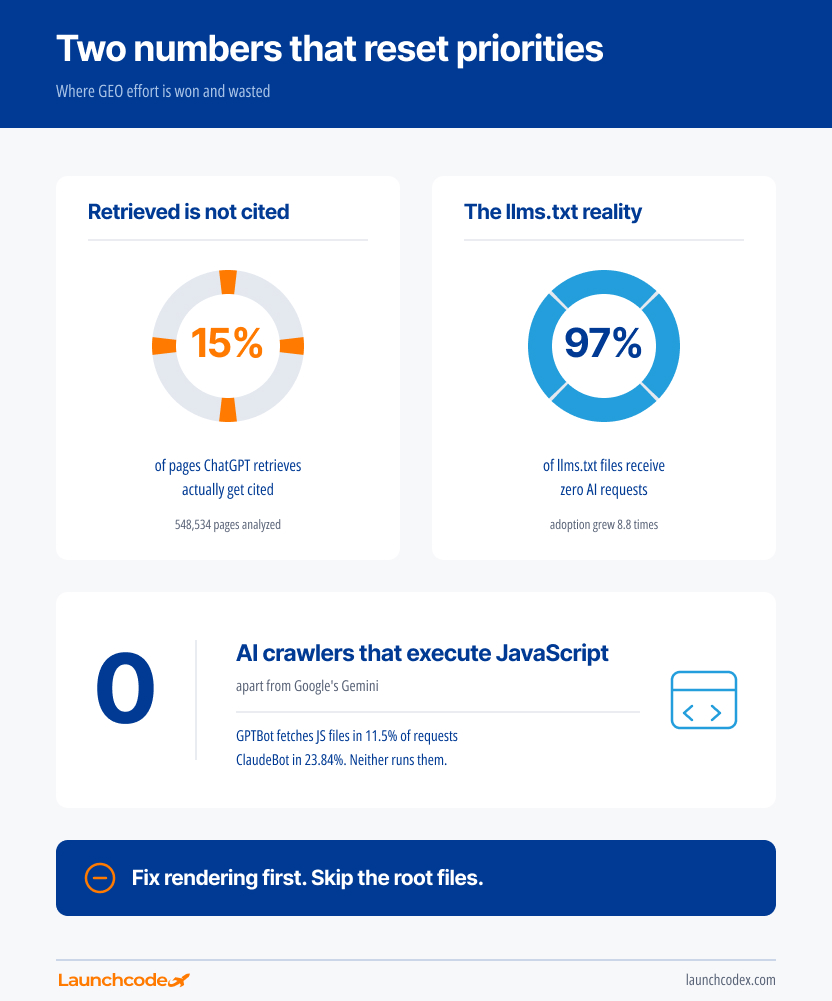
An AirOps analysis of 548,534 retrieved pages across 15,000 prompts, covered in this breakdown of ChatGPT search optimization, found ChatGPT cited only 15% of the pages it pulled in. The other 85% were evaluated and discarded.
There is a second reason to look past live retrieval. A Semrush analysis of 80 million queries, reported in this explanation of how ChatGPT search works, found only about 46% of queries trigger a web search at all. The rest come from training data, so third-party mentions of your brand across authoritative sources carry real weight.
"Bing verification is the cheapest win in this whole discipline. Ten minutes of setup, and we have seen sites go from zero ChatGPT citations to steady mentions within about three weeks." Derick Do, Co-Founder and Chief Product Officer
Perplexity runs a hybrid system. PerplexityBot builds the index behind cited answers, and Perplexity-User fetches pages live when someone asks a question. Retrieval happens per query rather than being banked like backlinks, so freshness and extractability get re-evaluated every time. Blocking the wrong crawler removes you from answers entirely.
Perplexity is the most architecturally distinct of the four. The crawler split is where most sites lose before content quality ever enters the picture.
Perplexity's crawler documentation lists both agents and publishes IP ranges for each, so you can verify traffic instead of trusting the user-agent string. Allow both. A web application firewall rule that blocks unfamiliar bots will disqualify you, and nobody on the marketing team will see it happen.
The payoff justifies the setup work. A Seer Interactive conversion benchmark put Perplexity-referred sessions at a 10.5% conversion rate against 1.76% for Google organic.
Gemini, AI Mode, and AI Overviews run on Google's index and use query fan-out, breaking one prompt into multiple parallel sub-queries and assembling one answer from many sources. Independent studies put AI Mode at roughly 5 to 11 sub-queries per prompt, with complex questions expanding past 20. Depth across a topic beats exact-match pages.
Google confirms the mechanic in its documentation on AI features and your website, describing multiple related searches issued across subtopics and data sources while a response is generated.
A page that covers a topic thoroughly gets pulled in for sub-queries you never targeted. That rewards one deep resource over several thin ones. Consensus across independent query fan-out research lands at 8 to 12 sub-queries for a typical AI Mode prompt, so a page answering only the headline question competes for a fraction of the retrieval events.
The obvious response to fan-out is to publish a page per variation. Google's guidance on optimizing for generative AI features says creating separate pages for every fan-out variation, mainly to influence rankings or AI responses, can violate its scaled content abuse policy. Fan-out rewards depth, not page count.
Google's own framing is worth keeping. Its documentation states that optimizing for generative AI search is optimizing for the search experience, and is therefore still SEO. Nikiya Griffith, Director of Organic Growth at BX Studio, gave the practitioner version in a review of Google's AI search guidelines: about 80% of the time, what is good for SEO is good for GEO.
Claude does not run its own retrieval index. When it searches, it sends a reformulated query to the Brave Search API and composes an answer from those results. Your Brave visibility therefore sets your Claude visibility, which is a different game from Bing or Google. Claude also answers many prompts without searching at all.
Anthropic confirms the Brave dependency in its documentation on Claude web search, noting that only the query string is transmitted to Brave. Claude earned a section here on volume, moving from fifth to second in measurable B2B AI referral share in eight months.
Anthropic runs three crawlers with separate jobs, and robots.txt controls them independently.
Block ClaudeBot to opt out of training and you stay eligible for citations, as long as Claude-SearchBot and Claude-User remain allowed. Blocking all three because one mentions training is common and costly. Search for your priority pages on search.brave.com before doing any Claude-specific content work, because nothing downstream matters if Brave has not indexed them.
Most AI crawlers cannot read JavaScript-rendered content. Vercel and MERJ found that no major AI crawler executes JavaScript. GPTBot fetched JavaScript files in about 11.5% of requests and ClaudeBot in about 23.84%, and neither executed them. Google's Gemini is the exception because it uses Googlebot's rendering infrastructure. A client-rendered page can rank on Google and read as an empty shell everywhere else.
This is the highest-leverage fix available, and no Google-based report will show it to you. At Launchcodex, rendering and crawler access get audited before any content work starts, because content quality cannot fix a page the crawler never read.
Fetch one of your key pages with JavaScript disabled and read what comes back. If the pricing table, feature grid, or body copy is missing, that is what GPTBot, PerplexityBot, and Claude-SearchBot see. The Vercel and MERJ crawler analysis is the reference dataset, drawn from real crawler traffic across their network. Server-side rendering or static generation fixes it.
"We ran a client's React pricing page through curl with no JavaScript. It returned an empty div. That page ranked page one on Google and had never been cited by any AI engine. Server-side rendering took one sprint." Derick Do, Co-Founder and Chief Product Officer
Two widely sold tactics have no evidence behind them. Google states you do not need llms.txt or AI-specific schema to appear in its AI features. Tracking shows 97% of llms.txt files receive zero AI requests. Structured data still earns rich results, but it is not an AI visibility lever.
Google's documentation is direct: there is no special schema.org structured data you need to add, and no new machine readable or AI text files are required.
John Mueller of Google settled the practical side plainly, writing that no AI system currently uses llms.txt. The usage data agrees. Reporting on llms.txt adoption growing 8.8 times found almost all of those files sit untouched by AI requests.
Duane Forrester, former Bing senior product manager, made the structural argument in his analysis of llms.txt as a proposed standard: a root-file standard without established trust is a liability, because every successful web standard answers the question of who owns the rules.
The file costs almost nothing to publish. Just do not let it displace the rendering and crawler work that has measurable effect.
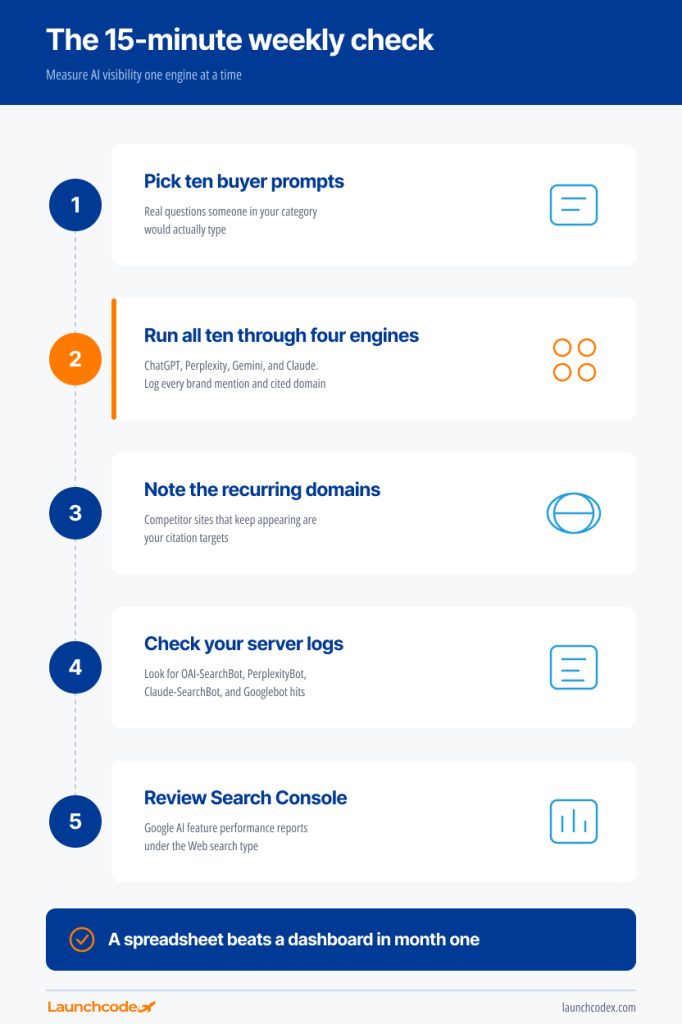
Split your reporting by engine or you will not see where the gap is. Run the same prompt set through ChatGPT, Perplexity, Gemini, and Claude on a fixed schedule, log whether your brand appears and which sources get cited instead, and check server logs for each retrieval crawler. This costs nothing and takes about fifteen minutes a week.
Most teams still report AI traffic as one line in GA4, which hides the exact divergence the overlap studies document.
"Ten prompts a week in a Google Sheet beats any dashboard you buy in month one. You find out fast which engine is your actual gap, and then you know where the budget goes." Tanner Medina, Co-Founder and Chief Growth Officer
Treat the citation overlap figures as a range rather than one number. The studies use different prompt sets and methods, which is why estimates run from 2.7% to 17% depending on how many engines are compared.
The engines read different webs, and every independent study available says the same thing. ChatGPT needs Bing. Perplexity needs both crawlers allowed and answers front-loaded. Gemini needs depth across sub-questions rather than a page per keyword. Claude needs Brave visibility. All four need HTML a crawler can read without a JavaScript runtime.
Start with the technical layer, because it is fast and it lifts all four surfaces at once. Fetch three key pages with JavaScript disabled, audit robots.txt against the crawler list above, and verify your site in Bing Webmaster Tools. Then run the ten-prompt check to find where your gap sits before committing to content work. If you want a structured audit of that stack, our team runs this order inside our SEO and GEO engagements.
Retrieval behavior was verified in July 2026. Crawler names and vendor guidance change often, so confirm current user agents in each vendor's documentation before you edit robots.txt.
ChatGPT Search retrieves primarily from Bing's index, supplemented by OpenAI's own crawlers. Independent testing suggests Google results appear for some account tiers, but Bing indexing remains the reliable prerequisite.
No. Google says no AI text files are required, and tracking found 97% of published llms.txt files receive zero AI requests. Spend the time on server-side rendering instead.
For citations, allow OAI-SearchBot, ChatGPT-User, PerplexityBot, Perplexity-User, Claude-SearchBot, Claude-User, and Googlebot. You can still block training crawlers like GPTBot and ClaudeBot separately.
Not reliably. The engines share only a small fraction of cited sources, and ChatGPT reads Bing rather than Google. Strong Google rankings with weak Bing presence produce poor ChatGPT visibility.
Not directly. Google states there is no special schema.org markup for AI features. Keep structured data in place for rich results, but do not treat it as an AI visibility tactic.




Generative engine optimization (GEO), sometimes called AI SEO, works differently on each engine. Here's how retrieval works ...
OpenSEO is an open-source SEO platform built for AI agents. See how its MCP server works with Claude Code, what AI visibilit...
See the 10 best WordPress SEO plugins with real AI automation. Compare features and pricing, then build a stack that ranks a...