


How to build an automated patient reactivation system for your dental practice
Build a dental patient reactivation system that runs on its own. Segment lapsed patients, automate compliant outreach, and r...





Most dental practices sit on hundreds of patients who stopped coming back. The hygiene schedule has gaps, the front desk runs out of time to call, and the production those patients represent goes uncollected. Manual recall rarely gets done consistently, so the list keeps growing.
This guide shows you how to build a reactivation system that runs on its own. You will learn how to define and segment inactive patients, connect the outreach to your practice management software, design a sequence that books appointments, stay inside HIPAA and TCPA rules, and measure the revenue you recover. The goal is a system you own, not a one-time campaign.
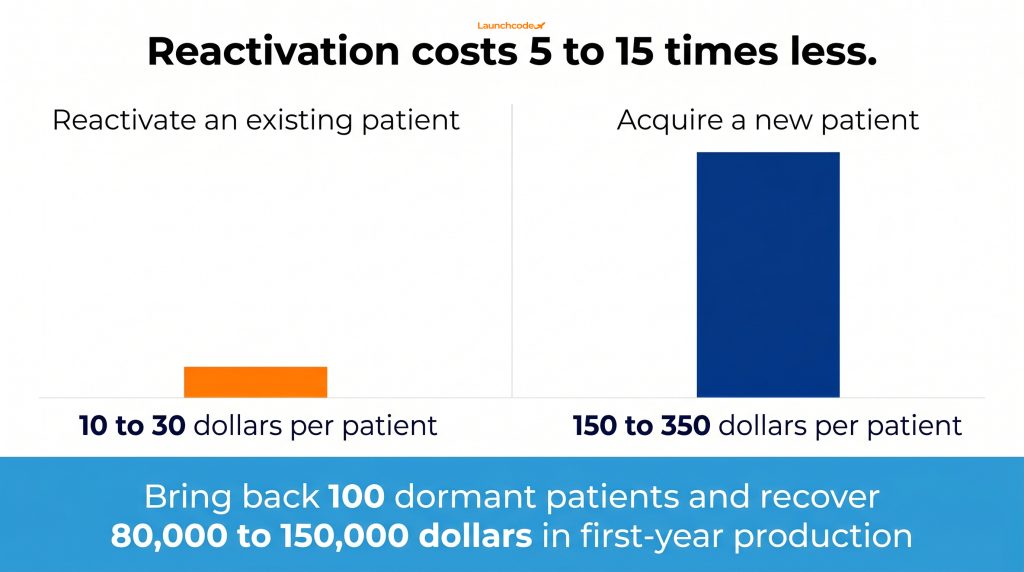
Reactivating an existing patient costs about 10 to 30 dollars, roughly 5 to 15 times less than acquiring a new one. The relationship, the chart, and the trust already exist. Bring back 100 dormant patients and you can recover 80,000 to 150,000 dollars in first-year production from hygiene visits and the treatment those visits surface.
Ready to grow your organic traffic?
Get a free SEO audit from the Launchcodex team.
New patient acquisition for general dentistry runs about 150 to 350 dollars per patient, according to Dentplicity acquisition benchmarks. Reactivation outreach sits far below that, as the Ainora reactivation data shows. You are reaching people who have already chosen your practice once.
"The 6 to 12 month lapsed segment returns the fastest cash in almost every account we run. A clean four-touch sequence rebooks more than 20 percent of that group inside a month." Tanner Medina, Co-Founder and Chief Growth Officer
The average practice retains 70 to 80 percent of patients year over year, and top performers reach 85 to 90 percent. Ainora retention figures put each 1 percent retention gain at roughly 500 to 1,000 dollars in lifetime value per patient. Small, steady recovery beats occasional pushes.
Through the third quarter of 2025, the ADA Health Policy Institute reported that practice busyness was down and new patient wait times hit their lowest point on record, even as dental spending rose. The ADA called it a "holding pattern." When fewer new patients walk in, the patients already in your database become a more reliable source of growth.
Set clear status thresholds before you build anything. A patient past their recall interval with no future appointment is overdue. At 6 to 12 months with no visit, treat them as inactive. For the past 18 months, treat them as dormant. These windows decide who enters the system and which message they get.
Most practices use vague or outdated definitions, which breaks every step that follows. Dr. Roger P. Levin of Levin Group pushes practices further, defining reactivation as scheduling "any patient who does not have their next appointment," as he told Dentistry IQ. The earlier you flag a gap, the cheaper it is to fix.
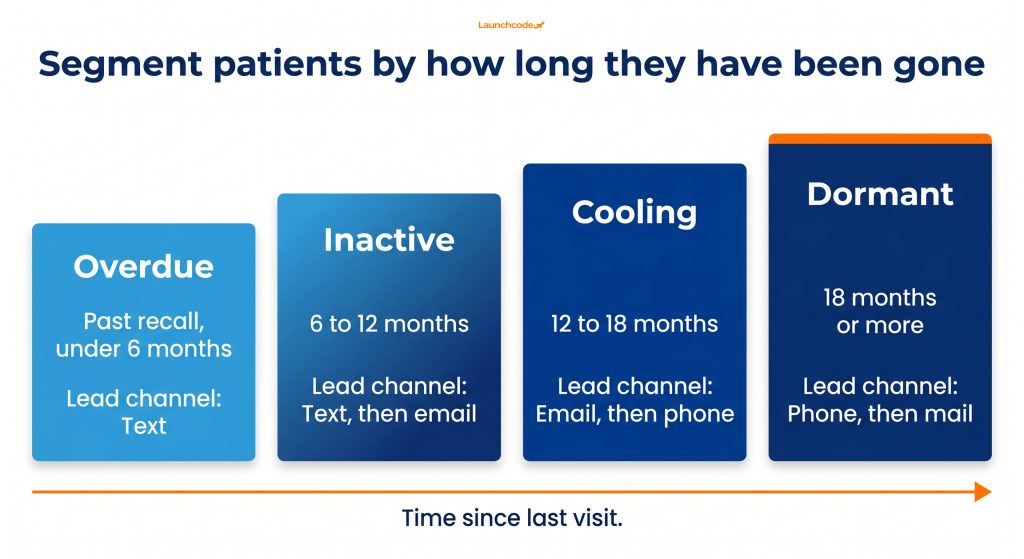
Group patients by how long they have been gone and by what they last needed. The message changes with the segment.
| Segment | Time since last visit | Best lead channel | Message focus |
|---|---|---|---|
| Overdue | Past recall, under 6 months | Text | Friendly nudge, easy booking link |
| Inactive | 6 to 12 months | Text, then email | We saved your spot, time for a cleaning |
| Cooling | 12 to 18 months | Email, then phone | Personal note, outstanding treatment |
| Dormant | 18 months or more | Phone, then mail | Direct outreach, reason to return |
Layer in treatment history. A patient with an unfinished treatment plan needs a different message than one who only ever came for cleanings.
Build the system in five stages: fix rebooking at checkout, connect outreach to your practice management software, segment the patient list, run a sequenced multi-channel campaign, and report recovered production. Each stage feeds the next. Skip the checkout stage, and you pay to reactivate patients who should never have lapsed.
Here is the build order that holds up in real practice.
The cheapest reactivation is the one you never need. One ByteCAT analysis found that improving checkout pre-scheduling cut a group's dormant patient pool by 40 percent in six months. Train the team to book the next hygiene visit before the patient leaves the chair. That shrinks the list your system has to chase.
The system only scales when it reads and writes to your schedule and patient record in real time. Dentrix, Eaglesoft, and Open Dental all support third-party integrations, with Open Dental known for its open architecture. The test for any vendor is direct: can the tool see appointment history and write a booking back into the schedule without manual exports? At Launchcodex, we build this kind of automation around the software a practice already runs, so patients enter the sequence the moment they cross a threshold and exit it the moment they book.
"The make-or-break test is whether the tool writes a booking straight back into Dentrix or Open Dental. If it cannot, the front desk falls back to manual exports and the system dies within a month." Derick Do, Co-Founder and Chief Product Officer
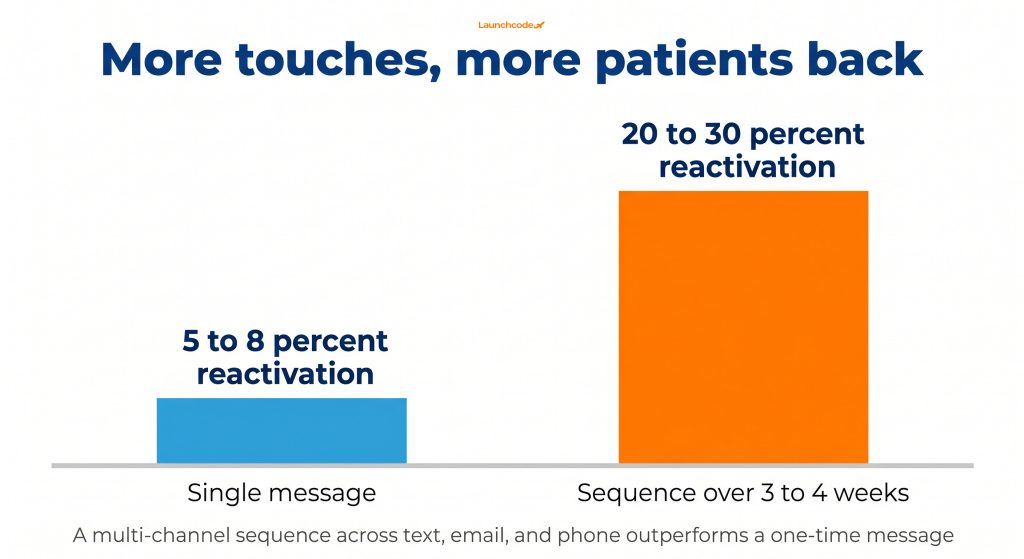
A multi-touch sequence over 3 to 4 weeks reaches 20 to 30 percent reactivation, compared with 5 to 8 percent for a single message. Lead with text because it reaches and gets read. Follow with email for context. Escalate to a phone call for non-responders, especially patients gone 12 months or more. Raise urgency as the sequence runs.
Text earns its place at the front. Viva reactivation data shows text reaches more than 95 percent of patients with open rates around 90 to 98 percent, while postcards draw only 2 to 5 percent, and generic text blasts draw 8 to 12 percent. The lift comes from personalization and sequence, not the channel by itself.
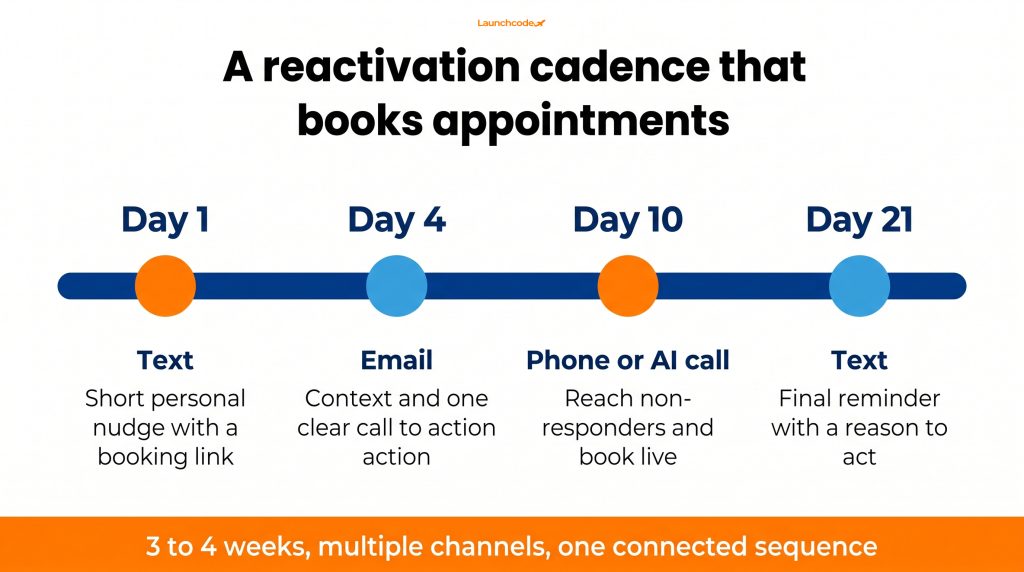
| Day | Channel | Purpose |
|---|---|---|
| Day 1 | Text | Short, personal nudge with a direct booking link |
| Day 4 | Context, reason to return, one clear call to action | |
| Day 10 | Phone or AI call | Reach non-responders, answer questions, and book live |
| Day 21 | Text | Final reminder with a time-bound reason to act |
Keep names and clinical details out of the message body. Avoid promotional wording that pushes a reminder out of healthcare territory. Do not over-message, since frequency caps apply. Personalize by segment so a dormant patient does not get the same text as someone two weeks overdue.
Text reminders are not automatically legal. The HIPAA Privacy Rule permits appointment reminders, but standard texting is not secure by default, and texting law requires consent. You need patient consent to text, a working opt-out, and a signed Business Associate Agreement with any vendor that handles patient data. Treat compliance as part of the build, not an add-on.
The HIPAA Journal states plainly that "SMS text messages are not HIPAA compliant" on their own, which means you obtain written consent for the channel and sign an agreement with the messaging vendor. Under the TCPA, you must get consent before texting and honor the Text STOP opt-out, as Demandforce explains.
A reminder qualifies for the healthcare exemption only when it is "intended to improve patient health outcomes rather than serve a marketing purpose," per the law firm Manatt, Phelps and Phillips. A care reminder reads differently from a discount offer. This section is general guidance, so confirm specifics with your own counsel.
Automate the repeatable outreach and keep human follow-up for high-value, long-inactive patients. A hybrid where AI handles first contact and staff call the non-responders reached 19 percent reactivation, versus 15 percent for automation alone. Automation scales the volume. The human touch closes the patients who need a real conversation.
That hybrid result comes from the same ByteCAT analysis, where the extra 4 percent added up to 2.85 million dollars of recovered production across 950 patients over a year. Pure manual outreach cannot keep pace, since staff can only call 15 to 25 patients an hour.
| Model | Who it fits | Key strength | Watch out for |
|---|---|---|---|
| Manual only | Very small practices | No new tools | Stops when staff get busy, low reach |
| Fully automated | Practices with large dormant lists | Scales, consistent, low-cost per patient | Misses patients who need a conversation |
| Hybrid | Most practices and groups | High reach plus human close on key patients | Needs clear handoff rules between system and staff |
Track reactivation rate as patients who rebook divided by patients contacted, times 100. Track recovered production as the dollars billed from reactivated patients. Report both monthly. A well-built sequence reaches 20 to 30 percent reactivation, and the math usually covers the system many times over in the first quarter.
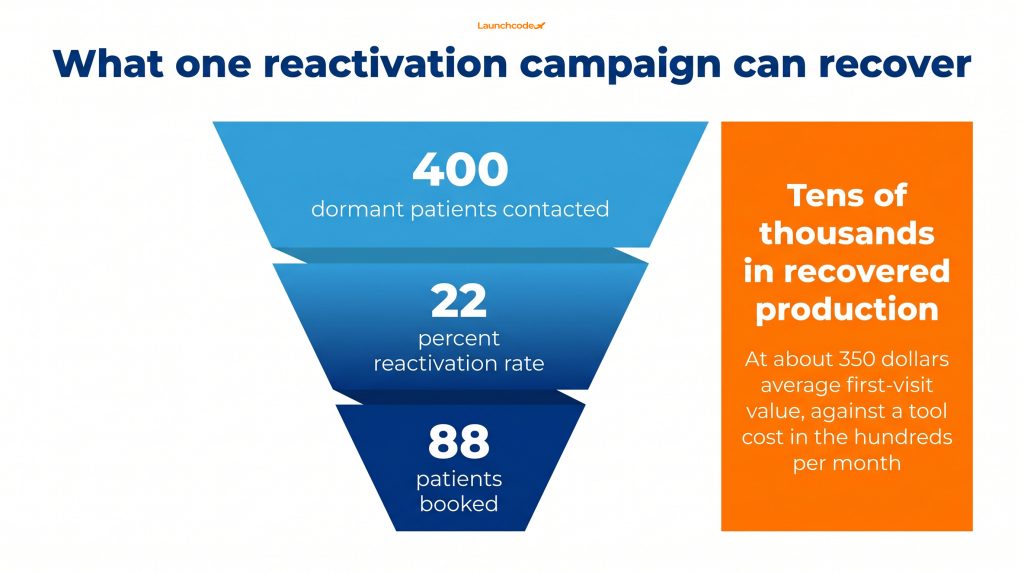
Run a worked example. Contact 400 dormant patients, reactivate 22 percent, and you book 88 patients. At an average first-visit value of 350 dollars plus the treatment, those visits surface, you recover tens of thousands of dollars against a tool cost in the hundreds per month. The leading indicator to watch upstream is your hygiene reappointment rate, the share of patients who rebook before leaving.
"We report two numbers to every client: reactivation rate and recovered production in dollars. Activity metrics like texts sent do not pay the bills, so we tie the system to billed treatment from day one." Tanner Medina, Co-Founder and Chief Growth Officer
Reporting only works when the data is clean and connected, which is why the data layer that ties outreach to revenue matters as much as the messages.
A reactivation system is not a January campaign. It is infrastructure. Fix rebooking at checkout first, connect outreach to your practice management software, segment by how long patients have been gone, run a 3 to 4 week multi-channel sequence, and keep human follow-up for the patients worth a call. Wrap the whole thing in consent and a signed vendor agreement so it stays compliant.
Start with one segment this month. Pull your patients who lapsed 6 to 12 months ago, build the four-touch sequence, and measure what you recover. Once the numbers are clear, expand to the rest of the database and let the system run.
Most practices treat 6 to 12 months without a visit and no future appointment as inactive, and 18 months or more as dormant. Set the threshold in your software so patients enter the reactivation sequence automatically.
Yes. Texting law requires consent before you message a patient, and you must honor a Text STOP opt-out. Capture consent in your intake forms and sign a Business Associate Agreement with your messaging vendor.
Plan for a sequence over 3 to 4 weeks. Single-touch outreach reaches only 5 to 8 percent, while a multi-channel sequence reaches 20 to 30 percent.
You can automate first contact and reminders. Long-inactive and high-value patients respond better when staff follow up by phone, which is why a hybrid model tends to outperform automation alone.
Track reactivation rate, patients rebooked divided by patients contacted, and recovered production in dollars. Report both monthly and compare against your baseline recall and hygiene reappointment rates.




Build a dental patient reactivation system that runs on its own. Segment lapsed patients, automate compliant outreach, and r...
Learn which Google Business Profile fields actually rank in 2026, which ones to skip, and how to win the map pack and AI sea...
Article 50 of the EU AI Act requires chatbot and AI content disclosure starting August 2026. Learn what it requires, who it ...