




The SEO MCP playbook: Unify your data and act on it
An SEO MCP connects Search Console, Semrush, and GA4 to an AI assistant. Learn how to unify your search data and turn it int...





Most SEO work still runs across three or more disconnected tools. You open Search Console for queries, Semrush for keyword difficulty, and Google Analytics for conversions, then export each one and combine the numbers by hand. The problem is not a shortage of data. The problem is that the data does not connect, so decisions get made on scattered exports that go stale the moment you download them.
This playbook fixes that. You will learn what an SEO MCP is, which sources you can connect today, and a five-step loop for turning unified data into changes you actually ship. You will also see how to handle security and how connected data supports generative engine optimization.
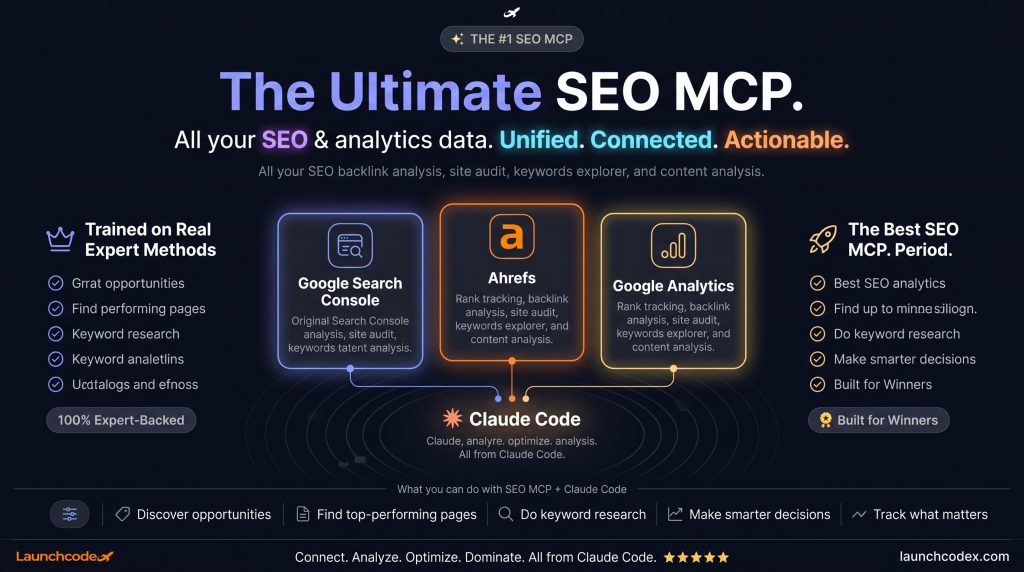
An SEO MCP is a connection built on the Model Context Protocol, an open standard that links an AI assistant to your SEO and analytics tools. Instead of exporting data from Search Console, Semrush, and Google Analytics, you ask questions in plain language and the assistant queries the live sources directly. The result is one workspace for search data that used to live in separate tabs.
Ready to grow your organic traffic?
Get a free SEO audit from the Launchcodex team.
The Model Context Protocol matters because it is not a single vendor feature. Anthropic introduced it in November 2024 as an open standard for connecting AI systems to data sources. Adoption moved fast. According to reporting compiled on Wikipedia, OpenAI and Google both adopted the protocol in 2025, and in December 2025 Anthropic donated it to the Agentic AI Foundation, a fund under the Linux Foundation co founded with Block and OpenAI.
MCP has three parts. A server exposes a data source, such as Search Console. A client is the AI application, such as Claude, that connects to servers. The protocol is the shared language between them. Commentators often describe MCP as a universal connector for AI, an analogy Ars Technica popularized as a "USB-C port for AI."
Before MCP, every tool needed its own custom integration. That work does not scale. Anthropic reported that running tools through MCP with code execution can cut context overhead by up to 98.7 percent when an agent handles many tools. For an SEO, that efficiency means you can query several sources in one session without hitting the usual limits.
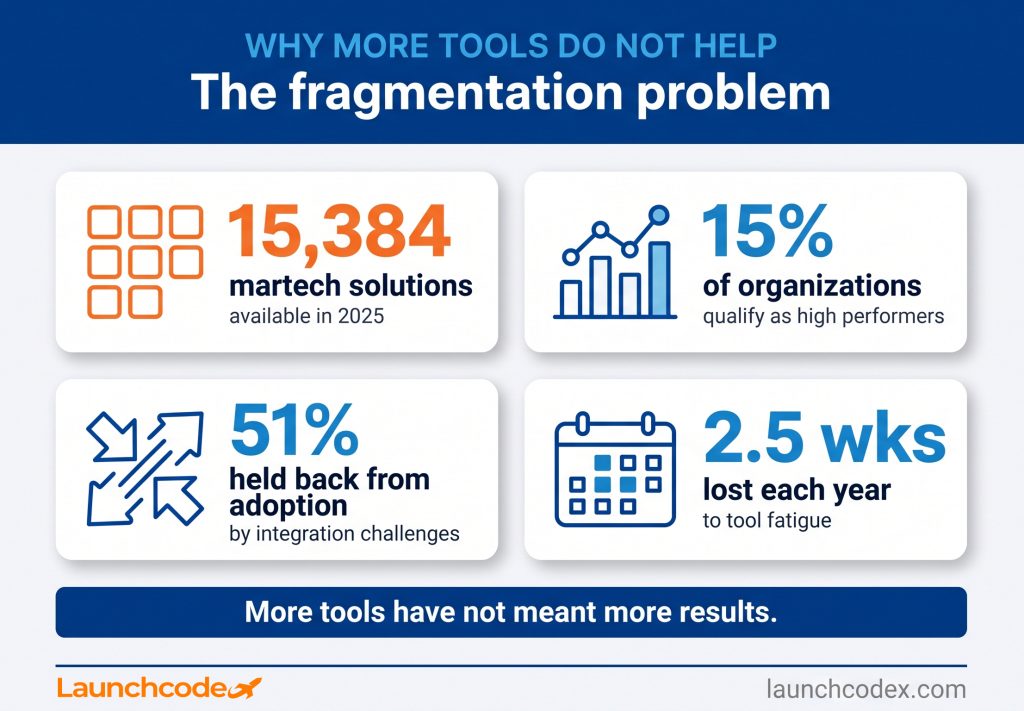
Fragmented tools cost hours before they cost rankings. Digital workers toggle between apps around 1,200 times a day, which adds up to nearly four hours each week just reorienting. For SEOs, that time goes to exporting, cross-referencing, and rebuilding context across Search Console, Semrush, and analytics, instead of deciding what to change on the site.
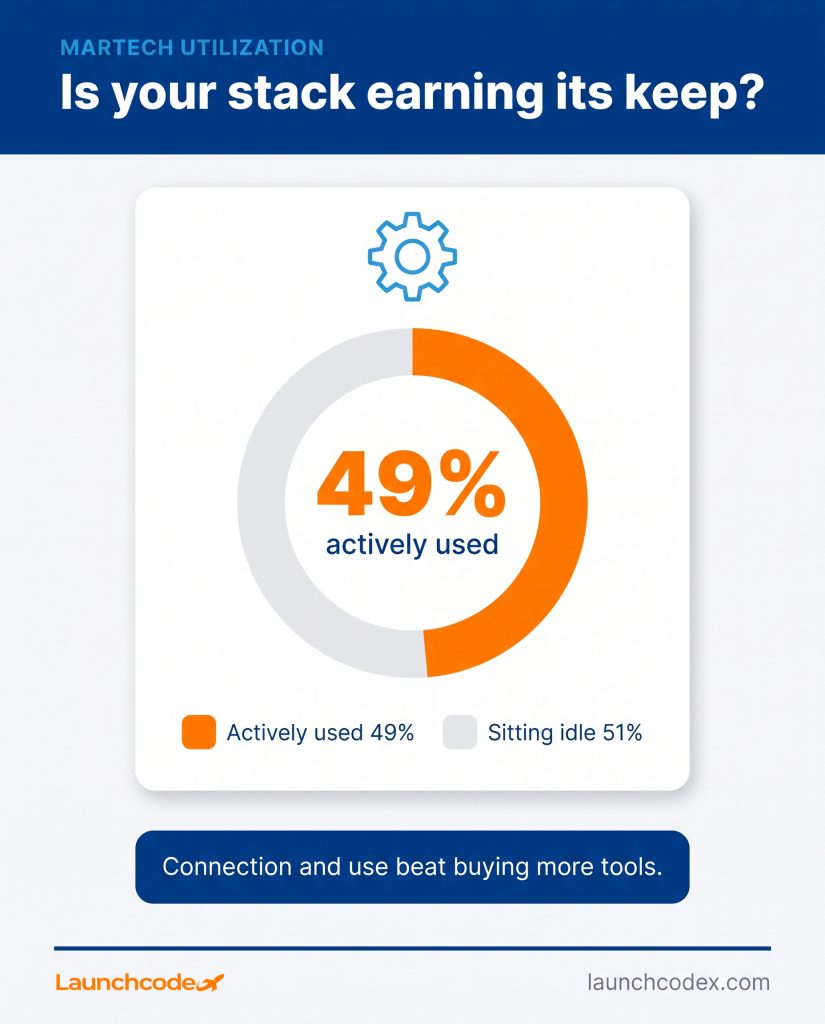
The scale of the problem is structural. The number of marketing technology tools reached 15,384 solutions in 2025, according to the State of Martech report by Scott Brinker and Frans Riemersma. More tools have not meant more results. Gartner found that only 49 percent of martech tools are actively used, and just 15 percent of organizations qualify as high performers.
Every switch carries a recovery cost. A study by Qatalog and Cornell University found it takes about 9.5 minutes to get back into a workflow after moving to a different app. Recent data from Lokalise puts app switching at 33 times a day on average, with 22 percent of workers losing two or more hours a week to tool fatigue, or 2.5 workweeks a year.
Marketers already know connection is the gap. In G2 survey data, 51 percent of marketers said integration challenges held back their adoption of new technology, and 29 percent ranked integration as the single most important factor when choosing a tool. An SEO MCP addresses that directly by making the data queryable in one place.
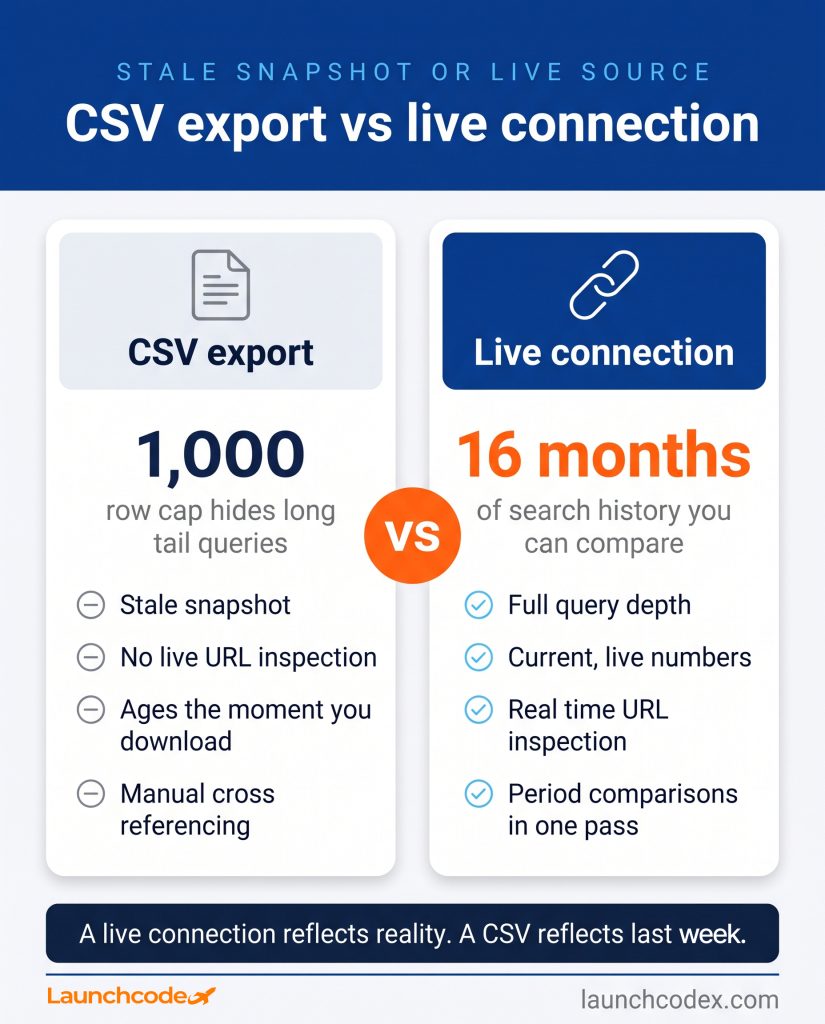
Uploading a CSV to an AI tool gives it a stale snapshot with hard limits. Connecting live data gives it a direct line to the source, with the full depth and current numbers. The difference decides whether your analysis reflects reality or a partial export from last week.
The Search Console interface caps manual exports at about 1,000 rows, which hides most long-tail queries on any large site. A live connection reads far more. Search Console also retains 16 months of search analytics data, so a connected assistant can compare periods and spot trends that a single export cannot show.
You can connect first-party and third-party sources right now. Google publishes an official MCP server for Google Analytics 4, Semrush and Ahrefs offer official servers for keyword and backlink data, and community servers cover Search Console and Bing Webmaster Tools. Most connect to Claude, Cursor, or any MCP-compatible client.
The practical choice depends on what you already pay for and what data you need. Google released an official GA4 MCP server, and first-party sources like Search Console give you your own numbers for free. Third-party indexes cost more. The Ahrefs server rides on paid plans that start around 129 dollars per month, and the Semrush server meters usage on API units.
| Source | What it provides | Who it fits | Watch out for |
|---|---|---|---|
| Google Search Console | Clicks, impressions, CTR, position, indexing | Every site owner | Community servers, not official |
| Google Analytics 4 | Traffic, engagement, conversions | Teams tying SEO to revenue | Official Google server |
| Semrush | Keyword research, competitive data | Keyword and market research | Metered on API units |
| Ahrefs | Backlink and keyword data | Link analysis | Paid plan required |
| DataForSEO | Raw SERP, keyword, backlink data | Developers, high volume | Billed per API call |
If you want first-party data end-to-end at no extra cost, start with Search Console and Google Analytics 4. Add one keyword and competitor source when you need difficulty scores and market data. This keeps setup small while covering both your own performance and the wider search picture.
Ahrefs took a different path from a standard MCP connection. In 2026 it launched Agent A, an AI marketing agent with direct access to Ahrefs data, running on a platform called Letaido. Instead of exposing data through the public API or MCP, Agent A uses the same endpoints as the Ahrefs interface, so it reads every metric, filter, and report the way a trained user would.
This matters for how you think about your stack. An SEO MCP connects a tool to your assistant through the open protocol. Agent A is closer to a managed agent that already owns its data source. Ahrefs states plainly that you could plug Claude into the Ahrefs API and hope it works, or use Agent A, which is wired to the full dataset. That dataset is large. Ahrefs reports more than 170 trillion pages in its web index, 41.9 billion keywords tracked, and 3.5 trillion external backlinks mapped.
Agent A runs marketing tasks end to end and delivers the output into tools you already use, such as Notion, Slack, Linear, and HubSpot. Its prebuilt skills map directly to the patterns in this playbook.
Letaido is the platform that Agent A runs on, built by the Ahrefs team. It gives each agent a dedicated, always on workspace that connects to your tools, runs scheduled jobs, stores files, and keeps working after you close the tab. Ahrefs founder Dmytro Gerasymenko frames the goal as letting people who know the business direct the work while the agent executes it. Letaido also ships security controls that match the concerns in the section above, including zero access by default, granular per workspace permissions, and full activity logs.
| Approach | How it accesses data | Best for | Watch out for |
|---|---|---|---|
| SEO MCP server | Open protocol links your assistant to each source | Teams who want to combine first party and third party data in one client | You configure and maintain the connections |
| Agent A on Letaido | Direct Ahrefs endpoints, plus integrations for your stack | Ahrefs users who want managed agents that ship finished work | Data access still follows your Ahrefs plan limits |
Agent A starts at 99 dollars per month, with native Ahrefs access at no extra API cost, though data access still follows your Ahrefs plan limits. If you already run Ahrefs, it is a fast way to put an agent on your data. If you want to combine sources like Search Console, GA4, and Semrush in one assistant, an SEO MCP setup still gives you the broader, tool agnostic view.
Connecting tools is only the first step. The value comes from a repeatable loop that moves from a question to a shipped change to a measured result. Run this loop weekly and the assistant becomes an analyst that works from your live data, not a chatbot that guesses.
At Launchcodex, this loop is the structure the team uses to run SEO analysis through a connected assistant, because it ties strategy directly to what gets built and shipped.
"We tie every connected session to one change. A single title tag rewrite on a page sitting at position 12 often returns more than a month of scattered reporting." Tanner Medina, Co-Founder and Chief Growth Officer
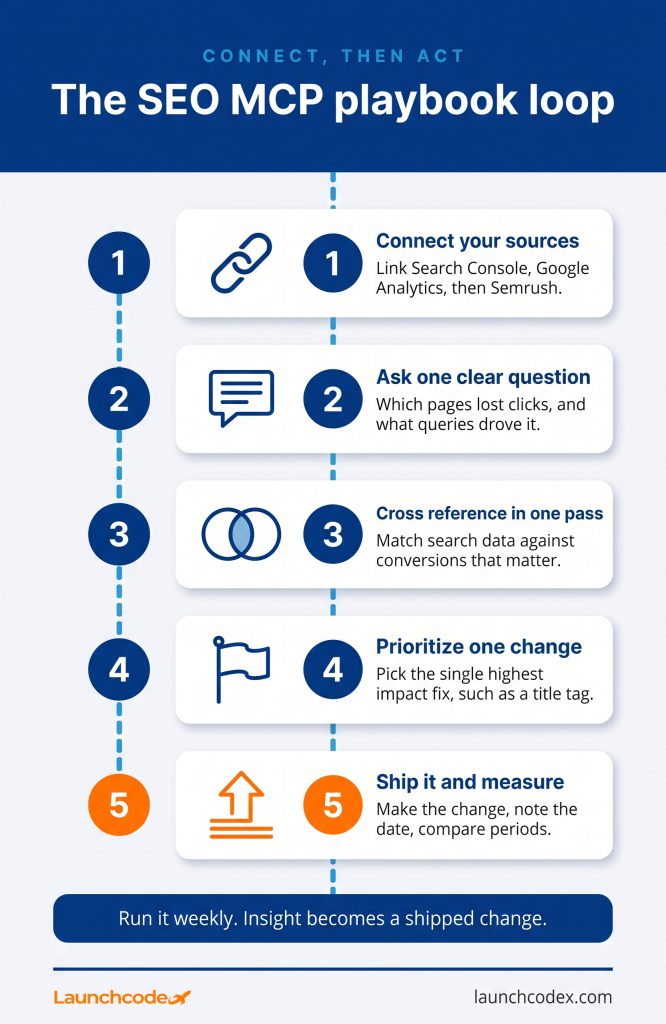
The most common mistake is stopping at step two. Teams ask a question, read an interesting answer, and never ship a change. An insight that does not lead to a decision is just a nicer-looking report. Tie every session to one prioritized action.
Unified data pays off when it points to a specific move. The strongest opportunities appear when you compare tools in one place, which is exactly what a single connected session does. Two patterns produce fast wins, and both need data from more than one source to spot.
Striking distance keywords rank just off page one, usually positions 8 to 20, with real impression volume. These are the cheapest wins in SEO because small changes move them. A connected assistant finds them in one query, then cross-references conversions so you fix the pages that matter to the business first. For example, a page sitting at position 12 with high impressions and a weak title tag is a clear candidate for a rewrite.
Keyword cannibalization happens when two pages compete for the same query and split their ranking signals. It is hard to see in a single export and easy to see when the assistant reviews query and page data together. The fix is usually a merge or a clear internal link that tells Google which page should rank. Our SEO and GEO services rely on exactly this kind of cross-source analysis to resolve competing pages.
AI speeds up the analysis, but the judgment stays human. As SEOptimer notes, insights an assistant generates should still be reviewed by an SEO professional, because a model can misread data or oversimplify a recommendation. Treat the output as a fast first draft of the analysis, not the final call.
Connecting live business data to an AI assistant is safe when you scope it well, but the risks are real and worth naming. In April 2025, security researchers documented weaknesses in MCP, including prompt injection and poisoned tools that could allow data exfiltration. Tight permissions and read-only access reduce that exposure.
The protocol includes safeguards. MCP supports OAuth-based permissioning, so you approve exactly what a server can access. Many SEO servers default to read-only, which means the assistant can analyze your data but cannot change settings or submit URLs. That boundary matters when you connect client accounts.
"When we connect a client's Search Console, we scope the OAuth permissions to read-only. The assistant reads the data. It never changes a setting." Derick Do, Co-Founder and Chief Product Officer
The risks documented on Wikipedia are a reason to configure carefully, not a reason to avoid the workflow. The same governance that now sits with the Agentic AI Foundation is pushing the standard toward safer defaults.
Generative engine optimization, or GEO, means optimizing content to appear in AI-generated search answers. Connected SEO data feeds it directly. The same query, page, and intent data that shapes your rankings also tells you which topics AI systems associate with your site, so you can strengthen the pages most likely to be cited.
The link between the two is practical. When you analyze which queries bring impressions but weak rankings, you are finding the topics search systems already connect to your site. Those are the pages to deepen and structure clearly, because well-structured, entity-rich content is what both search engines and AI overviews extract. This is where SEO and GEO stop being separate projects and become one workflow, which is a core part of how Launchcodex approaches AI automation and search.
"Every query with impressions but a weak ranking is a topic Google already ties to your site. Those are the pages we deepen first when we optimize for AI answers." Tanner Medina, Co-Founder and Chief Growth Officer
Run the five-step loop with GEO in mind, and each session produces two outputs. You get the ranking fix, and you get a clearer view of the topics where an AI answer might cite you. You do not need a separate GEO process. You need the same connected data read through a second lens.
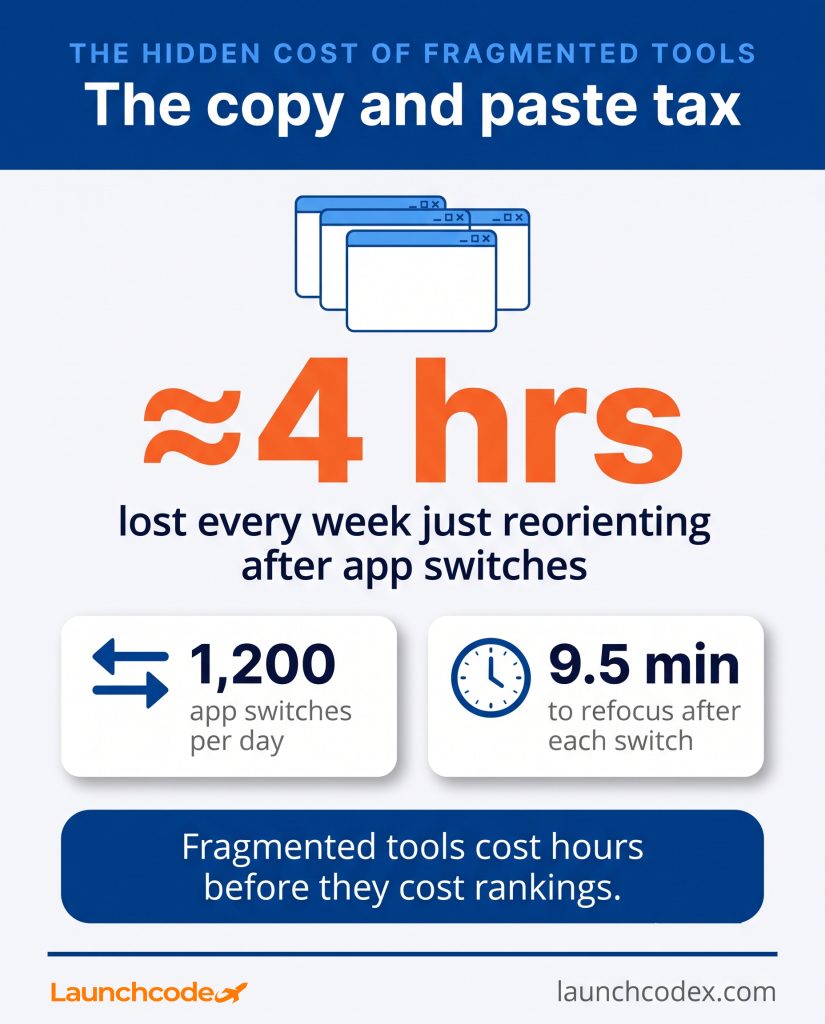
An SEO MCP removes the manual copy and paste work that consumes nearly four hours of every work week, but the connection alone changes nothing. The teams that win run the loop: connect the sources, ask one clear question, cross-reference against conversions, ship one prioritized change, and measure the result. Do that weekly and your search data starts driving decisions instead of filling reports.
Start small. Connect Search Console and Google Analytics, run one striking distance analysis, and ship a single title tag rewrite. Note the date, compare the next period, and let the result decide your next move. For a deeper look at connecting SEO and GEO into one system, see our guide to generative engine optimization.
It is a connection that lets an AI assistant read your SEO and analytics tools directly through the Model Context Protocol, so you ask questions in plain English instead of exporting and comparing files by hand.
Yes. Google publishes an official GA4 MCP server, and Semrush offers an official server that meters usage on API units. Both work with Claude and other MCP-compatible clients.
A CSV is a stale snapshot capped at about 1,000 rows in Search Console. A live connection reads far more data, stays current, and lets the assistant inspect URLs and compare periods across a 16-month window.
It can be, with care. Use OAuth permissions to scope access tightly, prefer read-only servers, and choose maintained servers. Researchers have documented risks like prompt injection, so configuration matters.
Yes. The same query and intent data that improves rankings also shows which topics AI systems link to your site, so you can strengthen the pages most likely to be cited in AI-generated answers.




An SEO MCP connects Search Console, Semrush, and GA4 to an AI assistant. Learn how to unify your search data and turn it int...
Learn how to connect your signal, data, outreach, and revenue tools to Claude through APIs, with a seven-layer map, waterfal...
SEO is not dead in 2026, its job changed. See the zero-click data, what still converts, and how to get your brand cited by A...