
Share:

AI marketing & automation


Most revenue teams do not have a tools problem. They have a connection problem. The average B2B sales team runs 10 to 15 different tools, and someone on the team spends their day copying data between them. Signals die in the tool that captured them. Contacts get enriched in one app and never reach the sequence. The stack looks impressive on paper and leaks pipeline in practice.
This article shows how to wire those tools into Claude through APIs so the whole go-to-market motion runs as one connected engine. You will get a vendor-neutral explanation of how the connection works, a seven-layer map of the stack, the data that proves connection beats collection, a staged build plan, and an honest look at where this approach breaks.
A GTM engine is a connected system where Claude calls your tools through their APIs and runs the full go-to-market motion, from detecting a buying signal to booking a meeting to tracking revenue. Instead of a person moving data between apps, Claude reads each tool, reasons across the results, and triggers the next action. The tools stay the same. The orchestration is new.
The shift here is from automation to orchestration. A workflow tool moves data from point A to point B on a fixed path. An orchestration layer decides what happens next based on what the data says. That difference matters because most GTM decisions are judgment calls, not routing rules.
“The moment that changed things for us was watching Claude decide, not just move data. It reads a funding signal and a hiring spike together and treats them as one trigger. A Zapier flow cannot do that.” Derick Do, Co-Founder and Chief Product Officer
Claude connects to external tools through the Model Context Protocol, an open standard Anthropic introduced in November 2024. MCP works like a universal port. Rather than building a custom integration for every tool pairing, you connect each tool once through the protocol and Claude can call it. Since launch, the community has built thousands of MCP servers, and the official SDKs now see more than 97 million monthly downloads, according to Anthropic’s engineering team.
The practical result is that Claude can query Apollo for contacts, run them through Prospeo, push the survivors into Instantly, and log everything to your CRM, all in one session. No copy-paste. No tab switching.
MCP is no longer a single-vendor bet. In December 2025, Anthropic donated the protocol to the Agentic AI Foundation under the Linux Foundation, co-founded with Block and OpenAI and backed by Google, Microsoft, AWS, Cloudflare, and Bloomberg. That matters for anyone deciding whether to build on it. A neutral, industry-backed standard carries far less risk than a proprietary integration layer that one company controls.
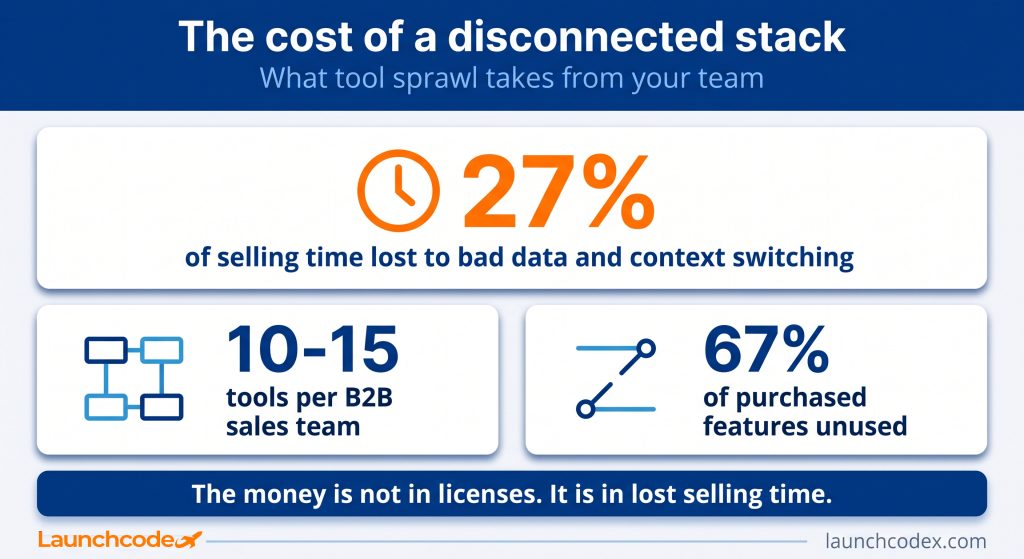
A disconnected stack costs you selling time, data accuracy, and pipeline. Bad data and context switching waste about 27% of a sales rep’s selling time. Teams run 10 to 15 tools where 67% of purchased features go unused. The money is not in the license fees. It is in the hours lost to being the human glue between systems that never talk.
Fragmentation does not announce itself. It builds one purchase at a time. A team hits a pain point, buys a tool, and the tool sits in its own silo. Repeat that eight times, and you have a stack where no single system holds the full picture.
The hidden costs usually beat the license line item. Getcleed’s analysis found the average B2B team runs 10 to 15 tools with two-thirds of features untouched. SyncGTM’s benchmark data puts a sharper number on the daily damage. Every tool switch burns 15 to 25 minutes of focus, and a rep on 10 tools makes 20 to 30 switches a day. That is hours of selling time lost to tab management.
The composite signal problem is worse. The most valuable insight often lives at the intersection of three signals: a pricing-page visit, a new RevOps job posting, and a champion who just changed companies. No single tool surfaces that picture, and nobody cross-references three dashboards by hand.
“When we audit a client’s stack, the wasted spend is rarely the real cost. It is the 27% of selling time gone to copy-paste. Connect the tools and reps get that time back for actual conversations.” Tanner Medina, Co-Founder and Chief Growth Officer
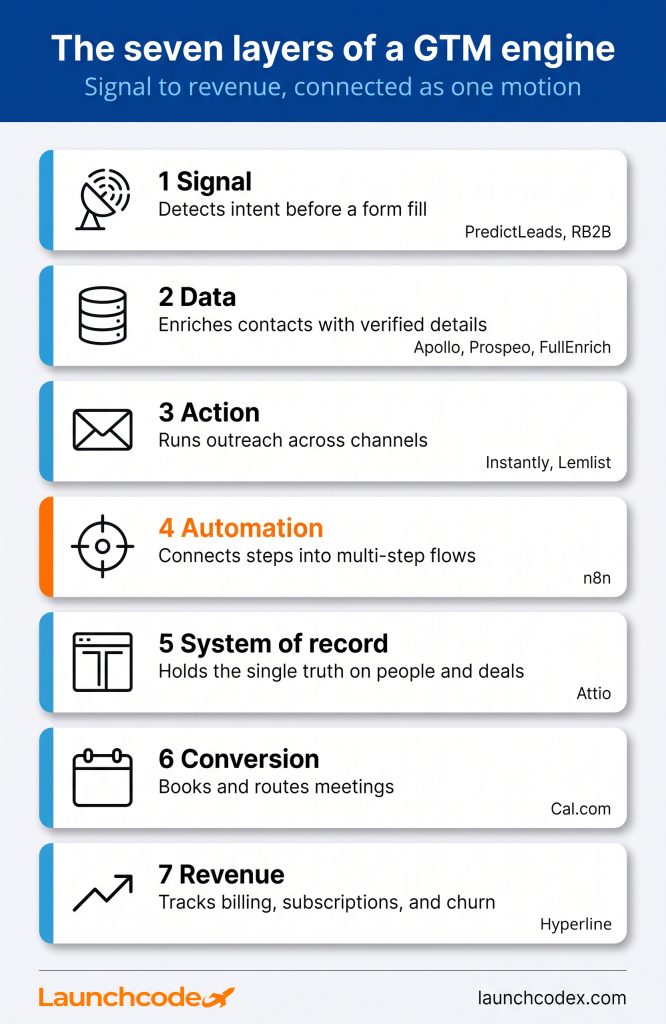
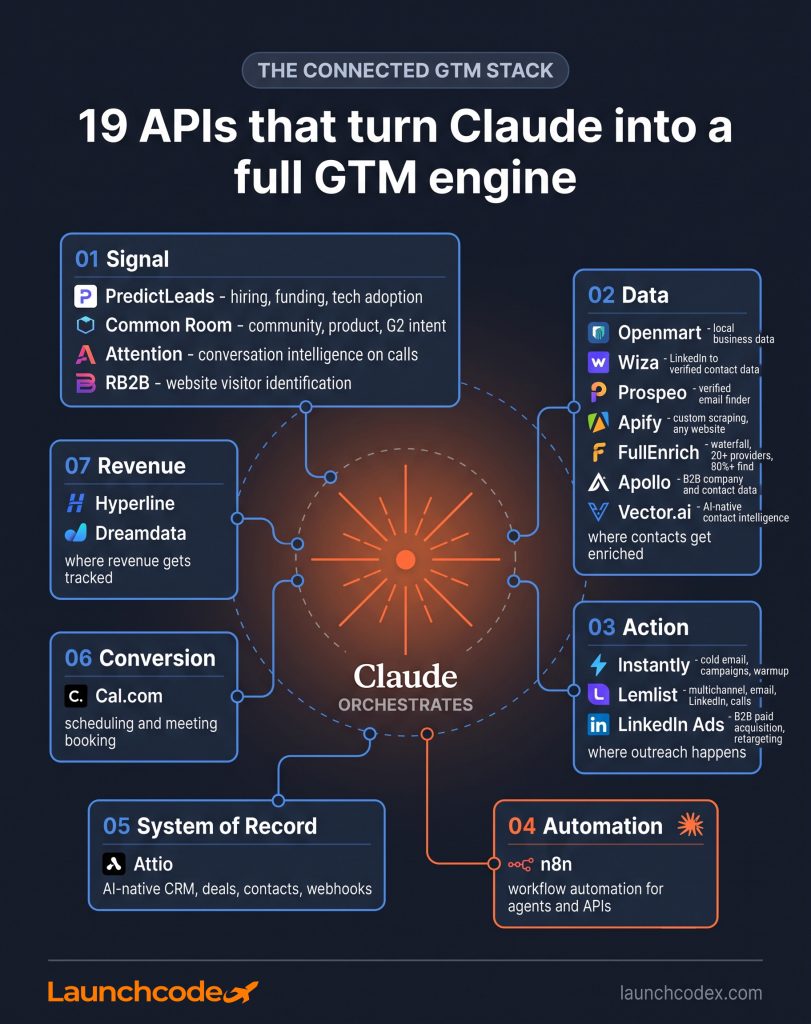
A full GTM engine spans seven layers: signal, data, action, automation, system of record, conversion, and revenue. Each layer hands off to the next. Signals trigger enrichment, enrichment feeds outreach, outreach books meetings, and meetings become tracked revenue. Claude sits in the middle, reading each layer and deciding what happens next.
This layer model turns a list of 19 tools into a system you can reason about and build in stages. It also shows why the connection matters more than any single tool. A great signal is worthless if it never reaches your outreach layer. This kind of full-funnel architecture is exactly what B2B SaaS teams need when demand generation and sales operations have to run as one motion.
| Layer | What it does | Example tools |
|---|---|---|
| Signal | Detects intent before a form fill | PredictLeads, Common Room, Attention, RB2B |
| Data | Enriches contacts with verified details | Apollo, Prospeo, Wiza, FullEnrich, Openmart |
| Action | Runs outreach across channels | Instantly, Lemlist, LinkedIn Ads |
| Automation | Connects steps into multi-step flows | n8n |
| System of record | Holds the single truth on people and deals | Attio |
| Conversion | Books and routes meetings | Cal.com |
| Revenue | Tracks billing, subscriptions, and churn | Hyperline |
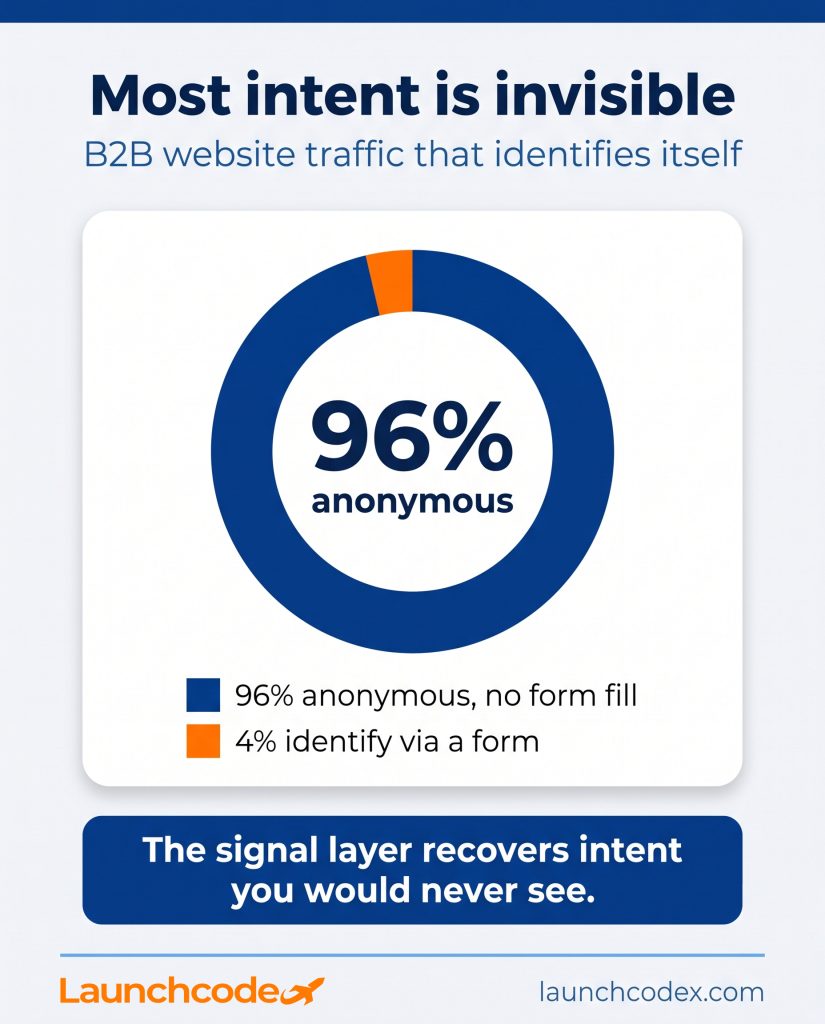
Signals are the trigger for the whole engine, and most intent is invisible without them. Only about 4% of B2B website traffic identifies itself through a form, which leaves roughly 96% of visitors anonymous, per Factors.ai. Visitor identification tools recover some of that intent. A person already on your pricing page is warmer than any cold list you can buy.
Be honest about the limits here. Person-level identification tools like RB2B match roughly 10 to 20% of US traffic and do not work in the EU, while account-level tools reach 25 to 40%, according to a detailed RB2B review by Derrick. Person-level data also carries higher privacy obligations, so treat it as one input, not the whole strategy.
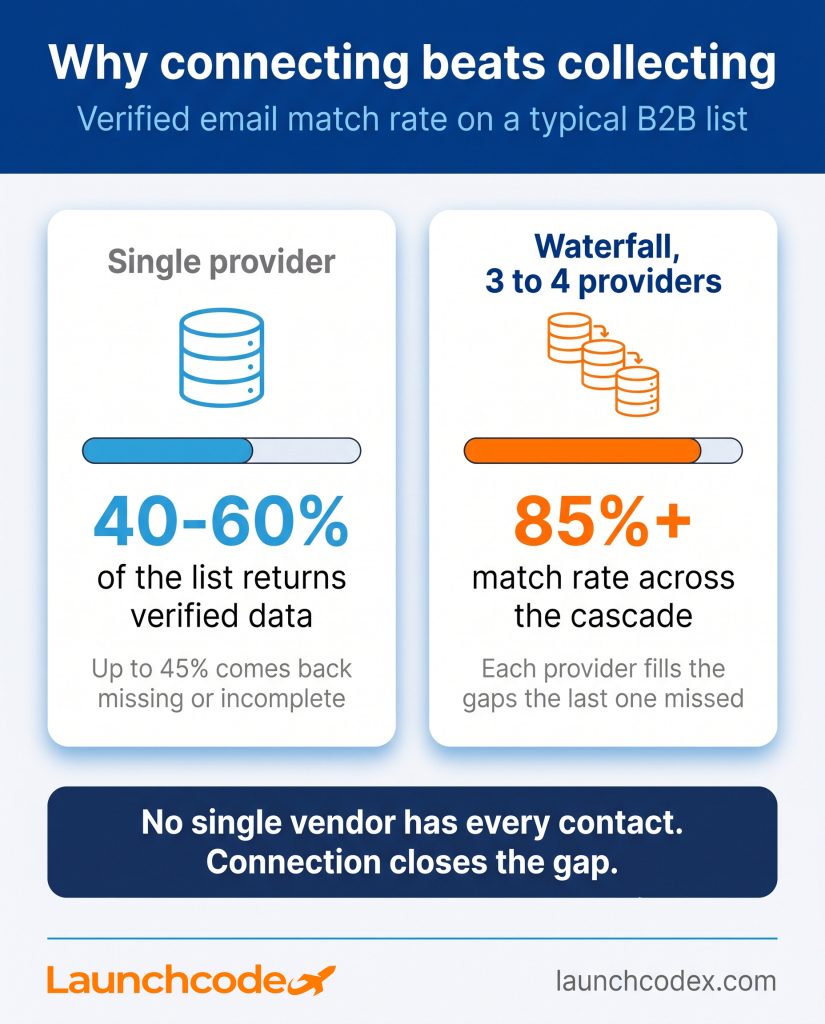
Connecting APIs beats buying more tools because coverage lives across many databases, not inside one. A single enrichment provider returns verified data for only 40 to 60% of a typical list. A waterfall that cascades through three or four providers lifts match rates above 80 to 85%. The gain does not come from a better tool. It comes from connecting several and letting Claude cascade through them.
This is the clearest proof of the whole thesis. No single vendor has every contact. When you connect several through one motion, you capture the contacts each one misses.
Unify’s benchmark data shows single-source match rates near 60% climbing above 85% across a three-to-four-provider waterfall. Michel Lieben of ColdIQ describes the same pattern in practice. His team starts with the largest database, then cascades to providers that fill the gaps, because no single provider hits 100% coverage.
A one-time enrichment guarantees decay. B2B databases lose about 30% of their accuracy a year as people change roles and companies move, which Amplemarket’s testing confirms. A record that was accurate in January can bounce by June. When enrichment runs inside a connected system, Claude can refresh contacts on a schedule instead of trusting a stale export. This is where a strong data infrastructure setup earns its keep, since clean, current data is the fuel every other layer runs on.
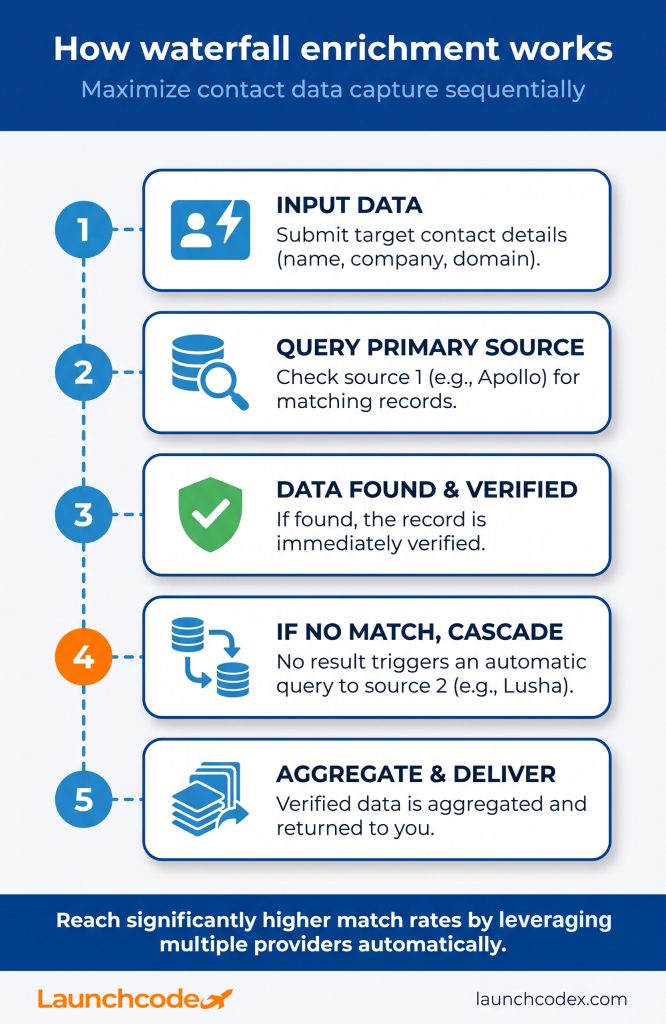
Do not build all seven layers at once. Start with a single connected workflow, prove it on a small batch, then expand. Most teams begin with waterfall enrichment because the payoff is immediate and easy to measure. Add the signal layer next, then outreach, then wire the CRM, conversion, and revenue layers once the front of the motion works.
Teams that try to build a full autonomous system on day one spend three times longer debugging and produce brittle results. Staging the build keeps each piece testable and keeps mistakes small.
Sales functions that integrate AI across the full workflow, not just the front end, report 2 to 3 times the productivity gains of teams that use AI selectively, based on McKinsey research cited by DevCommX. The full-cycle connection is where the compounding happens. The same staged approach shows up in our marketing automation work, where each workflow maps to one clear business outcome before the next one gets built.
“We always start clients on the enrichment waterfall, because it moves match rates from about 60% to above 85% in the first week. That single win funds the rest of the build and gets the team to trust the system.” Derick Do, Co-Founder and Chief Product Officer
Connection does not mean full autonomy. Keep these guardrails in place.
Gartner’s own guidance is worth holding onto here. More agents is not inherently better. Use agents where they deliver clear value, automation for routine routing, and simple assistants for retrieval, a point summarized well by Azumo. At Launchcodex, we build these systems for clients around exactly that principle. Architecture and staging beat tool count every time.
The connected GTM engine is not a far-off idea. Agentic AI adoption already sits near 79% of organizations, with 96% planning to expand, according to Landbase’s survey data, and Gartner projects that 60% of B2B seller work will run on generative AI by 2028, up from under 5% in 2023, as Apollo notes. The direction is set. The teams that win will not be the ones with the most tools. They will be the ones who connected them.
Start with the layer that hurts most, usually data. Build one waterfall, prove the match rate, and add the next layer only when the last one works. Keep a human on approval, treat governance as part of the design, and let Claude handle the glue work that used to eat your team’s day. For more on connecting AI systems into a working stack, our AI automation and agent guides and our AI automation playbooks go deeper on the build. The 19 tools were never the advantage. Connecting them is.
No, but you need comfort with APIs, JSON, and how webhooks work. Claude does the actual coding. Your job is to write the instructions, connect the tools, and review the outputs. A RevOps generalist with a few months of automation experience can run these workflows.
Automation moves data between tools on a fixed path. Orchestration decides what happens next based on what the data says. Deciding whether a funding round plus a hiring spike counts as a real buying signal is a reasoning task, not a routing task. That reasoning is what Claude adds.
There is no fixed number. Leading teams are consolidating from 10 to 15 tools toward 4 to 6 core platforms. The goal is not more tools or fewer tools. It is tools that connect and hand off cleanly, with each one doing a clear job in the motion.
MCP is an open standard now stewarded by the Agentic AI Foundation under the Linux Foundation, with support from most major AI and cloud providers. That neutrality lowers the risk of building on it. Verify each server you connect, since tools that fetch external content can carry prompt-injection risk.
Start with waterfall enrichment. It delivers an immediate, measurable win by lifting your verified contact match rate from roughly 60% to above 85%. Run it on 50 test contacts first, confirm the results, then expand to the signal and outreach layers once the data foundation is solid.


Real stories from the people we’ve partnered with to modernize and grow their marketing.