


How ChatGPT actually picks sources (and other LLMs)
See how ChatGPT, Perplexity, Gemini, and Claude choose which pages to cite, backed by data from Pew, Ahrefs, and Princeton, ...





Your page ranks on the first page of Google. Then a buyer asks ChatGPT the same question, and your brand is nowhere in the answer. That gap is not bad luck. AI engines select sources through a process that looks nothing like traditional ranking, and most explainers stop at generic tips like "write good content."
This article breaks down how ChatGPT, Perplexity, Gemini, and Claude actually pick sources, backed by data from Pew Research Center, Ahrefs, Profound, Yext, and the Princeton team that named the field. You will get the real mechanics, a side-by-side engine comparison, and a plan you can run this quarter to raise your citation odds.
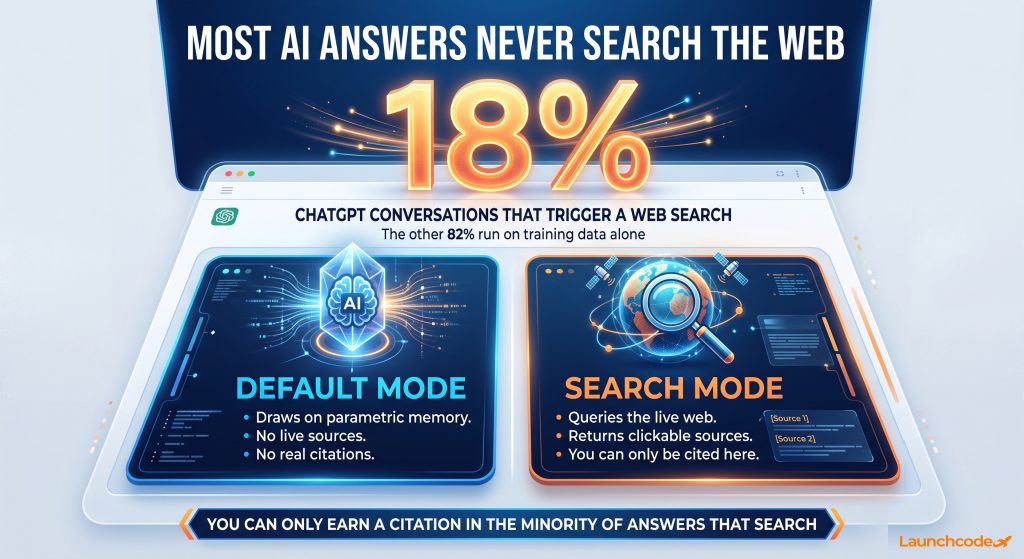
ChatGPT answers most questions from its training data, not the live web. Only about 18% of conversations trigger at least one web search, according to Profound's analysis of more than 700,000 conversations. When no search fires, there are no real citations. Any links you see in that mode are predicted patterns, not retrieved pages, which is why they sometimes lead nowhere.
Ready to grow your organic traffic?
Get a free SEO audit from the Launchcodex team.
This two-mode reality is the first thing to understand. In its default mode, ChatGPT draws on parametric memory, the knowledge stored in the model during training. In search mode, it queries the live web and returns clickable sources. You can only be cited in the second mode.
OpenAI states in its own ChatGPT search documentation that the model searches the web automatically when a question might benefit from current information. Questions about recent events, specific companies, prices, or people tend to trigger it. Broad conceptual questions often do not.
Timing inside a conversation matters too. Profound found that the opening question is roughly 2.5 times more likely to trigger a citation than the tenth turn. The first question in a session starts the research journey, so it pulls the most sources.
If your buyers ask questions that never trigger search, on page changes will not help. You need broad brand presence so the model already knows you from training. If their questions do trigger search, you need to be retrievable and citable in that moment. Most teams should plan for both, and treat the first question a user asks as the highest value target.
"We tested this with a B2B client last year. Their brand showed up in ChatGPT answers about their category even when no search fired, because they had years of mentions across review sites and industry press. Training presence is a moat most teams ignore." Tanner Medina, Co-Founder and Chief Growth Officer
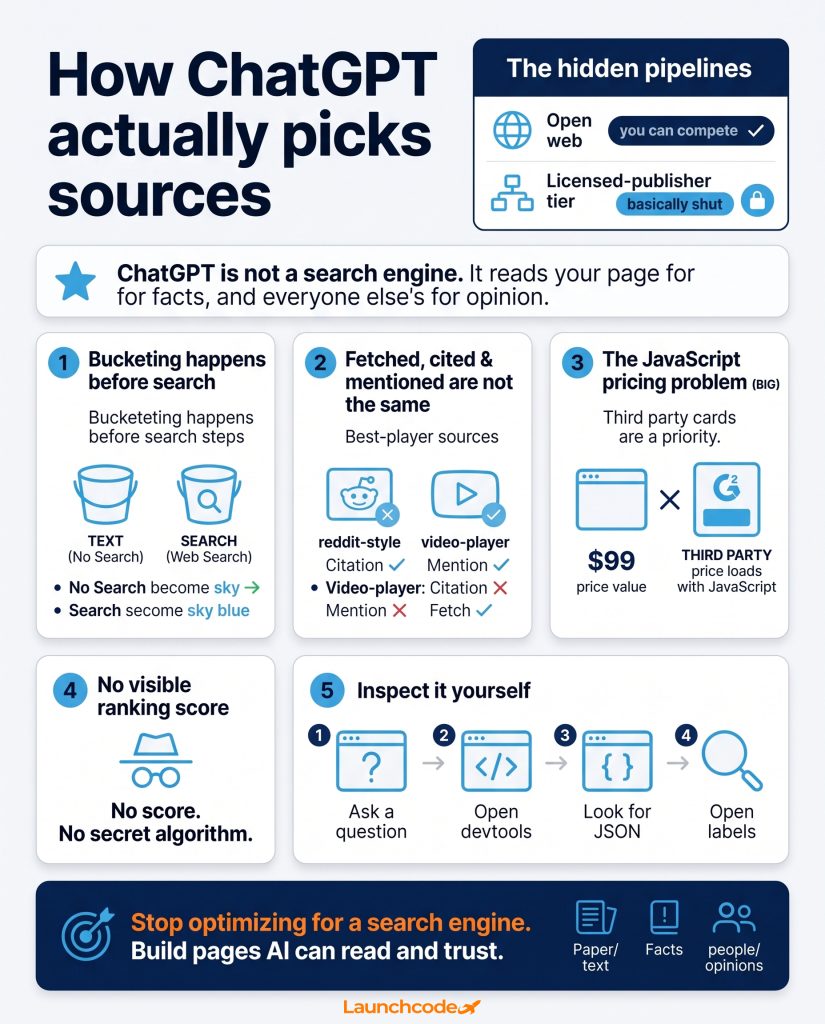
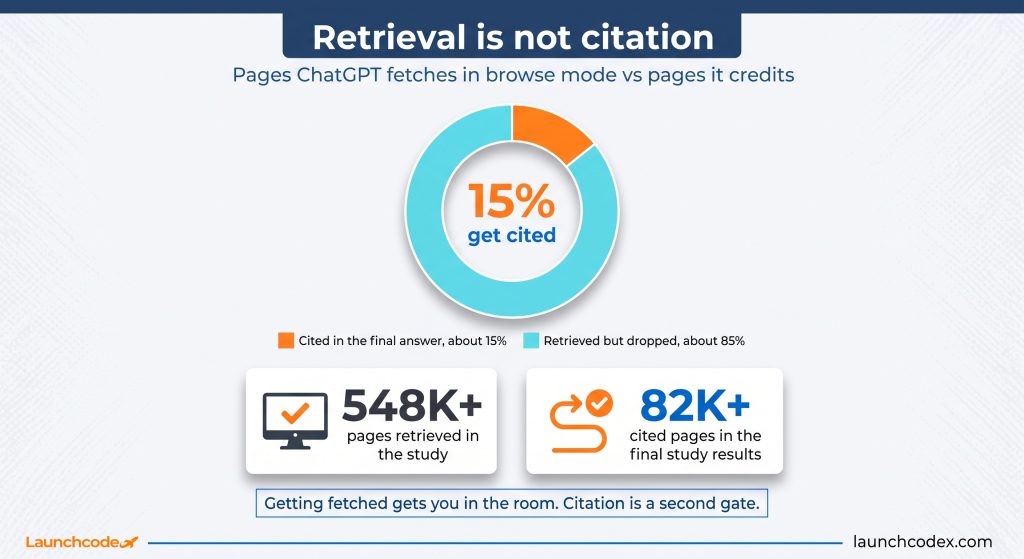
Being read is not the same as being credited. Across more than 548,000 pages ChatGPT retrieved in browse mode, only about 15% appeared in the final answer, per AirOps research reported by Search Engine Land. A separate Ahrefs study of 1.4 million prompts found only about half of retrieved pages get cited. Retrieval gets you into the room. Citation is a second gate.
Most GEO advice stops at retrieval, which is the wrong place to stop. Getting fetched proves your page is indexed and relevant enough to consider. It says nothing about whether the model will bind a claim in its answer to your URL.
Ahrefs found that pages with clear, natural language URL slugs were cited 89.78% of the time they appeared in results, compared to 81.11% for less descriptive URLs, as covered in Search Engine Journal's report on the study. That is an eight-point swing tied to something as simple as URL structure.
The same research showed that titles and URLs matching the model's narrower sub queries correlate with citation more strongly than pages that only match the broad keyword. The model needs a passage it can lift and attach to a specific claim.
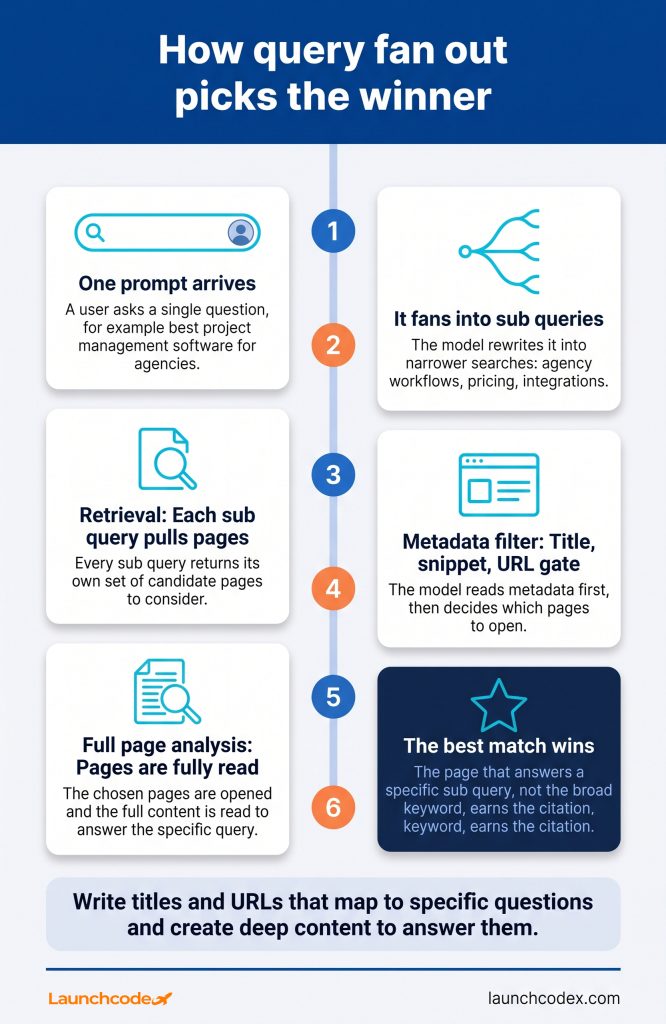
A single prompt does not become one search. ChatGPT rewrites it into several narrower sub queries, then searches each one. OpenAI confirms the model turns a request into one or more targeted queries and can run follow-up searches after reading the first results. The page that best answers a specific sub-query wins the citation, not the page that matches the original keyword.
This is the mechanic most competitor articles skip, and it explains a lot of confusing citation behavior. Two pages can both be relevant to the main topic, yet only the one aligned to a hidden sub-question gets credited.
OpenAI's documentation gives a real example. A researcher asking about drugs that target CCR8 for cancer might see the model first query something like CCR8 immunotherapy drug development, then follow up with a more specific query about a named compound after reading initial results. One prompt, several searches, each with its own candidate pages.
For a commercial query like best project management software for agencies, the fan out might include separate searches for agency workflows, pricing, and integrations. Your page needs to win one of those specific angles.
Ahrefs research shows the model first sees each result as a title, a short snippet, and a URL, then decides which pages to open and cite from that metadata, as detailed in its breakdown of why ChatGPT cites some pages over others. There is a gatekeeping layer before your full content is even read.
The practical move is clear. Write titles and URLs that map to specific questions, not just broad terms. A page titled with a precise question gets a stronger match against a subquery than a vague brand headline.
"When we rebuilt a client's URL structure to match how people phrase questions, their citation rate climbed within two refresh cycles. We moved slugs from product jargon to plain question language, and ChatGPT started opening those pages more often." Derick Do, Co-Founder and Chief Product Officer
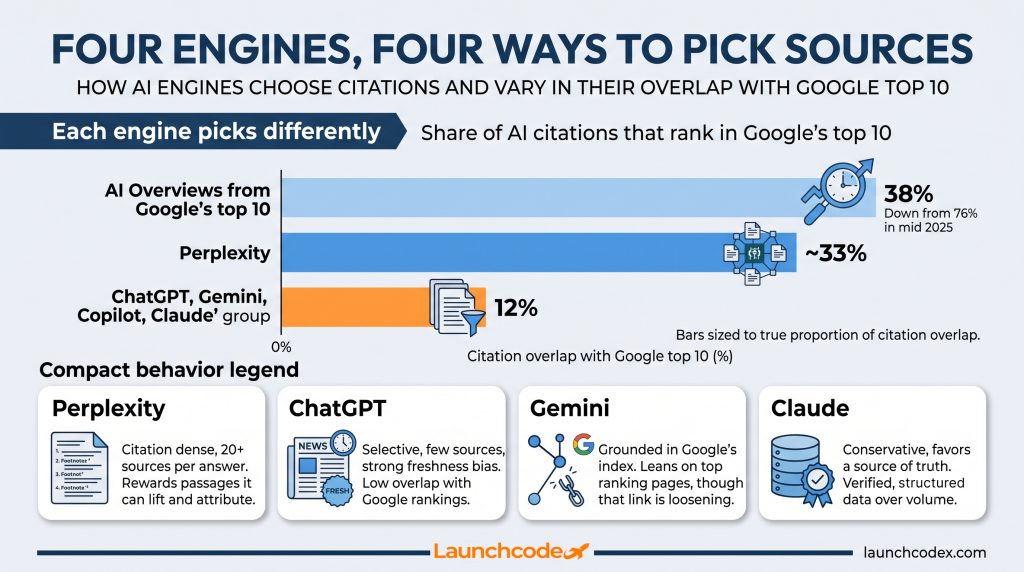
ChatGPT, Perplexity, Gemini, and Claude do not pull from the same places or cite at the same rate. Only about 12% of URLs cited by ChatGPT, Gemini, and Copilot rank in Google's top 10 for the same query, while nearly one in three Perplexity citations do, per Ahrefs. A page cited constantly on one engine can be invisible on another. One strategy will not cover all four.
Treating ChatGPT as a stand-in for all AI search is a mistake. Each engine has its own index, retrieval logic, and citation habits. The table below summarizes the differences that matter for planning.
| Engine | How it retrieves | Source preferences | Citation behavior | Watch out for |
|---|---|---|---|---|
| ChatGPT | Rewrites prompts into sub queries, retrieves via a search partner index | Reddit, Wikipedia, major publications, structured data | Selective, cites a handful of sources, strong freshness bias | Low overlap with Google rankings, most answers use no search |
| Perplexity | Runs queries against its own index, synthesizes with visible citations | Community content, real time news, extractable passages | Citation dense, often 20 or more sources per answer | Rewards passage extractability more than off site reputation |
| Gemini and AI Overviews | Grounded in the Google index and Knowledge Graph | Authoritative brand sites, strong traditional SEO signals | Leans on top ranking pages, though that link is loosening | Still tied to Google rank, so classic SEO carries weight |
| Claude | Web search with a distinct citation pattern, an outlier in studies | Verified, structured data over volume | Conservative, favors a source of truth | Least predictable across cross engine datasets |
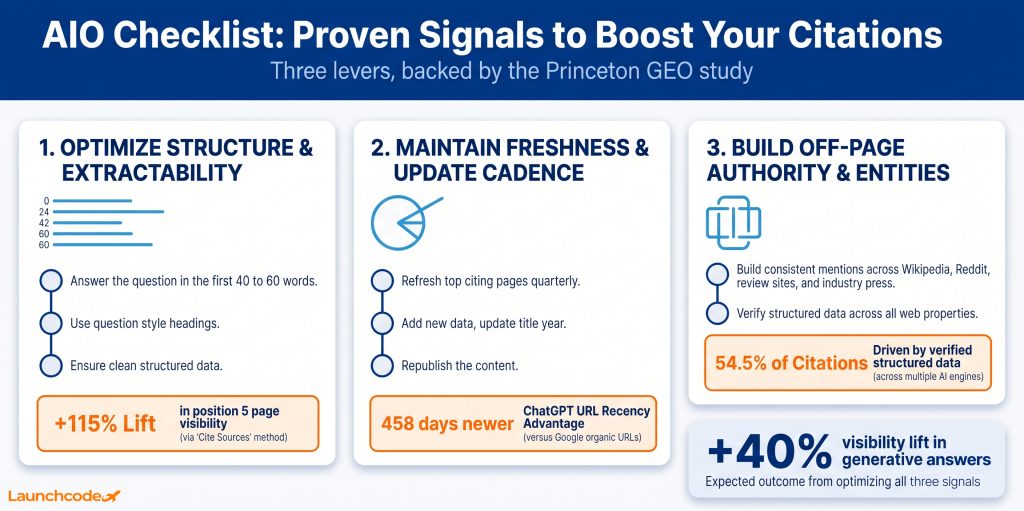
ChatGPT cited URLs that were on average 458 days newer than Google's organic results, the strongest freshness preference of any platform Ahrefs tested across 17 million citations. Its most cited domains for U.S. users are Reddit, Wikipedia, Amazon, Forbes, and Business Insider, based on 9.6 million queries. Authority plus recency wins here.
Perplexity works like a research engine. It cites generously and prizes passages it can lift and attribute, so self-contained statements outperform buried points. Gemini sits at the other end. Ahrefs found 76% of AI Overview citations came from Google's top 10 in a July 2025 analysis, a share that fell to about 38% by early 2026, as shown in its update on AI Overview citation overlap. Traditional ranking still matters most for Gemini, but the link is weakening.
Yext analyzed 17.2 million AI citations across the four engines and found verified, structured data made up 54.53% of distinct citation sources, detailed in its study on how each engine decides what to cite. The engines differ at the margins, but they agree on one thing. Clean, verifiable, structured facts get cited everywhere.
Three levers move citations across engines: content structure, freshness, and off-page authority. Princeton researchers tested this directly and found that adding statistics, quotations, and cited sources raised visibility in generative answers by up to 40%. Lower-ranked pages gained the most. The Cite Sources method lifted a position five page by 115.1%, while the top-ranked page's visibility fell 30.3%.
These findings come from the foundational GEO paper by Aggarwal and co-authors, presented at KDD 2024 by researchers from Princeton, Georgia Tech, the Allen Institute for AI, and IIT Delhi. They matter because they show citation odds respond to how you present content, not just how you rank.
AI systems cite passages, not whole pages. Make each claim self-contained and easy to lift.
ChatGPT's freshness bias means a strong page from 2024 can go invisible in 2026 if no one updates it. Build a quarterly refresh cycle for your top citing pages. Add new data, update the year in the title where it fits, and republish. This single habit fights the strongest citation decay signal ChatGPT shows.
Much of what decides your citation odds happens off your own site. Eli Schwartz, author of Product-Led SEO, put it plainly in an AirOps discussion: "AI visibility is fundamentally a brand game." Engines build a reputation graph from mentions across Wikipedia, Reddit, review sites, and news, then trust domains that show up consistently.
That does not mean SEO is dead. Jeremy Moser, CEO of uSERP, argues that "80% of GEO is good, fundamental SEO." The foundation still counts, especially on Gemini. To see how these terms fit together, our AI SEO glossary defines GEO, AEO, and the related metrics in plain language.
There is no rank position in AI search, so stop tracking rank. Track how often each engine cites you for your highest value prompts, and connect that to pipeline. Pew Research Center found users click a traditional result just 8% of the time when an AI summary appears, versus 15% without one, and click the summary's own sources only 1% of the time. The citation itself is now the visibility.
That click drop, documented in Pew's analysis of Google AI summaries, is why measurement has to change. You cannot rely on referral clicks alone to prove value, because many buyers read the answer and never click.
At Launchcodex, this is the core of our generative engine optimization work. We audit answers across engines, strengthen entity and structured data signals, then track citation share and assisted conversions rather than rankings alone.
"Weekly tracking of 25 prompts is the floor for us. When we ran it for a SaaS client across ChatGPT and Perplexity, we caught a competitor overtaking them on three buying prompts within a month and fixed it before it cost pipeline." Tanner Medina, Co-Founder and Chief Growth Officer
One caution from that work, and from the research: figures in this field reflect the dates of each study. Engine behavior shifts fast, so treat any single number as a snapshot, not a rule.
You now have the mechanics that competitor guides skip. Most AI answers never search the web, so broad brand presence matters. When search fires, the engine fans your prompt into subqueries, fetches many pages, and cites only the few that match a specific question with a clean, sourced passage. Retrieval is not citation, and each engine plays by its own rules.
Start with three moves this quarter. Rewrite your top page titles and URLs to match specific questions, not broad keywords. Add sourced statistics and self-contained answers to your highest value pages, then set a quarterly refresh cycle. Finally, measure citation share across ChatGPT, Perplexity, and Gemini weekly, and connect gains to pipeline. Do that, and you stop guessing why your competitors show up in AI answers while you do not.
No. Most answers come from training data. Profound's data suggests only about 18% of conversations trigger a live web search. When no search fires, any citations you see are predicted patterns and may not point to real pages.
Retrieval and citation are separate gates. Roughly 85% of pages ChatGPT fetches never make the final answer. Your page needs a clear, sourced passage that directly supports a claim, plus a title and URL that match the model's specific subquery.
Not on its own. Only about 12% of ChatGPT, Gemini, and Copilot citations rank in Google's top 10 for the same query. Ranking helps most on Gemini and AI Overviews, but ChatGPT and Perplexity often cite pages that do not rank well at all.
Refresh your top citing pages at least quarterly. ChatGPT shows the strongest freshness bias of any engine, citing URLs on average 458 days newer than Google's organic results. Add new data, update the title year where it fits, and republish.
It helps but is not required. Wikipedia appears in nearly one in six ChatGPT conversations with citations, so you rarely beat it directly. Aim to be the next source after it, and build consistent mentions across Reddit, review sites, and industry publications to strengthen your entity signals.
Prioritize where your buyers ask questions. ChatGPT drives the most AI referral traffic, Perplexity cites the most sources per answer, and Gemini rewards traditional SEO through AI Overviews. Measure your citation share on each, then invest where the gap between you and competitors is largest.




See how ChatGPT, Perplexity, Gemini, and Claude choose which pages to cite, backed by data from Pew, Ahrefs, and Princeton, ...
Google's new Search Console platform properties let you track how your TikTok, Instagram, X, and YouTube content performs in...
Learn the nine-step keyword research process used by growth-focused teams. Covers seed keywords, search intent, keyword diff...