
Share:

AI marketing & automation


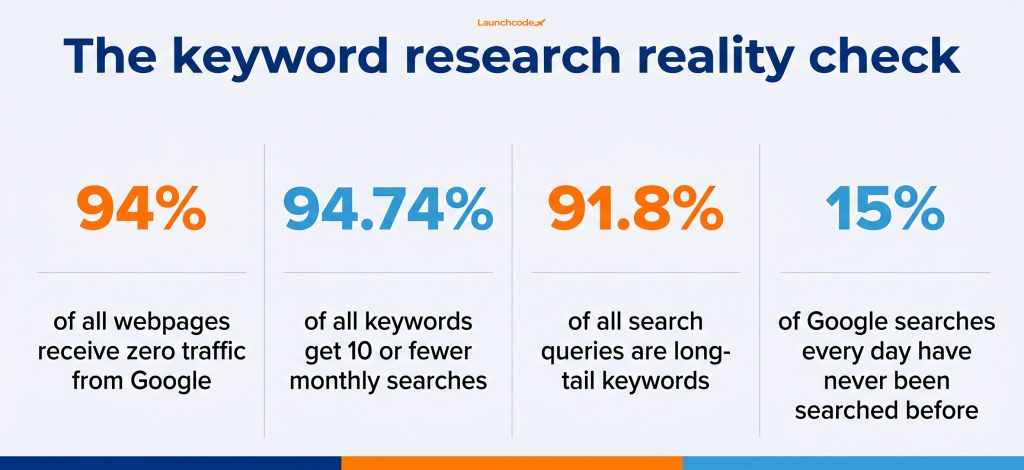
Around 94% of all webpages receive no traffic from Google, according to SE Ranking. That is not a web design problem or a technical issue. In most cases, it comes down to keyword selection. The page targeted the wrong term, misread what searchers actually wanted, or went after a head keyword the site had no realistic chance of ranking for.
Keyword research fixes that. This guide covers nine clear steps: defining goals, building seed lists, expanding with tools, filtering by intent, assessing difficulty, analyzing competitors, clustering, accounting for AI search, and prioritizing with a framework that connects every keyword decision to business outcomes.
Keyword research is the process of identifying the exact words and phrases your target audience types into search engines, then evaluating each term for relevance, ranking potential, and business value. The goal is not to build the longest keyword list. The goal is to find the right terms and connect them to content that ranks, gets clicked, and drives qualified traffic into the funnel.
Most teams rush straight to a tool, pull a list of high-volume terms, and start writing content. That approach produces pages competing against sites with far more authority, and the content rarely ranks. Rand Fishkin, co-founder of Moz and SparkToro, framed it clearly: “Effective keyword research is about understanding the problems your audience is trying to solve, not just the words they use to search.”
Keyword research is audience research with a search data layer on top.
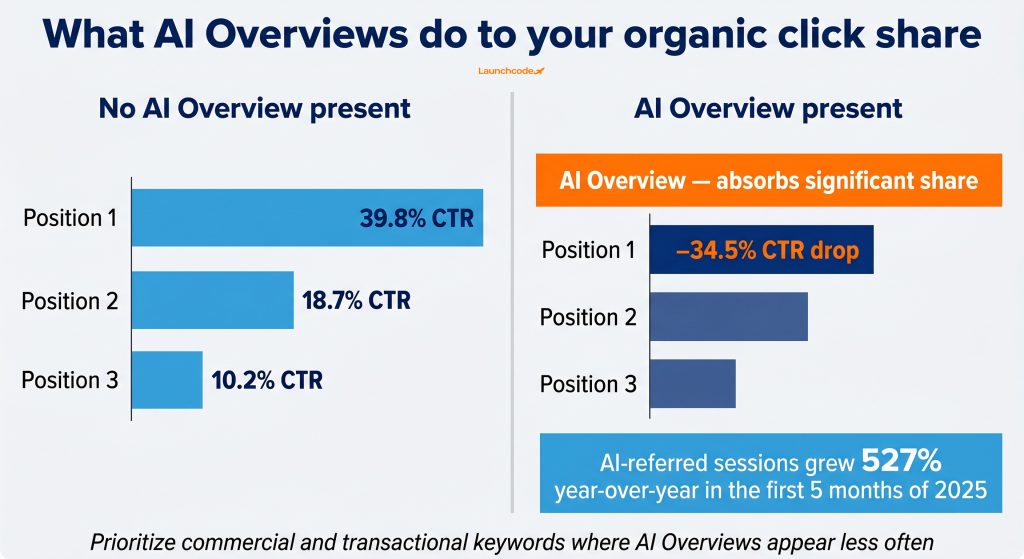
Organic search drives an average of 33% of overall website traffic across seven major industries, according to Conductor’s 2025 State of SEO report. The top organic result on Google averages a 39.8% click-through rate, per FirstPageSage. Position two drops to 18.7% and position three to 10.2%.
The gap between page one and everything else is significant. Keyword research is how you build a clear path to the terms that actually matter to your business.
Set a clear objective before starting keyword research. Without one, you will collect data with no filter. Your goal determines which intent types matter, which funnel stages to prioritize, and what a winning keyword looks like for your specific business. Write your goal in one sentence before touching Ahrefs or Semrush.
Goals shape every downstream decision. A SaaS company building top-of-funnel awareness needs different keywords than one capturing purchase-ready buyers comparing plans. A local service business targets different intent than a B2B consultancy building thought leadership.
“The first thing we ask new clients is: what does a qualified lead look like for your business? Keyword research should start with that answer, not with a tool.” Tanner Medina, Co-Founder and Chief Growth Officer, Launchcodex
Before opening any tool, answer these:
A keyword like “what is programmatic SEO” serves awareness. “Programmatic SEO agency pricing” serves a decision-stage buyer. Both are valid, but they need different content, different calls to action, and different success metrics. Mixing them without a plan produces a content calendar with no strategic direction.
Seed keywords are broad, short terms that anchor your research. They are not final targets. They are the starting point for expanding into the full range of phrases your audience uses. Start with what you know about your business, your customers, and the problems you solve, then confirm those assumptions with real search data.
A seed keyword for a content marketing platform might be “content strategy.” From that single term, a research tool can surface hundreds of variations, questions, and long-tail phrases that real people search every month. The quality of your seed list determines the quality of everything that follows.
Build a starting list of 10 to 20 seed terms. From each one, a tool like Ahrefs Keywords Explorer or the Semrush Keyword Magic Tool will generate dozens of related variations filtered by volume, intent, and difficulty.
Use a keyword research tool to turn your seed list into a full dataset with search volume, keyword difficulty, and traffic potential for each term. The right tool gives you enough data to filter, prioritize, and spot content clusters you would never find manually. Use at least one paid tool alongside Google Search Console for first-party validation.
Each major tool has a different strength.
| Tool | Best for | Key strength | Watch out for |
|---|---|---|---|
| Ahrefs Keywords Explorer | Paid SEO teams | Traffic potential and SERP analysis | Requires paid subscription |
| Semrush Keyword Magic Tool | Competitor research | Gap analysis and 27B keyword database | Can produce large, noisy lists |
| Google Keyword Planner | Paid search teams | Free, shows volume ranges | Less precise for organic research |
| Google Search Console | Existing sites | First-party impression and click data | No new keyword discovery |
| Moz Keyword Explorer | Beginner teams | CTR estimates and SERP analysis | Smaller database |
| AnswerThePublic | Question-based keywords | Visualizes autocomplete queries | Best for ideation, not data depth |
| Keywords Everywhere | Budget teams | Browser extension, real-time overlay | Lightweight, limited deep analysis |
For most teams, the strongest combination is Google Search Console for existing sites plus one paid tool like Ahrefs or Semrush.
Build a working spreadsheet with these columns:
Traffic potential deserves attention here. A keyword with 500 monthly searches where the top-ranking page pulls 4,000 visits across all its related variations is far more valuable than the raw number suggests. Ahrefs surfaces this metric directly, and it is one of the most underused filters in the tool.
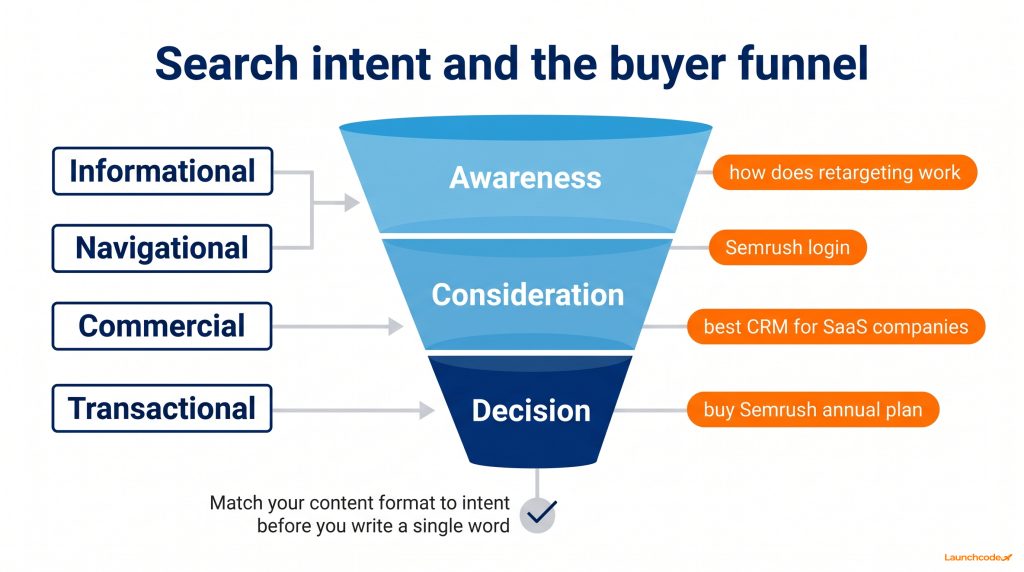
Search intent is the most important filter in keyword research. It defines what the searcher actually wants to find. Target the wrong intent type and Google will not rank your content, regardless of how well optimized it is. Check the SERP for every shortlisted keyword before committing resources to it.
Google recognizes four intent types:
Open Google and search the keyword. Look at the top five organic results.
That is the format Google has determined satisfies this query. Match it. Publishing a long-form educational guide when Google ranks product pages for the same keyword means your content will not rank, regardless of its quality or depth.
Map intent types to funnel stages when planning content:
A balanced content plan needs keywords across all three stages. A site that targets only informational terms builds traffic but rarely converts it.
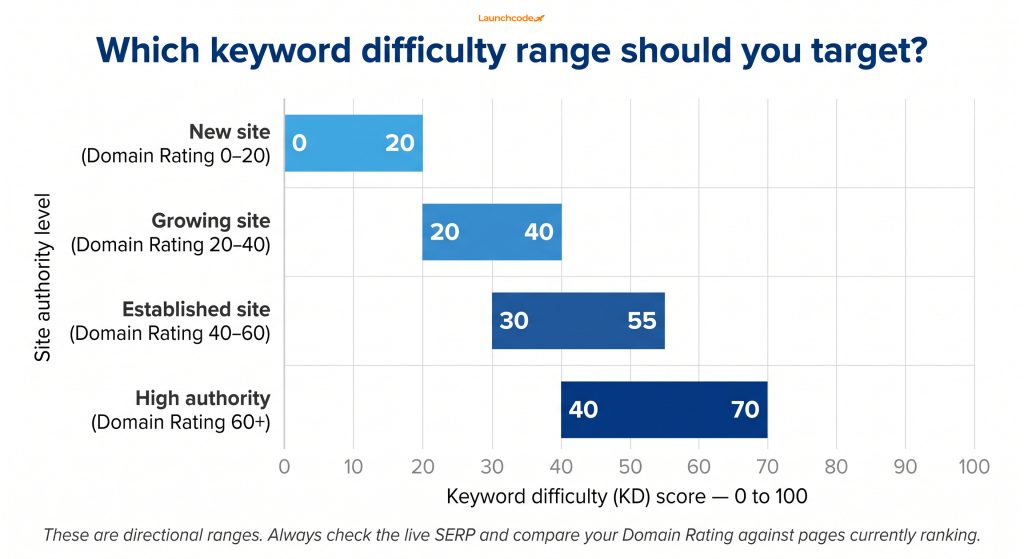
Keyword difficulty (KD) is a directional score, not an absolute measure. It tells you roughly how competitive a keyword is based on the backlink authority of pages currently ranking. Use it alongside your own site’s authority and the actual traffic potential of the keyword to decide whether it is worth pursuing.
According to Backlinko’s analysis of 306 million keywords, 91.8% of all search queries are long-tail keywords. Long-tail terms typically carry lower KD scores and lower search volume, but they convert at higher rates because they reflect more specific intent. Most content plans underweight them.
A KD of 35 on a site with a Domain Rating of 15 is an unrealistic target. The same KD of 35 on a site with a Domain Rating of 55 is very achievable. Always compare your site’s authority against the average authority of pages currently ranking for that keyword.
Rand Fishkin has said publicly that he avoids leading with volume metrics because they pull teams toward the wrong decisions. A senior marketer at a B2B SaaS company put the business-first view plainly, as cited by DOJO AI: “I’d rather rank for a keyword with 400 searches a month that drives demo requests than chase 10K searches that do nothing for the business.”
That framing is especially relevant in B2B and SaaS markets where a single conversion can justify months of content investment.
| Site authority level | Realistic KD target range |
|---|---|
| New site (Domain Rating 0 to 20) | 0 to 20 |
| Growing site (Domain Rating 20 to 40) | 20 to 40 |
| Established site (Domain Rating 40 to 60) | 30 to 55 |
| High authority (Domain Rating 60 plus) | 40 to 70 |
These are directional ranges, not fixed rules. Always review the actual SERP to check what content ranks, how many backlinks it has, and whether you can build something meaningfully better or more current.
Competitor keyword analysis reveals proven demand. If a competitor ranks for a term and drives traffic from it, that keyword has validated commercial interest. Your job is to find the terms they rank for, identify where their content falls short, and create something more useful, more thorough, or more current.
There are two types of competitors to analyze:
Both matter. Content competitors can dominate informational keywords your potential customers search early in the buying process, well before they reach a branded or transactional query.
All four are common. A SERP review and a quick scan of the competing page are enough to spot them.
Keyword clustering groups related terms by topic and intent so a single page can target multiple queries rather than a single phrase. This approach builds topical authority, prevents keyword cannibalization, and creates a more efficient content structure. Google’s algorithm rewards comprehensive topic coverage across a site, not just individual optimized pages.
As Nightwatch’s SEO team explains, “Grouping keywords by topic or intent is critical for modern SEO. It helps you build topical authority, create focused, high-performing content, and improve internal linking and on-page structure.”
Tools like Semrush’s Keyword Manager and Ahrefs can automate the initial grouping. Use them to generate cluster suggestions, then review manually to catch intent mismatches the algorithm misses.
After clustering, assign each cluster to a specific URL.
Build a keyword map in a spreadsheet with columns for cluster name, primary keyword, secondary keywords, target URL, and page status.
AI search is reshaping which keywords drive organic clicks. When a Google AI Overview appears in results, the top organic result loses approximately 34.5% of its clicks, according to Ahrefs data. Keywords that consistently trigger AI Overviews still carry brand visibility value, but factor the reduced click-through potential into how you prioritize and structure content around them.
AI-referred sessions grew 527% year-over-year in the first five months of 2025, according to Previsible’s 2025 AI Traffic Report. ChatGPT, Perplexity, and Google AI Mode now answer queries directly, often without sending users to a website at all. This changes how keyword decisions translate into actual traffic.
“AI tools cut keyword clustering time from hours to minutes, but they still miss the business context only you can provide. Validate every AI-generated keyword idea against real intent data before it goes on your map.” Derick Do, Co-Founder and Chief Product Officer, Launchcodex
Before finalizing your target list, search each keyword in Google and note whether an AI Overview appears. If it does:
Queries with informational intent trigger AI Overviews most often. Commercial and transactional queries are less affected, making them higher-value targets for organic click traffic.
GEO (Generative Engine Optimization) is the practice of structuring content so AI search engines cite it in generated responses. For each piece of content built around a keyword cluster, apply these rules:
A 2024 study by Princeton, Georgia Tech, and IIT Delhi tested nine GEO content methods across thousands of samples. Keyword stuffing scored lower than doing nothing. Authoritative, structured content significantly outperformed it.
Not every good keyword deserves equal investment. Prioritize by combining business relevance, intent type, keyword difficulty, and traffic potential into a single score. This keeps your content roadmap tied to revenue-generating potential rather than raw traffic volume.
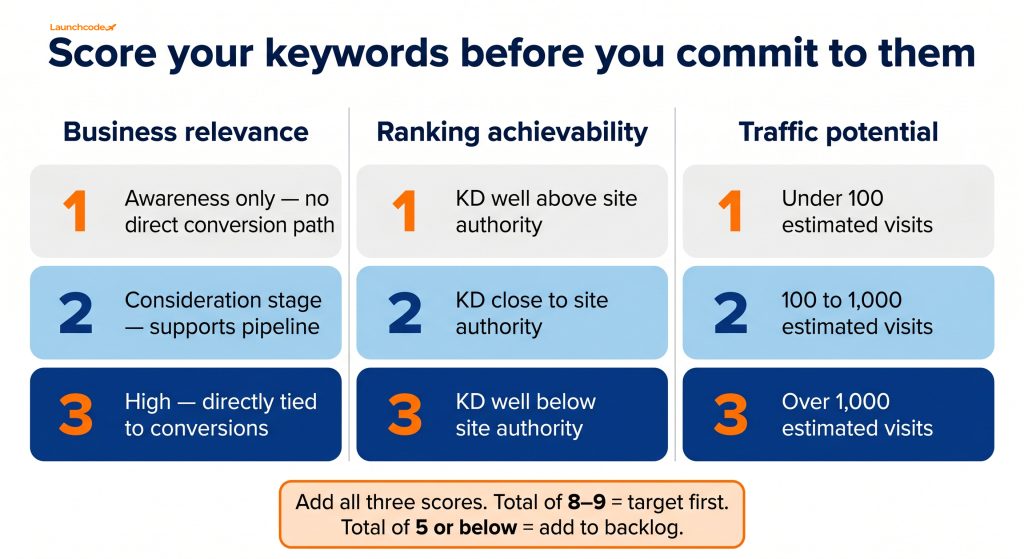
The KOB (Keyword Opportunity and Business value) framework, developed by Siege Media, formalizes this approach. It scores each keyword across three dimensions: how much traffic potential it carries, how achievable the ranking is for your site, and how directly it connects to what you sell.
Score each keyword across three dimensions using a 1 to 3 scale:
| Dimension | Score 1 | Score 2 | Score 3 |
|---|---|---|---|
| Business relevance | Awareness only, no direct conversion path | Consideration stage, supports pipeline | High, directly tied to conversions |
| Ranking achievability | KD well above site authority | KD close to site authority | KD well below site authority |
| Traffic potential | Under 100 estimated visits | 100 to 1,000 estimated visits | Over 1,000 estimated visits |
Add the three scores together. Target keywords with totals of 8 or 9 first. Keywords scoring 5 or below belong in a backlog for when your site’s authority grows.
A keyword with 200 monthly searches and a business relevance score of 3 often outperforms a keyword with 5,000 monthly searches and a relevance score of 1. This holds especially in B2B and SaaS contexts where buyer intent is specific, purchase cycles are long, and a single conversion justifies significant content investment.
Done once and filed away, keyword research stops working fast. Research from Passionfruit shows that 31% of high-value keywords change significantly in intent or volume every six months. Google’s own data confirms that 15% of all daily searches have never been made before. New queries emerge constantly. Keyword research is an ongoing system, not a one-time project.
When Launchcodex builds a keyword strategy for a new client, this review cycle starts on day one. The keyword map is a living document updated every quarter alongside performance data, not a static spreadsheet built at launch and forgotten.
86% of SEO professionals already use AI tools in their keyword research workflow, and 65% report improved results, according to Ranked.ai. The most practical use cases:
AI tools speed up the process. They do not replace the judgment required to connect keyword decisions to business goals. Validate AI-generated keyword ideas against real search data in Ahrefs or Semrush before adding them to your map.
Google Search Console is the best free starting point for any site already generating impressions. It shows exactly which queries are driving clicks and where gaps exist between impressions and rankings. For new sites with no traffic yet, Google Keyword Planner gives volume ranges at no cost. Pair both with the free tier of Keywords Everywhere for lightweight daily research.
Target one primary keyword and two to four secondary keywords per page. The primary term drives the page structure, title tag, and main heading. Secondary terms should appear naturally in subheadings and body copy. Trying to rank a single page for 10 unrelated keywords splits its focus and rarely works.
Run a full keyword research process when launching a new site or a new content program. After that, review the keyword map quarterly. Check Google Search Console monthly for new query opportunities. Major algorithm changes or new product launches also warrant a focused re-evaluation.
Yes, and it matters more than before. Understanding which queries trigger AI Overviews, which terms get cited in ChatGPT and Perplexity responses, and how to structure content for GEO all depend on the same foundational keyword intelligence. The outputs adapt to a new channel. The process does not go away.
Keyword cannibalization happens when two or more pages on the same site target the same keyword. Google splits its evaluation between the competing pages, which usually means neither ranks as well as it could. Fix it by deciding which page best serves the searcher’s intent, then redirecting or consolidating the weaker page into the stronger one.
Search volume is the average number of monthly searches for a specific keyword phrase. Traffic potential estimates the total organic visits the top-ranking page actually receives across all related keyword variations, not just the exact phrase. Traffic potential is almost always the more useful number when making content investment decisions.


Real stories from the people we’ve partnered with to modernize and grow their marketing.