
Share:

AI marketing & automation


Hiring an SEO agency is one of the most consequential decisions a marketing leader makes. The wrong choice costs more than the monthly retainer. It costs months of momentum, content that needs to be rebuilt, and the skepticism that makes the next investment harder to approve.
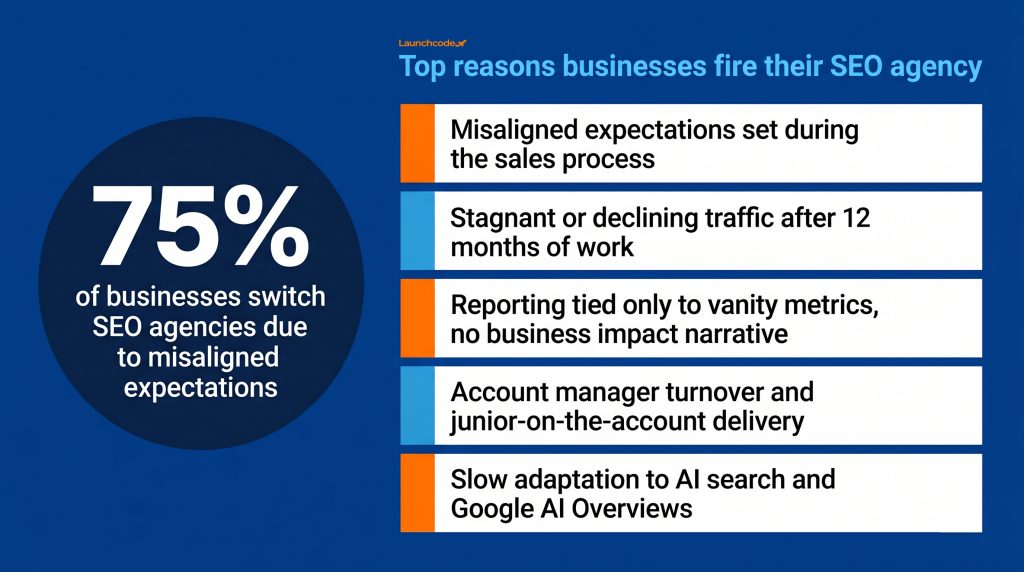
Nearly 75% of businesses that switch SEO agencies point to misaligned expectations as the primary cause, not poor performance after the work started. The problem almost always begins in the sales conversation. This guide gives you the specific questions that reveal how an agency actually thinks, what they do when results stall, and whether they are built for search in 2026.
Most vetting checklists test for skills that no longer define SEO success. Questions like “how do you build links” and “what tools do you use” get rehearsed answers. They reveal nothing about strategic thinking, AI search capability, or what an agency does when a campaign underperforms. A useful evaluation goes much deeper.
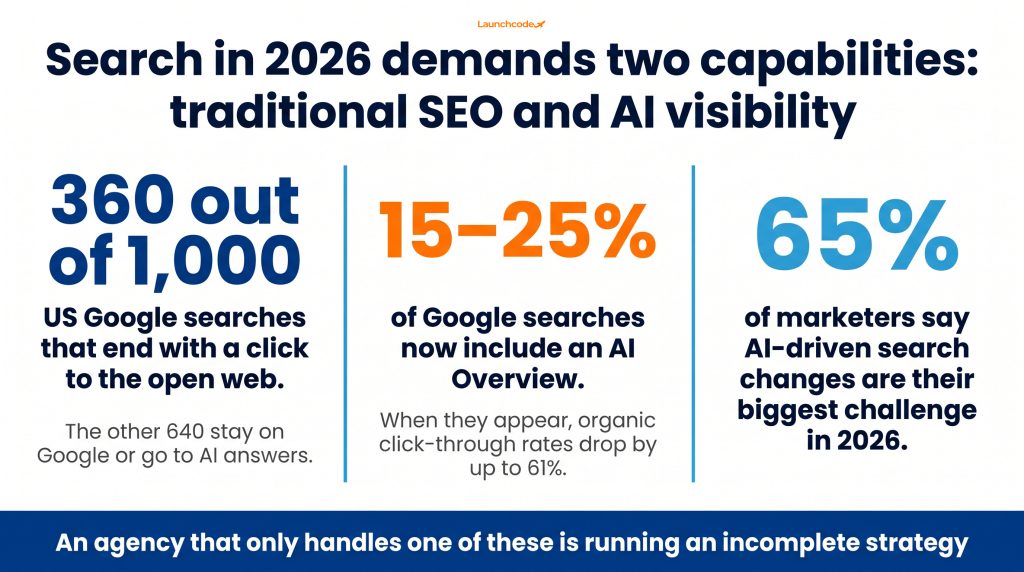
Search has changed significantly. Data compiled by Stridec, referencing Gartner research, projects that traditional search engine volume will drop 25% by 2026 as AI chatbots and virtual agents absorb more queries. Google AI Overviews now appear in 15 to 25% of searches. When they do, organic click-through rates fall by up to 61%.
An agency that cannot operate in this environment is not a strong SEO agency in 2026. It is a 2026 agency running a 2020 playbook.
Most hiring failures do not announce themselves in month one. An agency that lacks strategic depth, AI search capability, or honest reporting will look fine at first. By month four or five, traffic is flat, reporting is full of rank positions nobody asked for, and the account manager is a different person from the one you met during the pitch. By that point, you have spent $15,000 or more finding out.
The questions below are organized by the six areas where most hiring decisions go wrong. Each one is designed to expose how an agency actually thinks, not what they have been trained to say during a pitch.
Ask an agency to walk you through their methodology, not their services. A strong answer has named phases, a clear reason for the order of work, and a logic for prioritizing one action over another. A weak answer is a list of deliverables. If every new client gets the same starting sequence regardless of their situation, that is a checklist operation, not a strategy.
Methodology reveals whether an agency prioritizes by impact or by habit. Good answers include competitive gap analysis, traffic potential by keyword cluster, and an explicit distinction between quick wins and long-term authority plays.
“The agencies that cost us the most time were not the ones with the worst results. They were the ones that could not explain their process before we signed. If an agency cannot walk you through their methodology in plain terms, they are not running one.” Tanner Medina, Co-Founder & Chief Growth Officer
| Question | Strong answer | Weak answer |
|---|---|---|
| Walk me through your methodology | Named phases with a sequenced logic, explains priority decisions for this type of client | Lists deliverables (audits, content, links) with no strategic reasoning |
| How do you decide what to work on first | Mentions competitive gap, quick wins vs. authority plays, client-specific prioritization | “We start with a technical audit and then move to content” |
| Entity-first or keyword-first | Explains entity positioning and topical authority as the foundation for AI and traditional search | “We do both” with no explanation of what that means in practice |
| Content volume vs. precision | Has a named framework for deciding what to produce and why each piece exists in the strategy | “We create as much content as your budget allows” |
An agency that cannot show you a specific strategy for appearing in Google AI Overviews, ChatGPT, and Perplexity is selling an outdated service. Generative Engine Optimization, or GEO, is not a premium add-on for next year. The GEO market is growing from $848 million in 2025 to a projected $33 billion by 2034. Agencies without working GEO capability will fall behind fast.
Goodfirms’ 2026 survey of over 100 digital marketing practitioners across 20 countries found that 65% of marketers cite AI-driven search changes as their single biggest challenge this year. If the agency you are evaluating has not addressed this directly in their pitch, ask about it directly.
Traditional SEO earns clicks. GEO earns citations inside AI-generated answers, where the user may never visit your site but still encounters your brand as the source. According to SparkToro data published in our breakdown of the top GEO agencies in 2026, only 360 out of every 1,000 US Google searches result in a click to the open web. Winning inside AI answers is now as important as ranking in the top three positions.
“When we evaluate GEO capability, the first thing I look for is whether the agency can show their own brand appearing in AI answers for a competitive query. If they cannot do it for themselves, they cannot do it for you.” Derick Do, Co-Founder & Chief Product Officer
The Grow and Convert team identified a pattern worth naming directly. As they explain in their analysis of AI SEO agencies, agencies that claim a GEO strategy based on adding FAQ sections and rephrasing headings as questions are not running a strategy. They are applying random tactics without a framework.
A real GEO strategy explains how the agency builds entity clarity, earns citations from credible sources, and structures content so AI systems extract and surface it. Ask the agency to describe a specific GEO result they have achieved, what they did to get there, and what metric confirmed it worked.
Demand specific, verifiable results before you commit. Any agency can produce a slide deck with upward-trending traffic charts. What you want is a named client (or one willing to take a reference call), clear before-and-after metrics with a timeline, and results you can independently confirm. Unverifiable case studies are marketing collateral, not proof.
You do not need to take an agency’s word for it. Use Ahrefs or SEMrush to run an organic traffic estimate on any client domain the agency shares. Look at the traffic trend over the period the agency claims results. If the agency says they grew a client’s organic traffic by 200% in 12 months, the third-party data should reflect a pattern consistent with that claim.
Agencies that resist this step or discourage independent verification are not agencies you want to work with. Confidence in results comes with a willingness to show them.
The last two questions are the most revealing. Every agency has had a campaign underperform. How they talk about it, with honesty and a clear lesson, or with deflection, tells you more than any case study will.
One of the most common and expensive agency problems is the senior-to-junior handoff. A senior strategist runs the discovery call and pitch, then disappears after the contract is signed. A junior account manager inherits the account with a template and a monthly reporting schedule. Ask directly who will run your account, what their background is, and what the transition from sales to delivery looks like.
Account manager turnover is one of the leading reasons businesses fire their SEO agencies. This problem starts at the hiring stage, not after twelve months.
The sales-to-delivery handoff is where most agency relationships get quietly damaged before real work begins. The salesperson knows your goals, your competitive situation, and your concerns. If that knowledge does not transfer cleanly to the strategist running your account, you spend the first 60 days re-explaining context that should have been documented and shared from day one.
A structured onboarding process and a named primary contact, confirmed before you sign, are basic signals of a well-run operation.
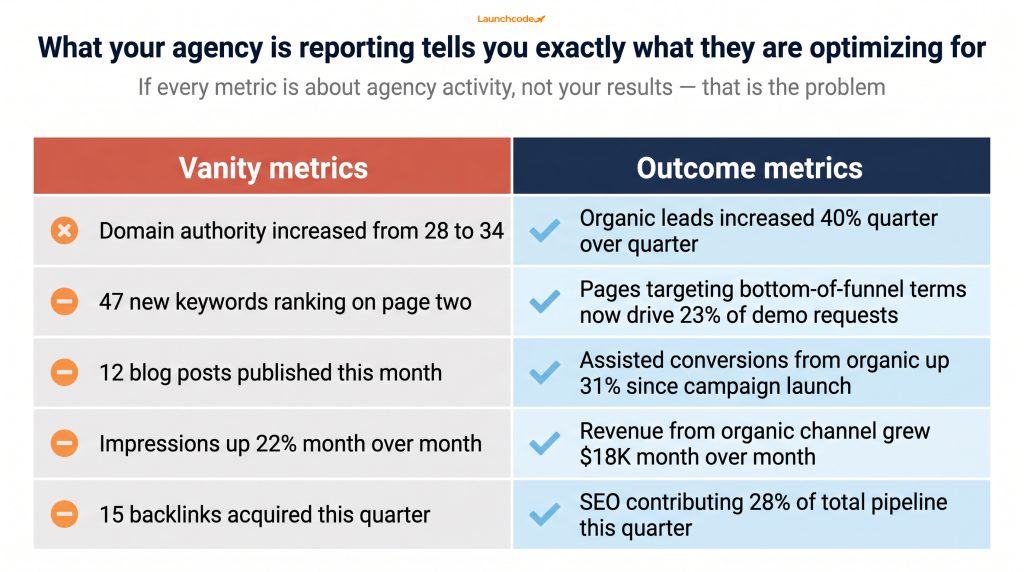
Good SEO reporting connects search performance to business outcomes. It shows organic traffic by landing page and intent, keyword movement tied to strategy milestones, conversion performance from organic channels, and how SEO contributes to pipeline or revenue. If a reporting template only shows rank positions and domain authority scores, the agency is measuring its own activity, not your results.
Aleyda Solis, founder of Orainti and one of the most respected SEO consultants working today, articulated this standard clearly in an interview with Advanced Web Ranking: “Our reports should move beyond tables of SEO metrics and instead focus on storytelling, explaining what’s happening, why, and how we will achieve the client’s goals. This type of communication builds trust, improves alignment, and keeps the focus on what truly matters: delivering business results.”
| Metric type | Example | What it actually tells you |
|---|---|---|
| Vanity metric | Domain authority increased from 28 to 34 | Agency activity, not business outcome |
| Vanity metric | 47 new keywords now ranking on page two | No direct connection to traffic or revenue |
| Vanity metric | 12 blog posts published this month | Volume without impact measurement |
| Outcome metric | Organic leads increased 40% quarter over quarter | Business impact, clearly attributable to SEO |
| Outcome metric | Pages targeting bottom-of-funnel terms now drive 23% of demo requests | SEO tied directly to pipeline contribution |
Regular communication matters more than most buyers realize. Waiting for a monthly report to discover a campaign is underperforming means you are always 30 days behind the problem.
Quality SEO from a capable agency starts at roughly $2,500 per month for most small businesses and scales to $10,000 or more for mid-market engagements. According to an Ahrefs survey, the average agency retainer sits at approximately $3,200 per month. Retainers below $500 almost always reflect outsourced work that produces little strategic value. The contract matters as much as the price, and most buyers skip reviewing it carefully.
| Business type | Typical monthly range | What it typically covers |
|---|---|---|
| Small business | $2,500 to $5,000 | Technical SEO, on-page optimization, content strategy, basic link building |
| Mid-market | $5,000 to $10,000 | Full technical and content programs, active link acquisition, AI search reporting |
| Enterprise | $10,000 and above | Multi-region SEO, content at scale, digital PR, custom reporting dashboards |
One pricing factor worth asking about: AI-powered tools have reduced the labor cost of routine SEO tasks by 20 to 30%, meaning agencies with efficient AI workflows can deliver more within the same retainer. Ask any agency you evaluate how they use AI internally and how that affects the scope of deliverables you receive each month.
Data ownership is non-negotiable. Contract experts at TopSEOAgencies.org recommend demanding this exact language in any SEO agreement: “Client retains full ownership and primary admin access to all digital accounts, including but not limited to Google Analytics, Google Search Console, and Google Tag Manager. Agency access shall be granted as authorized user or manager and shall be revoked or transferred within 5 business days of contract termination.”
Beyond ownership, your contract should include:
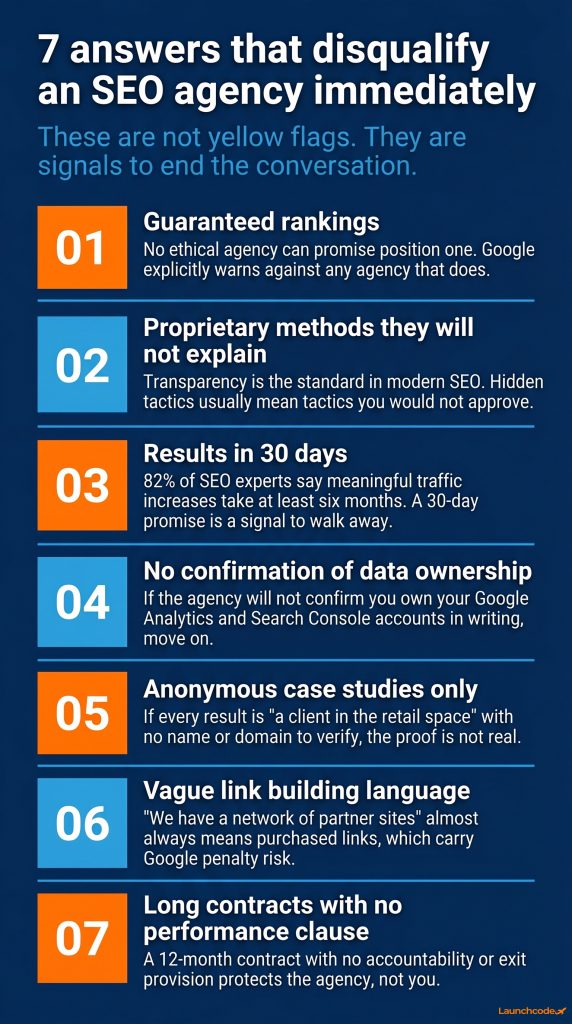
Some answers during the evaluation process are disqualifying. These are not signals that warrant a follow-up question. They are signals to move on to the next agency on your list. The clearest red flags appear during the pitch, not six months into an engagement. Spotting them early saves real money.
Any agency that guarantees specific rankings is either making claims they cannot honor or using tactics that will eventually result in a Google penalty. Google’s own guidelines explicitly warn businesses against agencies that make this promise.
Choosing a strong SEO agency is a repeatable process, not a gut call. The questions in this guide give you a framework for separating agencies that can deliver from agencies that are skilled at pitching.
Before you sign anything, work through these steps:
An agency confident in its work will not resist a single one of these steps. Any agency that does has told you what you need to know.
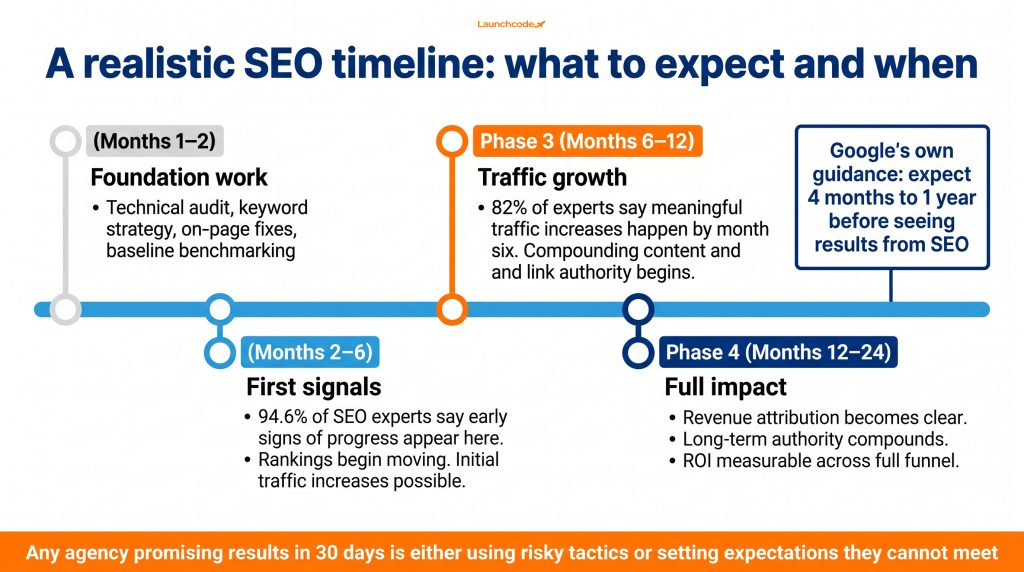
Most SEO experts agree the first signs of progress appear between months two and six. Full traffic impact typically takes six to twelve months. Google’s own former technical lead Maile Ohye has stated that businesses should expect between four months and one year. Any agency promising results in 30 to 90 days is either using risky tactics or setting expectations they cannot meet.
Small businesses typically pay $2,500 to $5,000 per month for comprehensive SEO. Mid-market companies pay $5,000 to $10,000. Enterprise programs run $10,000 and above. Retainers below $500 almost always reflect low-quality outsourced work. The average agency retainer based on Ahrefs survey data sits at approximately $3,200 per month.
No. Any agency guaranteeing specific rankings is making a claim Google explicitly warns against. Rankings are influenced by hundreds of factors outside the agency’s control, including algorithm changes and competitor behavior. Legitimate agencies commit to a clear process, specific deliverables, and measurable progress tied to business outcomes.
GEO stands for Generative Engine Optimization. It is the practice of optimizing content and brand signals to appear in AI-generated search results on platforms like Google AI Overviews, ChatGPT, and Perplexity. With AI Overviews reducing organic click-through rates by up to 61% when they appear, a modern SEO agency needs to operate across both traditional and AI search.
You should, always. Your analytics and Search Console properties are your business assets. The agency should have authorized user or manager access only, never primary ownership. Confirm this in writing before signing any contract.
The clearest red flags are guaranteed rankings, vague tactics the agency will not explain, link building through networks of sites, promises of results in 30 days, refusal to confirm your data ownership, and long contracts with no performance accountability clause or exit provision.
A specialist SEO agency typically delivers deeper capability if SEO is your primary growth channel. Full-service agencies can work well when you need coordinated campaigns across channels, but their SEO depth is often thinner because attention is divided across many disciplines.


Real stories from the people we’ve partnered with to modernize and grow their marketing.