





How to build an AI agent that actually works: The 3-layer playbook
Most AI agents fail on scaffolding, not the model. Learn the 3-layer playbook, context, harness, and loop, to build an agent...


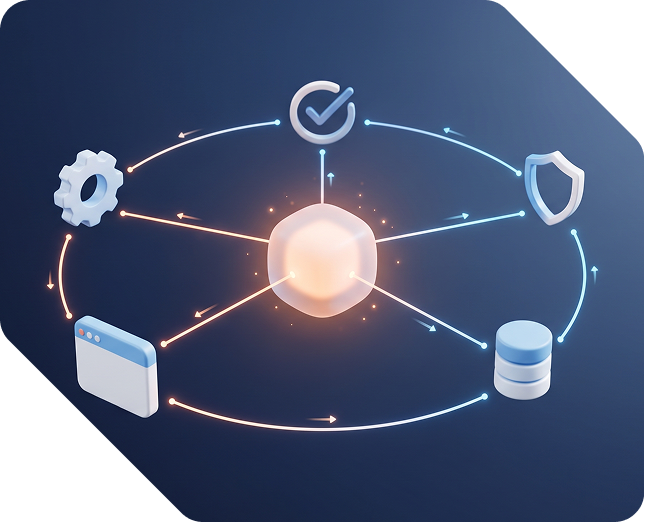


Your AI agent works in the demo and breaks in production. The common reaction is to blame the model and switch to a newer one. That rarely fixes anything, because the problem sits around the model, not inside it.
This article gives you a three-layer method to build an agent that holds up in real work: context, harness, and loop. You will learn how to scope the job, wrap the model in the right tools and controls, and prove it before you trust it. Each layer includes a short checklist you can run this week.
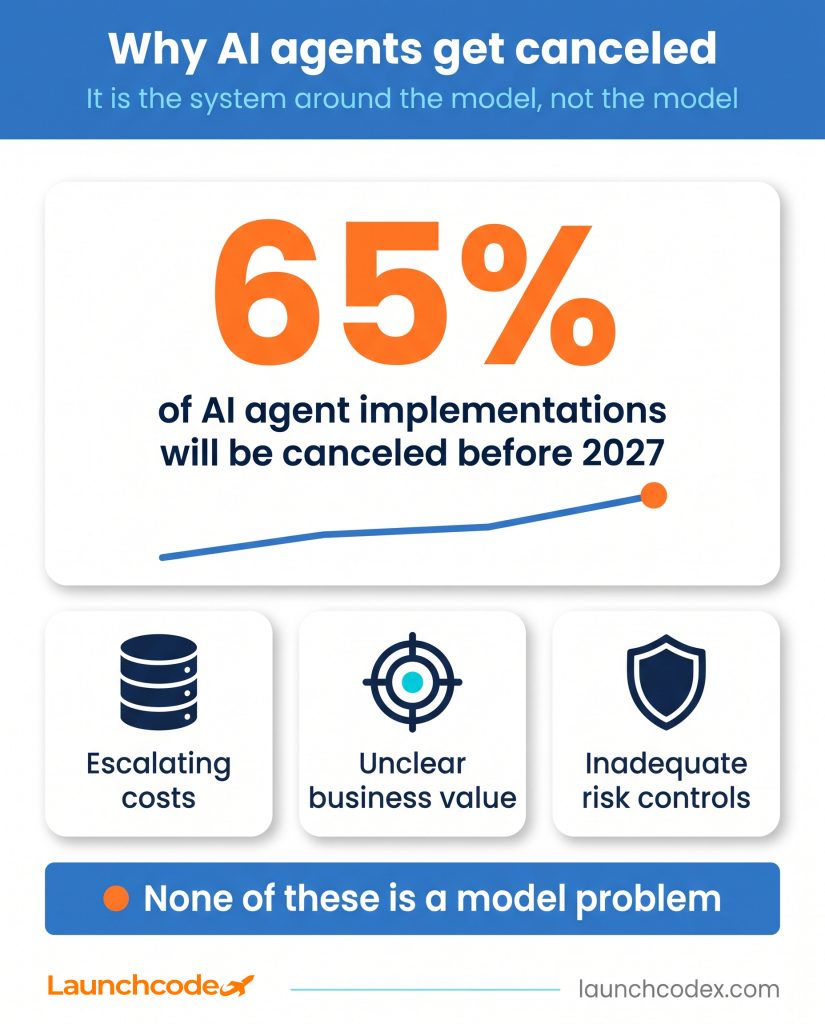
Agents fail on scope, cost, integration, and control, not on model intelligence. Gartner forecasts that more than 40 percent of agentic AI projects will be canceled by the end of 2027, and it names three causes: escalating costs, unclear business value, and inadequate risk controls. A smarter model fixes none of those. The fix is the system you build around it.
Ready to grow your organic traffic?
Get a free SEO audit from the Launchcodex team.
Look at those three causes. Each one lives in the build, not the model. Costs climb when nobody sets stop conditions. Value stays unclear when nobody defined what done means. Risk controls fail when no person can intervene. Gartner's Anushree Verma called most current projects early-stage experiments driven by hype and often misapplied.
A demo runs once, in a clean setting, with a friendly input. Production runs thousands of times against messy inputs, changing data, and edge cases. That gap is wide. According to McKinsey data compiled in this 2026 AI adoption analysis, nearly two-thirds of enterprises have experimented with AI agents, yet fewer than 10 percent have scaled them to real value. The experiment is easy. The scaled system is the hard part, and it is what this playbook covers.
Many tools marketed as agents are chatbots or automations with a new label. Gartner estimates that only about 130 of the thousands of vendors claiming agentic capabilities build genuine agents. Buying a relabeled chatbot and expecting agent behavior sets you up to fail before you write a single instruction.
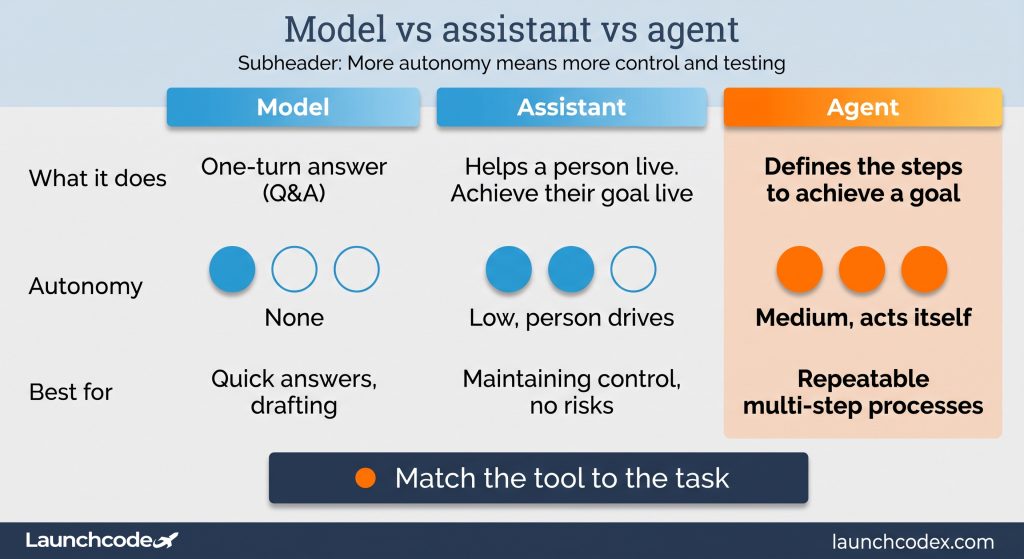
An AI agent is an LLM given a goal, access to tools, and enough autonomy to take steps toward an outcome. That is different from a chatbot that only answers, or an assistant that helps a person in real time. The distinction matters because it sets how much control and testing you need before the agent touches real work.
If you cannot describe the goal, the tools, and the point where the agent stops, you do not have an agent yet. You have a model in a chat window. Getting this definition right early prevents most downstream failures.
| System type | What it does | Autonomy | When to use it |
|---|---|---|---|
| Model or chatbot | Answers questions in a single turn | None | Quick answers, drafting, simple Q and A |
| Assistant | Helps a person complete a task live | Low, person drives | Support for someone who stays in control |
| Agent | Pursues a goal across multiple steps and tools | Medium, acts on its own | Repeatable jobs you want run without a person in every step |
Every reliable agent rests on three layers. Context sets the job. The harness gives the agent the means to do the job safely. The loop proves the agent before you scale it. Miss the context layer and the agent chases the wrong target. Miss the harness and it cannot act, or you cannot control it. Miss the loop and you find the failures in front of customers. The rest of this playbook works through each layer in order.
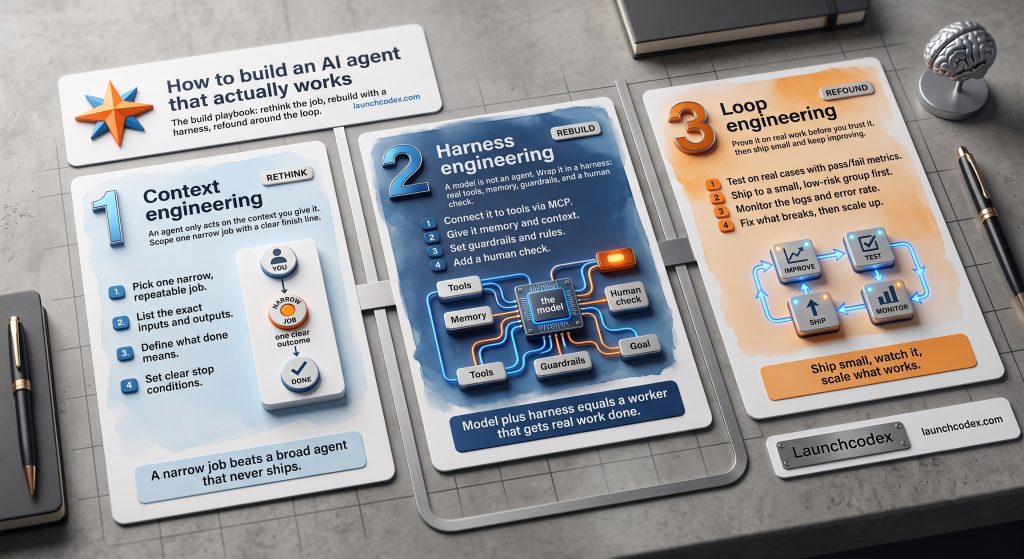
Context engineering means giving the model exactly what it needs to take the right next step, and nothing more. Andrej Karpathy describes it as filling the context window with the right information for the next step. For a working agent, that starts with one narrow, repeatable job and a clear finish line.
An agent only acts on the context you give it. A broad job with fuzzy edges produces broad, fuzzy behavior. A narrow job with clear inputs and a defined endpoint produces reliable behavior you can measure. This is the layer most teams rush, and it sets the ceiling for everything above it.
"On our own builds, the agents that hold up are scoped to a single job with a hard stop condition. When we skip that step, we spend about three times longer debugging behavior later." Derick Do, Co-Founder and Chief Product Officer
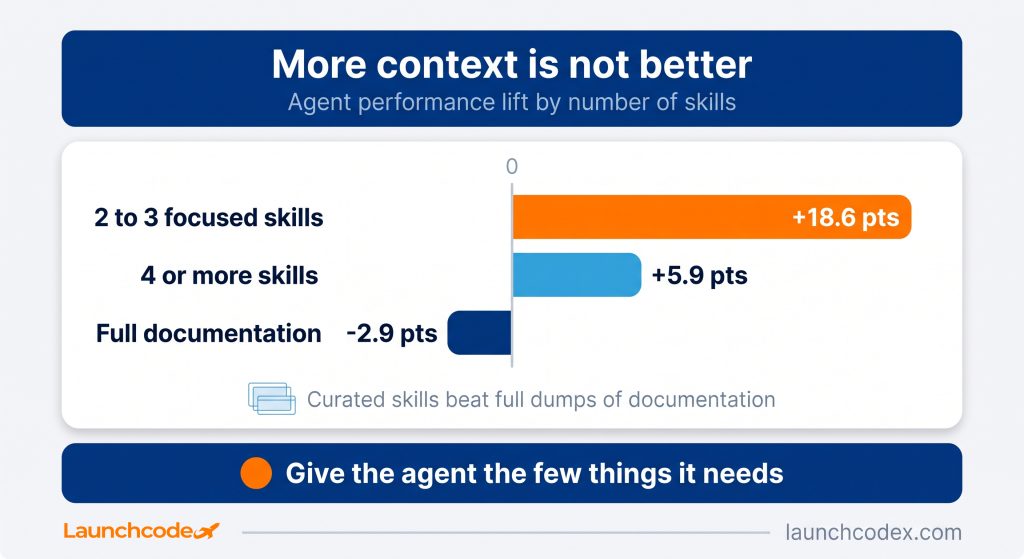
Teams often load the agent with every document and rule they can find, expecting better results. The opposite happens. Research summarized by InfoWorld found that two to three focused skills lifted agent performance by 18.6 points, while four or more collapsed the gain to 5.9 points, and full documentation reduced performance by 2.9 points. Curate the context. Give the agent the few things it needs, not everything you have.
A model is not an agent until you wrap it in a harness: real tools, memory, guardrails, and a human check. The harness lets the model act in your systems and keeps it inside safe limits. This is the layer teams underinvest in, and it is the single biggest reason capable models still produce broken agents.
Think of the model as the reasoning core and the harness as everything that makes it useful and safe. A strong model with no tools cannot act. A tool connected model with no guardrails is a liability. You need both, built deliberately.
The Model Context Protocol (MCP) is an open standard that connects an agent to tools and data through one shared interface, instead of a custom integration for every app. Anthropic introduced it in late 2024 and later gave it to the Linux Foundation. Adoption moved fast. The MCP SDK grew from roughly 100,000 downloads at launch to about 97 million monthly downloads within eighteen months, with more than 10,000 active public servers and support from OpenAI, Google, Microsoft, and Salesforce. Because it is vendor neutral, building on MCP lets you swap models later without rewriting every connection. Tools like Zapier's MCP server expose thousands of app connections through this one standard, which gives an agent reach without custom code for each system.
An agent that can act inside your business needs a person accountable for it and a fast way to stop it. Writing in Forbes, Robert Szczerba argued that the agents that survive will have a number attached to their job and a name on the override switch. Name the owner before launch. Build the stop before you build the scale.
"We connect every client agent to real tools through MCP, then gate the risky actions behind a human approval step. That one control has caught more bad outputs than any model upgrade." Derick Do, Co-Founder and Chief Product Officer
This is the discipline we apply when we scope AI automation and systems for clients: define the job, wire the tools, set the guardrail, and assign the human check before anything goes live.
Prove the agent on real work before you trust it, then ship small and improve. Agents are non deterministic, which means the same input can produce different outputs, so a passing demo does not mean a working system. Test against real cases with pass and fail metrics, release to a low risk group, monitor the logs, then scale what works.
This layer turns a promising build into a dependable one. It also protects your brand while you learn. Skipping it is how good agents cause real damage in front of customers.
Set clear pass and fail metrics tied to the job you defined in layer one. Goal completion rate, the share of tasks the agent finishes correctly, is a good anchor. Structure matters here too. InfoWorld reported that hybrid designs, which combine a structured workflow with agentic steps only where judgment is needed, reached an 88.8 percent average goal completion rate across five domains, beating agents left to act without structure. The practitioner view from CodeRabbit's David Loker matches this: treat agents as intelligence embedded in a workflow, not autonomous systems left to act on their own.
The stakes are concrete. Gartner predicts that in 2026, one third of companies will harm customer experience by deploying AI prematurely. A staged rollout keeps early mistakes small and private. It also gives you real data before you commit budget to scale.
Do not build an agent when a simpler tool does the job. If the task follows fixed rules with no judgment, use automation. If a person needs quick help but stays in control, use an assistant. Reserve agents for repeatable jobs that need judgment across several steps and that you want run without a person in every loop.
Building an agent for a task that does not need one adds cost and risk for no gain. The autonomy you are paying for becomes a liability instead of a benefit. Match the tool to the task.
Ask three questions. Does the task repeat often enough to justify a build? Does it need judgment that fixed rules cannot capture? Can you define a finish line and a stop condition? Only when all three answers are yes should you reach for an agent. This restraint is part of why real returns stay rare. Only 23 percent of organizations report significant ROI from AI agents, even though deployment is now nearly universal, according to a 2026 WRITER survey of 2,400 leaders.
"Most teams that ask us for an agent actually need a scoped automation. We map the workflow first, and about half the time the highest ROI move is not an agent at all." Tanner Medina, Co-Founder and Chief Growth Officer
The pattern across failed agents repeats. Teams focus on the model and neglect the context, the harness, and the loop. The three named causes behind Gartner's 40 percent cancellation forecast, cost, unclear value, and weak control, all live in those three layers. So does the fix.
Start narrow. Scope one repeatable job with a clear finish line. Wrap it in real tools, memory, guardrails, and a human check. Prove it on real cases, ship it to a small group, watch the logs, then scale. As WRITER's May Habib put it, the advantage goes to companies putting agent building power in the hands of people closest to the work. Give those people a method, and the agent stops being a demo and starts being a worker. If you want a partner to design and ship that system with you, that is the work Launchcodex does every day.
A chatbot answers questions in a single turn. An agent pursues a goal across multiple steps, uses tools, and takes actions on its own until it hits a defined finish line or stop condition.
No, but it helps. MCP is a shared standard for connecting an agent to tools and data. It reduces custom integration work and lets you change models later without rewiring every connection.
Testing usually uses clean inputs and runs once. Production brings messy inputs, changing data, and edge cases. The fix is loop engineering: real case testing, a staged rollout, and monitoring the error rate before you scale.
Give it a narrow job, set guardrails on what it can do, require human approval for high stakes actions, and name one owner who can shut it off. Control is designed in, not added later.
No. Use automation for fixed rule tasks and an assistant for live human support. Build an agent only for repeatable jobs that need judgment across several steps and that you want run without a person in every loop.




Most AI agents fail on scaffolding, not the model. Learn the 3-layer playbook, context, harness, and loop, to build an agent...
OpenAI custom audiences let you target, exclude, or bid on your own lists in ChatGPT Ads. See the 25,000 matched-user minimu...
Most agencies have strong client results that never get published. Learn how to turn those results into structured before-an...