
Share:

AI marketing & automation


OpenAI added custom audiences to ChatGPT Ads fast, and mostly without an announcement. Advertisers found the controls in the interface before the documentation caught up. That left conflicting numbers, thin guidance, and a lot of noise around a feature that changes how brands buy attention inside AI conversations.
This article gives you the current, confirmed picture. You will learn what custom audiences do, how big your list needs to be, how setup works, how the feature differs from Meta and Google, and whether it makes sense to test now. Where facts are still provisional, this piece says so.
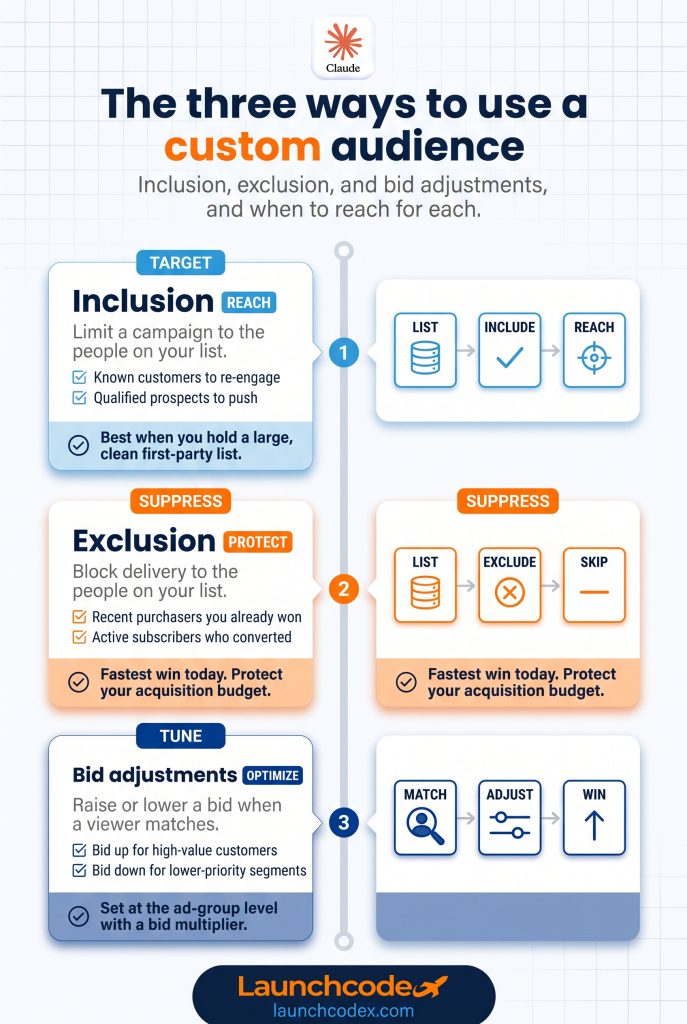
OpenAI custom audiences let advertisers upload their own customer or prospect lists to ChatGPT Ads, using email addresses or phone numbers. You can use a list three ways: include it to reach only those people, exclude it to skip them, or adjust bids when a viewer matches. OpenAI surfaced the feature in early July 2026, before any formal announcement.
OpenAI describes the feature plainly in its documentation. “Custom audiences let you apply your own customer or prospect lists.” The tool brings first-party data targeting, long standard on Google and Meta, into a conversational surface with real scale. Reuters reported ChatGPT passed more than 900 million weekly active users in June 2026.
The three uses each solve a different problem:
Advertisers found the controls first. Advertisers spotted the feature alongside advanced bid adjustments in early July 2026, which is why some early details were incomplete.
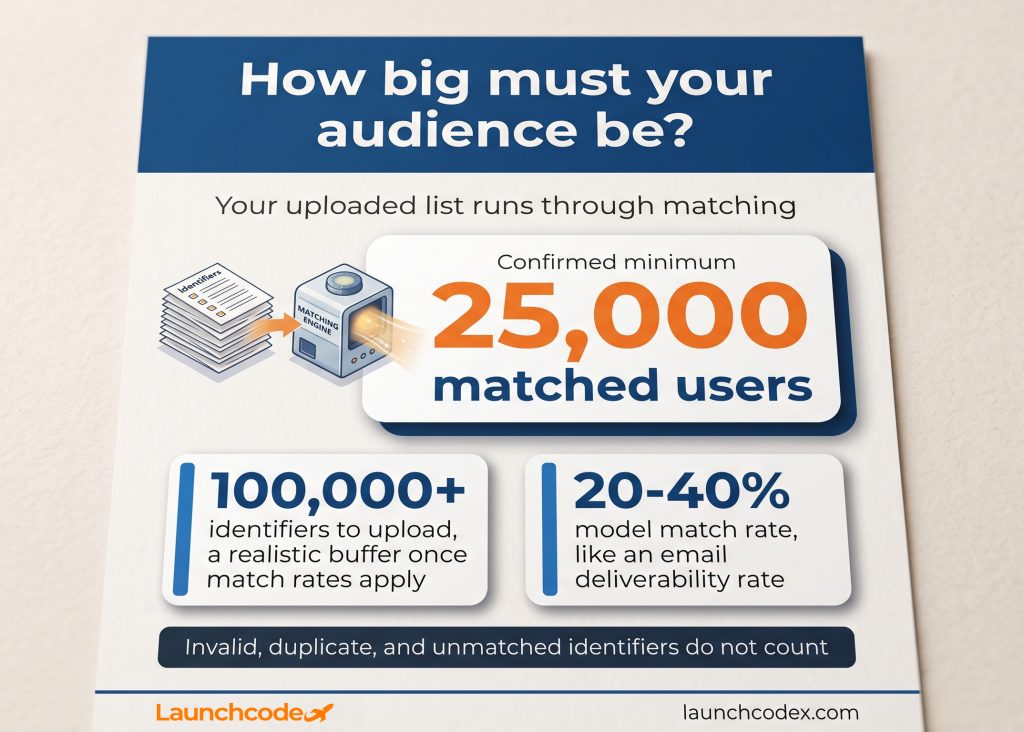
OpenAI’s documentation sets the minimum at 25,000 matched users, not uploaded rows. The beta interface first showed a tooltip citing 100,000 identifiers, which likely counts raw uploads before matching. Both numbers can be true. You may need well over 100,000 contacts on your list to clear 25,000 matched users, because unmatched, invalid, and duplicate identifiers do not count.
Most early coverage got this point wrong. An audience shows a “too small” status until it reaches the matched-user minimum stated in OpenAI’s setup documentation. Match rates matter here because ChatGPT accounts are not as universal as Facebook accounts, and people often sign up with a different email than the one in your CRM.
Paid media educator Jon Loomer called the feature “how incredibly basic this is” and flagged the 100,000 identifier tooltip before OpenAI published its docs. The practical takeaway is simple. Plan for shrinkage. If your goal is 25,000 matched users, a raw list of 100,000 or more gives you a realistic buffer.
“We tell clients to treat the match rate like an email deliverability rate. Model 20 to 40 percent, then size the upload backward from the 25,000 floor.” Tanner Medina, Co-Founder & Chief Growth Officer
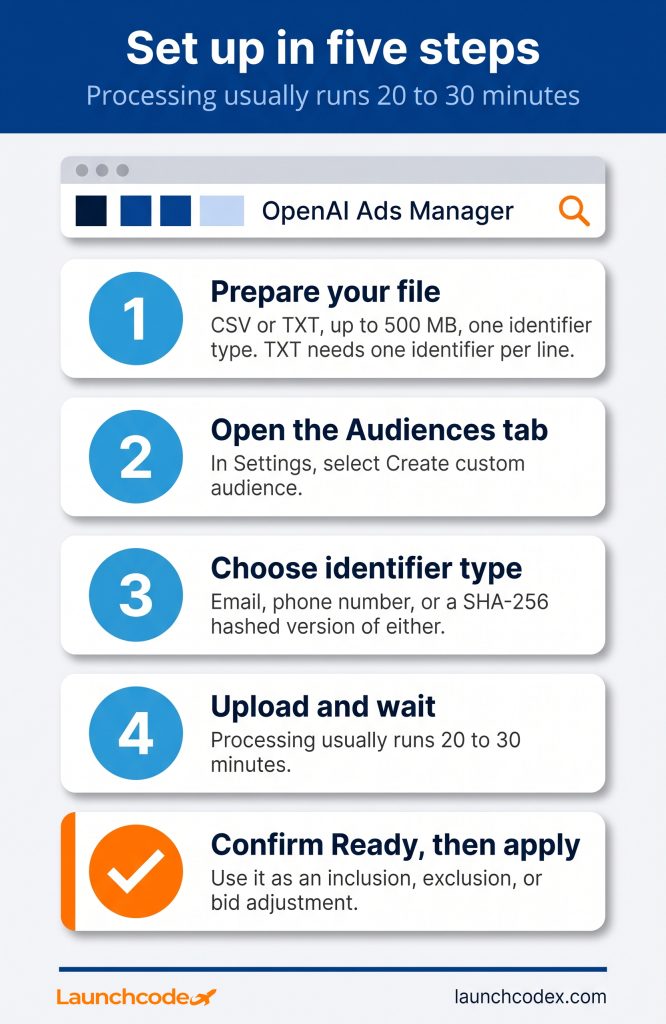
Setting up a custom audience takes a CSV or TXT file, one identifier type per upload, and about 20 to 30 minutes of processing. Prepare emails, phone numbers, or their SHA-256 hashed versions. Upload in the Audiences tab under Settings, name the audience, and wait for a Ready status before you apply it to a campaign.
The steps are simple for anyone who has run Google or Meta list uploads:
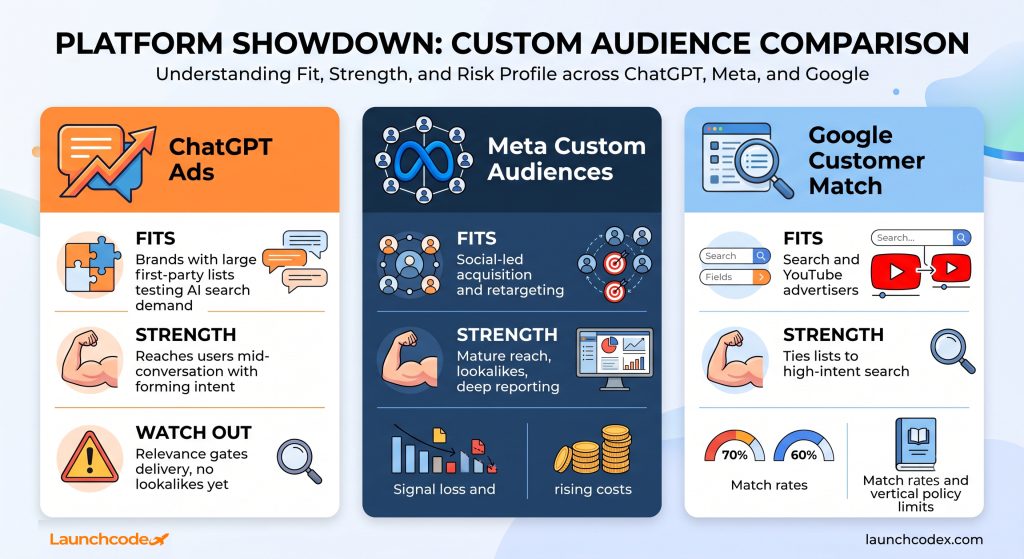
ChatGPT custom audiences look like Meta and Google customer match, but delivery works differently. OpenAI runs a relevance-weighted, second-price auction, so a matched list does not force your ad to appear. Relevance to the live conversation still decides whether you win the placement. Your audience sharpens who you reach, not whether the ad shows regardless of context.
On Meta, a matched audience serves whenever you win the auction. On ChatGPT, the relevance-weighted, second-price auction weighs how well your ad and landing page fit the current conversation. That protects the chat experience and changes how you plan a list. The audience is a signal, not a guarantee.
One feature is still missing. OpenAI does not offer lookalike audiences yet, so you cannot scale from a seed list to a statistically similar group the way Meta allows.
| Platform | Who it fits | Key strength | Watch out for |
|---|---|---|---|
| ChatGPT Ads custom audiences | Brands with large first-party lists testing AI search demand | Reaches users mid-conversation with forming intent | Relevance gates delivery, no lookalikes yet |
| Meta custom audiences | Social-led acquisition and retargeting | Mature reach, lookalikes, deep reporting | Signal loss and rising costs |
| Google Customer Match | Search and YouTube advertisers | Ties lists to high-intent search | Match rates and vertical policy limits |
“Do not port your Meta playbook over. On ChatGPT, a strong context hint plus a relevant landing page moves delivery more than the list itself.” Derick Do, Co-Founder & Chief Product Officer
Test ChatGPT custom audiences now if you hold a large, clean, consented first-party list and already run performance media. The exclusion use case delivers value right away, letting you suppress existing customers from acquisition spend. Wait if your list is small or your data consent is unclear. In regulated sectors, clear a legal review before you upload anything.
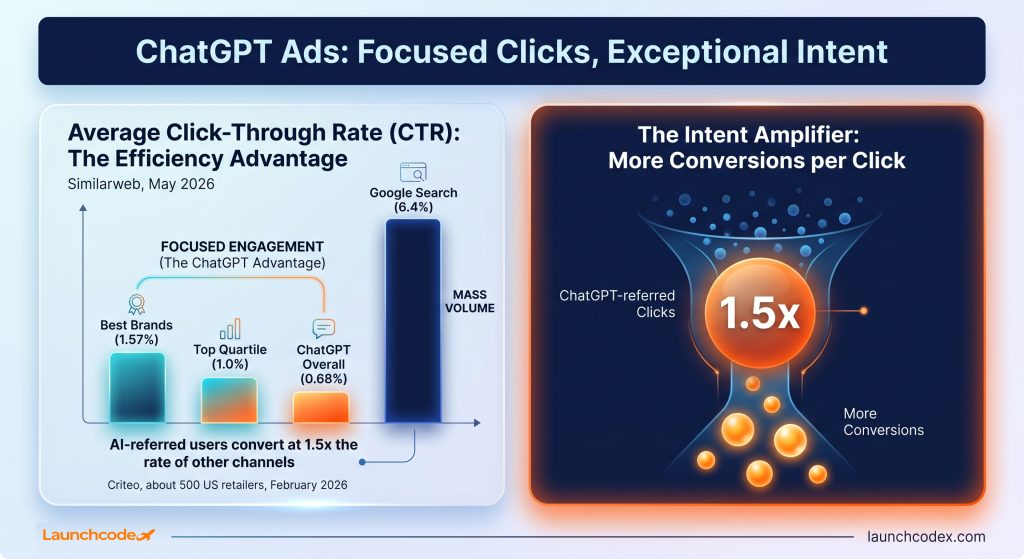
The intent quality argument supports testing. Similarweb put the average ChatGPT ads click-through rate at 0.68% in May 2026, well below Google Search. Criteo data from about 500 US retailers found that AI-referred users converted at roughly 1.5 times the rate of other channels. Low click volume can still pay off when intent runs high.
Craig Graham, a paid media consultant, told trade press the feature moves ChatGPT Ads “closer to the kind of first-party data targeting” that serious advertisers already use. Not everyone agrees on urgency. Agency founder Anthony Higman said the feature does little for his legal-vertical clients, while expecting others to welcome it. Value depends on your vertical and list quality.
Uploading customer data creates real obligations. OpenAI’s Ad Tools Terms, published in mid June 2026, define how advertiser Audience Data can be used. SHA-256 hashing lets you upload without sharing raw identifiers. At Launchcodex, we audit first-party data consent and run a small, instrumented test tied to cost per outcome before we scale any new channel.
Custom audiences make ChatGPT Ads look more like the performance channels your team already runs, though the platform is young and some details stay provisional. The context confirms the direction. OpenAI opened self-serve buying to all US businesses on May 5, 2026, as PPC Land documented the timeline, and custom audiences are the next step toward first-party targeting.
Start with exclusion to protect acquisition budget. Build a clean, consented list large enough to clear the 25,000 matched-user floor. Pair a small test with disciplined measurement, and treat early figures as directional. That approach turns a fast-moving beta into a usable channel without overcommitting spend.
OpenAI requires 25,000 matched users. Because match rates run low, plan for a raw list well above 100,000 identifiers to clear that bar.
Yes. Exclusion audiences prevent delivery to people on your list, which helps you suppress recent purchasers or active subscribers from acquisition campaigns.
The concept matches, but delivery differs. ChatGPT weighs conversation relevance in a second-price auction, so a matched list refines reach instead of forcing your ad to appear.
You can upload SHA-256 hashed emails or phone numbers instead of raw values. Review OpenAI’s Ad Tools Terms, confirm data consent, and seek legal review in regulated sectors.


Real stories from the people we’ve partnered with to modernize and grow their marketing.