


The performance marketer's guide to media planning and buying that actually converts
Learn how to build a media plan that drives real conversions. This guide covers full-funnel channel strategy, programmatic b...





Most performance marketers do not have a planning problem. They have a "skipping the plan" problem. Budget gets approved, channels get picked, ads go live, and two months later someone is asking why CPA is climbing with no clear answer. The plan was never built to convert. It was built to spend.
This guide walks through the full workflow: how to structure a media plan that assigns each channel a specific funnel role, how to buy more efficiently using programmatic tools and AI automation, how to protect budget from the most common forms of waste, and how to measure what actually drove revenue rather than what a platform dashboard wants you to believe.
Media planning is the strategic phase. Media buying is the execution phase. They are not interchangeable. Treating them as the same thing is one of the most common reasons campaigns underperform. The plan defines who you target, which channels carry which messages, how budget gets distributed, and what success looks like at each stage. Buying is what happens after those decisions are made.
Ready to grow your organic traffic?
Get a free SEO audit from the Launchcodex team.
The distinction matters because each requires a different skill set and a different timeline. Planners analyze audience data, assess channel fit, model reach and frequency, and build a brief that guides every buying decision. Buyers configure DSPs, negotiate placements, set bid strategies, and monitor pacing in real time. When both functions operate from the same brief, campaigns run efficiently. When they do not, you get channels chosen by habit and budgets allocated by gut feel.
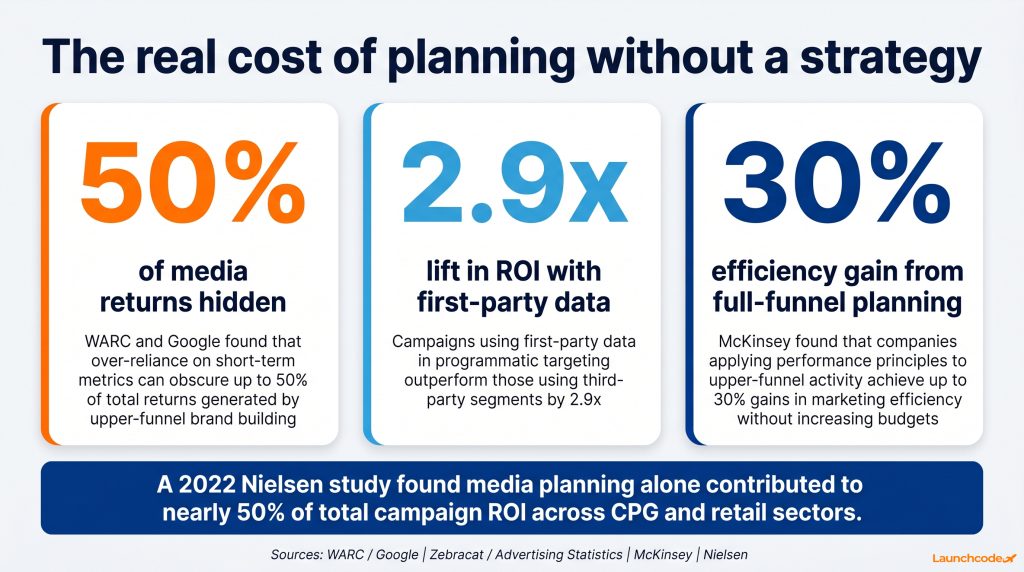
A 2022 Nielsen study found that media planning contributed to nearly 50% of total campaign ROI across CPG and retail sectors. Brands that invested in data-driven planning saw a 30% lift in brand awareness compared to brands that skipped the strategy phase and went straight to buying.
Before any buying happens, a strong media plan requires four inputs.
"When a client cannot define what a conversion is worth to them before we start, the plan is already broken. We set that number first, before recommending a single channel." Brittany Charles, SVP Client Services, Launchcodex
Plans fail because they are built around budget distribution rather than audience behavior. You decide how much to spend on each channel based on what worked before, what a platform rep recommended, or what competitors appear to be doing. None of those inputs tell you whether a channel will convert for your specific audience and offer.
The practical result is over-investment in bottom-funnel channels and underinvestment in the upper- and mid-funnel activity that builds the audience those conversion campaigns need to close. WARC and Google research found that an over-reliance on short-term metrics can obscure up to 50% of total media returns generated by longer-term brand building.
McKinsey data reinforces this directly. Companies that apply performance principles to upper-funnel activity can achieve up to 30% gains in marketing efficiency and up to 10% incremental top-line revenue growth without increasing budgets.
Most teams do not have a planning problem on paper. The brief exists. The channel list exists. The budget is approved. The gap is connecting those inputs to conversion logic.
Common failure points:
Fixing these gaps before launch separates plans that produce revenue from plans that produce activity reports.
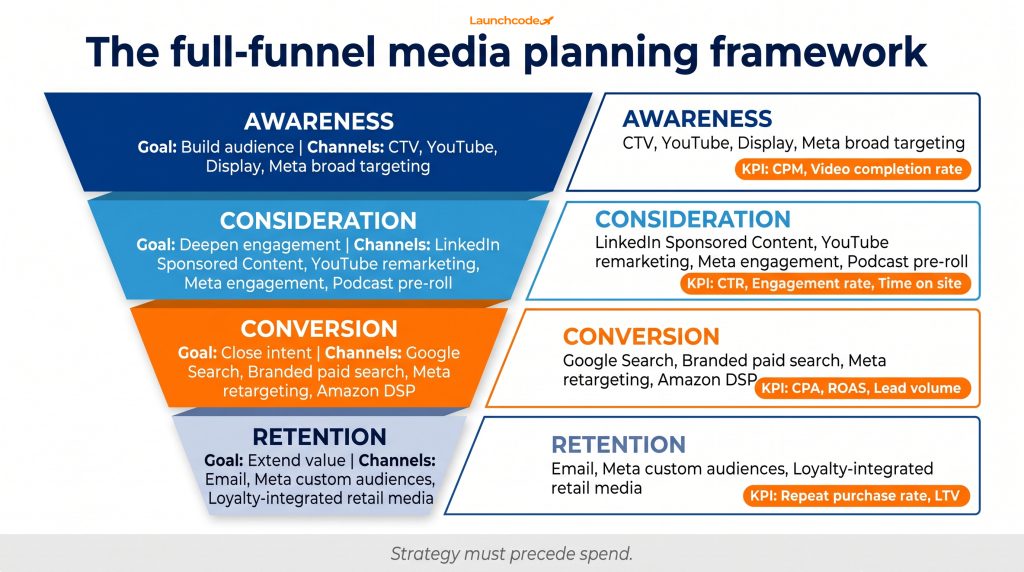
A full-funnel channel strategy gives each platform a specific job. Awareness channels build the audience. Consideration channels deepen engagement. Conversion channels close demand that already exists. Running all channels on the same objective and measuring them by the same KPI produces misleading results and inefficient spend.
The multi-channel approach consistently outperforms single-channel plans. Campaigns using three or more channels see purchase rates almost three times higher than single-channel campaigns. The payoff extends beyond wider reach. It creates continuity across the customer journey.
Use this framework to assign platforms to funnel stages based on audience intent and format behavior.
| Funnel stage | Goal | Channels that fit | Primary KPI |
|---|---|---|---|
| Awareness | Build audience | CTV, YouTube, display, Meta broad targeting | CPM, video completion rate |
| Consideration | Deepen engagement | LinkedIn Sponsored Content, YouTube remarketing, Meta engagement, podcast pre-roll | CTR, engagement rate, time on site |
| Conversion | Close intent | Google Search, branded paid search, Meta retargeting, Amazon DSP | CPA, ROAS, lead volume |
| Retention | Extend value | Email, Meta custom audiences, loyalty-integrated retail media | Repeat purchase rate, LTV |
Bottom-funnel channels like Google Search and branded retargeting are the most efficient converters in most plans. They can only close demand that upper- and mid-funnel activity built. Over-investing in conversion campaigns at the expense of awareness and consideration creates a pipeline that dries up within two to three months.
One of the most overlooked conversion levers in media planning is matching creative format to funnel stage. Sending a direct-response ad to a cold audience that has never encountered your brand wastes impressions and trains the algorithm on the wrong signal.
A practical format guide by stage:
Budget allocation should follow audience behavior and platform efficiency data, not channel popularity or last year's split. The biggest waste in most media plans is the wrong timing. Running continuous spend through high-CPM windows drives up cost-per-conversion without increasing qualified reach.
CPMs surge up to 66% during the Q4 holiday season, with peak periods like Black Friday and Cyber Monday seeing rates as much as 138% higher than annual averages. For brands outside direct-to-consumer retail, running at peak CPM means paying premium rates for an audience distracted by retail noise.
Flighting concentrates spend in periods where audience intent is highest and CPMs are lowest for your category. The goal is better cost-per-acquisition, not a pause in activity.
A practical flighting decision process:
"The biggest CPM trap we see is brands running their standard cadence straight through Q4 in categories where their audience is focused elsewhere. You end up paying Black Friday rates to reach people who are not thinking about your product." Olivia Tran, AVP Media Services, Launchcodex
In the US, more than 90% of digital display impressions now trade programmatically. That makes programmatic literacy a baseline requirement for any performance marketer. The core mechanic is real-time bidding: your DSP enters an auction for every available impression, evaluates it against your targeting criteria, and places a bid in milliseconds. The highest relevant bid wins the placement.
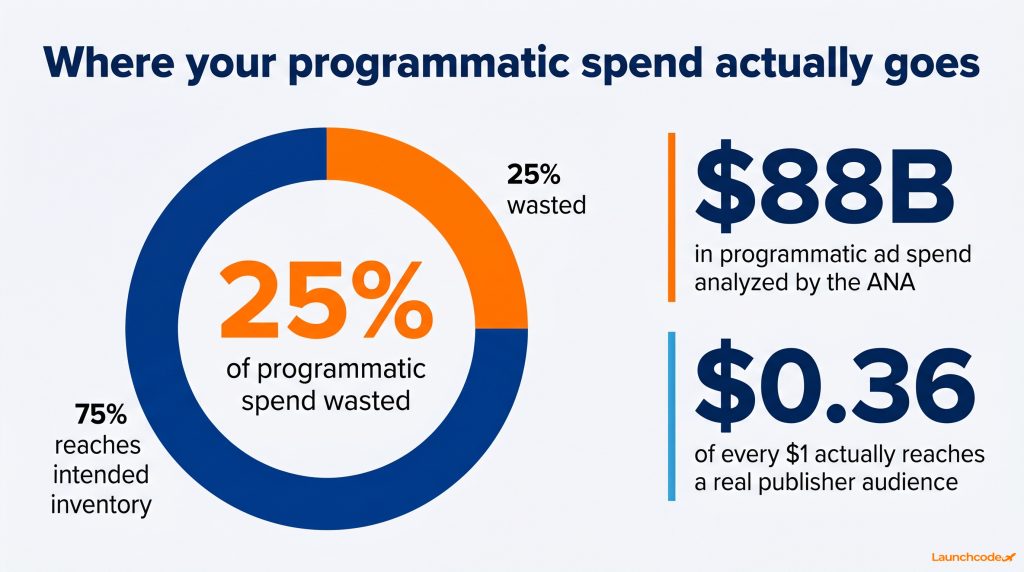
ANA research analyzing $88 billion in programmatic ad spend found that 25% of it was wasted on invalid traffic, low-quality inventory, and made-for-advertising sites. Only $0.36 of every $1 actually reached a real publisher audience. Programmatic scale creates programmatic waste when buying parameters are not configured carefully.
| Buying model | How it works | Best for | Watch out for |
|---|---|---|---|
| Open exchange (RTB) | Real-time auction across all available inventory | Scale and reach | Higher fraud risk, variable quality |
| Private marketplace (PMP) | Invite-only exchange with premium publishers | Brand safety, quality inventory | Higher floor prices |
| Programmatic guaranteed | Reserved inventory at a fixed CPM, purchased programmatically | Predictability and planning | Less flexibility mid-flight |
| Direct IO | Manual negotiation and placement with a publisher | High-impact placements, exclusive formats | Labor-intensive, no automation |
For most performance campaigns, a combination of PMP and open exchange with strong brand safety filters and fraud detection active produces the best balance of reach, quality, and cost efficiency.
First-party data is the most powerful targeting input available to performance marketers right now. Campaigns using first-party data in programmatic targeting see a 2.9x lift in ROI compared to campaigns using third-party segments. First-party targeting is a performance upgrade that happens to align with privacy requirements.
As Michael Hew, Director of Reporting and Technology at M+C Saatchi Performance, put it: "First-party data is often an overlooked asset. By dedicating teams to analyze, optimize, and activate this data, brands can transform it into a powerful tool for driving actionable insights and improved performance."
Most brands collect first-party data but do not activate it systematically inside their media buying. CRM records, website behavior, purchase history, and email engagement signals sit in separate systems and never make it into audience configuration inside Google Ads, Meta, or a DSP. Activation is the step that turns data ownership into performance advantage.
Zero-party data is what customers voluntarily share through quizzes, preference centers, and loyalty programs. It carries stronger signal than behavioral inference because it reflects stated intent rather than observed behavior. Brands that collect zero-party data through interactive formats build richer audience segments that perform better in both prospecting and retargeting campaigns.
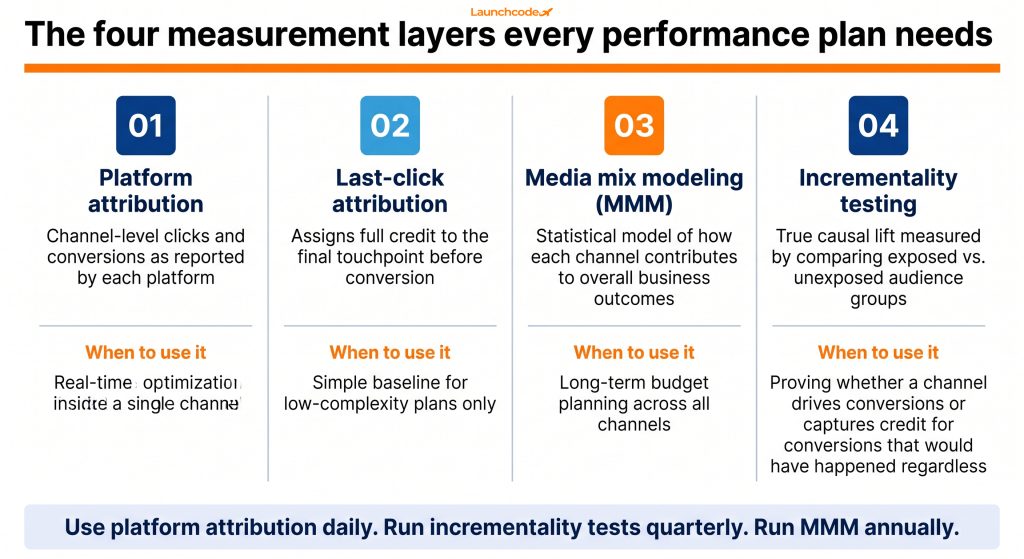
AI has moved from experimental to operational inside most media buying workflows. Advertisers using AI-driven bidding strategies see up to 45% better CPA performance compared to manual approaches, and brands integrating AI throughout campaigns are reporting ROAS improvements of 50% or more while reducing manual labor by up to 80%. The question is no longer whether to use AI in buying. It is which decisions to automate and which to keep human.
McKinsey estimates that generative AI could increase marketing function productivity by 5 to 15% of total marketing spend, effectively freeing budget to move into higher-impact activities. For performance teams operating under efficiency pressure, that is a meaningful reallocation.
AI performs best on high-frequency, data-dense decisions that happen faster than any team can process manually.
Automate:
Keep human:
Meta's Advantage+ Shopping Campaigns show what AI buying looks like in practice. Advantage+ delivers a 17% lower CPA compared to manually configured campaigns by automating audience targeting and creative serving within Meta's ecosystem. Campaign structure and creative inputs still require human strategy to work from.
In-platform ROAS is the number every platform wants you to optimize against. It is also the least reliable indicator of whether your media spend is actually driving business growth. Nielsen found that only 53% of marketers are confident in their ability to measure performance across the full funnel, and 69% say channel fragmentation makes it hard to understand how channels work together. Your measurement stack needs to match the complexity of your plan.
When ANA research showed that only $0.36 of every programmatic dollar reaches a real publisher audience, it also revealed that platform-reported metrics are built on a smaller foundation than they appear. In-platform ROAS numbers often reflect inflated efficiency while the underlying cost structure works against the campaign.
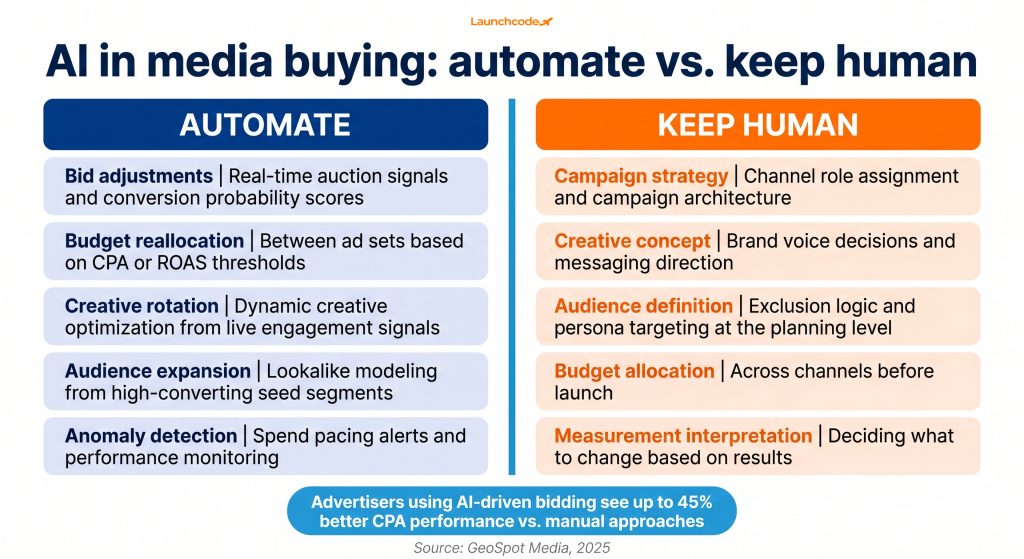
| Layer | What it measures | When to use it |
|---|---|---|
| Platform attribution | Channel-level clicks and conversions as reported by each platform | Real-time optimization inside a single channel |
| Last-click attribution | Assigns full credit to the final touchpoint before conversion | Simple baseline for low-complexity plans only |
| Media mix modeling (MMM) | Statistical model of how each channel contributes to overall business outcomes | Long-term budget planning across all channels |
| Incrementality testing | True causal lift measured by comparing exposed vs. unexposed audience groups | Proving whether a channel drives conversions or just captures credit for ones that would have happened regardless |
The most actionable approach is to use platform attribution for daily optimization, run incrementality testing to validate channel-level decisions quarterly, and run a media mix model annually to inform overall budget allocation.
Last-click attribution gives 100% of conversion credit to the final touchpoint before purchase. In a multi-channel media plan, that means paid search and bottom-funnel retargeting capture all the credit while awareness and consideration channels that built the demand register as zero contributors.
The result is a predictable budget shift: cuts to upper-funnel channels that were actually driving pipeline, and more spend on bottom-funnel channels that were closing it. This pattern compresses the pipeline. Within two to three quarters, conversion volume drops because no new audience is entering the top of the funnel.
The gap between a media plan that spends and one that converts comes down to three decisions made before launch: how channels are assigned to funnel roles, how budget is timed to match audience intent, and how measurement is configured to capture real causal impact rather than platform-reported credit.
At Launchcodex, media planning sits inside a broader performance framework where data infrastructure, audience segmentation, and creative strategy feed into every buying decision. That connection between analytics and execution prevents the most common failure modes: wrong channel, wrong timing, wrong measurement.
The workflow in this guide is a starting point. Every brand's audience, category, and competitive context shapes which channels belong in the mix and at what budget weight. What does not change is the sequence: plan with intent, buy with precision, measure what actually moved the business.
If your current media approach is producing activity but not revenue, the problem is usually in the plan.
Media planning is the strategic process of deciding which channels, audiences, and formats a campaign will use before any spend occurs. Media buying is the tactical process of purchasing, placing, and optimizing those ad placements. Planning sets the brief. Buying executes it.
ANA research analyzing $88 billion in programmatic ad spend found that 25% went to invalid traffic, low-quality inventory, and made-for-advertising sites. Only $0.36 of every dollar reached a real publisher audience. Setting brand safety filters, viewability thresholds, and invalid traffic controls significantly reduces this waste.
Incrementality testing measures the true causal lift a channel produces by comparing audiences that were exposed to an ad against audiences that were not. It answers whether a channel actually drove a conversion or simply appeared in the path of someone who would have converted regardless. It is the most reliable way to validate channel performance beyond platform attribution.
Campaigns using first-party data in programmatic targeting see a 2.9x lift in ROI compared to campaigns using third-party segments. First-party data includes CRM records, website behavior, purchase history, and email engagement. Uploading this data to ad platforms as customer match lists and building lookalike audiences from top-performing segments improves both targeting accuracy and conversion rates.
AI bidding tools outperform manual approaches on high-frequency decisions like real-time bid adjustments and creative rotation. Advertisers using AI-driven bidding see up to 45% better CPA performance. Manual control remains important for campaign strategy, audience definition, budget allocation across channels, and interpreting what measurement data actually means.
A full-funnel media strategy assigns each channel a specific role across the customer journey. Awareness channels build the audience, consideration channels deepen engagement, and conversion channels close existing demand. Running all channels on the same conversion objective and measuring them by the same KPI produces misleading data and typically erodes upper-funnel investment over time.



Learn how to build a media plan that drives real conversions. This guide covers full-funnel channel strategy, programmatic b...
Pay-per-lead costs $140 to $200 in higher ed and half of purchased leads never respond. Learn to vet vendors, meet TCPA requ...
Google banned demographic targeting for finance campaigns. Meta made Special Ad Categories mandatory. Here is what still wor...