

Share:

AI marketing & automation


Google quietly overhauled its Business Profile review rules in April 2026, and many businesses have not caught up. Reviews are disappearing. Profiles are getting warning banners. Some teams are still running review processes that became policy violations weeks ago.
This article covers exactly what changed, when it happened, what is now banned, and what a compliant review strategy looks like under the updated rules. If you manage a Google Business Profile, run local SEO for clients, or oversee marketing for a multi-location brand, this is what you need to act on now.
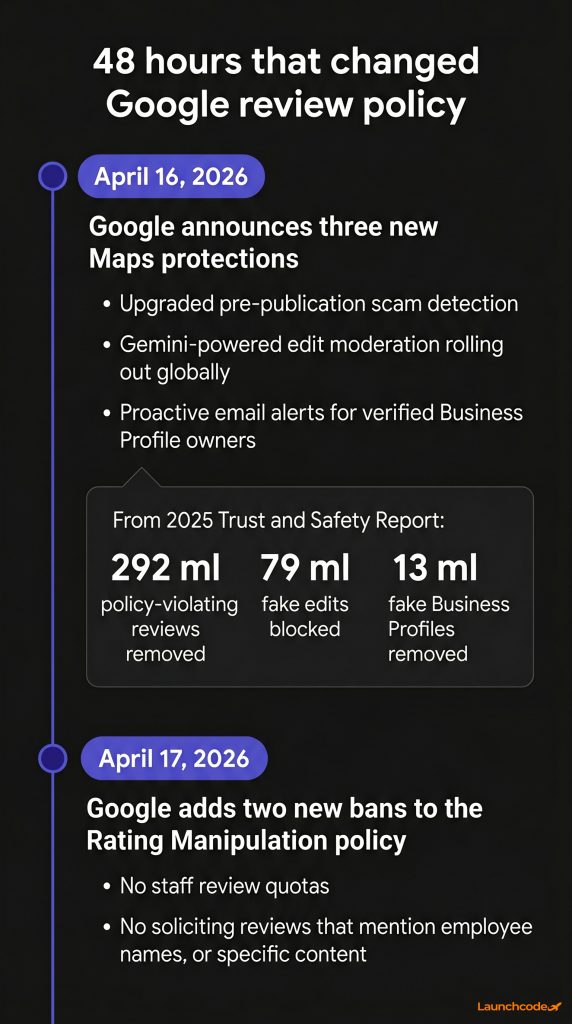
Two separate but connected events happened in less than 48 hours. On April 16, 2026, Google published its 2025 Trust and Safety Report alongside three new Maps protections. The next day, Google quietly added two new clauses to the Maps Rating Manipulation policy. Together, these changes represent the most significant review enforcement update Google has made in years.
Most coverage treats these as a single event or misses one entirely. They are connected, but they serve different purposes. The April 16 announcement focused on what Google is building to protect businesses from external abuse. The April 17 policy update focused on what Google now prohibits businesses from doing themselves. Understanding both matters.
The April 16 announcement came from Bibek Samantaray, Group Product Manager for User Generated Content at Google. It introduced three new defensive measures:
The following day, Amy Toman, a Google Diamond Product Expert, spotted and shared two new clauses added to the Maps User Generated Content Policy under the Rating Manipulation section. The policy now explicitly prohibits merchants from:
Both were common practices. Many businesses ran monthly staff contests tied to review counts or trained teams to ask customers to mention a specific employee. Both are now violations.
Toman noted in her LinkedIn post that she expects Google added these rules because it has seen too many review contests and quota-based programs. The wording of the second clause raised questions in the practitioner community. Miriam Ellis of Miriam Ellis Consulting pointed out that the phrase “reviews that include specific content” could be read broadly enough to restrict any content-specific prompting, including asking customers to review a particular product or menu item. Toman agreed the implications seemed broader than intended but had not received clarification from Google on the exact scope.
Until Google confirms the intended scope, keep every review request completely open-ended.
The updated policy creates a clear picture of prohibited practices. Incentivized reviews, review gating, on-premises pressure, staff quotas, and content direction are all now explicit violations. Google’s enforcement infrastructure is active and catches these patterns automatically.
Here is the full current list of prohibited practices under the Rating Manipulation and Fake Engagement policies:
The full Rating Manipulation policy also flags unusual volume spikes as signals of manipulation regardless of intent.
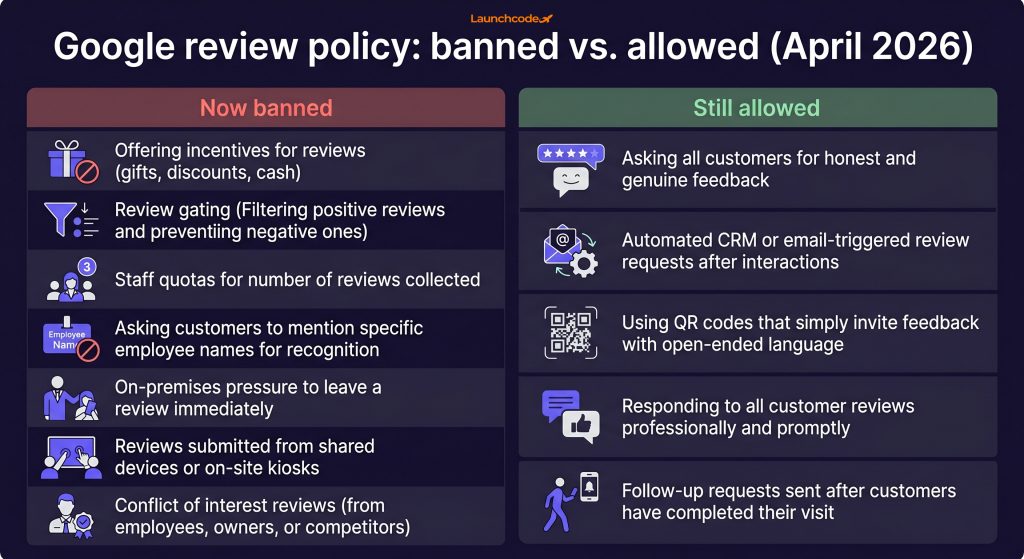
Review gating is one of the most common violations and one of the least well understood. Many businesses assume they are following the rules as long as they ask nicely. The violation is not the ask. It is the filter.
Sending review requests only to customers you expect to respond positively, while skipping customers who had a poor experience, is gating. The practice itself is the problem, regardless of how politely you phrase the request. The policy requires that review requests go to all customers equally.
96 percent of consumers specifically seek out negative reviews before making a purchase decision. A profile with gated reviews often looks too clean. It signals manipulation before any enforcement ever happens.
Google’s enforcement is no longer primarily reactive. The 2025 Trust and Safety Report shows that Google blocked or removed over 292 million policy-violating reviews in 2025, while more than 1 billion reviews were submitted in total. That is roughly 22 percent of all review activity classified as a violation. Gemini-powered systems now catch fake content, coordinated posting patterns, and policy-violating edits before they reach the public.
Most businesses assume review enforcement works like a manual complaint process. It does not. Google’s systems monitor patterns continuously: review volume spikes, shared device signatures, IP clustering, account activity history, and content similarity across submissions.
“Review enforcement used to be slow enough that businesses could react after the fact. Gemini changes that. When a system catches a pattern before it goes live, the window for bad actors closes fast, and so does the window for accidental violations.”
Derick Do, Co-Founder and Chief Product Officer, Launchcodex
Google’s Gemini models are applied to two types of content.
First, profile edits. Gemini checks suggested changes to business names, categories, hours, and other attributes against policy before they go live. A competitor changing your business category or embedding political commentary in your business name would previously require you to notice and report it after the fact. Now Google catches it before publication.
Second, review patterns. Gemini tracks review signals over time, including account age, activity history, and submission context. Reviews from accounts with no prior activity, reviews submitted from the same device or network as dozens of others, and reviews that use identical or near-identical phrasing all trigger filtering.
Fake reviews on Google Maps increased 21 percent year over year in 2025, according to Google data. That volume growth is a direct consequence of generative AI making fake review production easier. Gemini-powered detection is Google’s response to that acceleration.
According to BetaNews reporting on the official Google announcement, when Google detects a sudden spike in spam reviews, the enforcement response now includes four automatic actions: removing the fake content, pausing new reviews on the profile, alerting the Business Profile owner, and displaying a public notification banner to consumers explaining why contributions are temporarily paused.
That banner is visible to every potential customer searching for your business. That is a real reputational cost even when the attack is not your fault.
Penalties under the updated Fake Engagement policy range from review removal to full profile restrictions. The Google Business Profile restrictions page outlines three escalating consequences: temporary loss of the ability to receive new reviews, temporary unpublishing of existing reviews, and a public warning banner stating that fake reviews were removed. Full profile suspension is possible for repeated or severe violations.
Most businesses that encounter enforcement in the short term will see review removal first. That is the most common initial outcome.
The public warning banner is the most damaging penalty to consumer trust. A profile displaying that banner tells every visitor that the business was found to have fake reviews. It does not specify which reviews or what the violation was. The result is a trust signal working against the business at the exact moment a potential customer is making a decision.
73 percent of all online reviews globally are hosted on Google. 88 percent of consumers read those reviews before engaging with a local business. A warning banner on a Google Maps profile hits the top of the acquisition funnel directly.
If you believe reviews were removed incorrectly, the Reviews Management Tool inside Google Business Profile is the correct path for appeals. Document the pattern before filing, including which reviews were removed, when they were posted, and what your review request process looked like at the time.
Do not try to replace removed reviews quickly. A rapid volume spike is one of the exact patterns that triggers further automated removal. Steady, compliant review activity over time is the correct recovery approach.
Asking for reviews is still allowed. Google’s policy is explicit: merchants are permitted to solicit and encourage the posting of content that represents a genuine experience. The restrictions are on how you ask, who you ask, and what you ask for. A compliant process sends neutral requests to all customers, uses your own channels, and leaves the content entirely to the reviewer.
“The businesses that recover fastest from this update are the ones that already had a post-service follow-up system in place. When the review ask is built into the customer journey, compliance is straightforward. When it relies on a staff script, it is a liability.”
Tanner Medina, Co-Founder and Chief Growth Officer, Launchcodex
Here is what a compliant review collection process looks like in practice:
The restriction is not on asking. It is on directing. Businesses can and should invite customers to share honest feedback. QR codes, follow-up emails, receipts, and CRM-triggered messages are all compliant when the request language is neutral and goes to all customers.
The line is clear: asking customers to write reviews containing specific content, pushing them to post before they have left your premises, or tying any reward or consequence to the act of reviewing. Stay on the right side of that line and your review strategy remains intact.
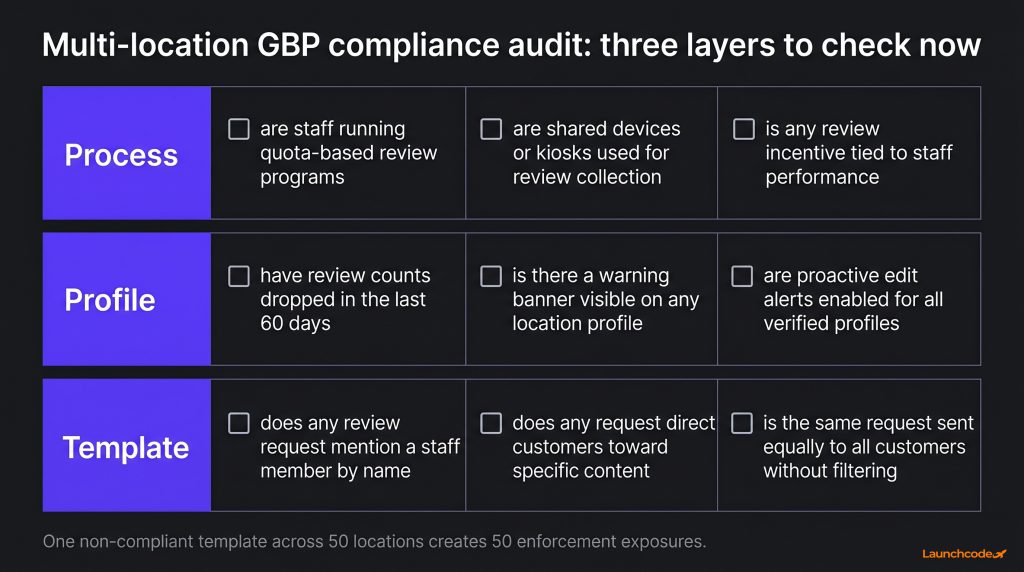
For brands operating ten, fifty, or hundreds of locations, one non-compliant review process replicated at scale is not one violation. It is one violation per location. A structured staff quota program or a shared-device review kiosk deployed across a franchise system could expose every location in that system to enforcement at the same time.
Widewail, a reputation management platform, put the staff quota issue plainly: tying a salesperson’s bonus to ten five-star reviews per month is now a direct liability. Google treats quotas as evidence of biased solicitation because they create pressure that shapes what customers actually write.
For multi-location operators, the risk audit has three layers:
| Audit layer | What to check | Risk if ignored |
|---|---|---|
| Process | Shared devices, kiosks, staff quota programs | Profile flags across all affected locations |
| Profile | Recent review count changes, warning banners | Visibility loss in local pack per location |
| Template | Review request copy containing content direction or staff names | Mass removal of reviews tied to that template |
One non-compliant template sent across 50 locations creates 50 enforcement exposures. That is not a marketing problem. It is an operational risk.
The businesses that come out ahead after this update are not the ones with the most reviews. They are the ones with the most credible reviews. Google’s shift from raw volume to signal integrity means a smaller profile with consistent, verified, unscripted reviews now outperforms a larger profile that shows signs of coaching or coordination.
When auditing GBP health for multi-location clients, the first flag to look for is any review request template that contains content direction, including subtle phrasing like “let us know how [staff name] did.” That phrasing is a violation under the April 17 rules.
Here is what to do now, in order:
The practitioner community is still seeking clarification on how broadly Google intends to apply the “specific content” clause from April 17. Until Google confirms scope, keep review requests completely open-ended.
Yes. Staff can invite customers to share their honest experience. What staff cannot do is ask customers to include specific content, mention an employee by name, or meet a quota tied to a reward or incentive. The ask must be open-ended and go to all customers equally.
Review removal is typically the first enforcement action under the Fake Engagement policy. Check the Reviews Management Tool in your GBP dashboard for status messages and look for patterns in which reviews were removed. Do not try to quickly replace removed reviews. A sudden volume spike triggers further automated filtering.
No. Review gating is explicitly prohibited. Any process that filters which customers receive a review request, whether by expected sentiment, transaction size, or staff recommendation, violates the policy. Requests must go to all customers equally.
Yes. Responses that include promotional language, discount offers, or links to sales pages are flagged as violations. Responses must be professional and address the customer’s actual feedback. Keyword stuffing in responses is also flagged as manipulation.
Verified Business Profile owners now receive email notifications before important suggested edits to their profile go live. This applies to changes in hours, name, address, category, and similar fields. The email lets you approve or reject the change. Profiles must be verified to receive these alerts.
Check your Reviews tab for a warning banner and compare your current review count to 60 days ago. Also check your Google Business Profile notification inbox for any policy-related emails. A sudden drop in review count or a visible banner on your Maps listing are the two clearest signals.


Real stories from the people we’ve partnered with to modernize and grow their marketing.