How to use Facebook Ads to get mortgage leads that actually close
Learn how to build a Facebook Ads system for mortgage that produces funded loans, not just form fills. Covers HEC compliance...




Most franchisors understand that local SEO matters. What fewer realize is that the rules change entirely when you operate at scale. The strategies that work for a single business or a national brand create serious problems when applied across 50, 100, or 500 locations. Duplicate content, inconsistent listings, and fragmented review management are not minor inefficiencies. They directly cost locations rankings, traffic, and revenue.
This article walks through the six areas franchisors must get right to build local search visibility that compounds across the network. It covers the technical foundations, the governance decisions, and the AI-powered tools that make scalable execution possible. By the end, you will have a clear picture of what to own at HQ, what to delegate, and where the biggest wins are hiding.
Franchise local SEO operates on two levels at once: brand-level authority and location-level relevance. These two goals do not always align. The tactics that work for a single location break when replicated across hundreds, and the strategy that builds national brand equity can suppress individual location rankings if it is not structured correctly.
A single-location business needs one Google Business Profile, one set of location pages, and one review strategy. A franchise with 200 locations needs 200 individual profiles, 200 unique location pages, and a review system that runs without manual oversight.
According to BrightLocal's research, 80% of US consumers search for local businesses online at least once a week, and 32% do so daily. That behavior plays out across every territory in your network simultaneously. If any location is invisible, inconsistent, or poorly reviewed, it is losing customers right now.
The data from SOCi makes the performance gap concrete. According to their local search statistics, multi-location enterprises that fully optimize their local search presence achieve 65.7% Google 3-pack presence for their most competitive keywords. Brands that do not fully optimize average 33.4%. That is nearly double the visibility, and it compounds across every location in the network.
Corporate wants consistency. Franchisees want flexibility. Both are right, and getting the balance wrong in either direction causes real problems.
Over-control at HQ means location pages that are too generic to compete in local markets, franchisees who feel unsupported, and missed opportunities for community-relevant content and local backlinks.
Under-control means listing inconsistencies, off-brand messaging, duplicate content problems, and review scores that vary widely by location. Each of those factors damages brand perception at the network level.
The 2025 State of Franchise Marketing report from Constant Contact found that 47% of franchisors cite managing brand reputation across multiple markets as their biggest marketing challenge. That same research found that franchisors who provide the right technology and support are 2.5 times more likely to achieve a best-in-class marketing strategy.
Technology and structure solve the tension. Stricter guidelines alone do not.
"The franchisors who struggle with local SEO almost always have a tactics problem disguised as a systems problem. Once the infrastructure is right, execution becomes manageable at any scale."
Tanner Medina, Co-Founder & Chief Growth Officer, Launchcodex
Every franchise location needs its own verified Google Business Profile. HQ should hold the primary owner role for every profile, franchisees should receive manager or site manager access only, and the corporate team should run consistent audits to catch drift. GBP is the single most important local SEO asset in the network, and it is also the most commonly mismanaged.
Google evaluates each location individually. A profile with accurate hours, complete categories, regular photos, and active review responses will consistently outperform a neglected one, regardless of how strong the corporate brand is.
For franchises with more than 10 locations, Google provides a bulk verification process using a CSV upload template. This lets franchisors verify multiple listings simultaneously rather than repeating the postcard process for each address. Access is managed through GBP location groups, which let HQ organize profiles by region, market, or franchisee and push bulk updates when needed.
Google Business Profile allows three levels of access: primary owner, manager, and site manager.
Never give a franchisee the primary owner role. If a franchisee exits the network, an improperly assigned profile becomes a serious operational and legal problem.
Proximity, relevance, and prominence are Google's three core local ranking signals. Proximity is fixed by location. Relevance and prominence are directly shaped by profile quality.
For each location profile, complete and maintain:
Inactive profiles lose authority over time. Regular posting, even simple updates, signals to Google that the business is engaged and the information is current.
NAP stands for Name, Address, and Phone number. Every online mention of a franchise location must use identical formatting. Minor variations like "St." versus "Street" or a toll-free number instead of a local number create citation conflicts that confuse Google and reduce the location's trust signals. For a 100-location network, even a 5% inconsistency rate means five locations are actively losing authority.
Citations are any online mention of your business's NAP data. They appear on directories like Yelp, Bing Places, Apple Maps, the Better Business Bureau, and hundreds of industry-specific platforms. Google treats these mentions as signals of legitimacy and prominence. Inconsistent or outdated citations work against a location rather than for it.
BrightLocal research shows that 62% of consumers would avoid using a business if they found incorrect information about it online. NAP errors affect both search rankings and the trust consumers place in a listing before they even click.
Tools like Yext, Moz Local, and Semrush Listing Management let franchisors push consistent NAP data across directories at scale and monitor for drift when franchisees or third parties make unauthorized changes.
A practical citation workflow for franchise systems looks like this:
Call tracking deserves attention here. Platforms like CallRail let franchisors assign trackable local numbers to each location, which keeps NAP consistent on public directories while connecting phone calls to specific marketing efforts and locations for reporting purposes.

The most common technical failure in franchise SEO is a website full of location pages that are nearly identical. Swap the city name, leave the rest the same, and Google struggles to determine which page to rank. The result is that all of them rank lower than they should, or none rank at all. Google's September 2025 Spam Update explicitly targeted this pattern.
According to PBJ Marketing's analysis of the update, websites relying on repetitive, cookie-cutter location pages were flagged for lacking originality and saw direct ranking drops as a consequence.
SEO analyst Jon Earnshaw from Pi Datametrics frames the root cause precisely: cannibalization is a keyword problem, not a content problem. When multiple location pages target the same search intent with the same keyword strategy, they compete against each other rather than reinforcing each other. As Earnshaw explained in a Lumar SEO webinar, injecting content across your location pages because someone told you Google rewards fresh content is not contextual optimization, and it leads directly to cannibalization.
The clearest recommendation across the industry is to house all franchise location pages under subfolders on the main corporate domain, not on subdomains or separate microsites.
The reason is domain authority. A subfolder page at yourbrand.com/locations/chicago passes the full benefit of the corporate domain's authority to that local page. A subdomain at chicago.yourbrand.com or a microsite at chicagoyourbrand.com starts with near-zero authority and requires independent link building, which rarely happens consistently across a franchise network.
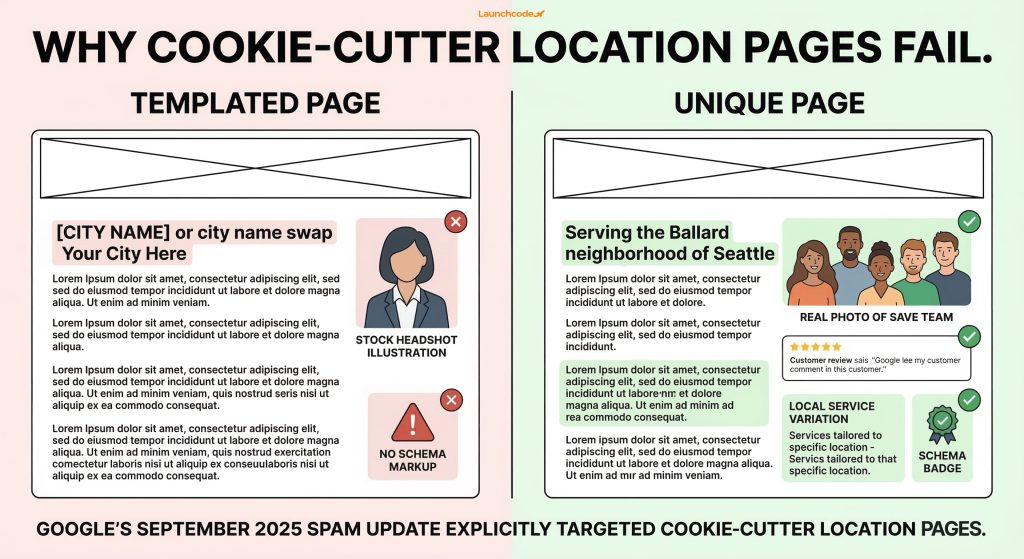
Each location page needs more than a swapped city name to be treated as distinct by Google. Unique elements include:
| Page element | Templated approach | Genuinely unique approach |
|---|---|---|
| Opening copy | "Serving [City] since 2010" | Specific neighborhood context and local market detail |
| Reviews | Generic brand testimonials | Location-specific Google review excerpts |
| Team | Corporate headshots | Photos and bios of staff at that location |
| Services | Standard list from HQ | Adjusted for local demand or market variation |
| Schema | No markup or incomplete | Full LocalBusiness schema with accurate NAP |
Reviews are both a ranking factor and a brand signal. At the franchise level, a single location with a 3.2-star average affects how consumers perceive every other location in the network. BrightLocal's 2024 Local Consumer Review Survey found that 91% of consumers say local branch reviews impact their overall perception of the entire brand. Most franchisors have no scalable system to manage this.
The challenge is volume. A franchise with 100 locations receiving an average of five reviews per week is managing 500 new reviews weekly. Responding to all of them manually is not realistic without automation or significant headcount.
That same BrightLocal survey found that 88% of consumers say they would use a business that responds to both positive and negative reviews. Only 47% said the same about businesses that do not respond at all. Response rates directly influence trust and conversion.
A practical review management system for franchise networks includes these components:
"When we audit a franchise network's local SEO, inconsistent review response rates are almost always the fastest indicator of a governance gap. It shows up in the data before anything else."
Brittany Charles, SVP, Client Services, Launchcodex
Research from SOCi shows that ignoring customers online costs the US retail industry an estimated $2.4 billion annually. For franchisors, unresponded reviews signal to Google that the profile is inactive, and they signal to prospective customers that the brand does not care.
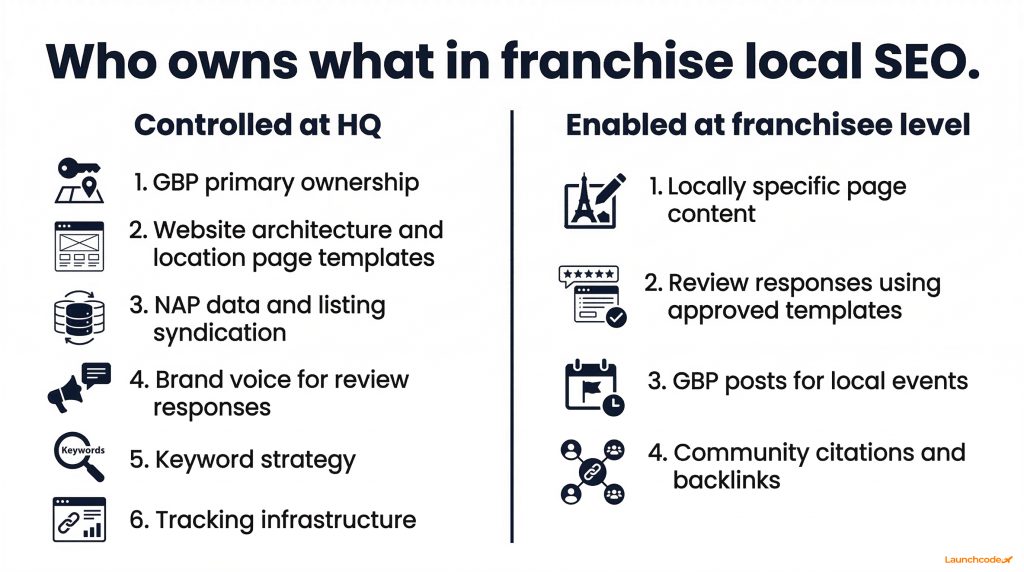
Franchisors should control the infrastructure and set the standards. Franchisees should execute at the local level within those standards. The breakdown of responsibility must be explicit, documented, and backed by the right tools. When this split is undefined, franchisees either do too little or go rogue, and both outcomes damage local SEO.
A practical way to frame this is two layers: controlled assets and enabled execution.
Controlled at HQ:
Enabled at franchisee level:
The governance model that works is one where franchisees cannot override the infrastructure but can contribute to local relevance within clearly defined boundaries. Marketing technology platforms with tiered access controls, where HQ sets the rules and franchisees operate within them, make this practical without constant oversight from the corporate team.
Franchisors who lock down everything miss the local relevance signals that help individual locations rank. A location page written entirely by corporate with zero local context will not outrank a locally relevant page from a competing independent business.
Franchisors who give full control to franchisees risk inconsistent NAP data, off-brand review responses, unauthorized listing changes, and individual locations building digital assets they take with them when they exit the system.
AI has moved from a marketing trend to an operational tool for franchise local SEO. Tasks that once required manual effort at each location, including generating review responses, scheduling GBP posts, auditing citation consistency, and reporting on location-level performance, can now be automated or significantly accelerated. For a franchise with 50 or more locations, this changes what is operationally possible.
The use cases with the most immediate impact are:
| Tool | Primary use | Best for |
|---|---|---|
| Yext | Listings management and data syndication | Large networks needing consistent directory coverage |
| Vendasta | All-in-one GBP, reviews, and reporting | Franchisors or agencies managing location portfolios |
| BrightLocal | Auditing, citation tracking, rank monitoring | Teams that need detailed reporting by location |
| Semrush Listing Management | Citation building and competitive analysis | SEO teams running keyword and competitive work |
| Screaming Frog | Technical site audits at scale | Identifying duplicate content and indexing issues |
| CallRail | Call tracking by location | Connecting local search to offline conversions |
According to BrightLocal's Brand Beacon Report, 36% of high-performing brands use AI extensively in their marketing, compared to only 13% of average-performing brands. Franchisors who build AI into their local SEO operations are not ahead of the curve. They are catching up to the brands already outperforming them.
You cannot improve what you cannot see. Most franchisors track aggregate website traffic but miss the location-level data that tells them which units are winning, which are losing, and why. Location-level reporting is not optional for a franchise that wants to scale local search performance systematically.
Each franchise location should have its own tracking baseline. The metrics that matter at the location level include:
The real value of location-level data is network intelligence. When one location consistently outperforms similar locations, the reasons are usually visible in the data: more photos, higher review volume, a stronger citation profile, more consistent posting activity. That pattern can be replicated across underperforming units.
SmartBug Media documented this in practice when they helped Two Maids optimize their franchise SEO and content strategy, resulting in a 50% increase in organic traffic and a 45% increase in organic leads. The mechanism was using network data to identify what high-performing locations were doing consistently and applying it across the system.
Platforms like Vendasta and BrightLocal offer executive reporting views that roll up location-level metrics to a single dashboard. HQ teams can set performance thresholds, flag underperforming locations automatically, and prioritize where to focus resources each quarter.
AI-powered search tools, including Google AI Overviews and ChatGPT's search functionality, are becoming a real channel for local business discovery. For franchises, this means that location data needs to be structured for the AI systems that are now synthesizing and surfacing local business recommendations in response to conversational queries, not just for traditional search engine crawlers.
BrightLocal research shows that ChatGPT Search pulls from business websites for 58% of its local search sources, with business mentions accounting for 27% and online directories accounting for 15%. The inputs that feed AI recommendations are the same ones that feed traditional local SEO, but the weight and format of what performs well is shifting.
What franchise locations need to be visible in AI-powered local search:
GEO is not a separate strategy from local SEO. It is an extension of the same infrastructure. A franchise with solid GBP profiles, consistent citations, unique location pages with schema markup, and an active review profile is already positioned better for AI-powered discovery than one that has not invested in those foundations.
Seventeen percent of US adults now use AI chatbots as a search tool, according to research cited by BrightLocal, and that share is growing. Franchise brands that treat AI visibility as a future concern rather than a current operational priority will lose ground to those that build for it now.
Local SEO at the franchise level is a system that requires governance, technology, and ongoing execution. The brands that win in local search across large networks are the ones that have built the infrastructure to run those activities consistently, at every location, without manual oversight at every step.
The six areas covered in this article form the foundation of that system:
BrightLocal's Brand Beacon Report found that 94% of high-performing brands have a dedicated local marketing strategy. Only 60% of average-performing brands do. The gap between those two groups is not access to information. It is execution infrastructure.
If your franchise network does not have a centralized local SEO system in place, every location is either leaving traffic on the table or actively competing against itself. At Launchcodex, we work with franchises and multi-location businesses to build these systems from the ground up, connecting SEO and GEO infrastructure to the full marketing stack so every location performs and every dollar invested has a traceable return.
Start with an audit. Understanding where your current network stands across GBP completeness, NAP consistency, location page quality, and review performance is the right starting point for a strategy that compounds over time.
Regular local SEO optimizes a single business location for nearby searches. Franchise SEO manages that process across multiple locations simultaneously, with the added complexity of brand consistency, governance between franchisor and franchisee, and technical challenges like duplicate content and keyword cannibalization across location pages.
Location pages on subfolders within the main corporate domain are the strongest structural choice. Subfolders pass full domain authority to each location page. Separate domains or subdomains start with little authority and require independent link-building, which rarely happens consistently at scale.
Each location page needs genuinely unique elements including locally specific introductory copy, location-specific staff information, customer testimonials from that location's reviews, and accurate LocalBusiness schema markup with that address. Swapping only the city name in a template is not sufficient and will trigger Google's duplicate content filters.
The franchisor's HQ or corporate marketing team should hold the primary owner role for every location's GBP. Franchisees should receive manager or site manager access for day-to-day tasks like review responses and post updates. If a franchisee holds the primary role and exits the network, the profile becomes difficult or impossible to reclaim.
Initial improvements in citation consistency and GBP completeness can show up in impressions within 30 to 60 days. Significant rank improvements in the local pack typically take three to six months. The compounding effect across a full franchise network builds over 12 to 24 months of consistent execution.
Generative Engine Optimization, or GEO, refers to optimizing content and structured data so that AI-powered search tools like Google AI Overviews and ChatGPT can accurately surface your business in response to relevant queries. For franchises, this means maintaining complete, accurate, schema-tagged location pages and GBP profiles, the same infrastructure that drives traditional local SEO, but structured with AI extraction in mind.




Learn how to build a Facebook Ads system for mortgage that produces funded loans, not just form fills. Covers HEC compliance...
The traditional college recruiting playbook is failing. Learn 6 data-backed digital marketing strategies that drive real enr...
Local SEO for franchises is a systems problem. Learn how to manage Google Business Profiles, fix duplicate content, scale re...