


How to optimize for each LLM: A GEO guide to ChatGPT, Perplexity, and Gemini
Generative engine optimization (GEO), sometimes called AI SEO, works differently on each engine. Here's how retrieval works ...





Running Google Ads is straightforward. Running them well is not. Most accounts follow the same pattern: launch campaigns, see some results, hit a wall, increase spend, watch CPA climb, and start questioning whether paid search works at all. The problem is usually not the budget or the market. It is the infrastructure underneath the campaigns.
This guide walks through Google Ads management as a connected system. It covers the foundational decisions that determine whether Smart Bidding has what it needs, the optimization levers that lower cost and raise quality, and the scaling method that grows spend without losing efficiency. Each section uses current benchmark data and covers the most significant platform changes from 2025 and early 2026.
The average Google Ads account wastes 20 to 30 percent of its budget on irrelevant or low-intent searches. That is not a targeting problem. It is a systems problem. Accounts without clean conversion data, tight campaign structure, and active search query hygiene train the algorithm on bad signals and pay for clicks that will never convert. Most accounts have real efficiency gains available before any advanced tactics are needed.
Ready to grow your organic traffic?
Get a free SEO audit from the Launchcodex team.
The pattern shows up clearly in benchmark data. The 2025 Google Ads industry benchmarks from WordStream and LocaliQ, drawn from over 16,000 US campaigns, found that the average cost per lead across all industries rose to $70.11 in 2025, up 5.13 percent from the prior year. Despite rising costs, 65 percent of industries saw better conversion rates during the same period. Well-managed accounts are pulling ahead of poorly managed ones even as the market gets more competitive.
Cliff Sizemore, Senior Marketing Manager at LocaliQ, noted that costs are rising, but so is performance, and that a smart strategy beats cheap clicks. That gap between the average account and the well-optimized one is where most of the opportunity lives.
Good Google Ads management follows three phases, and the order matters.
Most advertisers skip to scaling. That is where the waste comes from.
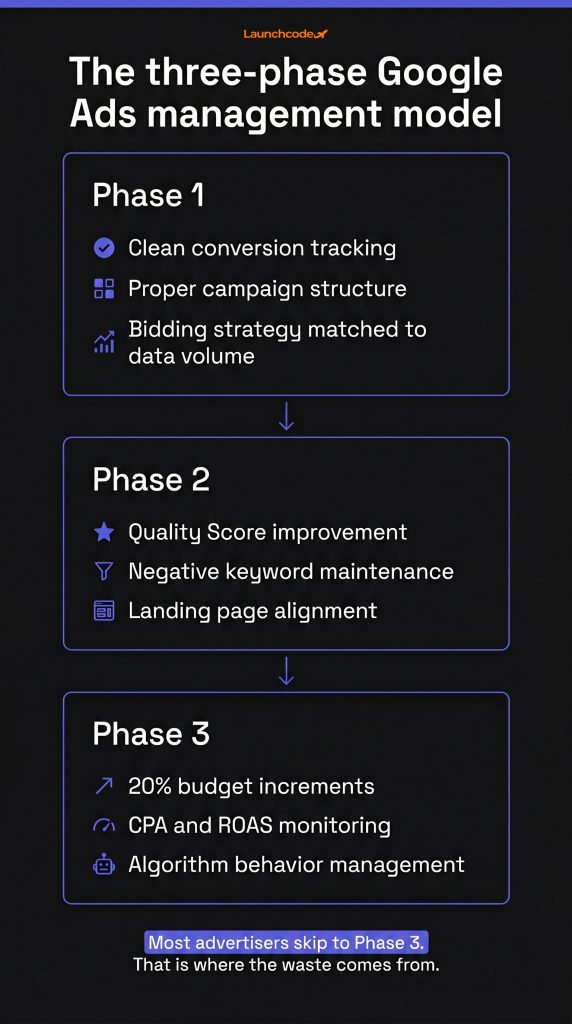
Conversion tracking is the single most important decision in a Google Ads account. Smart Bidding cannot optimize for outcomes it cannot measure. If tracking is broken, incomplete, or measuring the wrong actions, every automated bidding strategy in the account is optimizing for noise. Fix tracking first. Campaigns come second.
Google's Smart Bidding strategies have clear data requirements. Target CPA (tCPA) needs at least 30 conversions in the past 30 days to perform reliably. Target ROAS (tROAS) needs 50. Below those thresholds, the algorithm does not have enough signal to set accurate bids, and accounts in this state often perform erratically regardless of how the campaign is structured.
"The accounts we take over most often have the same problem: conversion tracking that was set up once and never validated. The first thing we do is audit every conversion action before touching anything else."
Brittany Charles, SVP, Client Services, Launchcodex
Most tracking setups contain errors that are invisible inside the Google Ads dashboard. These issues appear even in accounts managed by experienced practitioners.
A reliable tracking setup requires:
A misconfigured primary conversion action trains Smart Bidding to maximize the wrong behavior at scale.
Before building any campaign, define the business outcome it needs to produce and trace it to a trackable action. B2B accounts should track qualified lead submissions and demo bookings, not general contact form fills. Ecommerce accounts should optimize for purchase events with revenue values attached, not add-to-cart events.
This matters more now that Google has deprecated Enhanced CPC bidding for Search and Display. As of March 31, 2025, accounts not proactively migrated now default to Manual CPC. Automated bidding is the practical path forward for most accounts, which means conversion data is the fuel the entire system runs on.
A well-structured account gives Smart Bidding clean signals, makes budget allocation intentional, and keeps performance data readable. Poor structure forces the algorithm to mix signals from campaigns with different goals, audience types, and offer categories. That increases CPA and makes it nearly impossible to identify what is and is not working.
Structure decisions in 2026 need to account for how Smart Bidding reads the account. The algorithm learns at the campaign level. Grouping campaigns with fundamentally different conversion goals or CPA expectations creates conflicting signals that cap performance.
Google has made broad match the default and the primary expansion mechanism. Broad match now drives more impressions than phrase or exact match in many accounts. The system uses intent signals rather than literal keyword matching to determine which searches trigger ads.
Broad match combined with Smart Bidding can work well when conversion data is clean and targets are realistic. It demands an active negative keyword framework to prevent budget from flowing to low-intent queries. Phrase match and exact match still serve a clear purpose, particularly for high-value terms where precision matters and where you need clear visibility into what queries are driving spend.
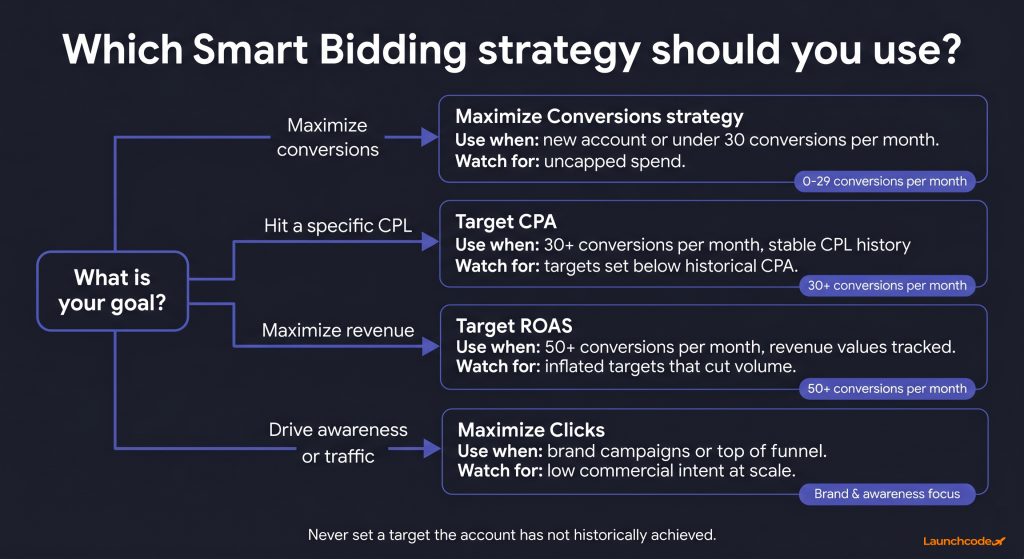
The right Smart Bidding strategy depends on your data volume and business goal. Start with Maximize Conversions if you are new to the account or below the data thresholds. Move to Target CPA when you have at least 30 conversions per month and a stable cost per conversion. Add Target ROAS when revenue values are attached to conversions and volume exceeds 50 per month. Never set a target the account has not historically achieved.
| Goal | Recommended strategy | When to use it | Watch out for |
|---|---|---|---|
| Maximize lead volume | Maximize Conversions | New accounts, below 30 conversions per month | Uncapped spend growth without guardrails |
| Hit a specific CPL | Target CPA | 30+ conversions per month, stable CPL history | Overly aggressive targets that restrict volume |
| Maximize revenue | Target ROAS | 50+ conversions per month, revenue values tracked | Inflated targets that cut volume significantly |
| Awareness or traffic | Maximize Clicks | Brand campaigns, top-of-funnel | Low commercial intent at scale |
Setting targets too aggressively is one of the most common Smart Bidding errors. If your historical CPA is $80 and you set a tCPA target of $30, Google will restrict volume dramatically while sourcing lower-quality conversions to hit the number. Your target should reflect what the account has actually achieved over the past 30 days, not an aspirational goal.
Google introduced Smart Bidding Exploration in 2025 to allow campaigns to test outside their current performance range using flexible ROAS targets. Accounts using this feature saw an 18 percent increase in unique search query categories with conversions and a 19 percent increase in overall conversions, according to Google's 2025 platform documentation. It works best when the account already has strong conversion data and you want to expand volume without rebuilding campaign structure.
Every significant campaign change, including bid strategy switches, budget increases, new creative at scale, and target adjustments, triggers a learning phase. This period typically runs 7 to 14 days. CPA often rises temporarily during this window as Smart Bidding recalibrates to new auction conditions.
The most common mistake during a learning phase is making additional changes. Each new change resets the clock. Let the algorithm stabilize before evaluating performance or making the next adjustment.
Optimization is not a one-time activity. It is a weekly discipline. The three highest-leverage optimization levers are Quality Score improvement, negative keyword maintenance, and landing page alignment with ad intent. Each one reduces waste, improves relevance, and gives Smart Bidding better signal to work with over time.
Fred, a PPC practitioner whose perspective is documented by Optmyzr, has noted that Quality Score still determines whether a given ad is the right match for a given user and query. Even in automation-heavy accounts, low Quality Scores point to real friction in the auction that adds cost.
Quality Score is Google's 1 to 10 rating of three factors: expected CTR, ad relevance, and landing page experience. It determines Ad Rank, which controls both ad position and the actual CPC paid at auction.
To move Quality Score higher:
Common sources of wasted spend include informational modifiers ("how to," "what is," "free"), competitor brand names appearing in non-competitor campaigns, and geographic or industry terms that attract off-target audiences.
A productive negative keyword practice includes:
A conversion rate improvement on the landing page compounds across the entire account. Higher CVR reduces CPL, improves Quality Score, and gives Smart Bidding a stronger signal to optimize toward.
A landing page that supports paid search performance must do the following: reflect the exact offer or solution from the ad headline, carry a single clear call to action, load fast (mobile will represent 66 percent of all search ad spend by 2029 per Cropink), and answer the user's question without requiring further navigation.
One analysis by the Modern Marketing Institute found that a 15 to 20 percent lift in landing page CVR compounds into measurable CPL reduction over a full campaign cycle. The investment in landing page quality almost always returns more than the equivalent spend increase.
Performance Max drives scale across Google's full network but typically produces lower conversion rates than standard Search on the same queries. AI Max adds intent-based targeting and AI-generated creative to Search campaigns without replacing the campaign structure underneath. Use PMax to expand reach across formats. Use AI Max to expand Search reach beyond a fixed keyword list. Neither replaces a well-structured Search campaign.
Performance Max lets a single campaign serve ads across Search, Display, YouTube, Gmail, Discovery, and Maps from a shared asset library and conversion goal. Over 1 million advertisers globally now use PMax, and Google's 2024 quality improvements increased automated conversions by more than 10 percent across the platform.
An Adalysis study across 3,300 campaigns found that when both PMax and standard Search campaigns were eligible for the same search terms, Search campaigns produced higher conversion rates. PMax often attributes brand and remarketing traffic to its conversions, which inflates its reported performance.
The practical setup for most accounts combines a tight brand Search campaign, a non-brand Search campaign for core terms, and a PMax campaign for incremental reach across formats and placements. Treat each as having a distinct role and a distinct KPI.
PMax requires a larger creative investment than standard Search. Multiple headlines, descriptions, images, and video assets are needed for the algorithm to test combinations across placements at scale. A thin asset library limits what PMax can do.
2025 updates made PMax significantly more controllable: campaign-level negative keywords, channel performance reporting, search theme guidance, and brand exclusion controls are now available to all advertisers.
AI Max for Search launched in May 2025 as a suite of AI-powered targeting and creative features applied on top of existing Search campaigns. It includes intent-based query matching that goes beyond traditional keyword lists, text customization that generates ad copy variations within defined brand guidelines, URL expansion to the most relevant landing pages based on query context, and brand controls to prevent AI output from going off-message.
Early testing showed 20 to 30 percent improvements in reach and relevance for Search campaigns using AI Max. By early 2026, keyword-free AI Max campaigns were available across all North American accounts. Advertisers provide a landing page and a conversion goal, and the system handles targeting and creative variation.
Jyll Saskin Gales, a former Google Ads Product Expert, has described AI Max as striking a balance between the transparency of manual Search campaigns and the automation of Performance Max.
AI Max works best when conversion data is solid, creative assets are on-brand, and you want to expand Search reach without maintaining an exhaustive keyword list. For accounts with limited conversion history, the algorithm has less to learn from and results are more variable.
Demand Gen campaigns run across YouTube, Gmail, and Discover. They are awareness and consideration tools, not direct conversion drivers. In 2025, Demand Gen saw a 26 percent increase in conversions per dollar driven by over 60 AI-powered optimizations to bidding and creative delivery, according to Google's year-end platform data.
For accounts with sufficient budget, running Demand Gen alongside Search and PMax creates a full-funnel structure where each campaign type has a distinct role. Demand Gen builds intent. Search captures it.
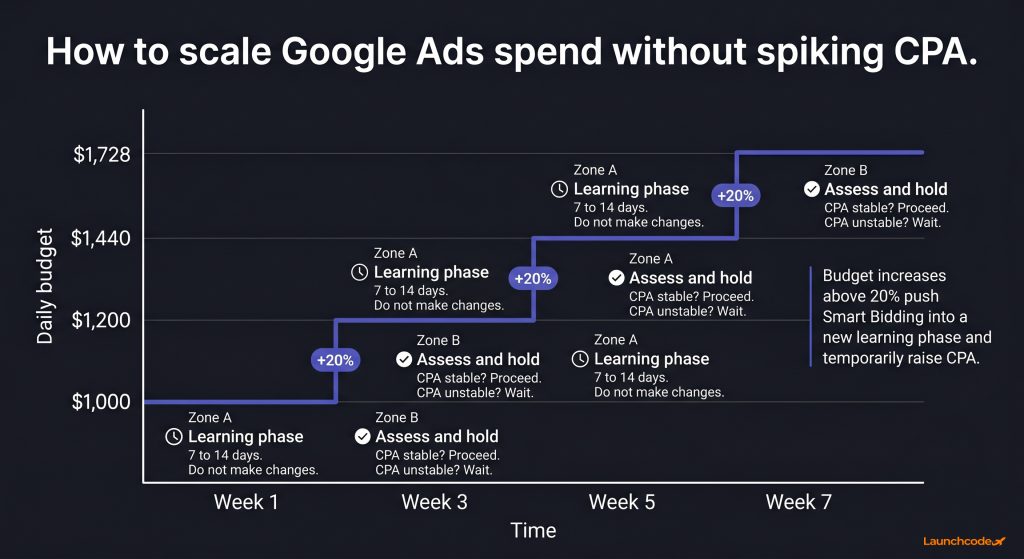
Increasing a campaign budget by more than 20 percent at a time pushes Smart Bidding into a learning phase. CPA rises temporarily as the algorithm recalibrates to new auction dynamics. The fix is straightforward: increase in 20 percent increments, wait 7 to 14 days for re-optimization, assess stability, then increase again if results hold. Larger increases save time but destroy efficiency.
The stair-step scaling method documented by GrowMyAds treats the temporary CPA spike after a budget increase as expected algorithm behavior, not a signal to pull back. Pulling back resets the learning phase and prevents the campaign from reaching its new equilibrium. Patience during the adjustment window is part of the process.
"Most clients come to us after hitting a ceiling on Google Ads. Nine times out of ten, the ceiling is a data problem, not a budget problem. Fix what you are measuring and scaling becomes much more predictable."
Tanner Medina, Co-Founder & Chief Growth Officer, Launchcodex
Not every campaign is ready for a budget increase. Before increasing spend, confirm:
Budget increases amplify what already exists in the account. If tracking is inaccurate or campaign structure is messy, scaling makes both problems larger.
HockeyStack's B2B benchmark data highlights an important distinction. Across B2B SaaS accounts, Google Ads generated an average pipeline ROI of $8.17 per dollar spent, but revenue ROI against actual closed deals averaged only 1.31. The gap reflects a lead quality problem that more ad spend cannot solve. Before increasing budget, confirm that current volume is converting downstream at a rate that justifies the investment.
Track four core metrics in priority order: conversion volume, cost per conversion (CPA), conversion rate (CVR), and return on ad spend (ROAS). CTR and CPC are diagnostic. They help you find the source of a problem but do not tell you whether the campaign is producing business value. Use them to investigate, not to evaluate.
Stephanie, a PPC expert at WordStream, has described KPIs as a diagnostic system: CPC and CTR point to where optimization is needed, while conversion rate and CPL show whether the work is translating to outcomes. Reading them together is more useful than reacting to any single metric in isolation.
Compare your account performance against your vertical, not the cross-industry average. These are medians across all industries from the WordStream and LocaliQ 2025 analysis:
| Metric | 2025 cross-industry average |
|---|---|
| Click-through rate | 6.66% |
| Cost per click | $4.66 |
| Conversion rate | 6.96% |
| Cost per lead | $70.11 |
Legal and financial services pay close to $9 per click and over $130 per lead. Automotive repair sits near the opposite end. A $70 CPL in a legal account is strong. In a home services account, it may be above market. Industry context determines what the numbers actually mean for your business.
Cliff Sizemore at LocaliQ has also noted that CPL is a useful metric, but lead quality and downstream revenue value matter equally. A $70 lead that closes at $10,000 is a very different outcome from a $40 lead that produces $500 in revenue. Build lead value reporting into the account if your business model supports it.
| What you see | What it usually means | Where to look first |
|---|---|---|
| High CTR, low CVR | Ad attracts clicks but the page does not convert | Message match between ad and landing page |
| High CVR, high CPA | Conversion rate is fine but CPC is too high | Quality Score and bid strategy configuration |
| Low impression share to budget | Campaign is capped, demand exists | Increase budget or tighten targeting |
| Low impression share to rank | Bids or Quality Score are not competitive | Improve Quality Score before raising bids |
| Rising CPA with stable CVR | CPCs are rising, often market-wide | Benchmark CPC against industry data |
Google Ads in 2026 is a more complex platform than it was two years ago. Enhanced CPC is gone. AI Max and Smart Bidding Exploration are live. Performance Max has more controls but also more decisions to make. Running an account well requires ongoing strategic judgment: data quality, bidding configuration, creative testing, disciplined scaling, and platform knowledge that keeps pace with changes.
The signs that an account needs a more systematic approach are usually visible in hindsight. CPA has risen for multiple quarters without a clear cause. Budget is increasing but revenue is not keeping pace. The team is reacting to performance drops rather than running planned tests. Conversion tracking has not been audited since the account was set up.
At Launchcodex, we build the measurement infrastructure before a single campaign goes live. Every engagement starts with a tracking audit, a defined KPI framework, and a review cadence that keeps decisions grounded in data from day one. That structure is what separates accounts that produce compounding returns from accounts that cycle through the same problems every quarter.
Google Ads management follows a clear sequence: build the right foundation, optimize systematically, scale with discipline. All three phases are required. The order is not negotiable.
There is no universal minimum, but accounts under $1,000 per month often cannot generate enough conversion data for Smart Bidding to function reliably. A more useful frame is clicks per day. Most ad groups need at least 15 clicks per day to produce meaningful data. Calculate your budget from that target using your expected CPC.
Most well-structured campaigns need 60 to 90 days to reach stable performance. The first 30 days gather data. The second 30 days involve active optimization based on that data. The third 30 days show the compounding effect of systematic refinement. Set stakeholder expectations before launch, not after the first month.
Use all three with intentional roles. Exact match for your highest-value, highest-intent terms where control matters. Phrase match for terms with specific intent that can flex on query phrasing. Broad match with Smart Bidding for discovery and expansion, supported by a strong negative keyword list that prevents off-target spend.
Performance Max is a campaign type that serves ads across all Google networks from a single set of creative assets. AI Max is a feature layer applied to existing Search campaigns that adds intent-based targeting, AI-generated ad copy variation, and URL expansion. PMax replaces separate Search, Display, and YouTube campaign structures. AI Max enhances a Search campaign without replacing its structure.
Submit a test conversion on your own site and confirm it appears in Google Ads within 24 hours. Verify that the conversion action is tagged as a primary action. Check that GA4 and Google Ads conversion counts are reasonably aligned. If they differ by more than 15 to 20 percent, investigate the tracking setup. Enable enhanced conversions for additional accuracy through first-party data matching.
Add a negative keyword any time the search term report shows a query that triggered your ad but has no realistic commercial intent for your business. Common examples include queries with "free," "DIY," "how to," job-related terms, or unrelated industry terms. Review the search term report weekly in active campaigns.



Generative engine optimization (GEO), sometimes called AI SEO, works differently on each engine. Here's how retrieval works ...
OpenSEO is an open-source SEO platform built for AI agents. See how its MCP server works with Claude Code, what AI visibilit...
See the 10 best WordPress SEO plugins with real AI automation. Compare features and pricing, then build a stack that ranks a...