





How to optimize for each LLM: A GEO guide to ChatGPT, Perplexity, and Gemini
Generative engine optimization (GEO), sometimes called AI SEO, works differently on each engine. Here's how retrieval works ...





Most teams measure creative performance by looking at CTR. A high rate feels like validation. A low rate triggers a redesign. The problem is that CTR only captures one moment in a much longer sequence, and it is not always an honest signal. In 2025, CTR improved across all 14 industries tracked by Triple Whale on Google Ads, but ROAS declined in 13 of those same 14 industries. More clicks, less revenue. That gap is exactly what happens when teams optimize the wrong metric.
This article gives you a practical, full-funnel framework for measuring creative performance. You will learn which metrics apply at each stage, how to read attention and engagement signals before a campaign wastes budget, how to detect creative fatigue before it cuts into ROAS, and how to prove upper-funnel creative is doing its job even when no one clicks.
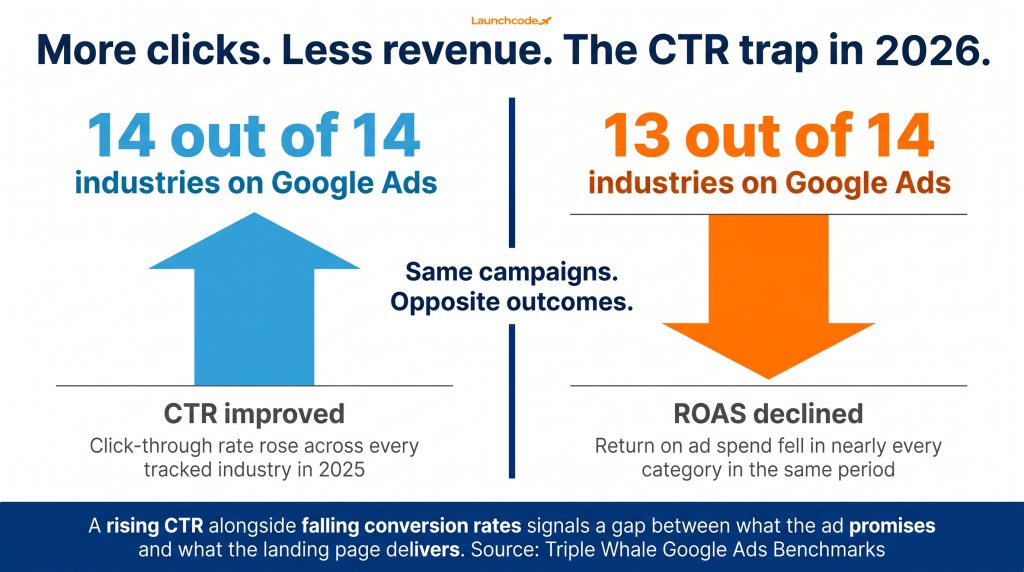
CTR measures whether your ad prompted a click. It does not measure whether your creative held attention, resonated with the right audience, drove a purchase, or built any memory of your brand. A creative can produce strong CTR and still fail on every metric that connects to revenue. Teams that optimize only for clicks are making decisions on a fraction of the available signal.
Ready to grow your organic traffic?
Get a free SEO audit from the Launchcodex team.
The disconnect is easy to miss because CTR moves in a satisfying direction. Impressions go up, clicks go up, the dashboard looks healthy. But conversion rate tells a different story. As Directive Consulting's performance team put it: CTR gauges stopping power, CVR measures message and offer fit, and CPA or ROAS reveals whether the economics make sense. Strip out the middle two layers and you lose the signal that actually drives decisions.
There is also a newer problem. Meta's Andromeda delivery system now uses creative signals as targeting inputs. The platform reads your creative to decide who sees it. If your creative is weak, your targeting degrades alongside your click rate. Poor creative no longer just underperforms. It misallocates your audience.
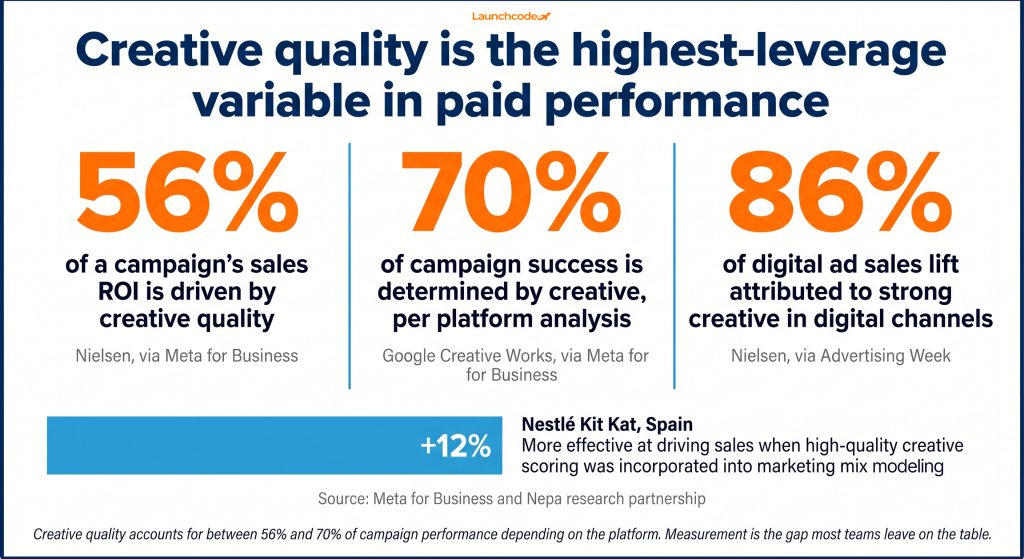
Research from Nielsen, cited by Meta for Business, shows creative quality accounts for between 56% and 70% of campaign performance depending on the platform. The MAGNA Media Study puts creative's impact on purchase intent at 56%. These are arguments for placing CTR inside a fuller measurement system, one that connects the creative decision to the business outcome.
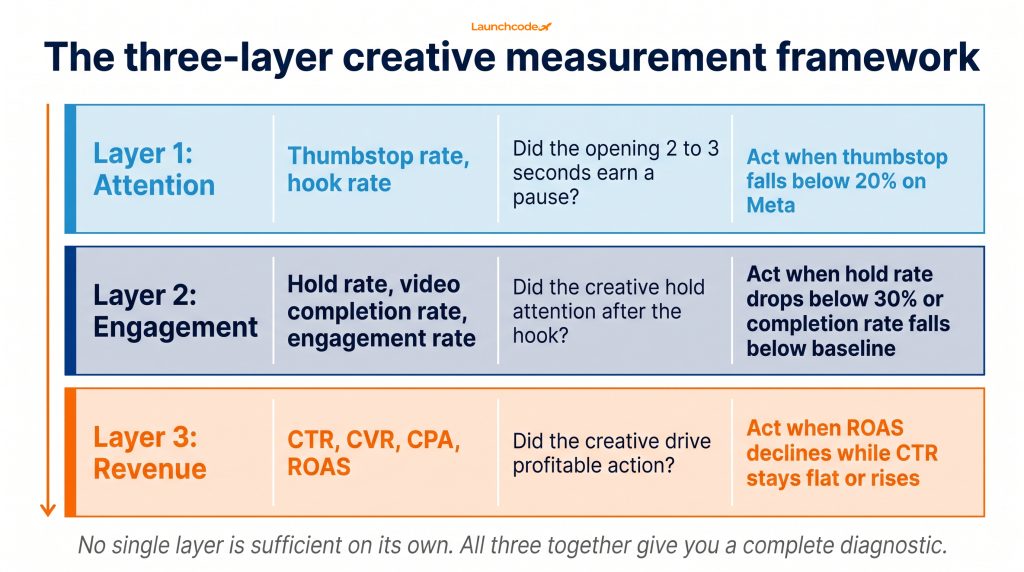
Creative performance should be measured in three connected layers: attention, engagement, and revenue. Attention metrics tell you whether your creative earned a look. Engagement metrics tell you whether it held that look. Revenue metrics tell you whether it produced a result. No single layer is sufficient on its own. All three together give you a complete diagnostic.
This framework maps naturally to how platforms deliver ads. A viewer must stop scrolling before they watch. They must watch before they click. They must click before they convert. Each stage has its own failure mode, and each failure requires a different fix.
| Layer | Primary metrics | What it diagnoses | When to act |
|---|---|---|---|
| Attention | Thumbstop rate, hook rate | Does the opening 2 to 3 seconds earn a pause? | Thumbstop below 20% on Meta |
| Engagement | Hold rate, video completion rate, engagement rate | Does the creative hold attention after the hook? | Hold rate below 30% or completion rate below your baseline |
| Revenue | CTR, CVR, CPA, ROAS | Does the creative drive profitable action? | ROAS declining while CTR stays flat or rises |
The attention layer is the most commonly skipped. Teams look at CTR without checking whether the creative ever had a chance to generate a click. If thumbstop rate is low, improving copy, call to action, or offer will not solve the problem. The opening visual or hook needs to change first.
Thumbstop rate is the percentage of people who stopped scrolling and watched at least 3 seconds of your video ad. It is calculated as 3-second video plays divided by total impressions, multiplied by 100. For Meta campaigns, a thumbstop rate of 30% or higher is the target. Below 20% means your creative is not competing for attention in the feed, regardless of how strong the rest of the ad is.
The benchmark comes from Madgicx's Facebook creative scoring analysis and is consistent with guidance from Motion. Hook rate and thumbstop rate are often used interchangeably. Both measure whether the first 2 to 3 seconds of a creative captures enough attention to make the rest of the ad worth watching.
Thumbstop rate varies by industry and format. E-commerce product demos regularly hit 35% or higher. B2B explainer videos may perform well at 25% to 28%. The right approach is to establish your own baseline by account and creative type, then compare new work against that benchmark rather than against a universal number.
One important caveat: a 2024 analysis of $1.47 million in Meta ad spend across F26 client accounts, published by Funnel Insiders, found no statistically significant correlation between thumbstop rate alone and revenue. Attention metrics predict creative health. They do not replace revenue metrics. A 38% thumbstop rate on a creative that never converts is not a win. Always connect attention data to the downstream metrics in the revenue layer.
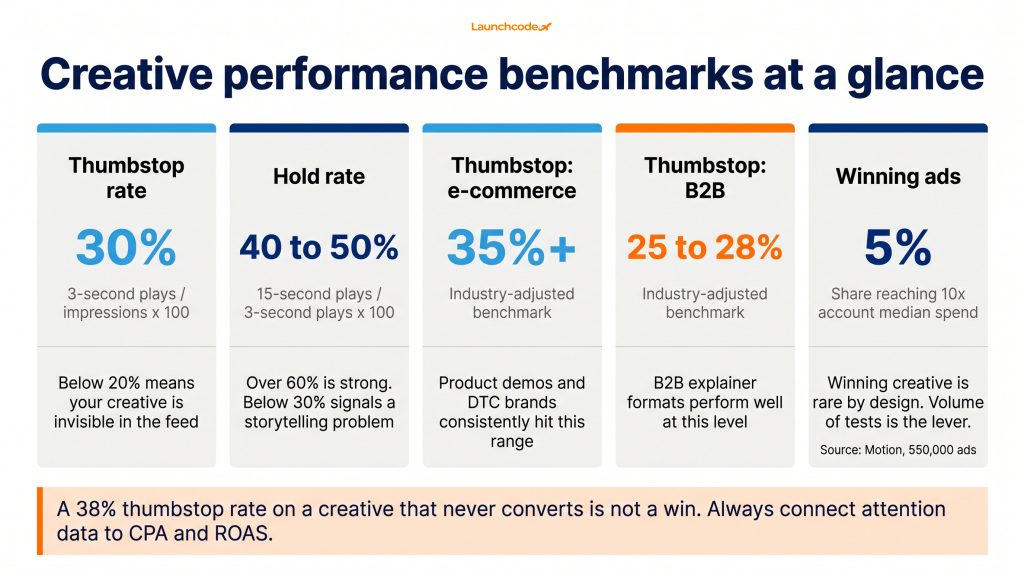
Hold rate measures the percentage of people who watched past 15 seconds after stopping on an ad. The formula is 15-second video plays divided by 3-second video plays, multiplied by 100. A hold rate of 40% to 50% is average on Meta. Over 60% is strong. Below 30% signals a structural problem with the creative's middle, not its opening.
According to Motion's benchmark data, hold rate is one of the clearest indicators of storytelling quality. A high thumbstop rate combined with a low hold rate means your hook is working but your content is not delivering on what the hook promised. That gap is fixable and diagnosable, if you are tracking hold rate.
"A high thumbstop rate with a weak hold rate is the clearest sign that the hook overpromised. The first frame sold something the rest of the creative did not deliver." Georgia Callahan, Executive Creative Director
Video completion rate (VCR) goes one step further. It measures the percentage of impressions where the video was watched to 100% completion. VCR is especially relevant for ads where the call to action or key message appears late in the video. If VCR is low, many viewers are exiting before they reach that point.
Hold rate benchmarks shift based on objective. A 30-second brand film and a 10-second retargeting ad should not be held to the same standard. A few practical applications:
CPA and ROAS are the creative metrics that connect to your business model. CPA measures how much you spend to acquire a conversion. ROAS measures revenue generated per dollar of ad spend. These are the metrics that tell you whether your creative produced profitable results. Every attention and engagement metric you track should ultimately feed toward improving these two numbers.
Conversion rate sits between CTR and CPA in the measurement chain. A high CTR with a low conversion rate means the creative promised something the landing page or offer did not deliver. Misaligned messaging between the ad and the page is a common cause, and it shows up first in conversion rate data.
Following Meta's creative best practices can drive a 1.2 to 7.4 times increase in short-term sales, according to a Meta and Nepa research partnership. The range is wide because creative quality interacts with audience, offer, and placement. That is why ROAS and CPA should always be analyzed at the creative level, separate from the campaign or ad set level.
A practical example: an e-commerce client runs two ad variants with similar spend. Variant A has a 3.2% CTR and a 1.1% conversion rate. Variant B has a 1.9% CTR and a 2.8% conversion rate. Variant A looks stronger on click data. Variant B generates roughly 2.4 times more conversions per impression. Most teams optimize toward Variant A if they are watching CTR only. Variant B is the correct answer by almost every revenue metric.
"When CTR and ROAS move in opposite directions, that disconnect is usually a creative problem hiding behind a media metric. We always trace it back to the asset before adjusting the audience or the budget." Olivia Tran, AVP, Media Services
When Nestlé incorporated creative quality scoring into marketing mix modeling for Kit Kat in Spain, high-quality creative ads proved 12% more effective at driving sales than low-quality creative, according to the same Meta for Business research. Advanced teams are now feeding creative performance scores into their marketing mix models as a dynamic input variable, not treating creative quality as a constant.
Most published ROAS and CPA benchmarks assume e-commerce or DTC business models. For B2B, SaaS, and service-based businesses, the downstream metrics look different. Relevant revenue metrics for these contexts include:
These businesses should build their own benchmarks from historical data rather than applying e-commerce standards to a fundamentally different unit economics model.
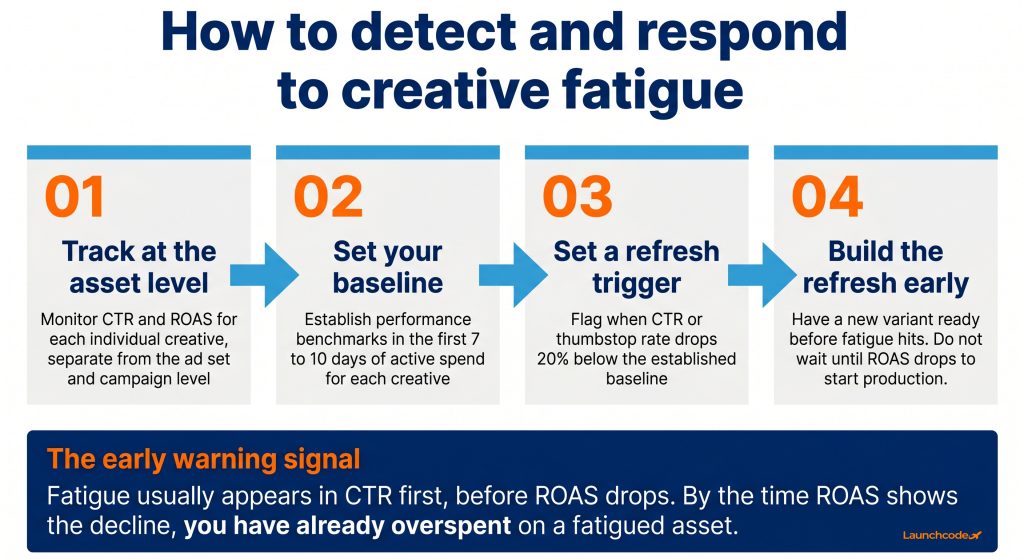
Creative fatigue happens when an audience has seen an ad often enough that performance declines. It is not a feeling or a judgment call. It shows up as measurable decay in thumbstop rate, hold rate, CTR, and eventually ROAS. Teams that track performance at the asset level, separate from the campaign level, can detect fatigue early and refresh creative before budget is wasted on a declining ad.
Creative fatigue is measurable and forecastable. The signal usually appears in CTR first, before ROAS drops. When CTR begins to fall relative to spend in a campaign that was previously stable, that is the early warning.
As Authencio's Motion analytics guide describes it: "Creative fatigue is the silent killer of ROAS. By setting up custom alerts or monitoring trend lines for CTR relative to spend, analysts can predict when a winning creative is about to saturate its audience." The key word is predict. By the time ROAS shows the decline, you have already spent more than you should have on a fatigued asset.
A creative refresh does not always require a full rebuild. Effective refresh options include:
Barry Hott of Hott Growth is a practitioner well known in direct response creative communities for his data-driven approach to refresh cycles. His position is consistent with the data: test before you need it, and treat every winning ad as a temporary asset.
Brand lift studies measure whether your campaign actually changed how people think and feel about your brand, not just whether they clicked. They compare brand awareness, ad recall, consideration, and purchase intent between audiences exposed to the campaign and a control group that was not. For upper-funnel creative, brand lift is often the only accurate measurement available.
Awareness campaigns, YouTube pre-roll, and brand video almost never produce strong click data. They are not designed to. But that does not mean they are unmeasurable. Google, Meta, and TikTok all offer brand lift study tools that run survey-based experiments to capture the signal that clicks cannot show.
A 2026 Brainlabs Digital analysis of 46 Meta brand lift studies across 225 campaigns found that product-focused ads drove a 3.9% lift in product consideration and 6.2% lift in brand consideration, outperforming other creative types. That kind of creative intelligence changes production decisions, and it only shows up in lift data.
Google runs brand lift studies inside the Experiments section of Google Ads, measuring ad recall, awareness, consideration, favorability, and purchase intent via surveys shown to exposed and control groups. Meta uses a similar test-and-control methodology with poll-based experiments.
Typical minimum spend thresholds for Google brand lift studies start around $50,000. Meta's threshold is lower and varies by campaign type. For brands without the budget for a full lift study, Meta's built-in poll tool and post-campaign survey platforms offer lightweight alternatives that still generate directional lift data.
The Google Brand Lift, Search Lift, and Conversion Lift study guide from newage.agency recommends running all three lift study types in parallel when possible. Combining them gives a complete picture of how creative moves awareness, branded search behavior, and final conversion in the same campaign window.
Tracking creative performance across Meta, TikTok, YouTube, and Google requires either a unified third-party analytics platform or a disciplined manual process across native dashboards. Most teams that rely on native dashboards alone end up optimizing each platform in isolation. The result is channel-level decisions that contradict each other and no clear view of which creative concept is actually driving growth.
The core challenge is that Meta Ads Manager, Google Ads Manager, and TikTok Ads Manager each surface performance data in different formats with different attribution windows. Pulling those signals together manually into a spreadsheet is possible but slow, and it is hard to maintain at scale.
| Tool | Best fit | Key strength | Limitation |
|---|---|---|---|
| Motion | Paid social teams (Meta, TikTok, YouTube) | Unified creative analytics with visual reporting and fatigue alerts | Limited Google Search integration |
| Madgicx | Meta-focused teams | Thumbstop and hold rate tracking, creative scoring | Primarily Meta only |
| Triple Whale | Shopify DTC brands | Asset-level ROAS and CPA attribution | Shopify-exclusive |
| Supermetrics | Multi-channel teams using Looker Studio or Sheets | Flexible data connector across all major platforms | Requires manual dashboard setup |
| Improvado | Enterprise teams | Deep multi-channel reporting with a creative layer | Higher cost, longer setup |
Motion addresses what their team calls the "wall of numbers" problem by aggregating creative metrics from Meta, TikTok, and YouTube into unified visual reports. For agency teams, this kind of cross-platform visibility sharpens client reporting by shifting the conversation away from which campaigns generated clicks and toward which creative concepts drove ROAS.
Regardless of which tool your team uses, a working creative performance dashboard should surface:
That setup turns creative reporting from a backward-looking summary into a forward-looking planning tool.
AI is changing creative measurement in two directions at once. First, platforms are using creative signals as targeting inputs, which means poorly measured creative now degrades audience quality alongside ad performance. Second, AI analytics tools can predict creative fatigue and surface winning patterns faster than any manual review process.
Meta's Andromeda delivery system is the clearest example of the first shift. The platform uses the signals inside your creative, visual style, copy tone, pacing, and format, to determine who is shown the ad. As a result, creative quality has become a targeting variable. A creative that communicates poorly wastes budget in two ways: it underperforms and it reaches the wrong people.
Google followed a similar path with its AI Max for Search campaigns, launched globally in early 2026. The system autonomously optimizes audiences, bids, and creative signals across Search placements. According to Google's own reporting cited by Terra HQ, campaigns using the full AI Max feature suite see an average of 7% more conversions at similar CPA levels.
The practical implication is that creative quality and creative measurement are now the same problem. If you cannot accurately read which creative is working and why, you are feeding weak signals into systems that increasingly rely on those signals to make targeting decisions.
At Launchcodex, measuring creative at the element level, separate from the campaign level, is a core part of how we build paid media strategies. Tracking which hooks, formats, and concepts win, and feeding that data back into production, is what separates a reactive creative process from one that compounds over time.
The teams that will consistently outperform in AI-optimized platforms are not the ones with the biggest budgets. They are the ones with the cleanest feedback loops between creative performance data and creative production decisions.
A full creative measurement system is not a set of metrics. It is a repeatable process that connects what you make to what you learn to what you make next.
The process looks like this:
The output of a strong creative measurement practice is not a better report. It is a shorter path from idea to winning ad, because your team stops guessing about what works and starts iterating on what the data confirms.
Research from Advertising Week, summarizing MAGNA and Nielsen findings, is direct on this point: solving for creative effectiveness is the most impactful way to combat rising media costs. For brands facing higher CPCs and tighter margins, the measurement system is the competitive advantage.
On Meta, aim for 30% or higher. A thumbstop rate below 20% means most people are scrolling past without stopping. E-commerce product demos often hit 35% or more. B2B formats may perform well at 25% to 28%. Always build internal baselines by account and creative type rather than relying only on published averages.
Hold rate measures whether viewers stayed with a video past 15 seconds after stopping. CTR measures whether someone clicked. A creative can have strong hold rate and low CTR, which usually means the audience is engaged but the call to action or offer is not compelling enough. Tracking both tells you whether the problem is the hook, the content, or the close.
Brand lift studies are most useful for upper-funnel campaigns, YouTube campaigns, or any creative where you cannot expect significant click activity. If your goal is awareness, ad recall, or consideration rather than direct conversion, brand lift is often the only accurate measurement. Meta's threshold is lower and varies by campaign. Google lift studies typically require around $50,000 in minimum spend.
Fatigue usually shows up as a declining CTR relative to spend, often before ROAS drops. Set a baseline for each creative in its first 7 to 10 days and flag it when CTR falls 20% below that baseline. Build your refresh creative before you hit the threshold so you are not spending on a declining asset while waiting for new work.
Motion aggregates creative performance from Meta, TikTok, and YouTube in one dashboard. Madgicx is strong for Meta-specific metrics including thumbstop and hold rate. Triple Whale is purpose-built for Shopify DTC attribution at the asset level. Supermetrics works well for teams that want to pull data from multiple platforms into Looker Studio or Google Sheets. Native platform dashboards are useful starting points but require manual work to compare across channels.
No. In 2025, CTR improved across all 14 industries tracked on Google Ads, but ROAS declined in 13 of those same 14 industries. A rising CTR alongside falling conversion rates often signals a gap between what the ad promises and what the landing page or offer delivers. CTR needs conversion rate, CPA, and ROAS alongside it to mean anything useful.




Generative engine optimization (GEO), sometimes called AI SEO, works differently on each engine. Here's how retrieval works ...
OpenSEO is an open-source SEO platform built for AI agents. See how its MCP server works with Claude Code, what AI visibilit...
See the 10 best WordPress SEO plugins with real AI automation. Compare features and pricing, then build a stack that ranks a...