




How to build an email list: Strategies that actually grow your audience
Learn how to build an email list that actually grows. Covers lead magnets, form placement, segmentation, deliverability, and...





Most businesses chasing online growth focus on followers, reach, and ad spend. Then an algorithm changes, a platform policy shifts, or ad costs jump, and the audience they spent months building shrinks overnight. An email list does not work that way. It is an asset you own, carry across platforms, and reach directly, without paying for access every time. This guide covers the strategies that actually grow an email list in 2025. Not a generic checklist. The full approach: why email beats social for audience control, which lead magnets convert today, where to place forms, how to segment from day one, how to keep the list healthy enough to perform, and where AI accelerates all of it.
Your social following is rented. Your email list is owned. That distinction matters more now than at any previous point in digital marketing. According to the HubSpot State of Marketing report, email delivers an average $36 return for every $1 spent. Instagram's organic reach dropped 12% year over year between 2024 and 2025. LinkedIn's organic reach declined too. A social audience that an algorithm controls is not a business asset. An opted-in email list is. The case for email is not about dismissing social media. Social drives discovery. Email drives conversion and retention. The strategic move is to use social to grow an audience you then own through email. When you need to announce a product, a sale, or an important update, an email lands in the inbox directly. No bid. No paid promotion. No middleman.
Hellobar's analysis of email versus social ROI shows that as organic reach on social platforms shrinks, the relative value of owned channels compounds. Every subscriber you add to an email list increases the return on all your future sends, not just the next campaign. Klaviyo's marketing mix report found that 76% of companies rank email among their top three ROI-generating channels. If your competitors are investing in list growth and you are not, the gap widens every month.
Ready to grow your organic traffic?
Get a free SEO audit from the Launchcodex team.
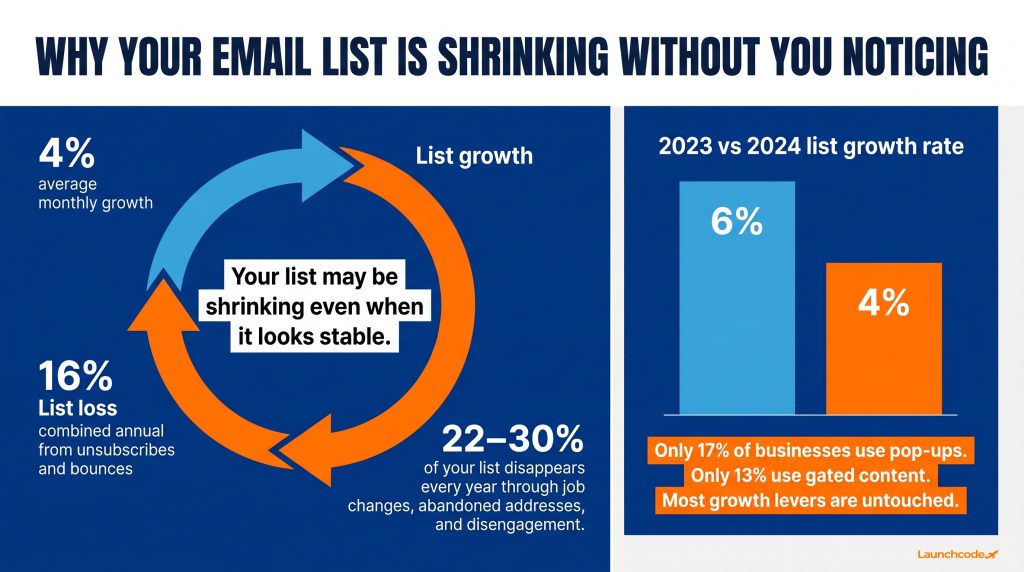
Average email list growth fell to 4% in 2024, down from 6% in 2023. At the same time, annual list loss from unsubscribes and non-deliverable bounces sits at roughly 16%. That is the treadmill problem. Subscribers churn in the background whether you notice or not. If your growth rate does not outpace your decay rate, your list is shrinking even when it looks stable. The same data shows that only 17% of organizations use email subscribe pop-ups on their website, and only 13% use gated content resources to grow their list. Most brands are leaving the simplest acquisition mechanisms completely untouched. "We look at a client's email list the same way we look at their website. It is a business asset that compounds. If you are not building it from day one, you are leaving future revenue on the table." Tanner Medina, Co-Founder & Chief Growth Officer
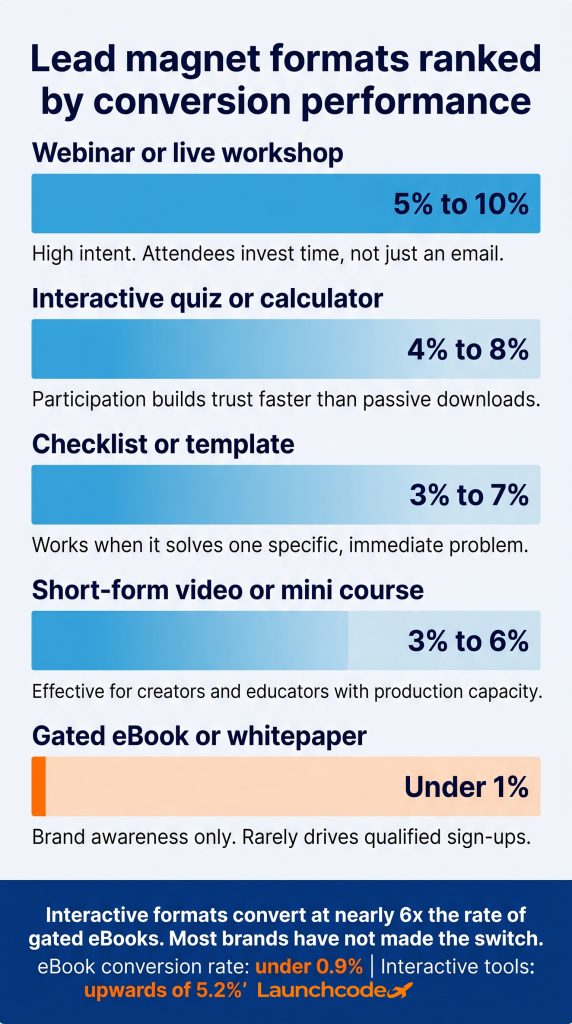
A lead magnet converts when it solves one specific problem immediately. The era of the gated eBook is over. According to a 2024 HubSpot report, conversion rates for gated eBooks have dropped below 0.9%. Interactive tools like quizzes, calculators, and templates now convert at upwards of 5.2%, a nearly six times difference. People want to do something useful, not download something they will not read.
Ann Handley of MarketingProfs frames the lead magnet question clearly: "Help them take one smart step forward. Not solve everything at once." A strong lead magnet solves a micro-problem right now. One step the subscriber can act on today.
Research from Amra and Elma shows that interactive lead magnets including calculators, quizzes, and product pickers produce a 70% conversion increase over static content. Interactive formats require participation, and participation builds trust faster than passive downloads.
| Format | Typical conversion rate | Best for | Watch out for |
|---|---|---|---|
| Interactive quiz or calculator | 4% to 8% | B2B and B2C, any stage | Needs a clear, useful result |
| Checklist or template | 3% to 7% | Operational roles, practitioners | Must be immediately usable |
| Webinar or live workshop | 5% to 10% at registration | Service businesses, SaaS | High production effort |
| Short-form video or mini course | 3% to 6% | Creators, educators | Requires production quality |
| Gated eBook or whitepaper | Under 1% | Brand awareness only | Rarely drives qualified sign-ups |
Most lead magnets fail for one of three reasons.
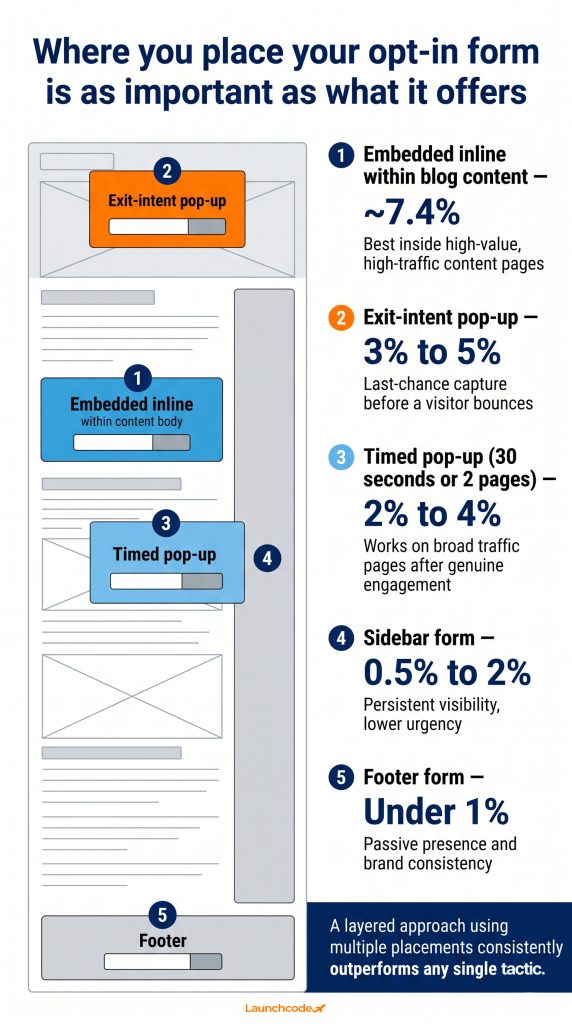
Form placement drives as much conversion as form design. The same offer in different locations produces dramatically different results. Pop-ups, inline forms, exit-intent triggers, and footer forms each have distinct performance characteristics. Most brands test one placement and stop, leaving significant subscriber volume on the table. A layered approach, using multiple placements tuned to different visitor behaviors, consistently outperforms any single tactic.
Here is how common form placements compare:
| Placement | Average conversion rate | Best use case |
|---|---|---|
| Embedded inline (within blog content) | ~7.4% | High-value, high-traffic content pages |
| Exit-intent pop-up | 3% to 5% | Last-chance capture before bounce |
| Timed pop-up (after 30 seconds or 2 pages) | 2% to 4% | Broad traffic pages |
| Sidebar form | 0.5% to 2% | Persistent visibility, lower urgency |
| Footer form | Under 1% | Passive presence and brand consistency |
Do not put one form on one page and call it a strategy. Layer multiple placements that each serve a different visitor behavior.
Generic copy kills conversions. "Sign up for our newsletter" tells the reader nothing about the value they receive.
Compare these two CTAs:
The second version answers three questions in one sentence: what do I receive, how often, and who else is doing this. Specificity converts.
High-quality content and organic search traffic are among the most efficient long-term list-building mechanisms available. Visitors arriving through search already have intent. They searched for a specific problem. If your content solves it and your opt-in offer extends that value, the conversion feels like a natural next step. The content upgrade model converts that search intent into subscribers at a rate a generic homepage pop-up cannot match.
The key is to match the opt-in offer to the content on the page. A post explaining how to configure email automation should offer an automation flow template. A post comparing email platforms should offer a comparison checklist. Relevance is the conversion driver.
A well-ranked blog post drives traffic for months or years after it is published. Every visit is a list-building opportunity. As Neil Patel has noted, email continually outperforms most other marketing channels he has tested, and structured organic content is one of the most reliable sources feeding those lists.
For brands investing in search and content, this is not a separate strategy. It is an extension of the same one. Every article you publish is also a potential opt-in landing page if it is built with the right offer and the right form placement.
Segmentation is not something you add after your list reaches a certain size. It is infrastructure you build at the start. Segmented email campaigns produce 760% more revenue than non-segmented sends. Segmented lists also grow faster and retain subscribers longer. Waiting until you have 10,000 subscribers to start segmenting means losing months of compounding performance on every send before that point.
As Mihail Stoychev of iSenseLabs puts it directly: "Email marketing is much more efficient as we have a well segmented opted-in list." That efficiency does not appear by chance. It comes from tagging subscribers at the point of sign-up and building differentiated sequences from the start.
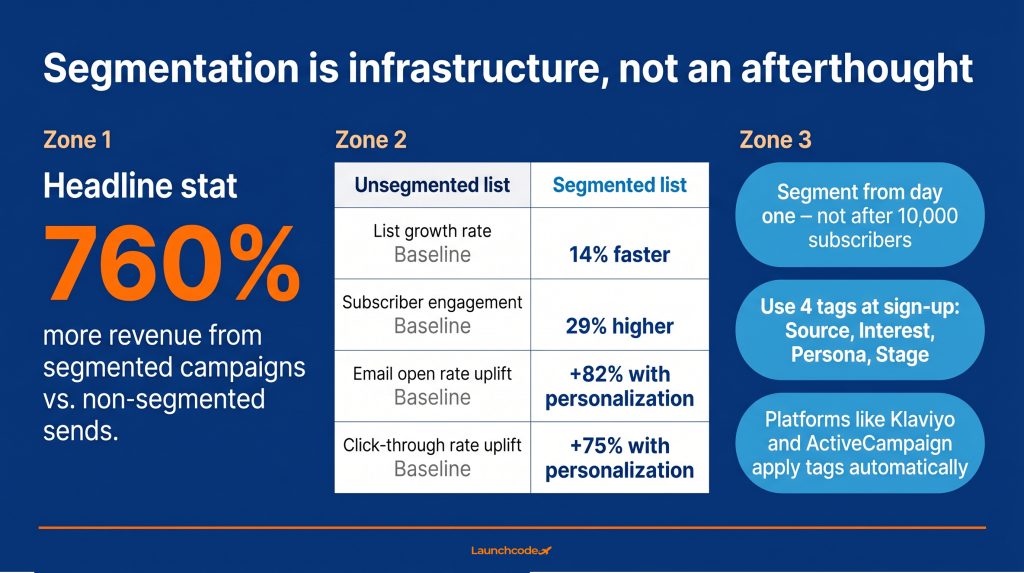
When a subscriber opts in, you already know something about them: which page they were on, which lead magnet attracted them, which topic brought them to your site. Each of those data points is a segmentation signal.
A simple starting framework uses four tag types:
Platforms like Klaviyo, ActiveCampaign, and ConvertKit apply these tags automatically based on form source or landing page URL. The setup is a one-time configuration that runs without manual effort on every future sign-up.
Research from Mailmodo shows that personalized emails produce an 82% increase in open rates and a 75% increase in click-through rates compared to generic sends. Segmentation creates the foundation for that personalization. You cannot send relevant content to someone whose context and interests you have not captured.
Opensend data via shno.co shows that segmented lists grow 14% faster and achieve 29% higher engagement than undifferentiated lists. Segmentation improves both acquisition performance and retention simultaneously. Fewer subscribers leave when the content they receive is relevant to why they signed up.
Email lists decay at 22 to 30% per year. That means even a well-managed list loses roughly one in four contacts annually through job changes, abandoned addresses, and gradual disengagement. Sending to that decay wastes budget and damages your sender reputation, pushing your emails toward spam for everyone on the list, including engaged subscribers who should be hearing from you.
In 2024, Google and Yahoo introduced mandatory bulk sender requirements. Gmail expanded enforcement to hard rejections in November 2025. The threshold is not negotiable. As MailCleanup's list hygiene guide explains, spam complaint rates above 0.3% trigger permanent delivery penalties. Poor list hygiene is the direct cause of crossing that threshold.
"When we audit a new client's email program, deliverability is always the first thing we check. A well-written campaign that lands in spam might as well not exist." Brittany Charles, SVP, Client Services
Hygiene is not a single event. It is an ongoing system with clear operational components.
Apple's Mail Privacy Protection broke open-rate-based hygiene decisions. As of 2024, roughly 55% of global email opens come from Apple devices using Mail Privacy Protection, which pre-loads images and registers a false open. A zero open rate no longer means a subscriber is disengaged. Use clicks, link activity, and purchase behavior as your engagement benchmarks for hygiene decisions instead.
If your email list includes subscribers from the EU, GDPR requires clear, affirmative, consent-based opt-in. CAN-SPAM in the US requires accurate sender information, honest subject lines, and a functioning unsubscribe mechanism on every send. CASL in Canada distinguishes between implied and express consent, with strict documentation requirements. These are general frameworks. Businesses sending across multiple jurisdictions should get legal review for their specific situation.
AI does not replace the strategy behind a strong email list. It reduces the execution cost of running one at scale. Behavioral segmentation that once required manual configuration across multiple tools can be deployed in hours with modern AI-powered platforms. Opt-in targeting, automated re-engagement, and predictive personalization all reduce friction without reducing output quality.
B2B email benchmarks from Verified.email note that future success in email depends on "technical excellence, strategic sophistication, and AI adoption rather than creative brilliance alone." That represents a meaningful shift in what separates high-performing programs from average ones.
Humanic's analysis of AI in email marketing found that automated emails generate 320% more revenue than manually sent campaigns despite representing just 2% of total send volume. AI-driven personalization has contributed to revenue increases of up to 760% in segmented campaigns compared to generic sends.
The practical takeaway for brands building a list-growth system is this: automate the repeatable execution. Use AI for targeting, personalization, and hygiene triggers. Reserve human judgment for strategy, brand voice, and creative direction.
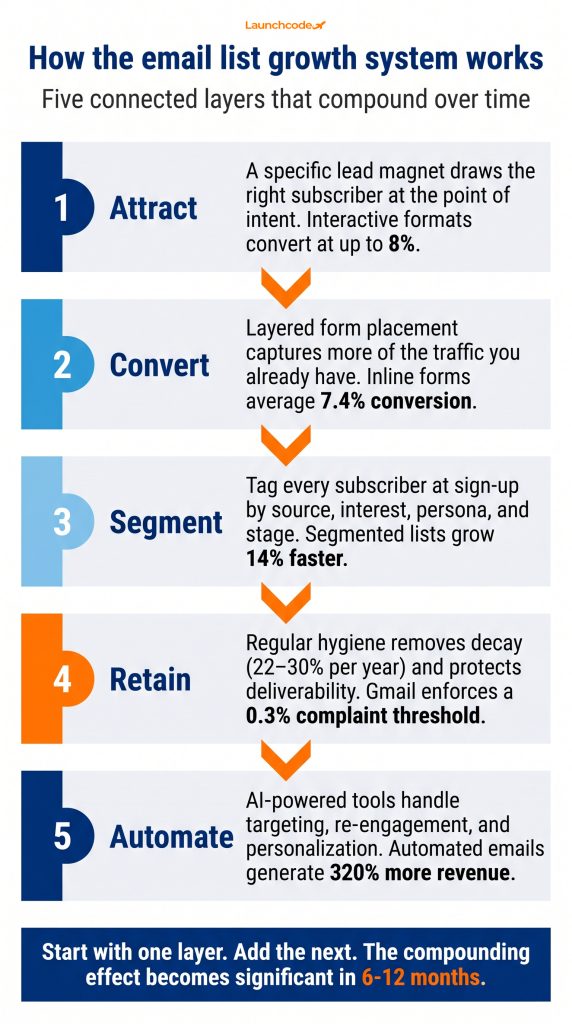
Most brands treat email list building as a number to hit. Get to 1,000 subscribers. Then 10,000. Then 100,000. The number is not the point. A list of 5,000 highly engaged, well-segmented subscribers will outperform a list of 50,000 undifferentiated, poorly maintained contacts in every metric that matters: open rates, click rates, inbox placement, and revenue per send.
The strategies in this article work together as a connected system. A specific lead magnet attracts the right subscriber at the point of intent. Smart form placement converts more of the traffic you already have. Content and SEO create an always-on acquisition channel. Segmentation from day one ensures relevance as the list grows. Regular hygiene keeps deliverability intact. AI reduces the execution overhead of running all of it at scale.
Start with one layer and add the next. The compounding effect becomes significant over six to twelve months when the infrastructure is built correctly from the beginning.
If you want to see how this system applies to your specific business, our email marketing services cover everything from list infrastructure and authentication setup through full campaign execution and ongoing optimization.
Average email list growth was 4% in 2024. Smaller early-stage businesses often see 5% to 10% monthly growth from a lower starting base. Enterprise-scale lists typically grow at less than 1% per month due to the larger denominator. Focus on net growth after accounting for natural list decay. A 6% growth rate with 25% annual decay produces a shrinking list in real terms.
Review engagement data at least quarterly. Remove hard bounces immediately after every send. Run a re-engagement campaign for subscribers showing no click or purchase activity in 90 to 180 days. Remove those who do not respond to the re-engagement sequence. Because of Apple Mail Privacy Protection, use clicks and purchases as your primary engagement signals rather than opens.
Webinars, ROI calculators, and highly specific templates or frameworks perform best for B2B audiences. The offer should solve a concrete business problem your buyer faces right now. Avoid broad whitepapers and long-form guides unless paired with a tactical follow-up asset. Interactive calculators have shown conversion rates of 4% to 8% in B2B contexts, well above the sub-1% rate of traditional gated PDF content.
GDPR does not explicitly require double opt-in, but it does require clear and affirmative consent. A well-structured single opt-in with an explicit consent statement, no pre-ticked boxes, and a compliant unsubscribe mechanism in every email can satisfy GDPR requirements. Double opt-in provides stronger consent documentation and typically produces a more engaged list. Consult a legal professional for guidance specific to your audience and geography.
No. Purchased lists deliver poor results and create serious risks. Recipients who never opted in generate high complaint rates, which damage your sender reputation with Gmail and Yahoo and can trigger permanent rejection penalties. Under CAN-SPAM and GDPR, sending to purchased contacts without valid consent creates legal exposure. Build your list through opt-in strategies. Each subscriber represents genuine interest and produces far higher ROI over time.



Learn how to build an email list that actually grows. Covers lead magnets, form placement, segmentation, deliverability, and...
Local SEO for healthcare networks with multiple locations. Step-by-step framework covering GBP, location pages, NAP, HIPAA r...
Open rate is broken. Apple Mail Privacy Protection distorts more than 55% of all recorded opens. Learn the three-tier email ...