949.822.9583
support@launchcodex.com

Email marketing metrics that matter: Beyond open rate

Last Date Updated:
June 17, 2026
Time to read clock
14 minute read
Open rate is broken as a performance metric. Apple Mail Privacy Protection now distorts more than 55 percent of all recorded email opens, and 40 percent of marketers still rely on it as their primary KPI. This article gives email teams a three-tier measurement framework covering list health, engagement, and revenue attribution, with benchmarks and formulas to act on today.
Email marketing metrics that matter_ Beyond open rate
Table of Contents
Primary Item (H2)
Build-operate-transferCo-buildJoint ventureVenture sprint
Ready for a free checkup?
Get a free business audit with actionable takeaways.
Start my free audit
Key takeaways (TL;DR)
Apple Mail Privacy Protection affects more than 55 percent of all recorded email opens, making open rate an unreliable performance signal
Click-to-open rate, revenue per email, and inbox placement rate connect email activity to real business outcomes
Automated flows generate 41 percent of total email revenue from only 5.3 percent of sends and need their own measurement track separate from broadcast campaigns

Open rate used to be the headline number in every email report. Subject line test? Measure open rate. New send time? Check open rate. New segment? Open rate tells you if it worked. That logic stopped being reliable in 2021 when Apple launched Mail Privacy Protection, and the situation has only gotten harder to ignore.

This article explains why open rate fails as a performance metric, what to track instead, and how to build a measurement framework that connects your email program to revenue. You will leave with specific benchmarks, formulas, and a clear tier structure for reporting email performance to the people who make decisions.

Why open rate is no longer a reliable performance metric

Open rate was never a perfect metric, but it used to be directionally useful. That changed in September 2021 when Apple launched Mail Privacy Protection (MPP), which automatically pre-fetches email content on Apple's proxy servers and triggers the tracking pixel before the recipient ever opens the message. As of early 2024, MPP accounts for roughly 55 percent of all email opens, according to Litmus. The majority of your open data does not reflect a real human action.

Ready to grow your organic traffic?

Get a free SEO audit from the Launchcodex team.

Book a Free Audit

MPP was built to protect user privacy, and it does that well. For email marketers, it creates a measurement problem that does not announce itself clearly. Open rates climb. Dashboard numbers look healthy. Revenue stays flat.

The second source of distortion is bot activity. Corporate email security tools, particularly those used in B2B environments, often pre-load email content to scan for threats. This inflates both opens and, in some cases, click data, especially for B2B lists routed through systems like Microsoft Defender or Proofpoint.

Chad S. White, Group VP of CRM Strategy at Zeta Global and author of Email Marketing Rules, is direct about it: "Open rates are health metrics, not success metrics. A sudden ten-point drop means you've got a deliverability problem. Beyond that, they can't tell you much anymore."

Litmus data from their State of Email Innovations survey shows 40 percent of email marketers still use open rate as their primary success metric. That is the core problem this article addresses.
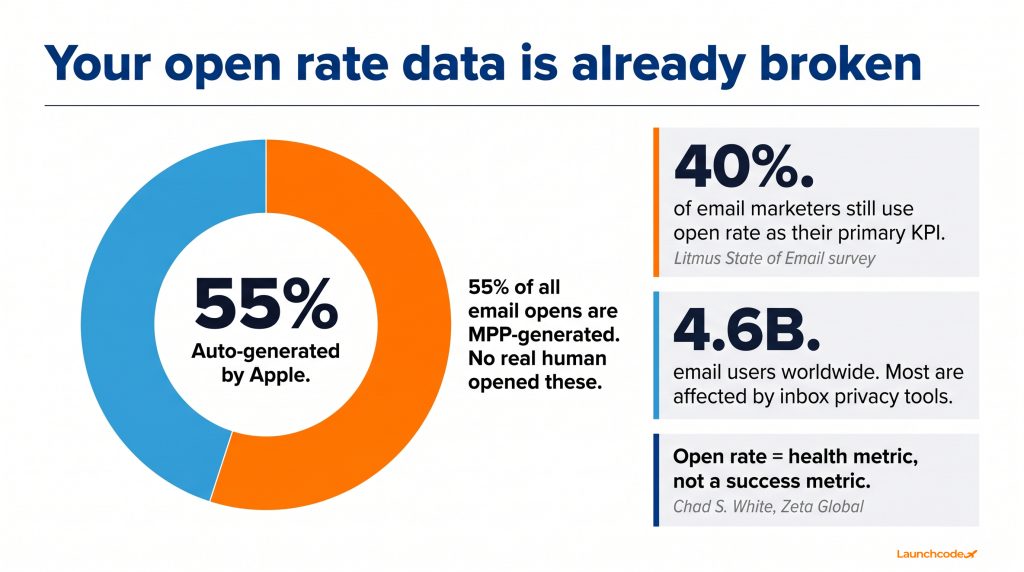
Why open rate is broken (the MPP problem)

What open rate is still useful for

Open rate has not become worthless. It has a narrow, specific job.

  • Deliverability signal: A sudden drop in open rate across a large send can indicate inbox placement problems, domain reputation issues, or a technical fault. Watch for drops of 10 or more percentage points.
  • List segmentation: Some ESPs let you filter out MPP-generated opens and use adjusted open data to identify genuinely inactive subscribers for re-engagement campaigns.
  • Directional A/B testing: If you test subject lines within the same send and your ESP filters MPP opens, open rate can give you a rough directional signal on subject line appeal.

That is where the use case ends. Open rate should not appear in a performance report next to revenue, pipeline, or lead numbers.

The MPP exclusion setting you should turn on

Several ESPs now allow you to filter MPP-generated opens from your reporting. Klaviyo and Brevo both offer this toggle. If you use click-to-open rate (CTOR) as a metric, turn on MPP exclusion before you calculate it. CTOR uses open count as its denominator. Inflated opens deflate your CTOR and make content look less effective than it is.

The three-tier email metric framework

A useful email measurement framework organizes metrics into three tiers: list health, engagement, and revenue attribution. Each tier answers a different question. List health tells you whether your program can function. Engagement tells you whether your content connects. Revenue attribution tells you whether email is driving outcomes the business cares about.

Most email programs track one tier at best. High-performing programs track all three and review them on different cadences.

"When we switch clients from open rate reporting to CTOR and revenue per email, the first thing they notice is how much cleaner the conversation with leadership becomes. There is no longer a number that looks good but explains nothing." Brittany Charles, SVP, Client Services
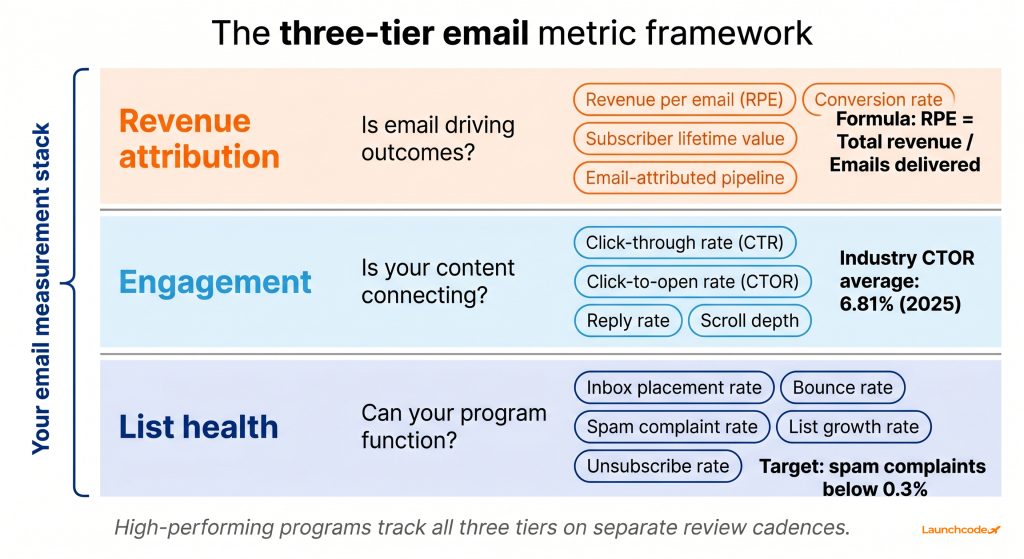
The three-tier email metric framework

Tier 1: List health metrics

List health metrics tell you the quality and deliverability potential of your subscriber base. They are not headline numbers, but they are the foundation everything else depends on.

Key metrics in this tier:

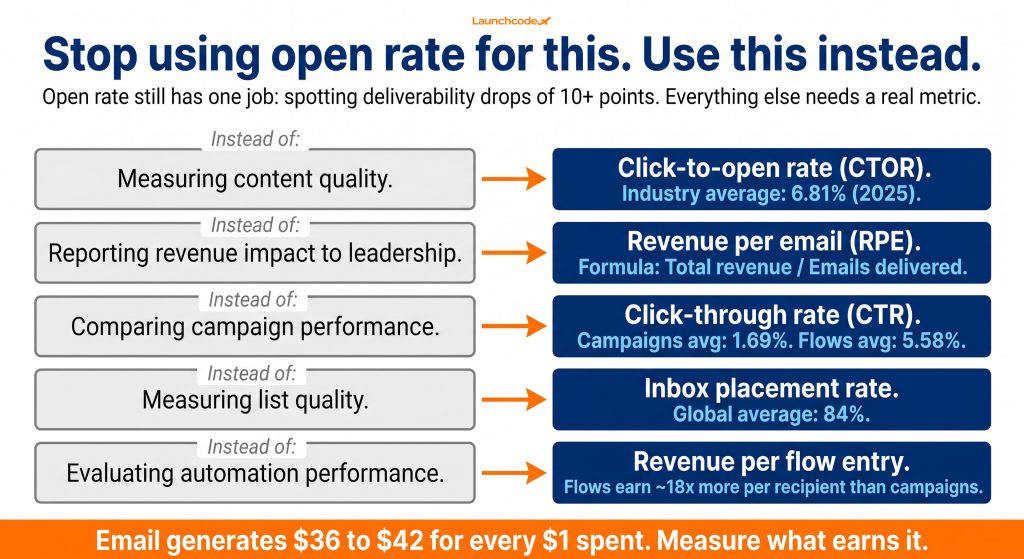
  • Inbox placement rate: The percentage of sent emails that land in the primary inbox rather than spam or promotions. The global average sits at 84 percent, meaning roughly one in six emails never reaches the inbox, according to Validity's 2024 Email Deliverability Benchmark. Delivery rate and inbox placement rate are not the same thing. Your ESP reports the former. The latter is what actually matters.
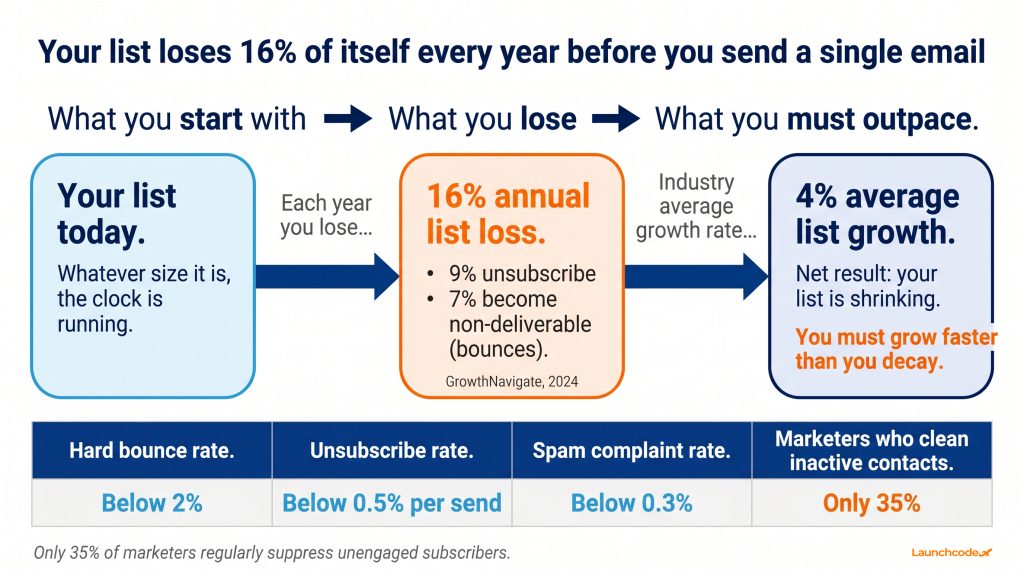
  • Bounce rate: Hard bounces signal invalid addresses and harm sender reputation. Keep hard bounce rate below 2 percent.
  • Unsubscribe rate: Rates above 0.5 percent on a regular send often indicate a relevance or frequency problem worth investigating.
  • Spam complaint rate: Gmail and Yahoo now require bulk senders to keep spam complaint rates below 0.3 percent. Exceeding this threshold triggers immediate deliverability penalties. This is a compliance metric, not just a hygiene number, following Google and Yahoo's enforcement changes in 2024.
  • List growth rate: In 2024, the average email list grew at just 4 percent while losing roughly 16 percent to unsubscribes and bounces combined. A list that is not growing faster than it churns is shrinking in usable reach.

Tier 2: Engagement metrics

Engagement metrics tell you how your content performs once emails land in the inbox.

Key metrics in this tier:

  • Click-through rate (CTR): The percentage of delivered emails that generated at least one click. CTR requires a deliberate human action, which makes it far more reliable than open rate. The average CTR across industries sits at around 2.09 percent for campaigns, per MailerLite's benchmark dataset of 3.6 million sends.
  • Click-to-open rate (CTOR): The percentage of openers who clicked. CTOR measures content quality relative to the promise of your subject line. The industry average was 6.81 percent in 2025, up from 5.63 percent in 2024. Filter MPP opens before calculating CTOR, or the denominator will be inflated.
  • Reply rate: For B2B and cold outreach programs, reply rate is often the most direct engagement signal available. It requires no tracking pixel and is not affected by MPP.
  • Scroll depth and read time: Available in tools like Litmus and some ESPs, these signals show whether recipients read your emails or stop after the first few lines.

Tier 3: Revenue attribution metrics

Revenue attribution metrics connect email activity to business outcomes. These are the numbers that belong in executive reports.

Key metrics in this tier:
  • Revenue per email (RPE): Total revenue from a campaign divided by number of emails delivered. Formula: RPE = Total revenue / Emails delivered. This metric shows financial output per send without relying on any engagement proxy.
  • Revenue per recipient (RPR): Similar to RPE but useful when comparing segments or flows with different list sizes.
  • Conversion rate: The percentage of delivered emails where a recipient completed a desired action, whether a purchase, a form fill, or a booking. Email campaign click-to-conversion rates grew by 27.6 percent in 2024 according to Omnisend's ecommerce statistics, showing that recipients who click are increasingly likely to purchase.
  • Subscriber lifetime value (SLV): Average revenue per email multiplied by the expected total number of emails sent to a subscriber over their active period. SLV is useful for comparing the value of different list segments and acquisition channels.
  • Email-attributed pipeline: For B2B teams, the value of pipeline deals where email played a documented role in the conversion journey.
List health decay, the silent list killer

Click-through rate and click-to-open rate: Your engagement baseline

CTR and CTOR are the two most actionable engagement metrics available now that open rate has lost reliability. CTR tells you whether your email drove action across your full list. CTOR tells you whether the content was compelling to the people who saw it. Both measure real behavior. Neither is inflated by pre-fetching or bot activity.

How to use CTR in practice

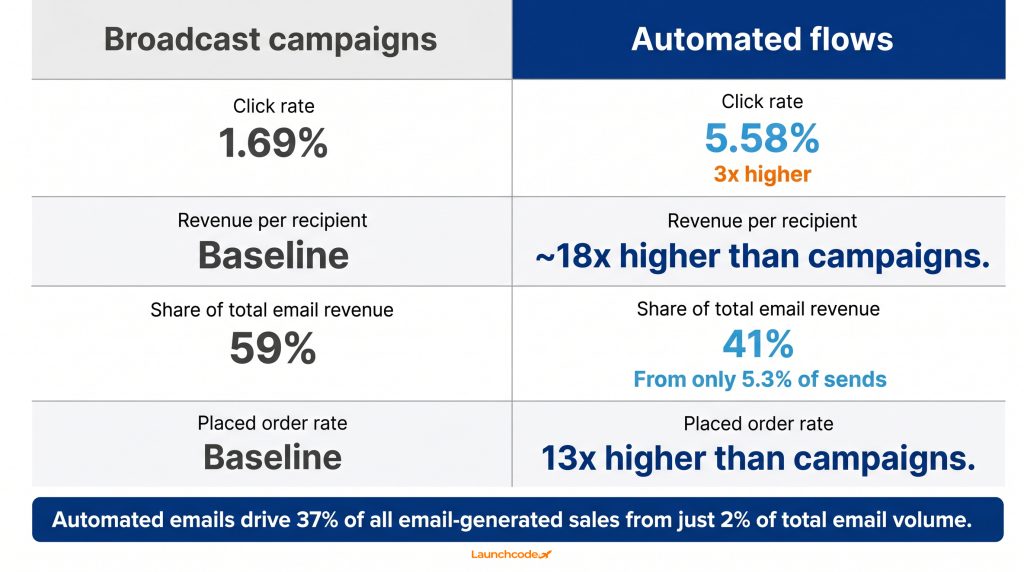
CTR benchmarks vary significantly by industry and email type. Klaviyo's 2026 email marketing benchmarks, drawn from over 183,000 brands, show automated flows delivering a 5.58 percent click rate versus 1.69 percent for broadcast campaigns. That is more than a 3x gap.

If your broadcast CTR consistently falls below 1 percent and your flows hover at 3 percent or above, the gap usually traces back to one of three causes:

  1. Broadcast emails lack a clear, singular call to action
  2. The content does not align with where those subscribers are in their lifecycle
  3. The segment is too broad and includes disengaged contacts

A useful diagnostic: calculate CTR by segment rather than by full campaign. If engaged subscribers click at 4 percent and your full list averages 1.5 percent, the issue is not your content. It is list hygiene.

How to use CTOR to improve content quality

CTOR isolates content quality from subject line quality. A high open rate paired with a low CTOR means your subject line created interest that your email body did not deliver on. A low open rate with a high CTOR means your content is strong but your subject lines are underperforming.

Use CTOR to:

  • A/B test email body formats, content depth, and CTA placement without subject line variation
  • Compare performance across content categories such as promotional, educational, and transactional emails
  • Set a content quality benchmark by email type and track it over time as a trend

The MailerLite 2025 benchmark report, covering over 3.6 million campaigns, puts the average CTOR at 6.81 percent across all industries. Manufacturing, legal, and media categories typically sit well above that. Insurance, beauty, and political emails track significantly below.
The open rate replacement guide

Revenue per email: The metric leadership actually cares about

Revenue per email (RPE) is the clearest bridge between your email program and the outcomes your leadership team reports on. It does not require explaining click anomalies or subject line results. It answers one question: how much revenue did each email generate? For revenue-focused teams, RPE belongs at the top of the reporting stack.

The formula is simple. Divide total revenue attributed to an email by the number of delivered sends. If a campaign generates $12,000 in revenue from 60,000 delivered emails, your RPE is $0.20.

That number becomes actionable when you:

  • Compare RPE across campaigns to identify which content categories, segments, or send times drive the most revenue per send
  • Compare RPE for flows versus broadcasts to understand where to invest more automation effort
  • Calculate subscriber lifetime value by multiplying average RPE by the expected total sends per subscriber over their active period

Klaviyo's benchmark data shows that automated flows generate revenue per recipient nearly 18 times higher than broadcast campaigns. Automated emails also drive 37 percent of all email-generated sales despite making up only 2 percent of total email volume, per Litmus research cited by InboxAlly. That ratio should shift how teams allocate time between campaign creation and flow optimization.

What a strong RPE signals

A rising RPE over time, while holding CTR stable or improving, signals that:

  • List quality is improving as low-value contacts churn out
  • Content-to-audience match is strengthening through better segmentation
  • Automation is capturing more revenue from behavioral triggers

A falling RPE alongside a rising CTR typically signals that clicks are not converting. That is a landing page or offer problem rather than an email problem, and it shows exactly where the fix needs to happen.

Inbox placement rate vs. delivery rate: The distinction that protects your revenue

Delivery rate measures whether your email was accepted by the receiving server. Inbox placement rate measures whether it actually landed where the recipient will see it. These two numbers can diverge significantly, and most ESPs report only the former. A 98 percent delivery rate alongside a 60 percent inbox placement rate means 38 percent of your delivered emails went directly to spam.

Roughly one in six marketing emails never reaches the inbox, per Validity's 2024 Email Deliverability Benchmark. That represents significant lost revenue before any engagement begins.

Why inbox placement falls and how to protect it

Inbox placement is determined primarily by sender reputation, which inbox providers like Gmail and Yahoo calculate using:

  • Authentication compliance (DMARC, DKIM, SPF): Gmail and Yahoo introduced mandatory authentication requirements for bulk senders in 2024. Non-compliance results in immediate deliverability penalties. This is a foundation requirement, not an advanced configuration.
  • Engagement history: Inbox providers track whether recipients open, click, delete, or mark emails as spam. Low engagement signals low relevance and reduces inbox priority over time.
  • Spam complaint rate: Complaints above 0.3 percent trigger deliverability action from Gmail. Complaints above 0.1 percent are worth investigating proactively before they escalate.
  • List hygiene: Sending to large numbers of invalid or inactive addresses damages sender reputation over time and compounds with each send.

The practical path to protecting inbox placement follows four steps:

  1. Verify that DMARC, DKIM, and SPF are configured correctly for every sending domain.
  2. Use a seed list or inbox placement testing tool to measure where emails land before major sends. Tools like Validity, GlockApps, and MailReach cover this.
  3. Suppress or sunset contacts who have not engaged in 90 to 180 days. Only 35 percent of marketers regularly remove unengaged subscribers per GrowthNavigate's email marketing data, which means most programs are actively degrading their own deliverability with stale contacts.
  4. Monitor spam complaint rates daily for large-volume senders and weekly for smaller lists. Gmail Postmaster Tools provides direct complaint rate visibility for Gmail recipients at no cost.

List health metrics: The foundation everything else sits on

A large email list is only valuable if it is also an engaged and clean one. In 2024, the average email list lost roughly 16 percent of its subscribers through unsubscribes and bounces combined, while growing at only 4 percent. That is a net decline. Tracking list health metrics separately from engagement metrics is the only way to see this problem before it erodes your sending infrastructure.

List health problems compound quietly. A list with 20 percent inactive contacts does not just reduce engagement rates. It drags down sender reputation, reduces inbox placement, and inflates the cost of every send. Removing those contacts improves every downstream metric.

The list health metrics worth tracking regularly

  • Hard bounce rate: Target below 2 percent. Hard bounces are permanent delivery failures, usually from invalid addresses. Accumulating hard bounces signals poor list acquisition or outdated contact data.
  • Soft bounce rate: Monitor for increases. Soft bounces are temporary and often resolve, but a pattern of repeated soft bounces for the same address is a candidate for suppression.
  • List growth rate: Calculate net growth monthly using this formula: (new subscribers minus unsubscribes and bounces) divided by total list size, multiplied by 100. A healthy program shows positive net growth consistently.
  • Unsubscribe rate per campaign: Industry averages sit around 0.22 percent per MailerLite's benchmark data. Rates consistently above 0.5 percent warrant an audit of frequency, relevance, or segmentation strategy.

Common list health mistakes and how to avoid them

  • Buying or scraping email lists: Purchased lists damage sender reputation immediately. The addresses are often invalid, unengaged, or registered to spam traps that report activity directly to inbox providers.
  • Skipping re-engagement campaigns: Before deleting inactive subscribers, run a re-engagement sequence. Subscribers who re-engage are valuable. Those who do not should be suppressed, not left to accumulate.
  • Skipping double opt-in for new subscribers: Double opt-in reduces junk signups and produces a more engaged list from day one. It trades list size for list quality, and list quality wins every time.

Campaigns vs. flows: Why you need two separate measurement tracks

Broadcast campaigns and automated flows should not be measured against the same benchmarks. They serve different purposes, reach audiences at different moments, and produce dramatically different results. Treating them as a single category obscures where your email program is actually creating value.

Klaviyo's 2026 benchmark data across 183,000 brands makes the gap concrete. Automated flows deliver click rates of 5.58 percent compared to 1.69 percent for campaigns. Flows produce placed order rates 13 times higher than campaigns. And flows generate 41 percent of total email revenue from just 5.3 percent of all sends.

That is a fundamental distinction in how these two email types operate, and it demands a separate measurement structure for each.

"The moment you separate campaign data from flow data in your reporting, patterns you were missing start surfacing immediately. Flow performance tells a completely different story from campaigns, and conflating them means you are optimizing for the wrong thing." Derick Do, Co-Founder and Chief Product Officer

What to measure in broadcast campaigns

Broadcast campaigns go to a defined segment at a scheduled time. The right metrics for campaigns are:

  • CTR: Did recipients click through relative to the size of the send?
  • CTOR: Did openers engage with the content?
  • Conversion rate: Did the email drive the desired action?
  • RPE: What revenue did this specific send generate?
  • Unsubscribe rate per campaign: A spike signals a relevance or frequency problem for that segment

What to measure in automated flows

Automated flows run continuously and trigger based on subscriber behavior. The right metrics for flows are:

  • Flow conversion rate: The percentage of flow entries that resulted in the desired outcome, whether a purchase, a booking, or a completed onboarding
  • Revenue per flow entry: Total revenue attributed to the flow divided by total entries over a given period
  • Step-level drop-off: Where do subscribers stop engaging within a multi-step flow? Drop-offs at specific steps indicate weak content or poor timing at that stage
  • Flow health over time: Flows that performed well six months ago can decay as list composition changes. Review flow performance quarterly and refresh copy and offers annually at minimum

The Litmus State of Email Reports for 2025-2026 notes that the top 8 percent of email programs, those generating 45:1 ROI or higher, most commonly send newsletters and onboarding sequences, not promotional blasts. Relationship-building email types, measured properly through flow-level metrics, consistently outperform volume-driven campaign strategies.
Campaigns vs. flows performance comparison

AI personalization and the signals that come next

AI is changing what is worth measuring in email. Personalization tools now produce measurable performance differences that show up in standard metrics. AI product recommendations lift average email click rates to 3.75 percent, and to 8.79 percent for top-performing brands, per Klaviyo's 2026 benchmarks. Those numbers justify tracking AI-driven sends as a distinct measurement category.

Segmented campaigns already show what targeted relevance can do. Segmented sends produce 28 percent higher click rates and 14 percent higher open rates compared to unsegmented sends. Advanced personalization, when fully implemented, has been linked to revenue increases of up to 760 percent across multiple industry studies.

What AI personalization changes in your measurement practice

When AI drives the send logic, your measurement approach needs to adjust:

  • You need a control group: Testing AI product recommendations against standard content requires a clean A/B split with a meaningful sample size to isolate the variable accurately.
  • RPE becomes your primary signal: AI-personalized sends are built to drive conversion. RPE and conversion rate are the right metrics to measure whether they are working. CTR alone does not capture the revenue impact.
  • Behavioral triggers expand what counts as a flow: As AI enables more sophisticated behavioral triggers, such as predictive churn signals or purchase likelihood scores, the line between broadcast and flow blurs further. Track these triggered sends under flow metrics, not campaign metrics.

Emerging metrics worth tracking now

A handful of advanced signals are beginning to appear in high-performing programs and will become standard measurement practice over the next two years:

  • Predictive engagement score (PES): Combines engagement velocity, scroll depth, and session time to forecast purchase likelihood. Platforms like Klaviyo are incorporating this into segmentation logic, which will change how inactive contacts are defined and treated.
  • Email-attributed MQL and SQL rate: For B2B programs, tracking how email engagement correlates with marketing-qualified and sales-qualified lead creation connects email directly to pipeline. Litmus reports a 22 percent year-over-year increase in multi-channel attribution as email teams move reporting closer to revenue accountability.
  • Revenue per flow entry: As flows become more sophisticated, tracking revenue at the flow level rather than the campaign level gives a clearer picture of where automation is driving returns.

Build a measurement stack your team will actually use

Email metrics only create value when they drive decisions. The most common failure in email measurement is a reporting structure that looks organized in a dashboard and means nothing to the people reviewing it.

Here is a practical approach to building a measurement stack that holds up in practice:

  1. Assign each metric to a tier. List health metrics belong in a separate section from engagement metrics and revenue metrics. Keep them organizationally distinct so problems in one tier do not get obscured by performance in another.
  2. Set a review cadence by tier. Check list health monthly. Review engagement metrics per campaign and weekly for flows. Report revenue metrics to leadership monthly with trend context against prior periods.
  3. Replace open rate in your stakeholder report with two numbers: CTOR as your content quality signal and RPE as your revenue signal. These two metrics tell a cleaner story than open rate ever did.
  4. Benchmark against your own history first. Industry averages vary widely by ESP, list type, and audience composition. Your historical data is the most relevant baseline available.
  5. Separate campaign and flow reporting. Track them in parallel with distinct benchmark targets. The purposes are different, the optimization levers are different, and the benchmarks reflect that.
  6. Enable MPP filtering in your ESP before calculating CTOR. This applies to Klaviyo, Brevo, and several other major platforms. Without it, your CTOR denominators are inflated by machine-generated opens, and every comparison will be off.

At Launchcodex, separating campaign and flow reporting is one of the first structural decisions we make when building email infrastructure for clients. That single decision makes every performance conversation afterward cleaner and more useful.

Email marketing generates between $36 and $42 for every dollar spent across multiple industry benchmarks. Capturing that return consistently requires building measurement on data that reflects real behavior. If you want help building email infrastructure or attribution reporting that connects to your growth goals, our email marketing services cover the full stack from sending infrastructure to performance reporting.

FAQ

Is open rate completely useless now?

Not completely, but its use case is narrow. Open rate works as a deliverability health signal. A sudden drop of 10 or more percentage points across a large send usually indicates an inbox placement or sender reputation problem. It should not be used as a primary engagement or performance metric.

What is a good click-to-open rate?

The industry average across all sectors was 6.81 percent in 2025 per MailerLite's benchmark data. CTOR varies significantly by industry and email type. Transactional emails and automated flows typically outperform broadcast campaigns. Use your own historical baseline as the primary reference before comparing to industry averages.

How do I calculate revenue per email?

Divide total revenue attributed to an email by the number of emails delivered. If a campaign generates $5,000 from 25,000 delivered emails, your revenue per email is $0.20. Track this per campaign and per flow separately to see where your program creates the most financial value per send.

What is inbox placement rate and how do I check it?

Inbox placement rate measures the percentage of delivered emails that land in the primary inbox rather than spam or promotions. Your ESP delivery rate does not show this. Use a dedicated inbox placement testing tool such as Validity, GlockApps, or MailReach to test placement before major sends.

Why do automated flows outperform broadcast campaigns on revenue?

Flows reach subscribers at high-intent moments tied to their own behavior, such as after signup, after cart abandonment, or after a purchase. That behavioral relevance produces higher click and conversion rates than scheduled broadcasts. Klaviyo's 2026 benchmark data shows flows generating revenue per recipient nearly 18 times higher than campaigns from just 5.3 percent of total send volume.

What spam complaint rate should I target?

Keep spam complaint rates below 0.3 percent to comply with Gmail and Yahoo's 2024 bulk sender requirements. Rates above 0.1 percent are worth investigating for relevance, frequency, or list acquisition issues before they trigger deliverability action.

Launchcodex author image - Brittany Charles (1)
— About the author
Brittany Charles
- SVP, Client Services
Brittany leads client delivery and account strategy. She ensures every engagement is organized, clear, and tied to business results. Her approach blends structure, communication, and accountability.
Launchcodex blog spaceship

Join the Launchcodex newsletter

Practical, AI-first marketing tactics, playbooks, and case lessons in one short weekly email.

Weekly newsletter only. No spam, unsubscribe at any time.
Envelopes

Explore more insights

Real stories from the people we’ve partnered with to modernize and grow their marketing.
View all blogs

Move the numbers that matter

Bring your challenge, we will map quick wins for traffic, conversion, pipeline, and ROI.

Get your free audit today

Marketing
Dev
AI & data
Creative
Let's talk
Full Service Digital and AI Agency
We are a digital agency that blends strategy, digital marketing, creative, development, and AI to help brands grow smarter and faster.
Contact Us
Launchcodex
3857 Birch St #3384 Newport Beach, CA 92660
(949) 822 9583
support@launchcodex.com
Follow Us
© 2026 Launchcodex All Rights Reserved
crossmenuarrow-right linkedin facebook pinterest youtube rss twitter instagram facebook-blank rss-blank linkedin-blank pinterest youtube twitter instagram