
Share:

AI marketing & automation


Most businesses know email works. Few treat it like the system it actually is. They send newsletters when they have news, run a promotion when revenue dips, and wonder why results are inconsistent. The problem is not the channel. It is the approach.
This guide covers the email marketing best practices that matter most in 2025, from setting up the technical foundation that keeps emails out of spam to building segmentation, automation, and content strategies that turn subscribers into buyers. Every section is tied to data, and every recommendation has a clear business reason behind it.
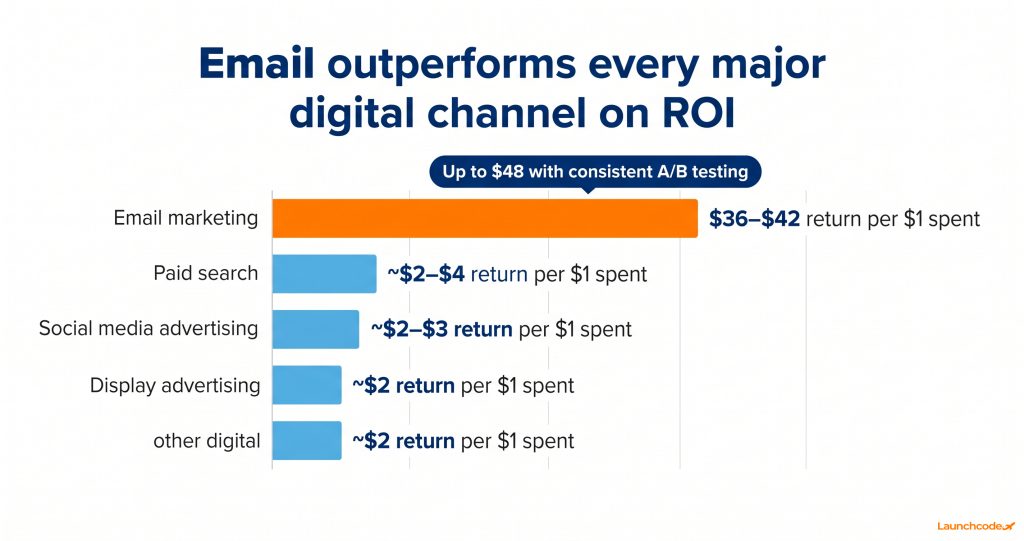
Email marketing generates an average ROI of $36 to $42 for every dollar spent, according to research from Litmus cited in HubSpot’s 2025 State of Marketing Report. That outperforms paid search, social media, and display advertising. Brands that A/B test consistently push that return to $48 per dollar. For any business evaluating where to focus budget, email is the most defensible choice.
Email earns strong ROI because every subscriber on your list asked to hear from you. That permission changes how people engage with your messages compared to every other digital channel. Paid media interrupts. Email is invited.
The global email marketing industry generated $12.33 billion in 2024 and is on track to reach $17.9 billion by 2027, according to Mailmend. That growth reflects how businesses vote with their budgets.
The average program and the top-quartile program do not just differ by degree. They differ by design.
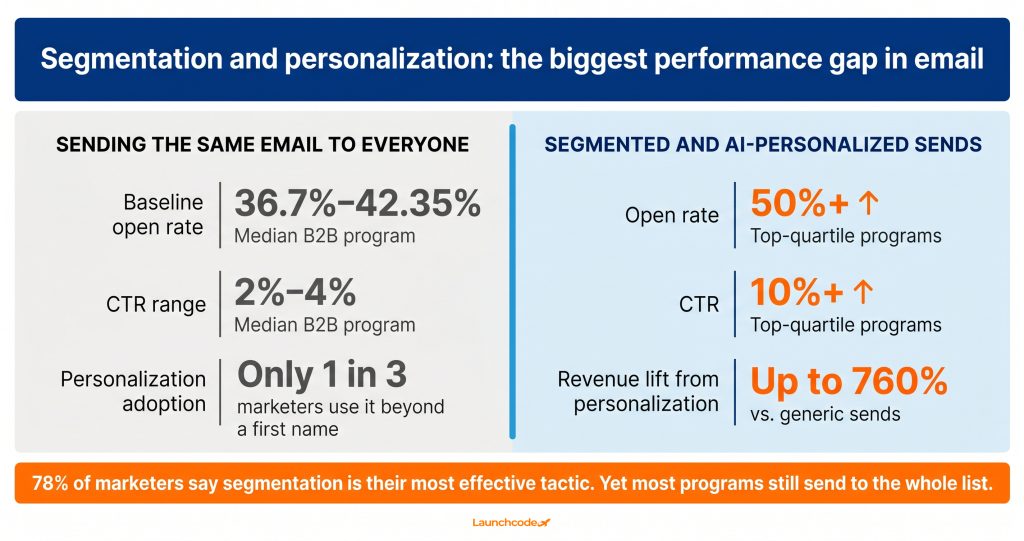
According to verified.email’s B2B benchmark report, median B2B open rates sit between 36.7% and 42.35%, with click-through rates averaging 2% to 4%. Top-performing programs that use rigorous segmentation and AI-powered personalization achieve open rates above 50% and CTR above 10%.
That gap is not talent. It is infrastructure, process, and execution.
Chad S. White, GVP of CRM Strategy at Zeta Global and author of four editions of Email Marketing Rules, describes the dynamic directly: “Investments in greater email marketing sophistication often lead to even higher returns, not diminishing returns.”
Deliverability determines whether your emails reach the inbox at all. Without it, every other best practice is irrelevant. Since 2024, Gmail and Yahoo require SPF, DKIM, and DMARC authentication for senders of 5,000 or more emails per day. Microsoft added similar requirements in May 2025. If your domain is not authenticated, inbox providers will filter or block your emails before your subject line is ever seen.
Deliverability is not a one-time setup task. It is ongoing reputation management. Inbox providers score every sender based on three signals: sending behavior, subscriber engagement, and list hygiene. When those signals are healthy, emails land in the primary inbox. When they are not, deliverability erodes quickly and quietly.
Three DNS records protect your domain and tell inbox providers you are a legitimate sender.
Setting up all three is required, not optional. Campaign Monitor’s best practices guide states it plainly: “Email authentication isn’t just a best practice anymore; it’s a requirement.”
If you send from a dedicated subdomain such as mail.yourdomain.com, configure authentication records for that subdomain specifically. Sending from an unauthenticated subdomain while your root domain is clean still triggers deliverability problems.
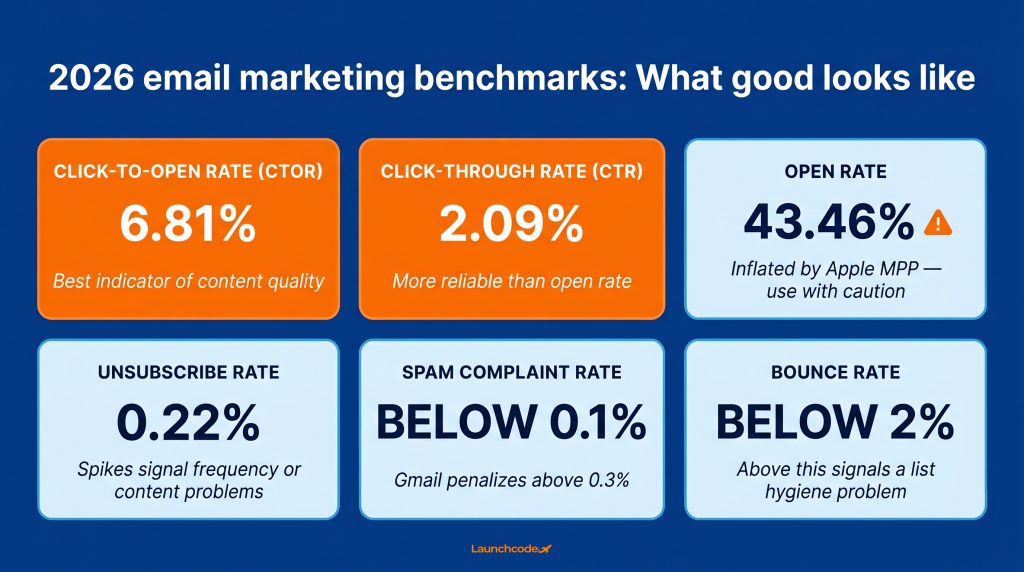
Google recommends keeping spam complaint rates below 0.1%. Rates above 0.3% trigger active penalties. The damage is not confined to a single campaign. A complaint spike on a promotional send can hurt deliverability for your transactional emails as well.
Litmus’s State of Email team makes the business case clearly: “Strong sender credibility, built on engagement, boosts inbox placement for future email campaigns, leading to higher traffic, engagement, and conversions.”
Protect complaint rates by making unsubscribing easy. A clear, one-click unsubscribe link in every email footer is both a legal requirement under CAN-SPAM, GDPR, and CASL, and a deliverability protection. Subscribers who cannot unsubscribe easily will mark your email as spam instead.
“The first thing we check when a client’s campaigns underperform is authentication. SPF, DKIM, or DMARC is misconfigured on the sending domain more often than you would expect. Fixing it is usually the fastest way to get emails back to the primary inbox.”
Brittany Charles, SVP, Client Services
A smaller, engaged list outperforms a large, unclean one on every metric. Contact databases decay at roughly 22% per year as subscribers change jobs, abandon addresses, or lose interest. If you are not actively cleaning your list, you are sending to a growing percentage of addresses that will bounce, sit inactive, or trigger spam traps that damage your sender reputation.
Purchased lists are a fast path to deliverability damage. Those addresses never opted in. They generate high complaint rates and often include spam traps. There is no shortcut around organic list building.
List hygiene means removing subscribers who will not engage again. Here is a practical cadence.
Mailsoftly’s email marketing guide describes the core risk plainly: your email list is “a depreciating asset.” Active management of that asset is what separates programs with consistent deliverability from programs that erode without obvious cause.
Segmented campaigns generate 30% more opens and 50% more click-throughs compared to non-segmented sends, according to HubSpot’s 2025 State of Marketing Report. 78% of marketers identify segmentation as their most effective tactic. Yet most programs still send the same email to their entire list. That gap is where the biggest available performance gains sit.
Segmentation means dividing your list into groups that share a meaningful characteristic and sending each group content that fits their situation. It does not have to be complicated to be effective. Even basic segmentation, splitting new subscribers from long-term subscribers, or buyers from non-buyers, produces measurable results.
New subscribers Send a welcome series immediately. New subscribers are at peak interest. A three to five email sequence that delivers on the opt-in promise and introduces your brand drives engagement before the relationship cools.
Active engagers vs. inactive subscribers Separate people who have opened or clicked in the last 90 days from those who have not. Active subscribers get your full content cadence. Inactive subscribers should receive a separate re-engagement sequence before you clean them from the list.
Buyers vs. prospects Someone who has purchased needs different messaging than someone who has not. Prospects need trust-building content and a clear reason to try. Buyers need retention content, upsell opportunities, and loyalty recognition.
High-value vs. low-value customers For e-commerce and SaaS businesses, segment by purchase value or plan tier. Your highest-value customers should receive different offers and more personalized communication than someone who made a single low-value transaction.
“The clients generating real pipeline from email are not sending more. They are sending to better segments. One focused, well-timed sequence to the right portion of a list consistently outperforms sending to the whole database.”
Tanner Medina, Co-Founder & Chief Growth Officer
93.2% of marketers in HubSpot’s 2026 State of Marketing report say personalized or segmented experiences generate more leads and purchases. The data on impact is sharp: personalized emails generate up to 760% more revenue compared to generic sends, according to Sopro’s email marketing statistics.
Despite that, only one-third of email marketers currently use personalization beyond a first name token.
True personalization uses behavioral data. It changes email content based on what the subscriber has browsed, purchased, or engaged with. A subscriber who read three posts on SEO should receive different content than one who only opened promotional emails. Dynamic content blocks inside platforms like Klaviyo, HubSpot, and ActiveCampaign make this possible without building separate campaigns for each segment.
The average recipient decides whether to open an email in under two seconds. Subject lines with around 41 characters, roughly seven words, receive the highest open rates across major email clients and devices, according to Marketo research. Your preheader text, the short preview line that appears next to the subject line in most inboxes, is a second chance at the same moment. Most brands ignore it entirely.
Together, the subject line and preheader form a two-part headline. If they do not communicate clear value, the email is finished before it is opened.
Strong subject lines share a few characteristics.
Preheader text defaults to the first line of your email if you do not set it manually. That often means subscribers see something like “View this email in your browser” or a navigation link. That is a missed opportunity every single time you send.
Write preheader text as a continuation of the subject line. If the subject is “Your Q2 email audit checklist,” the preheader might be “Five things to fix before your next send.” Together they form one complete, specific promise.
Test one variable at a time. If you test subject line length and emoji presence simultaneously, you cannot know which change produced the result.
Effective variables to test include:
Platforms like Klaviyo, Mailchimp, and ActiveCampaign all include native A/B testing for subject lines. Document every result. Over six months, you will have a clear picture of what your specific audience responds to. Your own historical data tells you whether you are improving.
The average recipient spends fewer than nine seconds reading an email, according to Sopro. In that window, they decide whether to click or close. Emails with a single call to action can increase clicks by up to 371% compared to emails with multiple CTAs, according to HubSpot. Every design and content decision should direct the reader toward one action.
Over 55% of emails are opened on mobile devices, and half of users delete emails that are not optimized for mobile. A template that looks clean on desktop but breaks on a phone is losing clicks on every send.
Chad S. White describes the underlying rule clearly: “Concise, value-driven messaging consistently outperforms bloated creative because it respects time, sharpens intent, and drives faster decisions.”
Apply that principle through these content choices.
Build emails in a single-column layout. Test on both iOS and Android before any send using tools like Litmus or Email on Acid. Confirm that:
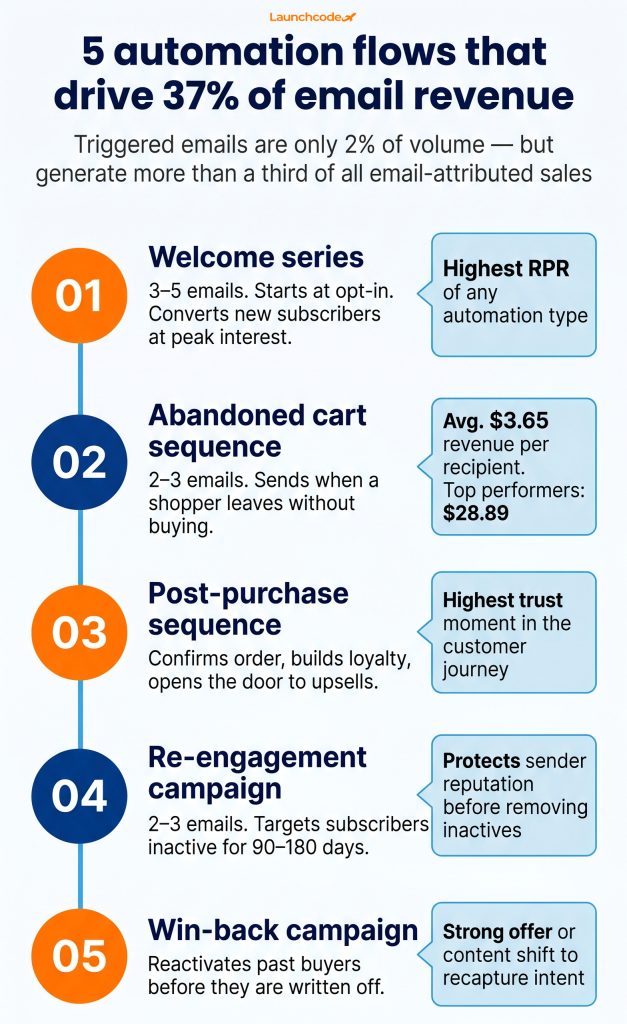
Automated and triggered emails make up only 2% of total email volume. Yet they drove 37% of all email-attributed sales in 2024, according to Mailmend’s ROI research. Triggered emails are sent at the exact moment a subscriber is most likely to act. That timing advantage explains why they convert at dramatically higher rates than broadcast campaigns.
Most programs have a welcome email. Fewer have a full welcome series. Fewer still have post-purchase sequences, browse abandonment triggers, re-engagement flows, and win-back campaigns. Each of those gaps represents revenue that is available but uncollected.
One of the most common automation mistakes is building a sequence and walking away. Chad S. White addresses this directly: “Automation doesn’t mean set it and forget it. Automated campaigns are still living communication and need nurturing to be most effective.”
Review every triggered sequence quarterly. Check for broken links, outdated offers, and declining engagement rates. A welcome email written two years ago may reference an offer that no longer exists. A post-purchase sequence tied to a discontinued product needs to be updated or retired. Triggered emails should be A/B tested more often than broadcast campaigns, not less, precisely because of their outsized revenue contribution.
AI in email marketing goes well beyond generating subject lines. It is being used to predict the best send time for each individual subscriber, dynamically assemble email content based on behavioral history, score list segments by purchase intent, and test content variations at scale. Programs that integrate AI at the infrastructure level are achieving measurably better results than those using it only as a writing assistant.
According to a HubSpot newsletter survey, 42% of email marketers already save between 30 minutes and two hours per week using AI tools. That efficiency gain understates the performance impact when AI is embedded into segmentation and personalization logic.
Send-time optimization AI analyzes each subscriber’s historical open behavior and sends at the moment they are most likely to be in their inbox. This requires a platform that tracks individual engagement patterns, not list-level averages. Tools like Klaviyo, HubSpot, and ActiveCampaign all offer send-time optimization features.
Dynamic content generation AI builds different email variants for different segments from a single campaign brief. A subscriber who clicked a pricing page gets a different email than one who downloaded a how-to guide, without the team building two separate campaigns manually.
Predictive segmentation AI groups subscribers by predicted future behavior, such as likelihood to purchase in the next 30 days or risk of churn, rather than only past behavior. This is what separates top-quartile programs from median programs in the benchmark data.
Subject line testing at scale AI generates and tests dozens of subject line variants simultaneously and learns from engagement data to refine future recommendations.
Brands using AI-driven personalization report up to 42% higher revenue and click-through rates exceeding 13%, according to verified.email’s ROI statistics.
AI improves efficiency and personalization at scale. It cannot replace brand judgment, content strategy, or the decision about what to say. Over-relying on AI-generated content without human review produces emails that feel generic, which is the opposite of what personalization is supposed to achieve. The best programs use AI to handle volume and timing while humans set strategy and tone.
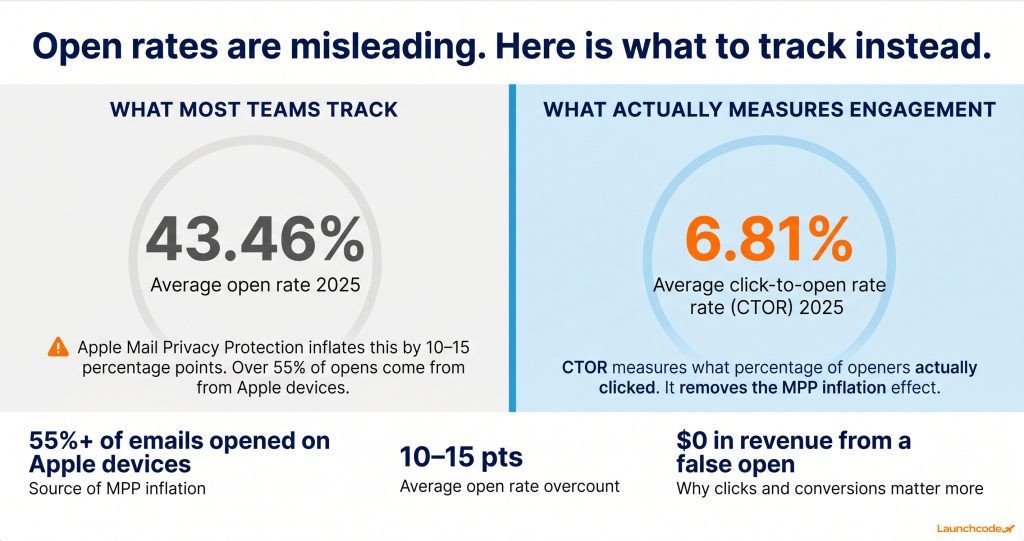
Open rates are no longer a reliable primary metric. Apple Mail Privacy Protection automatically preloads email images for Apple Mail users, registering opens even when the email was never read. As of 2025, more than half of global email opens come from Apple devices affected by this change, inflating reported open rates by 10 to 15 percentage points. Click-to-open rate (CTOR) and conversion rate now reveal actual engagement far more accurately.
The average email open rate across all industries in 2025 was 43.46%, according to MailerLite’s benchmark report based on over 3.6 million campaigns. The average CTOR was 6.81% and the average click rate was 2.09%. Use these as directional references, not performance targets.
| Metric | What it measures | 2025 benchmark | Why it matters |
|---|---|---|---|
| Click-to-open rate (CTOR) | Content quality among openers | 6.81% average | Shows how well your content converts readers to clickers |
| Click-through rate (CTR) | Overall list engagement | 2.09% average | More reliable than open rate as a health signal |
| Conversion rate | Revenue or goal completions | Varies by goal | The real business outcome metric |
| Unsubscribe rate | List health and frequency fit | 0.22% average | Spikes signal a content or frequency problem |
| Spam complaint rate | Sender reputation risk | Below 0.1% target | Gmail flags and penalizes senders above 0.3% |
| Bounce rate | List quality | Below 2% | High hard bounce rates signal a hygiene problem |
Chad S. White offers the most practical framing in Email Marketing Rules: “Benchmark yourself primarily against yourself. External benchmarks are of little use for a number of reasons. Focus on systematically beating your own performance.”
Use industry averages to confirm you are within a normal range. Use your own rolling 90-day averages to track whether you are improving. Segment your metrics by campaign type in your reporting tool, whether that is Klaviyo, HubSpot, or Mailchimp. Promotional emails, newsletters, and triggered sequences perform differently. Blending them into a single number hides what is actually working.
Most email programs plateau because they optimize one campaign at a time instead of building a system. The programs that outperform year over year share the same structural characteristics: a clean, authenticated sending setup, a well-maintained list, segmentation that reflects subscriber behavior, automation covering the key lifecycle moments, and a consistent testing cadence.
None of those elements are complicated on their own. The compounding effect happens when they work together.
At Launchcodex, email infrastructure is built as a system before the first campaign goes out: dedicated sending subdomains, domain authentication, segmented list architecture, and automation flows configured in advance. That foundation is what makes campaign-level improvements stick.
If your program is underperforming, do not start with subject line tests. Start with your authentication records, your list hygiene, and your segmentation structure. Fix the foundation, then optimize the surface.
For more on how email integrates with a broader lead generation and conversion strategy, visit the Launchcodex email marketing services page.
The industry average across all sectors in 2025 is 43.46%, but that figure is inflated by Apple Mail Privacy Protection. A more useful metric is click-to-open rate, where the 2025 average is 6.81%. Focus on trending your CTOR upward over time rather than chasing a specific open rate number.
Most B2B businesses see strong results with one to two emails per week. E-commerce brands can send more frequently, particularly during promotions. The right frequency is the one your audience tolerates without unsubscribing or complaining. Monitor unsubscribe rates and complaint rates after any increase in send volume.
Segmentation determines who receives a message by grouping subscribers based on shared characteristics. Personalization determines what they see inside the message based on individual data. Both work together. Segmentation targets the right audience; personalization makes the content relevant to each person within that audience.
The most common causes are missing or incorrect SPF, DKIM, or DMARC authentication records, high spam complaint rates above 0.1%, sending to invalid or purchased addresses, and using spam trigger words in subject lines or body copy. Start with authentication and list hygiene before adjusting content.
Build a welcome series first. New subscribers are at peak interest and a three to five email sequence delivers the highest return per subscriber for the lowest ongoing effort. Add an abandoned cart or re-engagement sequence next, depending on whether your business is e-commerce or lead generation focused.
AI is used to optimize send times for individual subscribers, generate and test content variations at scale, build predictive segments based on future behavior, and personalize email content dynamically based on browsing and purchase history. The biggest performance gains come from embedding AI into segmentation and timing logic, not just using it to write copy.



Real stories from the people we’ve partnered with to modernize and grow their marketing.