
Share:

AI marketing & automation


Most brands underestimate email marketing until they run the numbers. Paid ads require ongoing spend. Social media reach keeps contracting. Email gives you direct access to people who asked to hear from you. That ownership, combined with the ability to automate, personalize, and measure at scale, makes email the most reliable revenue channel available to growing brands.
This guide explains what email marketing is, how it works end-to-end, and what separates programs that generate real returns from those that collect dust in the promotions tab. Whether you are building your first list or rebuilding a program that has gone stale, you will find a clear, practical framework here.
Email marketing is the practice of sending targeted, permission-based messages to a list of people who opted in to hear from your brand. Unlike paid advertising or social media, you own the channel outright. No algorithm controls your reach, and no platform change can cut off your audience overnight. That direct ownership is the reason email consistently outperforms rented channels in reliability and return.
The concept has a strong philosophical foundation. Marketing strategist Seth Godin described permission marketing as the privilege, not the right, of delivering anticipated, personal, and relevant messages to people who actually want to receive them. That framing, first outlined in his 1999 book and explored widely by email practitioners since, still holds. The brands getting the best results from email are not blasting promotions at everyone on their list. They are building relationships with people who chose to engage.
The scale of the channel supports the investment. According to email marketing statistics compiled by Marketing LTB, 4.6 billion people used email globally in 2025, with projections showing growth to 4.85 billion by 2027. That is a larger addressable audience than any social platform on earth.
Social media and paid search are rented channels. You pay for access, and the platform controls who sees what. Algorithm changes, rising CPMs, and policy shifts can reduce your reach without warning and without recourse.
Email works differently. Your list belongs to you. A subscriber who opted in three years ago is still reachable, provided you maintain good sending practices. That durability makes email one of the few marketing channels that compounds in value over time rather than depreciating with market conditions.
Seth Godin made this point directly on his blog: a permission-based campaign only grows in value over time, can become the foundation of an entire business, and earning permission is a long-term, profitable, scalable strategy that pays for itself.
At its core, an email marketing program connects four components:
When these four elements are configured well, the result is a program that runs largely on its own, reaches the right people at the right time, and generates measurable returns with each send.
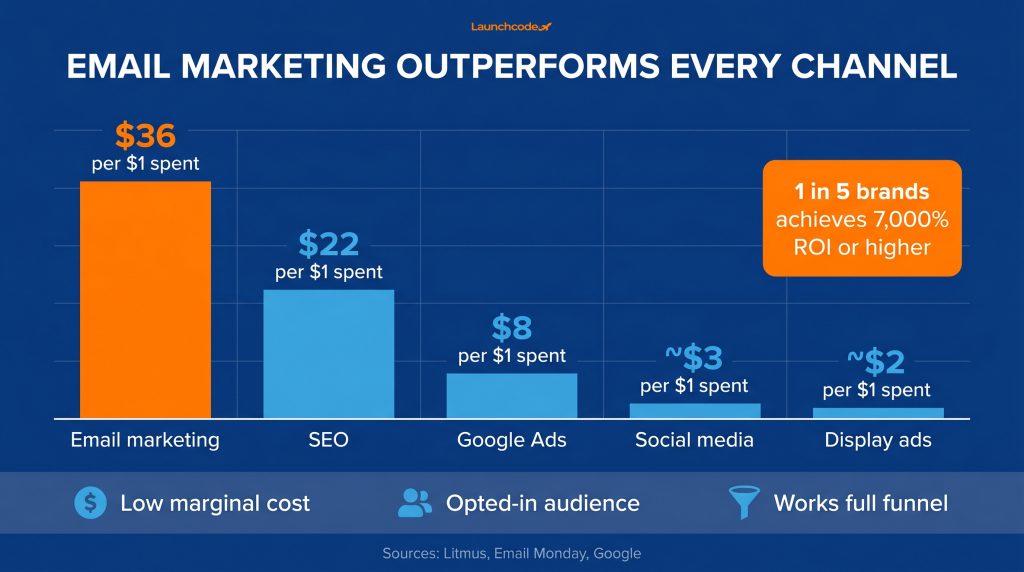
Email marketing delivers an average return of $36 for every $1 spent, a 3,600% ROI. No other digital channel matches this consistently. Retail and ecommerce lead all sectors at 4,500% ROI. Mid-market B2B programs regularly produce returns that dwarf paid social or display. The reason is straightforward: low cost per send combined with high purchase intent from an audience that already raised its hand.
According to data compiled by Email Monday, nearly one in five companies achieves email marketing ROI of 7,000% or higher. Automated workflows generate 30 times the revenue of one-off campaigns. Among marketing professionals, 44% identify email as their most effective channel, ahead of social media and paid search, which each scored 16%. Separately, 87% of marketing leaders say email is critical to their company’s success.
“When we connect email performance to pipeline data, the brands that invest in proper segmentation and automation see returns that paid channels cannot match at the same spend level.” Tanner Medina, Co-Founder and Chief Growth Officer, Launchcodex
Budget allocation directly predicts outcomes. Research from Mailmend shows that 75% of low-ROI email programs spend less than 20% of their total marketing budget on email. Companies achieving exceptional returns invest more than 20% in the channel. The global email marketing industry was valued at $12.33 billion in 2024 and is projected to reach $17.9 billion by 2027, growing at a 13.3% compound annual rate. Brands that cut email investment are moving against a sustained, growing market.
There are five categories of marketing emails every brand should understand: promotional campaigns, newsletters, transactional emails, drip sequences, and behavioral trigger emails. Each serves a different function in the customer lifecycle. Combining the right types into a coherent program is what separates a reactive email strategy from one that drives revenue at every stage of the funnel.
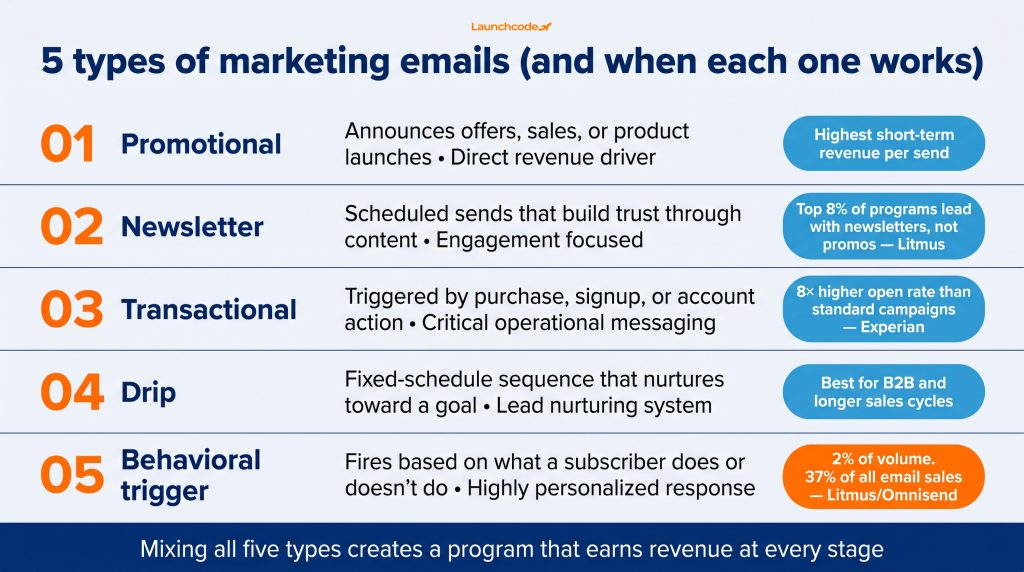
Promotional emails announce a specific offer, product, or sale. They are the most common type and the easiest to measure for direct revenue impact. Flash sales, new product launches, and seasonal promotions all fit here. These emails can produce high short-term revenue per send, but engagement tends to drop when they dominate a program’s output.
Newsletters are regular, scheduled sends that deliver value through content: industry insights, practical tips, curated resources, or updates from your team. They build trust and keep your brand relevant between purchase cycles. Research from the Litmus State of Email Report found that the top-performing 8% of email programs, those achieving 45:1 ROI or better, most commonly send newsletters and onboarding sequences rather than promotions. Relationship-first emails drive better long-term returns than promotional blasts.
Transactional emails trigger from a specific user action: a purchase confirmation, shipping update, password reset, or account notification. They are not marketing emails in the traditional sense, but they are the most opened emails a brand sends. Experian research shows transactional emails see eight times higher open and click rates than standard campaigns. Brands that add relevant cross-sells or meaningful brand content to transactional templates capture revenue that most programs leave on the table.
Drip campaigns are pre-written sequences sent on a fixed schedule to guide a subscriber toward a goal. A common use case is a five-email nurture sequence for new leads that educates them on a product before asking for a sale. Drip campaigns work well for longer sales cycles, B2B lead nurturing, course delivery, and onboarding new users or customers.
Behavioral trigger emails fire based on what a subscriber does or does not do: visits a pricing page, abandons a cart, clicks a specific link, or goes 30 days without engaging. These are the highest-performing emails in any program. Behavior-based emails generate 10 times more revenue than standard campaign types. They represent just 2% of total email volume but drove 37% of all email-attributed sales in 2024, according to InboxAlly’s email statistics analysis.
Build your list only from people who explicitly opted in to hear from your brand. Buying lists, scraping contacts, or adding people without consent destroys your sender reputation, triggers spam complaints, and produces no real ROI. List quality matters far more than list size. A clean list of 1,000 engaged subscribers will consistently outperform a purchased list of 50,000.
The most effective list-building strategies share one trait: they offer something worth trading an email address for.
Use double opt-in where possible. It adds one confirmation step but filters out bots, reduces spam complaints, and produces a cleaner, more engaged list from the start.
Sending the same email to every subscriber wastes the most valuable asset you have: your data. Segmented campaigns generate up to 760% more revenue than unsegmented sends. Personalized subject lines produce a 26% higher open rate on their own. The opportunity in email is not in sending more messages. It is in sending more relevant messages to the right subset of your audience at the right time.
According to Tabular’s comprehensive email marketing research, 90% of email marketing professionals report that delivering targeted messages to segmented audiences boosts performance. That consensus reflects years of consistent evidence across industries and business models.
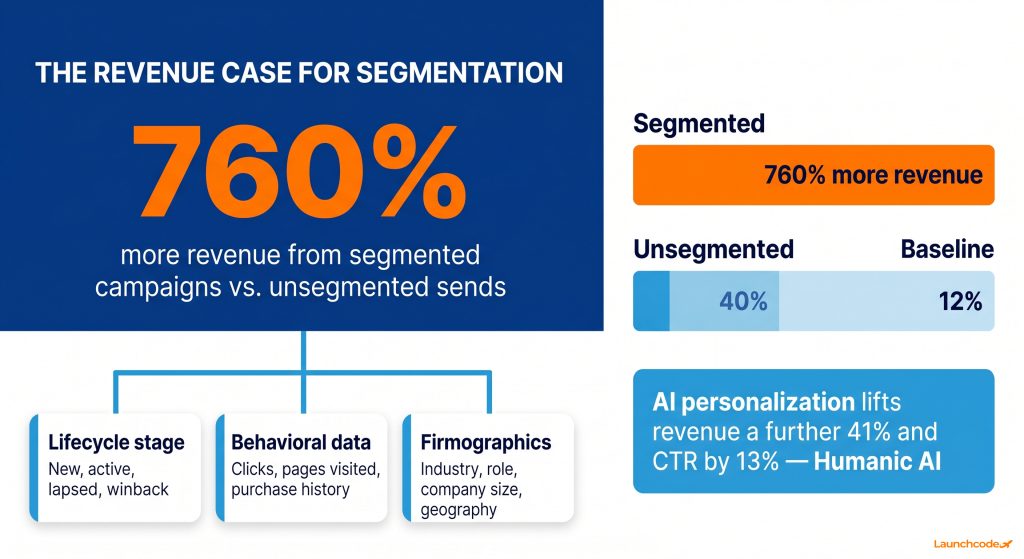
Start with three dimensions before adding complexity:
Manual segmentation has limits. AI-powered personalization goes further by analyzing behavioral patterns across thousands of subscribers and dynamically adjusting content, timing, and offers for each individual. Marketers using AI-driven personalization report a 41% increase in revenue and a 13% rise in click-through rates compared to non-personalized campaigns, according to research from Humanic AI. In 2025, 63% of marketers were already using AI tools in their email programs. The performance gap between those who use it and those who do not is already measurable in revenue.
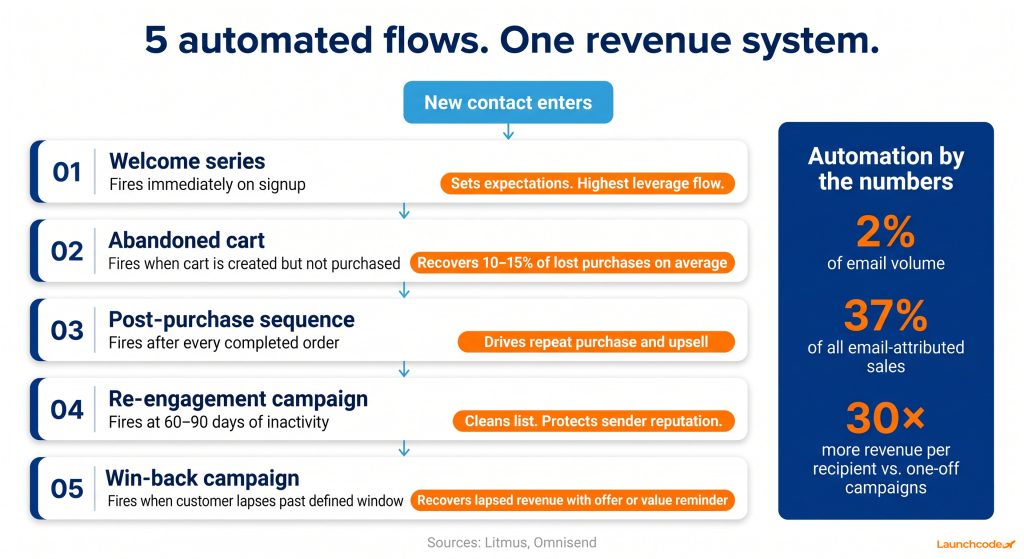
Email automation is the practice of setting up emails that send automatically based on specific triggers or schedules, without manual effort for each send. Automated flows consistently outperform broadcast campaigns across every metric. They deliver 30 times more revenue per recipient than one-off promotional emails. For any program competing seriously in 2025 and beyond, core automation flows are foundational infrastructure.
Build these in order, starting with the highest-impact automation first:
“When we audit underperforming email programs, the problem is almost never the copy. It is usually a list that has not been segmented in months, or automation flows that were built once and never reviewed. Fix the system first.” Brittany Charles, SVP, Client Services, Launchcodex
Email deliverability is the ability of your emails to reach the inbox rather than the spam or promotions folder. An estimated one in six marketing emails never reaches the inbox at all. Strong deliverability depends on technical authentication, sender reputation, list hygiene, and engagement quality. Without this foundation, even the best email copy never gets read.
In 2024, Google and Yahoo introduced stricter authentication requirements for bulk senders. Any business sending marketing emails at volume now needs three technical configurations in place before campaigns go out.
Most ESPs provide step-by-step documentation for configuring these records. If you send through an agency or managed service, verify all three are active on your sending domain before your first campaign launches.
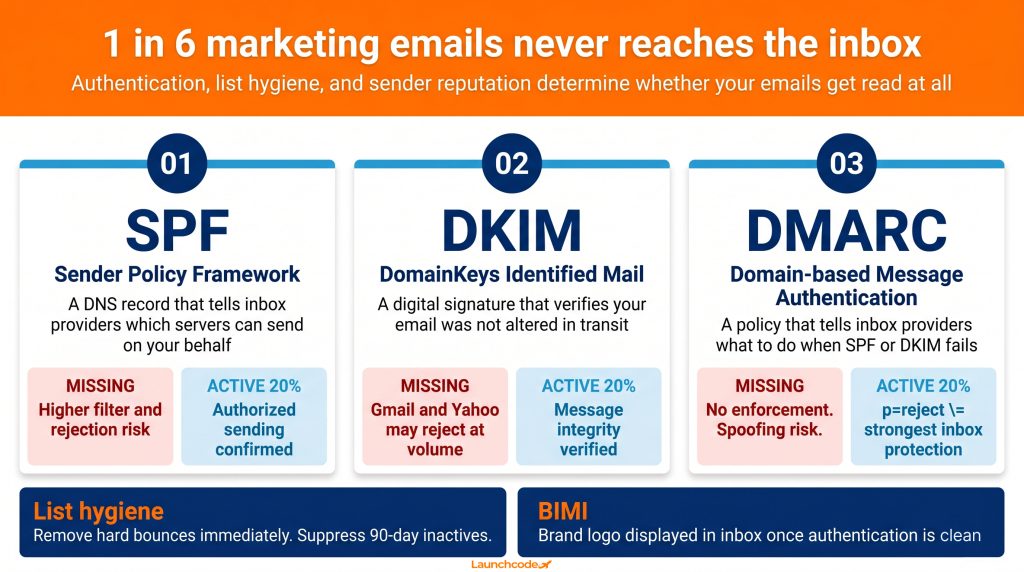
Inbox providers assign your sending domain a reputation score based on how recipients interact with your emails. High spam complaint rates, hard bounces, and low engagement all damage that score and push future emails toward spam. Maintaining a clean sender reputation involves:
BIMI (Brand Indicators for Message Identification) is worth implementing once authentication is fully configured. It displays your brand logo next to authenticated emails in supported inboxes, improving recognition and trust without requiring any change to email content.
Open rate is no longer a reliable indicator of email performance. Apple’s Mail Privacy Protection pre-fetches email tracking pixels in supported clients, inflating open rates with bot activity rather than real human engagement. High-performing teams have shifted to revenue-based metrics: revenue per recipient, click-through rate, conversion rate, and list health trends over time. These numbers tell you whether your program drives actual business outcomes.
The Litmus 2026 State of Email report noted that bot-driven phantom engagement has made open rates unreliable, pushing high-performing teams toward revenue per email, list churn, and lifetime value as the metrics that actually matter.
| Metric | What it measures | Target benchmark |
|---|---|---|
| Click-through rate (CTR) | Percentage of recipients who click a link | 2.0% to 2.6% industry average |
| Click-to-open rate (CTOR) | Clicks as a share of openers | 10% to 15% for campaigns |
| Conversion rate | Percentage who complete a desired action | 2% to 5% across most industries |
| Revenue per recipient (RPR) | Revenue generated per email sent | Automated flows average $1.94 vs. $0.11 for campaigns |
| Unsubscribe rate | Percentage who opt out per send | Under 0.2% is healthy |
| Spam complaint rate | Percentage who mark as spam | Keep below 0.1% per send |
| Hard bounce rate | Percentage of undelivered emails | Above 2% signals list quality problems |
Look at trends across multiple sends rather than reacting to single data points. A CTR that drops across three consecutive campaigns signals a shift, whether in audience fit, offer relevance, or content quality. A single low metric is noise. A pattern is a signal.
Track automated flow performance separately from campaign performance. Flows will almost always outperform campaigns, and combining the data into a single view obscures where the real leverage sits. Review both in parallel so you can clearly see which part of your program needs attention.
The right ESP depends on your business model, list size, automation requirements, and technical capacity. No single platform fits every situation. An ecommerce brand running behavioral flows through Shopify needs different capabilities than a B2B company managing a multi-stage nurture sequence for a six-month sales cycle. Match the platform to the program you are building, not just the one you have today.
| Platform | Best fit | Key strength | Watch out for |
|---|---|---|---|
| Mailchimp | SMBs and beginners | Easy setup, large template library | Automation depth limited on entry tiers |
| Klaviyo | Ecommerce, especially Shopify brands | Deep behavioral flows, revenue attribution | Pricing scales steeply with list size |
| ActiveCampaign | B2B and service businesses | Automation depth and CRM integration | Learning curve for users new to automation |
| HubSpot | Enterprise and multi-team organizations | Native CRM and multi-channel workflows | Higher cost. Best suited for teams already in the HubSpot ecosystem. |
| Brevo | Budget-focused SMBs | SMS and email in one platform | Less sophisticated automation than Klaviyo or ActiveCampaign |
All platforms listed here support SPF, DKIM, and DMARC configuration. Verify that your chosen platform allows sending on a custom domain rather than a shared IP. Shared IP environments limit your control over sender reputation and create a ceiling on long-term deliverability performance.
Every effective email program rests on the same four-layer foundation: a clean, growing list; reliable deliverability infrastructure; a set of core automated flows; and a measurement framework tied to revenue rather than engagement proxies. These four layers do not all need to go live at once, but each one needs to be built.
Start with authentication and deliverability. No amount of strong copy matters if your emails land in spam. Then build your welcome series. Every new subscriber experiences it, which makes it the most leveraged automation in your program. Layer in the remaining flows from there, and add broadcast campaigns once the foundation is stable.
Segmentation and personalization are not finishing touches. They are the multiplier on everything else you build. A program that sends the right message to the right person based on real behavioral signals will always outperform one that sends the same message to everyone, regardless of how good that message is.
At Launchcodex, we build email infrastructure for brands that want their program to function as a revenue system rather than a broadcast channel. That means configuring authentication, designing flow architecture, building segmentation logic, and reporting on outcomes tied directly to pipeline and revenue. If you want to evaluate whether your current email program is built to perform at that level, our email marketing service is a practical starting point.
The brands winning with email right now are not winning because they send more. They are winning because they built better systems.
Email marketing is the practice of sending targeted emails to a list of people who agreed to receive communications from your brand. It is used to build relationships, promote products or services, and generate sales. Unlike social media or paid advertising, you own your email list, which gives you direct and durable access to your audience.
Costs vary by platform and list size. Most ESPs charge between $15 and $300 per month for small to mid-sized lists. Enterprise platforms cost more. The cost per individual email sent is minimal, which is the primary reason email consistently delivers the highest ROI of any digital marketing channel.
Yes. Email marketing remains the highest-ROI digital channel, returning $36 for every $1 spent on average. With 4.6 billion global email users in 2025 and continued growth in AI-powered automation and personalization, well-built email programs continue to outperform comparable alternatives across both B2B and B2C contexts.
A drip campaign is a time-based sequence that sends emails on a fixed schedule regardless of subscriber behavior. An automated flow triggers based on specific actions, such as a signup, a purchase, or a pricing page visit. Automated flows consistently outperform drip campaigns because the timing aligns with actual subscriber intent rather than an arbitrary calendar.
Email deliverability is the ability of your emails to reach the inbox rather than the spam or promotions folder. Poor deliverability means your content never gets seen, regardless of quality. It is affected by authentication records (SPF, DKIM, DMARC), sender reputation, list hygiene, and engagement rates over time. Building strong deliverability is the foundation of any serious email program.
Focus on click-through rate, click-to-open rate, conversion rate, revenue per recipient, unsubscribe rate, and spam complaint rate. Open rate has become unreliable due to Apple Mail Privacy Protection, which inflates counts with automated bot activity. Revenue-based metrics give a more accurate picture of actual program performance.
Use lead magnets, content upgrades, email-gated webinars, exit-intent pop-ups, and dedicated newsletter landing pages. Each tactic should offer clear, specific value in exchange for the subscription. Buying contacts produces low engagement, high spam complaints, and no real ROI. Only grow your list from people who explicitly asked to hear from you.



Real stories from the people we’ve partnered with to modernize and grow their marketing.